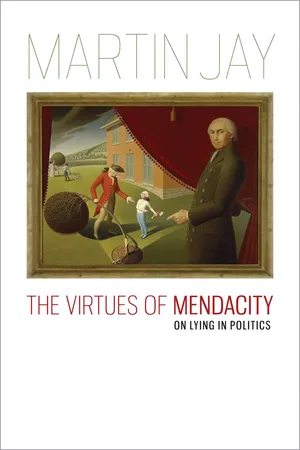
When Michael Dukakis accused George H. W. Bush of being the "Joe Isuzu of American Politics" during the 1988 presidential campaign, he asserted in a particularly American tenor the near-ancient idea that lying and politics (and perhaps advertising, too) are inseparable, or at least intertwined. Our response to this phenomenon, writes the renowned intellectual historian Martin Jay, tends to vacillate—often impotently—between moral outrage and amoral realism. In The Virtues of Mendacity, Jay resolves to avoid this conventional framing of the debate over lying and politics by examining what has been said in support of, and opposition to, political lying from Plato and St. Augustine to Hannah Arendt and Leo Strauss. Jay proceeds to show that each philosopher's argument corresponds to a particular conception of the political realm, which decisively shapes his or her attitude toward political mendacity. He then applies this insight to a variety of contexts and questions about lying and politics. Surprisingly, he concludes by asking if lying in politics is really all that bad. The political hypocrisy that Americans in particular periodically decry may be, in Jay's view, the best alternative to the violence justified by those who claim to know the truth.
- 264 pages
- English
- ePUB (mobile friendly)
- Available on iOS & Android
eBook - ePub
About this book
Information
1
ON LYING
All men are liars.
—PSALMS 116:11
Mundus vult decipi, ergo decipiatur.
[The world wants to be deceived; therefore it should be deceived.]
—PETRONIUS, LYING AND NATURE
LYING AND NATURE
Even benign Nature habitually lies, except when she promises execrable weather.
—MARK TWAIN, “ON THE DECAY OF THE ART OF LYING”
Invoking “nature” as a norm has been a persistent temptation for those unable to provide other, more compelling reasons for value choices. To be called “unnatural” or “against nature” often serves the purpose of stigmatizing behavior or inclinations that are for one reason or another abhorrent to the stigmatizer. To be in tune with nature—both internal and external—seems somehow “healthier” in a moral as well as a physical sense. Natural rights and natural laws are often invoked as a standard against which to measure the limitations of positive law, and not only by conservative Straussians or neo-Thomists.1
The virtues of artificiality have, of course, been celebrated by those who recognize the arbitrariness of what counts as “natural”—Joris-Karl Huysmans’s classic “decadent” novel À Rebours is sometimes translated as Against Nature—and radical constructivists have sometimes promoted a no less one-sided domination of “culture” over “nature.” The fallacy of a naturalist ethics has also been subjected to withering criticisms from commentators like G. E. Moore. But no matter how often refuted, the appeal to nature, defined in a myriad of ways,2 has been a perennial ultima ratio for those repelled by the hubris of humans who claim they can invent out of whole cloth the norms they then feel obliged to follow.
In the case of lying, however, those who are its harshest critics cannot easily resort to the accusation that it is an unnatural act. Although on occasion theologians like Martin Buber have claimed that “the lie is the specific evil which man introduced into nature … the lie is our very own invention,”3 his is very much a minority view. For, as many commentators have pointed out, both the animal and vegetable kingdoms are replete with examples of deception and duplicity, which if not based on speech acts are still designed to produce the effect of a deliberate lie. Even on the molecular level, deceptive strategies have been developed by human pathogens like viruses to defeat our immune systems.4 In the evolutionary struggle, clear advantage routinely goes to those who can find ways to deceive their enemies or rivals and avoid loosing the battle for survival. Darwin himself approvingly cited the work of Henry Walter Bates, the Victorian entomologist who realized in 1862 that one tasty species of butterfly in the Amazon region, the Pierids, cleverly imitated the coloration of their inedible counterparts, the Heliconids, to fool hungry birds.5 The never-ending contest between predator and prey involves camouflage, mimicry, and other forms of hiding the truth. Deceptive imitation, in which appearance belies reality, can take place in a variety of ways, including alteration of the animal’s own body parts and even a kind of cross-dressing.6 In the no less critical struggle for sexual selection, similar tactics often decide who gets to pass down his or her genes to the next generation. Although interpreting the adoption of deceptive tactics as evidence of a deliberate intelligence at work—the putative “cunning” of nature—may be dubious, its ubiquity is not.7
To the extent that humans are part of nature, it is thus argued by some observers that the ability to lie is an invaluable tool developed to avoid early extinction, either of the individual or of the species.8 Rather than being against nature, deception—in the broadest sense of unspoken as well as spoken representations and acts—is one of the cleverest instruments the natural world has at its disposal. A soldier’s camouflaged uniform and streaked face paint echoes the efforts of the insect to blend in with the leaf on which it sits (and indeed, modern camouflage, historians tell us, was inspired by scientists like Abbot Thayer familiar with animals’ mimesis of their environment).9 The impulse to adorn our bodies and cosmetically improve our appearances in order to increase our desirability to potential sexual partners is on a continuum with the fish who flash a red patch on their sides to show they have robust genes. Recent sociobiologists, such as David Livingstone Smith, who want to make sense of all human behavior by assimilating it to an evolutionary model have been keen to defend the capacity to lie as hardwired in the evolved human unconscious, because of the functional advantage it gives to those who use it skillfully. Not surprisingly, as we will see, political theorists like Machiavelli and Leo Strauss, who recognize the virtues of mendacity in the public sphere, tend to find a norm in nature rather than in a moral law that transcends it (although, to be sure, Strauss didn’t share Machiavelli’s penchant for comparing us to animals). Livingstone tellingly dubs the area of the unconscious that teaches us to lie “the Machiavellian module.” The evolutionary biologist Dario Maestripieri adds that both humans and rhesus macaque monkeys have “macachiavellian intelligence.”10
Even self-deception may well prove a useful tool, they have conjectured, in certain cases when acknowledging a terrible truth—about for example the odds against defeating a formidable foe—is best ignored if the chances to survive are to be maximized. In addition, the ability to lie to oneself—or more precisely, for one part of a divisible self to lie to another11—may also be functional in decreasing the likelihood of competitors discerning deliberate lies through the bodily cues that are given off by even the most accomplished deceiver.12 As Smith suggests, “The liars’ tendencies to betray themselves inadvertently acted as a selection pressure for the evolution of self-deception. Self-deception did not appear in the mental repertoire of our hominid ancestors to protect them from distress qua distress, as champions of the mental health industry assume. Instead, it emerged as a tool for social manipulation.”13 Although it would be difficult to maintain that all self-deceivers, or “mythomaniacs,” as they are sometimes called, are helping themselves survive, at least some may benefit from their unconscious duplicity. And if Nietzsche is right to argue that the founders of great religions were all believers in their own self-deception, than perhaps others have been as well.14
It is also sometimes argued that children come into the world not trailing clouds of glory, innocent and uncorrupted, but rather armed with the potential, even inclination, to deceive. The great developmental psychologist Jean Piaget once said of young children, “The tendency to tell lies is a natural tendency, so spontaneous and universal that we can take it as an essential part of the egocentric thought.”15 The opposite imperative, to tell and honor the truth, may be a learned behavior that comes later. But it is a lesson never fully mastered. As Smith sardonically notes, “Children who are unable to lie, as George Washington reputedly was (in yet another lie often told to children), are not ‘good’ boys and girls: they may quite possibly be autistic.”16 Indeed, another commentator adds, “a reliable indicator of autism seems to be an incompetence in the arts of hiding, pretending, dissembling and lying.”17 That is, an autistic child is generally unable to tell when someone is simply under a false impression or is deliberately uttering a falsehood.
From a very different perspective, lying was praised as “life-affirming” by Friedrich Nietzsche, who had no use for Darwinian notions of adaptation or the survival of the fittest. As a great hermeneutician of suspicion, to borrow Paul Ricoeur’s famous characterization, Nietzsche argued that “healthy” life—and he often fell back on health as a norm—would be promoted, not by trust, but by distrust of all that passed for sincerity in the world of respectable people. The question of truth and lies should be approached from an “extramoral” perspective, with no regard for its ethical implications. For
in man this art of simulation reaches its peak: here deception, flattering, lying and cheating, talking behind the back, posing, living in borrowed splendor, being masked, the disguise of convention, acting a role before others and before oneself—in short the constant fluttering around the single flame of vanity is so much the rule and the law that almost nothing is more incomprehensible than how an honest and pure urge for truth could have arisen among men.18
Although suspicious of the concept of nature, the later Nietzsche came to believe that something called “life” was abetted by illusions, or rather by the realization that beneath the surface of things there were no essences, no hidden truths, just further illusions. As he put it in the preface to The Gay Science in 1886,
This bad taste, this will to truth, to “truth at any price,” this youthful madness in the love of truth, have lost their charm for us; for that we are too experienced, too serious, too merry, too burned, too profound. We no longer believe that truth remains truth when the veils are withdrawn. We have lived too much to believe this. Today we consider it a matter of decency not to wish to see everything naked, or to be present at everything, or to understand and “know” everything.19
Too much truth is “unhealthy,” since we need our illusions, our myths, our lies, to survive the harsh realities of existence. “No living things would have survived if the opposite tendency [to telling the truth]—to err and make up things rather than wait, to assent rather than negate, to pass judgment rather than be just—had not been bred to the point where it became extraordinarily strong.”20 Although something explicitly called “nature” could not be a norm for art, the ideal of “life” should determine aesthetic value, not art for its own sake.21 Whether or not “life” was as open to interpretation as “nature”—just think of the change of meaning in contemporary America when “life-affirming” has become “pro-life”—and thus a cultural construct seemed not to dissuade him from employing it as an absolute value.
Such speculations about the naturalness or “life-affirming” function of deception, however, do not entirely dispel the suspicion that the appeal to nature is no less problematic when it comes to defending stigmatized behavior than criticizing it. For the “natural” propensity to deceive in order to foil a predator or seduce a breeding partner is necessarily based on the no less “natural” propensity—innate or nurtured through experience—to believe in the truthful evidence of one’s senses in perceiving the world. No one can be fooled, after all, if there isn’t a more fundamental presupposition of experiential veracity; nature, like Descartes’ God, would be in trouble if she were a systematic deceiver.22 Species who can’t tell the difference between what is true and what is not are unlikely to prosper for very long. The ability to detect deception is, after all, just as functional in evolutionary terms as the ability to deceive. Animals with improved perceptual systems, capable of differentiating appearance from reality, have an advantage over those with lesser ones. The radical and sustained disjuncture between truthfulness and what is in fact the case—normally called “the truth”—is not inherently in the service of self-preservation or that of the species.
Moreover, just because predator/prey relationships between species often rely on a duel to the death of competing deceptions, it doesn’t follow that human behavior can—let alone should—be modeled on this interaction. Just as some animals within and even across species cooperate symbiotically for mutual benefit and may well employ truth-telling as an instrument to that end—the deer alerting the herd to the presence of a wolf rather than prudently running away to save its own hide—humans can also derive evolutionary benefit from assessing their environment as accurately as possible and sharing the results of their investigations with their kind. Altruism, even sociobiologists agree, may be functional in evolutionary terms, and if so, then conveying the truth to a friend may be as useful as deceiving an enemy.
So too might the sharp moral disapproval that is almost univesally expressed about lying, even as the practice continues unabated, something totally absent from the nonhuman biosphere. It might, in fact, have emerged at a later evolutionary moment than the initial use of deception, which, to be sure, it could not entirely supplant. As one commentator has noted, “A capacity or propensity that is advantageous at one stage of human evolution need not necessarily remain advantageous indefinitely…. Cooperation entailed trust and hence disapproval of deceit, but Machiavellian skill, essential for cooperation, could continue to be used deceptively to further individual interests. Hence deceit persisted despite disapproval.”23 To the extent that humans evolved into beings who are both communal and individual—unlike uniformly social, nonindividuated animals like ants or bees—they needed contrary skills that might allow the flourishing of both the imperative to tell the truth and the ability to subvert it.
Moreover, if it is the case that human culture is a necessary supplement to make up for the inadequacies of human nature, that we are as the anthropologist Arnold Gehlen famously noted a “defective life form” which lacks instinctual self-sufficiency,24 then there is no reason to posit a parallel between those behaviors that we call natural and explain in evolutionary terms and those that we call cultural and understand as a necessary supplement to what is given to us by our genetic inheritance. As Bernard Williams once remarked, “The insistence on finding explanations of cultural difference in terms of biological evolution exactly misses the point of the great evolutionary innovation represented by Homo sapiens, the massive development of non-genetic learning.”25 Culture, itself a word no less polysemic than nature,26 can, after all, suggest both the cultivation of the potential traits provided us by nature and the contrivance of new modes of being that extend well beyond anything that might be seen as latent in our genes. And to the extent that lying, according to a strict definition, may be best understood as a special case of deception based on language—Wittgenstein saw it as a learned language game not available to other animals—it needs the supplement of culture, nongenetic learning, to make it fully possible.
Deception, in short, may be an inevitable feature of the biosphere and of the human world to the extent that we are part of natural evolution. But it is certainly a more variable practice in cultural—and a fortiori individual—terms, with humans generally seeking to avoid it as much as possible and bemoaning their weakness when they are inclined to employ it. For however much evidence we may adduce to show the ubiquity of mendacity in the natural and human world...
Table of contents
- Cover
- Title
- Copyright
- Contents
- Preface
- Acknowledgments
- Introduction
- 1 On Lying
- 2 On the Political
- 3 On Lying in Politics
- Notes
- Index
Trusted by 375,005 students
Access to over 1.5 million titles for a fair monthly price.
Study more efficiently using our study tools.
Frequently asked questions
Yes, you can cancel anytime from the Subscription tab in your account settings on the Perlego website. Your subscription will stay active until the end of your current billing period. Learn how to cancel your subscription
No, books cannot be downloaded as external files, such as PDFs, for use outside of Perlego. However, you can download books within the Perlego app for offline reading on mobile or tablet. Learn how to download books offline
Perlego offers two plans: Essential and Complete
- Essential is ideal for learners and professionals who enjoy exploring a wide range of subjects. Access the Essential Library with 800,000+ trusted titles and best-sellers across business, personal growth, and the humanities. Includes unlimited reading time and Standard Read Aloud voice.
- Complete: Perfect for advanced learners and researchers needing full, unrestricted access. Unlock 1.5M+ books across hundreds of subjects, including academic and specialized titles. The Complete Plan also includes advanced features like Premium Read Aloud and Research Assistant.
We are an online textbook subscription service, where you can get access to an entire online library for less than the price of a single book per month. With over 1.5 million books across 990+ topics, we’ve got you covered! Learn about our mission
Look out for the read-aloud symbol on your next book to see if you can listen to it. The read-aloud tool reads text aloud for you, highlighting the text as it is being read. You can pause it, speed it up and slow it down. Learn more about Read Aloud
Yes! You can use the Perlego app on both iOS and Android devices to read anytime, anywhere — even offline. Perfect for commutes or when you’re on the go.
Please note we cannot support devices running on iOS 13 and Android 7 or earlier. Learn more about using the app
Please note we cannot support devices running on iOS 13 and Android 7 or earlier. Learn more about using the app
Yes, you can access The Virtues of Mendacity by Martin Jay in PDF and/or ePUB format, as well as other popular books in Política y relaciones internacionales & Historia y teoría política. We have over 1.5 million books available in our catalogue for you to explore.