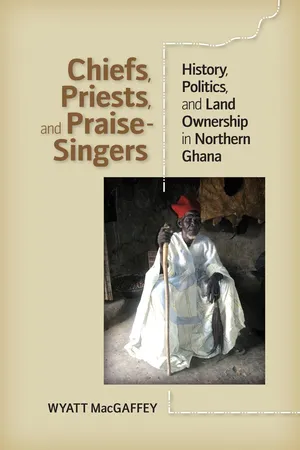
In his new book, the eminent anthropologist Wyatt MacGaffey provides an ethnographically enriched history of Dagbon from the fifteenth century to the present, setting that history in the context of the regional resources and political culture of northern Ghana. Chiefs, Priests, and Praise-Singers shows how the history commonly assumed by scholars has been shaped by the prejudices of colonial anthropology, the needs of British indirect rule, and local political agency. The book demonstrates, too, how political agency has shaped the kinship system. MacGaffey traces the evolution of chieftaincy as the sources of power changed and as land ceased to be simply the living space of the dependents of a chief and became a commodity and a resource for development. The internal violence in Dagbon that has been a topic of national and international concern since 2002 is shown to be a product of the interwoven values of tradition, modern Ghanaian politics, modern education, and economic opportunism.
eBook - ePub
Chiefs, Priests, and Praise-Singers
History, Politics, and Land Ownership in Northern Ghana
- 248 pages
- English
- ePUB (mobile friendly)
- Available on iOS & Android
eBook - ePub
Chiefs, Priests, and Praise-Singers
History, Politics, and Land Ownership in Northern Ghana
About this book
 | Colonial Anthropology and Historical Reconstruction |
The assumptions upon which the colonial practice of government was based are built into the political discourse of the north, in association with ongoing conflicts that threaten at times to engulf in warfare all three administrative regions into which the north is now divided.1 One of those assumptions is that there is a radical difference between the Northern Region, in which the major kingdoms are located, and the other two, the Upper East and the Upper West, where other forms of political order prevail. It is more consistent with the available facts and with modern political anthropology to treat the north as a single region in which the boundaries separating states from the stateless were permeable, political structures were in constant reorganization, and identities were fluid and situational. Most of the population speaks languages of the Gur group (Guan, the language of the Gonja aristocracy, is the major exception), and I argue here that whatever their language, they shared a common political culture and responded to the opportunities and limitations of a common regional resource base.
The image of Dagbon as an integral state is probably a projection from modern times, a simplification of a much more amorphous situation, as David C. Davis suggests for Mamprugu also.2 An alternative, albeit speculative history of Dagbon and neighboring states would say that they grew slowly over many generations in the unsettled conditions after the expansion of the Songhai Empire in the fifteenth century. There were no doubt invaders and migrants, but it may be that in the history of a given kingdom, instead of a single invading group at a single time, there were, as R. S. Rattray suggested, different bands of horsemen, whose stories have been reduced to that of a single dynasty. Dagbon grew over a period of time during which alliances were formed and the territory expanded to its present outline, beyond that of Na Nyagse’s murderous tour and shaped by competition with Gonja for control of economic resources—salt, gold, iron, the kola trade, located primarily on the eastern or the western frontier.
Local investigations reveal inconsistencies in the heroic narrative and suggest alternative stories. The picture of Dagbon to be gleaned from the many tindanas—known as “fetish priests” in colonial English, also called “Earth priests”—still independent today is not that of a unified kingdom but a mosaic of chieftaincies subordinate to the Ya Na at Yendi, interspersed with the territories of tindanas, who are thus also “chiefs” (nanima, s. na). Their stories of what allegedly happened in the fifteenth century are no less political than history as recited by the praise-singers of the chiefs, but they fit with other evidence that Dagbon was always a work in progress rather than a direct product of conquest; that the relationship between chiefs and tindanas was always intimately complementary; and that some of the chiefs were originally tindanas. It is even possible that the kingdom was created, at least in part, “from below” rather than simply by invasion.
The Region
The knowable history of the precolonial north extends for about four hundred years, from the late fifteenth to the late nineteenth century. It is shaped by the development of trade along two principal routes and the social changes associated with that development: a western route followed the Black Volta to link the Songhai Empire (in modern Niger and Burkina Faso) to the gold-bearing regions of the south; an eastern link ran through the Oti valley between the Hausa states of the Middle Niger and Kumasi.3 The goods transported from the south included cloth, gold, kola nut, and commodities imported from Europe, such as guns and gunpowder; from the north came iron, talismans, horses, luxury goods from the Mediterranean, and, above all, slaves. Although the western route was not regularly developed until the late nineteenth century, there is evidence that slaves were taken both north to Songhai and south to the coast by the early sixteenth century.4 Slave raiding and trading intensified as demand increased from the Asante Empire and from the European forts on the Gold Coast, especially between about 1722, when Asante conquered Gonja, and the mid-nineteenth century.
For the first two centuries little definite information is available; archaeology is of little help, and the primary sources are oral traditions of questionable validity. The names of people and places begin to take historical form as long-distance trade increases in volume. The traditions of the kingdoms of Dagbon and Gonja, recorded in drum histories, tell of invasions and conquests by raiders from the northeast and the northwest, respectively, disturbances that may have provoked indigenous communities to migrate to less accessible territories.5 For the eighteenth and nineteenth centuries, some correlations can be established among local traditions, Arabic and Hausa manuscripts, travelers’ accounts, and events elsewhere in West Africa.
The north was clearly a frontier area, perhaps a backwater, separated from the largely Akan-speaking south by a belt of almost uninhabited country and marginal also to the Sahelian states, such as Songhai. But it was also an area of contested internal frontiers, in which the multiplication or expansion of states was limited by the agricultural potential of the region, the carrying capacity of the major trade routes, the reluctance of marginal communities to accept overlordship, and the fact that once incorporated in states, communities were not available for slave raiding. The soils of the generally flat, undulating savanna are gravelly and the rains unreliable, offering small rewards to the farmer and no surplus for the ready formation of states.
Only the interregional trade routes could support stable hierarchies through tolls and looting; elsewhere, scattered villages were organized by kinship networks. Trade itself depended on demand from elsewhere, which varied over time; in the early period, gold and salt, both found in the west, were more valuable than slaves, which is probably why Gonja was stronger than any of the eastern kingdoms. First Dagbon and then Gonja controlled the north-south trade in kola and salt through Daboya, on the west side of the White Volta. From 1700 on, slaving became relatively more important, increasing the demand for iron, which came mostly from Bassar country, east of the Oti River. The balance of power shifted in favor of Dagbon, particularly after Asante conquered Gonja in 1722 and raided Yendi, the capital of Dagbon, in 1744. These kingdoms were required to provide Kumasi with thousands of slaves every year; the chiefs raided the rest of the north to satisfy these demands but raided and traded for their own profit as well, absorbing slaves into their own communities. The courts of princes required slave attendants, and the major trading depots, such as Salaga, required the support of plantations worked by slaves.6 Kola from the forested south, imported guns, and northern goods such as horses, leather, and cloth paid for the movement of slaves south to Kumasi and north to Hausaland in increasing volumes of trade. Yendi flourished because the major routes from the Hausa states passed through it on the way to Kafaba, which until the early nineteenth century was more important than Salaga. Merchants paid taxes and gifts to the Ya Na to secure safe passage.7
Horses do not breed in most of the north, but they could be acquired in exchange for slaves and in turn helped to generate more slaves (the “horse-slave cycle”).8 As slaving increased and horses became readily available, small communities raided by cavalry from Dagbon, Gonja, Mamprugu, and elsewhere fled to the west or sought refuge in fortified villages and scattered outcrops of rock, such as the Tong Hills, famous in anthropology as the habitat of the Talensi. “Stateless” peoples defended themselves, but leaders among them also raided and sold slaves. The frontier between states and the stateless reflected the dynamic of slaving: to the extent that marginal groups were incorporated in the state, they were no longer available as a source of captives, some of whom might well be needed as soldiers for the raiding armies of the state.9 Claude Meillassoux writes of the Sahelian slave trade: “Its internal organization is necessarily linked to the historical and social context in which a society is situated and to the nature of its external relations. These relations, being essentially of two kinds, war and trade (rendered inseparable by slavery), the circulation of slaves among raided societies, the raiders and the purchasers, constitutes a system which represents the true economic dimension of slavery. Here too the scope of a monograph is too limited; it should open onto social and economic history on the scale of the region.”10
The typical frontier situation was, and still is (e.g., in eastern Dagbon), one in which princes affiliated with the state attempted to keep marginal communities in subordination, subject to intermittent and arbitrary forms of extraction, but were unable to incorporate them. In the twentieth century, colonial officials accepted the claims of the states to have ruled marginal communities in the past and “restored” their authority, but resentments against this imposition fuel conflicts to this day, between Gonja and Nawuri, Mamprugu and Kusasi, Dagbon and Konkomba, among others. In modern times, in the Northern Region as in the rest of Ghana, the parties to the conflicts accuse one another of being immigrants or “strangers” rather than firstcomers and “landowners.”11
In 1898 and 1899, British, French, and German expeditionary forces overcame local resistance and divided the savanna region of West Africa into their several colonies. In 1902 the British annexed to their Gold Coast Colony an area falling roughly between longitude 8° and 11° north, bounded on the west by the Black Volta and on the east by the Oti River, calling it the Protectorate of the Northern Territories. The political boundaries of the Northern Territories were finally settled in 1919, when the kingdom of Dagbon, partitioned in 1899 between Britain and Germany, was reunited as part of the protectorate.12 As a protectorate, the Northern Territories were ruled differently from the Gold Coast Colony and Ashanti, with which they were united only in 1951. In 1960 the “Northern Region” of 1951, with its capital at Tamale, was divided into the Upper and Northern Regions, the first of these being itself divided into the Upper West and the Upper East in 1983.13
When British officials arrived in the north, like the representatives of other imperial powers worldwide they regarded the states, founded, according to tradition, by immigrants like themselves, as superior to village networks, which they saw as primitive. Nineteenth-century anthropology took for granted the essentially different qualities and capacities of discrete races, arranged on an evolutionary scale from primitive to advanced. Primitive promiscuity supposedly led to matrilineal descent (succession passing from a man to his sister’s son), then to patriliny (sons succeeding their fathers). Primitive people were passive, anarchic, and religious, or merely superstitious. Advanced races had an inherently greater political capacity, evident in centralized government and in acts of conquest. These alternatives are linked and ranked, so the received story tells us that Dagbon and other states were created by a superior, politically competent patrilineal group that conquered a disorganized, matrilineal people whose leaders had merely religious capacities. This anthropology thus legitimated British rule as the next stage in a natural sequence.
In going about the business of administration, colonial officials classified the people into tribes, which were supposedly stable cultural entities, and sought to encourage social evolution and make administration easier by incorporating unorganized societies into neighboring kingdoms that had once ruled them, or so officials believed.14 The invidious distinction they imposed between politically competent peoples organized into states and acephalous societies, whose leaders were merely religious, infuriates modern spokesmen for the latter.15 The states, on the other hand, cite it in asserting their claims: in 1993 the king of Dagbon wrote that as an “aucefuloss” society the Konkomba could have neither chiefs nor central authority.16
The Ghanaian historian Benedict Der blames Fortes and Evans-Pritchard for introducing the distinction, although it has very old roots in European political philosophy and was meant to be much more benign than he supposes. Their celebrated African Political Systems was a relatively late, liberal, and romantic attempt to show that acephalous societies, or “tribes without rulers,” were not anarchic but had their own form of government, one that could even be admired for its freedom from the despotic potential of centralized rule.17 Der, who is from the Upper West, proceeds to dispute Carola Lentz’s statement that there were no chiefs in that area in precolonial times. The issue is partly semantic: by chief do we mean one exercising leadership and public responsibility or the occupant of a perpetual office with regular succession and control of a definite territory?18 But the issue is also political: in the northern context today, to have or to have had “chiefs” is to associate oneself and one’s group with superior status; those who supposedly had none are at risk of being called “slaves” by others. To finesse issues of boundaries and political structure, the Ghanaian government prudently uses the vague name Traditional Areas.
The States
The kingdom of Gonja (Ngbanya) is said to have been founded in the fifteenth century by raiders who moved down the Black Volta from Mande country on the upper Niger River. They conquered a band of territory that stretches across the southern edge of the north, thinly inhabited by speakers of several different languages (map 2). The conquerors adopted one of these, Guan, a language of the Kwa group spoken in southern Ghana. It is difficult to know what to make of this early history; the stories relate all events to a hero called Jakpa, who probably stands for a number of military figures active over a period of time. His reputed descendants in the male line constitute the ruling estate, eligible for the highest titles. Jakpa is said to have owed his success to the supernatural powers of a Muslim cleric whose descendants constitute a separate estate in the kingdom, exercising important ritual and political functions.19 The Gonja link all their traditions to the name of Jakpa, creating “a skein of stories impossible to untangle.”20 In the nineteenth century the paramount, the Yagbumwura, had little physical force at his disposal; his authority was limited to ritual. The revenues of the chiefs came from slaving, taxes on trade, and some servile agricultural labor.
The history of Wa, on the Black Volta, is the most complex and the most difficult to make sense of. According to Ivor Wilks, the Wala “make constant reference to a past, embodied in oral and written texts [but not drum histories], in t...
Table of contents
- Cover
- Half title
- Title
- Copyright
- Contents
- Preface
- A Note on Dagbani Orthography
- Introduction
- 1. Colonial Anthropology and Historical Reconstruction
- 2. Drum Chant and the Political Uses of Tradition
- 3. Tindanas and Chiefs: Ethnography
- 4. Chiefs and Tindanas: Making Nam
- 5. Tamale: The Dakpema, the Gulkpe’Na, the Bugulana, and the Law of the Land
- 6. Chiefs in the National Arena
- Conclusion
- Appendix: Outline of Ritual Practice in Dagbon
- Notes
- Glossary
- Bibliography
- Index
Trusted by 375,005 students
Access to over 1.5 million titles for a fair monthly price.
Study more efficiently using our study tools.
Information
Publisher
University of Virginia PressYear
2013Topic
HistorySubtopic
African HistoryeBook ISBN
9780813933870
Index
HistoryFrequently asked questions
Yes, you can cancel anytime from the Subscription tab in your account settings on the Perlego website. Your subscription will stay active until the end of your current billing period. Learn how to cancel your subscription
No, books cannot be downloaded as external files, such as PDFs, for use outside of Perlego. However, you can download books within the Perlego app for offline reading on mobile or tablet. Learn how to download books offline
Perlego offers two plans: Essential and Complete
- Essential is ideal for learners and professionals who enjoy exploring a wide range of subjects. Access the Essential Library with 800,000+ trusted titles and best-sellers across business, personal growth, and the humanities. Includes unlimited reading time and Standard Read Aloud voice.
- Complete: Perfect for advanced learners and researchers needing full, unrestricted access. Unlock 1.5M+ books across hundreds of subjects, including academic and specialized titles. The Complete Plan also includes advanced features like Premium Read Aloud and Research Assistant.
We are an online textbook subscription service, where you can get access to an entire online library for less than the price of a single book per month. With over 1.5 million books across 990+ topics, we’ve got you covered! Learn about our mission
Look out for the read-aloud symbol on your next book to see if you can listen to it. The read-aloud tool reads text aloud for you, highlighting the text as it is being read. You can pause it, speed it up and slow it down. Learn more about Read Aloud
Yes! You can use the Perlego app on both iOS and Android devices to read anytime, anywhere — even offline. Perfect for commutes or when you’re on the go.
Please note we cannot support devices running on iOS 13 and Android 7 or earlier. Learn more about using the app
Please note we cannot support devices running on iOS 13 and Android 7 or earlier. Learn more about using the app
Yes, you can access Chiefs, Priests, and Praise-Singers by Wyatt MacGaffey in PDF and/or ePUB format, as well as other popular books in History & African History. We have over 1.5 million books available in our catalogue for you to explore.