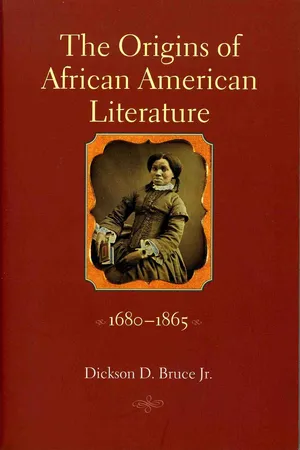
The Origins of African American Literature, 1680-1865
eBook - ePub

The Origins of African American Literature, 1680-1865

  1. 374 pages
  2. English
  3. ePUB (mobile friendly)
  4. Available on iOS & Android
eBook - ePub

The Origins of African American Literature, 1680-1865

About this book

From the earliest texts of the colonial period to works contemporary with Emancipation, African American literature has been a dialogue across color lines, and a medium through which black writers have been able to exert considerable authority on both sides of that racial demarcation.

Dickson D. Bruce argues that contrary to prevailing perceptions of African American voices as silenced and excluded from American history, those voices were loud and clear. Within the context of the wider culture, these writers offered powerful, widely read, and widely appreciated commentaries on American ideals and ambitions. The Origins of African American Literature provides strong evidence to demonstrate just how much writers engaged in a surprising number of dialogues with society as a whole.

Along with an extensive discussion of major authors and texts, including Phillis Wheatley's poetry, Frederick Douglass's Narrative, Harriet Jacobs' Incidents in the Life of a Slave Girl, and Martin Delany's Blake, Bruce explores less-prominent works and writers as well, thereby grounding African American writing in its changing historical settings. The Origins of African American Literature is an invaluable revelation of the emergence and sources of the specifically African American literary tradition and the forces that helped shape it.

Frequently asked questions

Yes, you can cancel anytime from the Subscription tab in your account settings on the Perlego website. Your subscription will stay active until the end of your current billing period. Learn how to cancel your subscription.
No, books cannot be downloaded as external files, such as PDFs, for use outside of Perlego. However, you can download books within the Perlego app for offline reading on mobile or tablet. Learn more here.
Perlego offers two plans: Essential and Complete
  • Essential is ideal for learners and professionals who enjoy exploring a wide range of subjects. Access the Essential Library with 800,000+ trusted titles and best-sellers across business, personal growth, and the humanities. Includes unlimited reading time and Standard Read Aloud voice.
  • Complete: Perfect for advanced learners and researchers needing full, unrestricted access. Unlock 1.4M+ books across hundreds of subjects, including academic and specialized titles. The Complete Plan also includes advanced features like Premium Read Aloud and Research Assistant.
Both plans are available with monthly, semester, or annual billing cycles.
We are an online textbook subscription service, where you can get access to an entire online library for less than the price of a single book per month. With over 1 million books across 1000+ topics, we’ve got you covered! Learn more here.
Look out for the read-aloud symbol on your next book to see if you can listen to it. The read-aloud tool reads text aloud for you, highlighting the text as it is being read. You can pause it, speed it up and slow it down. Learn more here.
Yes! You can use the Perlego app on both iOS or Android devices to read anytime, anywhere — even offline. Perfect for commutes or when you’re on the go.
Please note we cannot support devices running on iOS 13 and Android 7 or earlier. Learn more about using the app.
Yes, you can access The Origins of African American Literature, 1680-1865 by Dickson D. Bruce in PDF and/or ePUB format, as well as other popular books in Literatura & Crítica literaria norteamericana. We have over one million books available in our catalogue for you to explore.

Index

Abolition Intelligencer, 169
Abolitionist, 237
abolition movement: as community of “respectability,” 195, 212, 213, 231–32; as discursive community, 194–95, 201, 208–10, 223–24, 232–34; as moral community, 215–16, 218–20, 227–28, 245, 260, 296; racial dynamics of, 211–16, 218–20, 223–26, 233–34, 251, 256–57, 260, 267–68, 277–78; racial tensions in, 223, 233, 255–57, 260, 268; significance of African American voice in, 220–27, 233–38, 256, 258–60, 273–74
Abraham (biblical patriarch), 122, 125
Abzug, Robert, 185
Ada. See Forten, Sarah
Adahoonzou, King of Dahomey (pseud.?), 71
Adams, John, 45
Adams, Nehemiah, 280, 285, 289; A South-Side View of Slavery, 275
“Address to the Free People of Colour of the United States,” 178
“Address to the Heart, on the Subject of Slavery,” 66
“Address to the humane and benevolent Inhabitants of the city and county of Philadelphia,” 141, 145
Africa: ancient, 12, 82–83, 121–25, 154–55, 167–68, 180, 205–6, 217, 229–30, 310–11; corruption of, 119–20, 133; cultural traditions of, in America, 5–7, 10; images of, 2, 25, 27, 57–61, 87–88 (see also exoticism; primitivism) African Church (New York), 122
African Civilization Society, 271
African Free School (New York), 99, 107, 119
African Institution (England), 129
African Masonic Lodge (Boston), 82–83, 128
African Meeting House (Boston), 109
African Methodist Episcopal Church, 116, 126–27, 144, 235, 304, 306
African nobility, stories of, 19, 25, 42, 86–87, 88, 89, 121
African Ob...

Table of contents

  1. Cover
  2. Title
  3. Copyright
  4. Contents
  5. Preface
  6. Acknowledgments
  7. Background to an African American Literature, 1680–1760
  8. The Age of Revolution, 1760–1800
  9. Literary Identity in the New Nation, 1800–1816
  10. The Era of Colonization, 1816–1828
  11. The Liberator and the Shaping of African American Tradition, 1829–1832
  12. Literary Expression in the Age of Abolitionism, 1833–1849
  13. African American Voices in the American Crisis, 1850–1861
  14. The War for Emancipation and Beyond
  15. Notes
  16. Works Cited
  17. Index