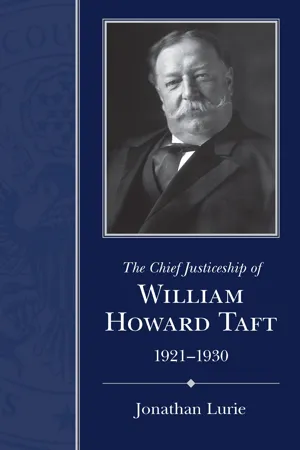
A study of the Supreme Court tenure of the only US president to serve as chief justice provides a unique perspective on 1920s America.
In this book, Jonathan Lurie offers a comprehensive examination of the Supreme Court tenure of the only person to have held the offices of president of the United States and chief justice of the United States Supreme Court. William Howard Taft joined the Court during the Jazz Age and the era of prohibition, a period of disillusion and retreat from the idealism reflected during Woodrow Wilson's presidency. Lurie considers how conservative trends at this time were reflected in key decisions of Taft's court.
Although Taft was considered an undistinguished chief executive, such a characterization cannot be applied to his tenure as chief justice. Lurie demonstrates that Taft's leadership on this tribunal, matched by his productive relations with Congress, in effect created the modern Supreme Court. Furthermore he draws on the unpublished letters Taft wrote to his three children, Robert, Helen, and Charles, generally once a week. His missives contain an intriguing mixture of family news, insights concerning contemporaneous political issues, and occasional commentary on his fellow justices and cases under consideration.
Lurie structures his study in parallel with the eight full terms in which Taft occupied the center seat, examining key decisions while avoiding legal jargon wherever possible. The high point of Taft's chief justiceship was the period from 1921 to 1925. The second part of his tenure was marked by slow decline as his health worsened with each passing year. By 1930 he was forced to resign, and his death soon followed. In an epilogue Lurie explains why Taft is still regarded as an outstanding chief justice—if not a great jurist—and why this distinction is important.
"Conflicts from the early twentieth century endure, and Lurie gives us old and new perspectives from which to understand a living Constitution." —
Journal of American History
- 264 pages
- English
- ePUB (mobile friendly)
- Available on iOS & Android
eBook - ePub
The Chief Justiceship of William Howard Taft, 1921–1930
About this book
Information
1
TAFT AND HIS COURT IN 1921
1
IN ITS ENTIRE HISTORY no member of the United States Supreme Court has brought to the bench the unique perspective and experience of William Howard Taft. To be sure, before and since his appointment, no man has ever served as both president and Supreme Court justice—let alone chief justice. Indeed only two former presidents have ever returned to federal office: John Quincy Adams to the House of Representatives, and Andrew Johnson to the U.S. Senate. When compared with Chief Justices John Marshall and Roger Taney, who between them served for about sixty years, William Howard Taft’s tenure as chief justice was relatively brief—barely eight years.1 But for that period of time, Taft brought an incredible resume to this office.2
His life (1857 to 1930) began on the eve of the Civil War. He matured at the height of the Gilded Age, and he was one of the youngest solicitor generals in the history of the Justice Department. He witnessed the transformation and travails of urban America, the violence between labor and capital, the triumph of American industrialism, the new concepts of law as a science, the emergence of the United States as a world power, the rise and fall of populism, the Progressive Era, the Spanish-American War and America’s introduction to imperialism, World War I and its tragic denouement concerning the ill-fated League of Nations, and finally the Roaring Twenties.
Taft did more than just observe these developments. They formed the background for a career in which he held an unusual variety of positions, virtually all of them appointed. As a young superior court judge in Cincinnati, he rendered decisions on a variety of legal issues. As the U.S. solicitor general, he regularly appeared before the Supreme Court between 1889 and 1892 and won the great majority (sixteen out of eighteen) of the cases in which he argued. As a judge in the newly created U.S. Circuit Court of Appeals, Taft left his mark on the law especially in the fields of labor relations and industrial regulation, and as the president of the commission to govern the Philippines, he saw for himself what American adventures on the imperialistic stage might ultimately cost. His seemingly firm friendship with Theodore Roosevelt began in the 1880s and ripened to a point where as president TR not only offered Taft an appointment to the high court on at least two different occasions but also made him his secretary of war. In 1908 at TR’s urging Taft sought and won the Republican presidential nomination and succeeded TR as president. Their friendship shattered during his term, and in 1912 TR insisted on running against the man he had selected as his successor, ensuring defeat for them both by Woodrow Wilson. Upon leaving office Taft became a professor of law at Yale, his old alma mater (he declined to be a candidate for its presidency). In 1921 he was appointed chief justice of the United States by President Warren Harding.
Such is a very short summary of Taft’s early career, one remarkable for its variety and for the high level of attainment matched by the humiliation of galling defeat. With the exception of his ill-fated run for reelection, when it came to opportunities for advancement Taft had always seemed to be in the right place at the right time with the right friends. Looking back on his various legal careers, Taft affirmed that “I love judges and I love courts. They are my ideals, that typify on earth what we shall meet hereafter in heaven under a just God.”3 But Taft also possessed certain ideals and values to which he appears to have adhered with marked consistency. As he prepared to teach at Yale University, he looked forward to taking “little excursions into various new fields of knowledge,” resulting in “the increased humility one has in regard to his own ignorance.” He saw “a very large sphere for change and reform and experiment. I wish to avoid as far as I can dogmatism and rigid conservatism, but history teaches so certainly some truths that a man who does not accept them is blind.”4
2
In the fall of 1889 President Benjamin Harrison offered Taft appointment as the solicitor general of the United States. One of two significant moves by Congress to improve the federal judicial system during the late nineteenth century (the other being creation of the circuit appellate courts in 1891), the post of solicitor general had been established in 1870. Although a prime function of the solicitor general has always been to represent the United States in cases before the Supreme Court, the solicitor general also was on call to advise the attorney general, as well as the president himself. The solicitor general had to be familiar not only with federal statute law but also with current rules of federal practice, as well as decisions of the high court, all areas in which Taft previously had not needed nor acquired any expertise.
It is not surprising then that his first instinct was to decline Harrison’s offer, even though his wife, Helen—invariably referred to as Nellie—strongly encouraged him to accept it. So too did Will’s father, Alphonso. Both father and wife may well have realized that Taft’s new position placed him very close to the entire executive branch of the federal government, to say nothing of the high court. In fact however no solicitor general had ever been or would be appointed to the high court in Taft’s lifetime except himself. Misgivings aside, in a scenario that would be repeated more than once later in his career, Taft allowed himself to be persuaded to accept a position he did not really desire.
Indeed Taft tended to doubt the quality of his oral arguments as solicitor general. Reporting to Alphonso early in his tenure that “I do not find myself at all easy or fluent on my feet,” he alluded to his apparent inability to attract the sustained attention of “a lot of mummies.” The justices, he added, “seem to think when I begin to talk that that is a good chance to read all the letters that have been waiting for some time, to eat lunch, and devote their attention to … other matters.” But he would gain “experience in not being overcome by circumstances.” And so he did. After he had left the presidency, in 1913 Taft recalled with nostalgia and humor his two years as solicitor general.5
He observed that the Supreme Court “is a great court. They hear you state the case, and after that when you go on to make your argument, if they are with you they don’t pay much attention to you. For the first six months, I had good causes for the Government, and I would present the cases and then attempt to make an argument—and really it was just like talking to nine tombstones! In fact, it was a little worse than that, because they would be affirmative in their disregard of your argument…. Well in about six months after that, I got a lot of cases in which I didn’t have a good cause, and then I found that their attention was altogether too minute.”6 Eight years after these comments, Taft became chief justice among the “tombstones.”
Unlike some other chief justices—Marshall, Taney, and Warren immediately come to mind—Taft had limited exposure to the practicality of politics, and this in spite of his single term as president. On the other hand, as will be seen, Taft possessed impressive administrative skills, which he retained beyond the presidency. With one exception he never ran for statewide office, never competed in any national election until 1908, and never enjoyed the political environment.7 The happiest years in his varied career were those when he sat on the bench.
As other books in this series have demonstrated, each chief justice leaves his mark on the court, some more distinct than others. But with the possible exception of John Jay, no chief justice has started with a clean slate. In the guise of precedent, decisions of earlier tribunals inevitably affect the court that the justice joins. Before considering the significance of key rulings handed down by the Taft court, some familiarity with the justices who constituted it, as well as with the existing state of federal jurisprudence as he took the center seat in 1921, is necessary.
During his presidency Taft appointed more jurists to the Supreme Court in four years than any other single-term chief executive in our history. He selected five new associate justices and elevated one already on the court, Edward White, to the center seat, the first time in our history that this had occurred.8 (It would not be the last.) Behind Taft’s elevation of White lies an intriguing set of circumstances.
Had Theodore Roosevelt been able to offer his erstwhile friend Will Taft the chief justiceship of the Supreme Court, both Taft’s later career as well as court history would have been very different. But TR never had this opportunity, and when Chief Justice Melville Fuller passed away on July 4, 1910, it was President Taft who had to select his replacement. Taft had made no secret of his yearning for the center seat. Yet for the time being such an event was an impossibility. On the other hand Taft was prepared to anticipate future possibilities as he decided on Fuller’s replacement.
His second selection to the court had been New York governor Charles Evans Hughes, a truly distinguished lawyer and public servant and an obvious candidate for the center seat. On the other hand Hughes was relatively young, a mere forty-eight, while Taft himself was five years older. If he selected Hughes as chief justice, there was a good chance that the former New York governor would outlive Taft, as indeed he did. On the other hand White was now sixty-five and was supported by former president Theodore Roosevelt, who already was acting like a presidential aspirant. One can sympathize with Taft as he suffered through his actuarial agonies and ultimately selected White. If he was to have any chance at all of gaining the center seat, it would probably be as a replacement for White and not Hughes.
So Taft made his decision and started a period of waiting that would ultimately last a decade. Two major developments took place in 1921. Warren G. Harding was inaugurated president, returning a Republican to the White House, and in mid-May Chief Justice White died. Now, with a new president who had already been informed by the former president that he could accept only the chief justiceship, Taft continued his wait, not without some anxiety replete with a synthesis of fatalism and hope. Finally on June 30 Harding sent Taft’s nomination to the Senate, which did not even bother to refer it to the Judiciary Committee, but confirmed him, albeit not unanimously, on the same day.
Meanwhile eight members of the Supreme Court had awaited word from President Warren Harding concerning his replacement for Chief Justice Edward White, who had passed away on May 19, 1921. In order of seniority they included Joseph McKenna, Oliver Wendell Holmes, William R. Day, Willis Van Devanter, Mahlon Pitney, James C. McReynolds, Louis D. Brandeis, and John H. Clarke.9
3
Alone among his brethren Joseph McKenna brought limited experience as a trial lawyer to the court. Although he had been admitted to the California bar in 1865, McKenna focused his attentions on a political career.10 After serving both as a local district attorney and a state legislator, from 1885 to 1892 held a seat in the U.S. House of Representatives. A staunch Republican McKenna got to know William McKinley, who supported his appointment to the Ninth Circuit Court of Appeals in 1892. He might also have become acquainted with William Howard Taft, happily ensconced at the time on the Sixth Circuit Court of Appeals. When McKinley won the presidential election in 1896, he selected McKenna as his attorney general. But McKenna served for barely six months as a cabinet member, and with the long-awaited retirement of Stephen Field from the high court, McKinley promptly selected the young Californian to replace him.11 Although he may well have possessed legal instincts, McKenna felt that he lacked legal learning. For several months he attended “courses at Columbia Law School, prior to taking his seat on the court.”12
Similar to many conservative Republican jurists at the turn of the twentieth century, McKenna had a healthy respect—if not veneration—for property rights in the context of what William Wiecek has well described as “classical legal thought.”13 Thus he voted with the majority in Lochner v. New York (1905), a case that expanded liberty of contract, and Muller v. Oregon (1908), a case that restricted it. Yet McKenna wrote the majority opinion in Bunting v. Oregon (1917). Possibly unaware of any inconsistency in his voting, in 1923 he was with the majority in Adkins v. Children’s Hospital, a decision that apparently resurrected Lochner.14
While McKenna, again in concert with other...
Table of contents
- Cover
- Title Page
- Copyright
- Dedication
- Contents
- List of Illustrations
- Series Editor’s Preface
- Preface
- 1 Taft and His Court in 1921: The Cast of Players
- 2 Arrival and Beginnings, 1921–1922
- 3 New Arrivals, Ongoing Litigation, and New Statutes
- 4 The Judges’ Bill, 1922–1925
- 5 1924–1925: A Final Appointment amid Emerging Judicial Trends
- 6 1926: Lengthening Shadows, and Litigation of Significance
- 7 1927–1928, Part I: Civil Rights, Civil Wrongs, and Some Apparent Cracks in Classical Legal Thought
- 8 1927–1928, Part II: Battle Lines Harden, and Planning for the Future
- 9 1928–1929, Part I: The Fissures Deepen
- 10 1928–1929, Part II: The Taft Court in Decline
- Epilogue
- Bibliography
- Index of Cases
- Subject Index
- About the Author
Trusted by 375,005 students
Access to over 1.5 million titles for a fair monthly price.
Study more efficiently using our study tools.
Frequently asked questions
Yes, you can cancel anytime from the Subscription tab in your account settings on the Perlego website. Your subscription will stay active until the end of your current billing period. Learn how to cancel your subscription
No, books cannot be downloaded as external files, such as PDFs, for use outside of Perlego. However, you can download books within the Perlego app for offline reading on mobile or tablet. Learn how to download books offline
Perlego offers two plans: Essential and Complete
- Essential is ideal for learners and professionals who enjoy exploring a wide range of subjects. Access the Essential Library with 800,000+ trusted titles and best-sellers across business, personal growth, and the humanities. Includes unlimited reading time and Standard Read Aloud voice.
- Complete: Perfect for advanced learners and researchers needing full, unrestricted access. Unlock 1.5M+ books across hundreds of subjects, including academic and specialized titles. The Complete Plan also includes advanced features like Premium Read Aloud and Research Assistant.
We are an online textbook subscription service, where you can get access to an entire online library for less than the price of a single book per month. With over 1.5 million books across 990+ topics, we’ve got you covered! Learn about our mission
Look out for the read-aloud symbol on your next book to see if you can listen to it. The read-aloud tool reads text aloud for you, highlighting the text as it is being read. You can pause it, speed it up and slow it down. Learn more about Read Aloud
Yes! You can use the Perlego app on both iOS and Android devices to read anytime, anywhere — even offline. Perfect for commutes or when you’re on the go.
Please note we cannot support devices running on iOS 13 and Android 7 or earlier. Learn more about using the app
Please note we cannot support devices running on iOS 13 and Android 7 or earlier. Learn more about using the app
Yes, you can access The Chief Justiceship of William Howard Taft, 1921–1930 by Jonathan Lurie in PDF and/or ePUB format, as well as other popular books in Law & Law Biographies. We have over 1.5 million books available in our catalogue for you to explore.