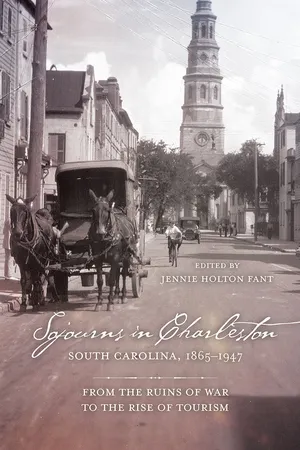
Sojourns in Charleston, South Carolina, 1865–1947
From the Ruins of War to the Rise of Tourism
- 384 pages
- English
- ePUB (mobile friendly)
- Available on iOS & Android
Sojourns in Charleston, South Carolina, 1865–1947
From the Ruins of War to the Rise of Tourism
About this book
Travelers' accounts of the people, culture, and politics of the Southern coastal region after the Civil War
Charleston is one of the most intriguing of American cities, a unique combination of quaint streets, historic architecture, picturesque gardens, and age-old tradition, embroidered with a vivid cultural, literary, and social history. It is a city of contrasts and controversy as well. To trace a documentary history of Charleston from the postbellum era into the twentieth century is to encounter an ever-shifting but consistently alluring landscape. In this collection, ranging from 1865 to 1947, correspondents, travelers, tourists, and other visitors describe all aspects of the city as they encounter it.
Sojourns in Charleston begins after the Civil War, when northern journalists flocked south to report on the "city of desolation" and ruin, continues through Reconstruction, and then moves into the era when national magazine writers began to promote the region as a paradise. From there twentieth-century accounts document a wide range of topics, from the living conditions of African Americans to the creation of cultural institutions that supported preservation and tourism. The most recognizable of the writers include author Owen Wister, novelist William Dean Howells, artist Norman Rockwell, Boston poet Amy Lowell, novelist and Zionist leader Ludwig Lewisohn, poet May Sarton, novelist Glenway Wescott on British author Somerset Maugham in the lowcountry, and French philosopher and writer Simone de Beauvoir. Their varied viewpoints help weave a beautiful tapestry of narratives that reveal the fascinating and evocative history that made this great city what it is today.
Frequently asked questions
- Essential is ideal for learners and professionals who enjoy exploring a wide range of subjects. Access the Essential Library with 800,000+ trusted titles and best-sellers across business, personal growth, and the humanities. Includes unlimited reading time and Standard Read Aloud voice.
- Complete: Perfect for advanced learners and researchers needing full, unrestricted access. Unlock 1.4M+ books across hundreds of subjects, including academic and specialized titles. The Complete Plan also includes advanced features like Premium Read Aloud and Research Assistant.
Please note we cannot support devices running on iOS 13 and Android 7 or earlier. Learn more about using the app.
Information
Table of contents
- Cover
- Title Page
- Copyright
- Contents
- List of Illustrations
- Acknowledgments
- Introduction
- W. F. G. Peck (1865): “Four Years Under Fire”
- Whitelaw Reid (1865): “City of Desolation”
- Sidney Andrews (1865): “The Dead Body of Charleston”
- Oliver Bell Bunce (1870): “Charleston and its Suburbs”
- Edward King (1873): “Charleston, South Carolina. The Venice of America”
- Sir George Campbell, M.P. (1878): “The Petrel State”
- “B.” (Eliza Houston Barr) (1880): “Inside Southern Cabins”
- Lady Duffus Hardy (1883): “A Ghost of Dead Days”
- Owen Wister (1901 and 1902): “Enchanted”
- Charles Henry White (1907): “Charleston”
- Edward Hungerford (1912): “Where Romance And Courtesy Do Not Forget”
- Mrs. T. P. O’Connor (Betty Paschal O’Connor) (1913): “Hospitable Charleston”
- William Dean Howells (1915): “In Charleston, A Travel Sketch”
- Norman Rockwell (1918): “The Battle of Charleston 1918”
- Amy Lowell (1912–1922): “And the Garden Was a Fire of Magenta”
- Ludwig Lewisohn (1922): “A Lingering Fragrance”
- Schuyler Livingston Parsons (1928): “Mr. Parsons’ Mansion”
- M. A. De Wolfe Howe (1930): “The Song of Charleston”
- Emily Clark (1930): “Supper at the Goose Creek Club”
- Holger Cahill (1935): “Scouting for Folk Art”
- Edward Twig (Richard Coleman) (1940): “Charleston: The Great Myth”
- May Sarton (1941): “Charleston Plantations”
- Glenway Wescott (1942 and 1946): “With Maugham at Yemassee”
- Vashti Maxwell Grayson (1945): “Charleston”
- Simone de Beauvoir (1947): “These Aristocratic Paradises”
- Bibliography
- Index