BBC RADIO 4 BOOK OF THE WEEK 18-22nd FEBRUARY 2019
Marking the 50-year anniversary of the legendary banned song
Je t'aime… moi non plus, Véronique Mortaigne's brilliantly-written book skilfully identifies the pairing of Gainsbourg and Birkin as an expression of the spirit of the age.
Synonymous with love, eroticism, glamour, music, provocation, their affair would set France aflame as the sixties ebbed, and set in motion many of the ideas we have by now come to think of as specifically 'French'.
Skipping back and forth in time,
Je t'aime takes the reader from the foggy Normandy landscapes where Serge and Jane retreated, to their carefree summers on the coast. En route to their superstardom in films and music, we experience their intrigues, triangular relationships, and jealous rages, the genius and the self-torture.
Tenderly told, via new interviews with key players in their story,
Je t'aime details the coming together of two massive personalities, who together created a model of the rebel couple for the ages.
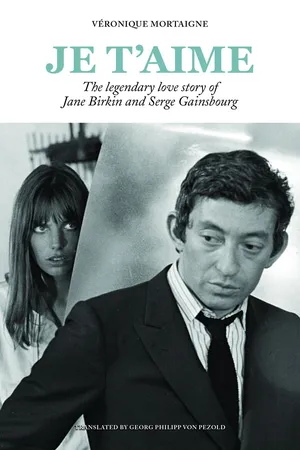
eBook - ePub
Je t'aime
The legendary love story of Jane Birkin and Serge Gainsbourg
- 256 pages
- English
- ePUB (mobile friendly)
- Available on iOS & Android
eBook - ePub
About this book
Information
Subtopic
Music Biographiesseven
The hell of St. Tropez
In 1959, Gainsbourg dreamt up a tormented tableau on the album jacket of Gainsbourg nº 2: a mixture of cannibalistic mambo and a manifesto against an old-fashioned, stifling notion of love. A jug-eared dandy, he posed in a pin-striped suit. Thuggish, a smoker of Gitanes, he propped himself up on an elegant side table adorned with a bunch of red roses and a revolver. In 1966, Gunter Sachs released red roses over La Madrague, Bardot’s house, from a helicopter – a commando operation to try and secure nuptials with BB. Two years later, Serge took the revolver to Saint-Tropez and never fired it. Artists sometimes have premonitory visions.
Ordeal at Saint-Tropez! The filming of The Swimming Pool turns into a nightmare. Gainsbourg is pole-axed by jealousy. What a year 1968 is! In January, he cries over BB. In May, he meets Jane. In August, he risks the lot. Saint-Tropez features as a rite of passage in the development of the myth, and in the fabrication of the ‘couple of the year’: so happy, so close, so glam during the preview of their film Slogan a few months later. It’s a trying ordeal. An unimpressive pétanque player, more prone to all-nighters than to associating with the bowlers of the Place des Lices, Serge Gainsbourg is afraid of the unfair competition of two good-looking guys of princely build and fiery eyes.
Hired by Jacques Deray, Jane Birkin will take part in the cinematographic lives of Alain Delon and Maurice Ronet for a few weeks. All of this in Saint-Tropez, the undisputed fiefdom of BB, whose presence still haunts a Serge now reduced to a bundle of nerves. Gainsbourg follows Jane to Saint-Tropez. He carries a gun. He promises to draw it if these notorious womanisers make eyes at ‘Djenne’. ‘I’ll kill the first one who touches her,’ he tells Pierre Grimblat.
Gainsbourg, who is caught in the middle, spends the Tropezien summer of 1968 in a state of discomfort. Jane’s youth takes hold of life. He is mired in doubt. One evening, the young Englishwoman sees him suddenly pale. ‘He’d just seen Bardot enter a restaurant. Furious, he pounces on the piano.’ Seized by a complex amorous logic, by vengeance, he plays the first thing that crosses his mind: the theme tune to James Bond: composed by John Barry, Jane’s ex-husband. Jane feels neither jealous, nor mortified. Once again, she understands that she’s dealing with a wounded man ‘who, like myself, was going to take time to heal.’
And yet, not everything is all that black. In all her generous frankness, Jane offers her new companion moments of relief, a garden of delights. Observed by photographers, they stroll around in tight jeans, get helpless with laughter. Taken by Mediterranean sensuality, they sit down on hot stone steps and look each other deep in the eyes. Open shirt and miniskirt, they smile at each other. Jane discovers the breadth of the Gainsbourg sense of humour, but also the sharing of fougasse and stuffed vegetables, Minuty rosé and olive oil on bread. As far as his singing career goes, Serge is at ease. Of course, the yé-yé period has brought him his share of young girls sleeping on his doormat, but the passionate fans, the ‘fan-a-tics’, in his words, who’ll be on his heels once he’s become Gainsbarre, spare him for the time being.
The Saint-Tropez episode takes place in the thick of love’s ‘crystallisation’ – a small twig immersed in salt adorns itself with crystals. Gainsbourg is cautious: the emergence of love makes him run away, the process of transforming another being into a precious treasure is intolerable for him. He’d written as much the previous year, in his musical Anna: a triangular story where Gainsbourg, Jean-Claude Brialy and Anna Karina play cat and mouse. In one scene, they are drinking beer at Deauville:
SERGE: I’ll tell you one thing: If you lose your lucidity for a single moment, you’re screwed.
BRIALY: Come on! You drink like a fish!
SERGE: No, really – you’re screwed. You lose all the others.
BRIALY: That’s ‘crystallisation’, as Stendhal puts it.
ANNA: You’re not funny, the two of you, it’s the same routine every evening.
Exiled on the shores of the Mediterranean, Lucien the Slav willingly adorns Jane with all of the crystals: freedom, abundance, style, fun, audacity and profligacy. But, on the other hand, the filming of The Swimming Pool is a return to the depths of the salt mine.
Gainsbourg knows from experience that film sets have a particularly aphrodisiac quality. For the man in love, all the warning lights turn to red. Unsurprisingly, Delon starts hitting on Birkin, taking her everywhere in the chauffeur-driven black Cadillac Fleetwood provided by the production company. Romy Schneider is amused. Gainsbourg has rented a chauffeur-driven Rolls to pick his sweetheart up every evening in the hills of Ramatuelle. ‘I’ve never found out if the gun was also rented,’ quips Grimblat, who had suggested carrying a second revolver in order to defend against possible assault from the skilful seducer Maurice Ronet.
Serge Gainsbourg was certainly energised by the radiance of the yé-yés, particularly thanks to France Gall, the eighteen-year-old ‘baby shark’, a young thing full of blondness and innocence. But who is he, in comparison to the fascinating pair who are Alain Delon-Romy Schneider? Romy, the ‘Sissi’* already famous at nineteen, had arrived at Paris-Orly Airport one day in 1958 from Vienna. She’s here to film Christine, a Franco-Italian film by Pierre Gaspard-Huit, a remake of Liebelei by Max Ophüls, in which her mother, the actress Magda Schneider, had played the main role in 1933.
At the foot of the gangway, Delon awaits her with a bunch of flowers. Yet again, they fight. She was ‘stuck up’, he ‘too handsome, too sleek’. Five years of turbulent passion ensued, closely narrated by a European press fascinated by their beauty. When they break up, in 1963, Romy is holed up in Germany. For The Swimming Pool, Delon has insisted on having Romy in the role of his companion, Marianne. In real life, Alain Delon is in the process of separating from his wife, Natalie: he has begun a tumultuous affair with the actress Mireille Darc.
Their cinematic ‘reunion’ confounds gossip columnists and housewives alike. The script of The Swimming Pool brings them together: Jean-Paul (Delon) and Marianne (Romy) are a happy couple. Harry (Maurice Ronet), an ageing but dominant playboy, a big shot in the music industry, turns up to wreak havoc. He arrives at the wheel of his Maserati Ghibli, an absolute object of desire, accompanied by his daughter Pénélope – Jane – who feigns innocence. The eyes are piercing, blue, green, grey. The bodies are perfect. There is much diving and splashing. There is flirting in the blue water. And there is killing, too.
In the sixties, the pool symbolises the fulcrum of eroticism and wealth. But also anticipation and possible disaster – a dive into and disturbance of the smooth blue surface, hidden behind gates and doorways, rows of cacti and palm trees. In 1967, while Jacques Deray is dreaming up the scenario of The Swimming Pool, the British painter David Hockney paints A Bigger Splash – the iconic canvas from a series dedicated to Californian swimming pools. In 2015, the Italian director Luca Guadagnino draws the parallel: he directs a remake of The Swimming Pool and calls it A Bigger Splash. This psychological thriller is filmed on the island of Pantelleria, off the southern coast of Sicily, where the light is starker. Dakota Johnson, main actress in the adaptation of the erotic bestseller Fifty Shades of Grey, replaces Jane Birkin in the role of Pénélope, minus the freshness and innocence. Nonetheless, vacuity prevails around the edge of the pool with the same implacability.
The Swimming Pool is about moneyed ennui. Delon is depressed. Birkin drags around her startled longing. Ronet has nothing left to gain. Romy gets her senses muddled in a bewildering reality. Halfway through the film, in an atmosphere fraught with suspicion, Pénélope and Jean-Paul transgress the architectural order and rigid setting of the pool by escaping to the beach to swim. They come back late, Jane has her hair full of salt. They have ‘messed around’: that much is obvious. The realisation appears in the eyes of their partners. In actuality, it breaks Gainsbourg’s heart.
A rerun of The Swimming Pool on French television, as well as the general fascination that continues to be wielded by the nuances of Romy’s gaze, made me want to go to Saint-Tropez, which to my mind was Françoise Sagan’s territory. Serge Gainsbourg considered her an unreadable writer. He had refused to set one of her poems to music. He hadn’t understood how much Sagan preferred the car accident to deadly boredom.
We are in September: the swarms of gapers have withdrawn, the stars have migrated elsewhere. On the vast beach of Pampelonne, the beauty competition has begun to slacken. Everything breathes once more: the birds, the plants, the trees – dog figwort, Jupiter’s beard, dwarf palm, Stachys maritima. The regulars, permanent residents or natives, regain possession of the place. Tanned all year long, they can gauge at first glance the intensity of the squalls that are announcing themselves on the Mediterranean, or the flight trajectory of the yellow-legged gull. They know the cartography of the reputable beaches and restaurants.
Calmly, I explore the fortifications of the town of Ramatuelle, crucible of either doomed or unconditional love, depending on the glances cast in The Swimming Pool. The private lanes of the Oumède neighbourhood lead nowhere. The one-way streets prevent fans of Johnny Hallyday, who died on 5 December 2017, from locating what’s left of his ‘Mexican hacienda’-style villa, ‘la Lorada’, which he’d sold in 2000. There is an olive grove, a bowling pitch, a 500-square-metre swimming pool with artificial lagoons and palm-lined islets, a fountain with an arrangement of water lillies and papyrus … Compared to this, the nearby villa that was the setting of The Swimming Pool is a mere cottage. Albeit a luxury one.
The Oumède neighbourhood is in a slightly elevated position. The terrain is quite flat. It is reached via the beach road. Everything is devoted to privacy: the yews are meticulously trimmed. A bit further up, the sea and vineyards come into view. I discover the things that cannot be captured on film: the fragrance of thyme and laurel, the perspiration of bodies, the sweet breeze. Jacques Deray suggested them skilfully in the love scenes of his film. In this Tropezian landscape, full of smells and scorched by the sun, the two icons have rediscovered the ardent gestures and rekindled the smiles of their past passions. They touch each other lightly. Between Ronet and Birkin, everything plays out in their glances. Enraptured, stirred, cornered, dangerous. Jane, 21 at the time, finds her place among the stars with natural elegance. Gainsbourg is trapped, he is furious, he drinks and he waits.
I try to imagine the ghostly shape of Gainsbourg at Saint-Tropez, amidst the rugged beauty of Tahiti Beach. Serge loved stories, he loved history. He would definitely have been interested in that of Tahiti and its neighbours. Tahiti ‘beach’ had been created in 1934, and was then re-established by Félix Palmari – a police officer from Marseilles who was transferred to Saint-Trop’ – and his wife, Marie, a winemaker’s daughter. Here, the couple buy ‘a rabbit hutch inhabited by a Belgian who only wanted to leave, a cart track as its only access, disgusting grapes, neither water nor electricity …’ as the owner explained, claiming ‘a touch of madness’. A bit further along the beach of Pamplonne, Bernard de Colmont and his wife Marie have bought a cabin. In 1954, Brigitte Bardot and Vadim move there to shoot … And God Created Woman. It is so successful, and the paparazzi are so numerous, that the Colmonts start the very chic Club 55 the following year.
La Voile Rouge opened in 1963, a hot spot for licentious parties, closed in 2000 for public nuisance. And private beaches flourish at Pamplonne: almost five kilometres of sand, an enchanting bay and the vineyards of the Var in the background. Here, as at Deauville, man has won the battle with the swamps and mosquitos. The long, bending reeds that protect against the mistral and the insects have helped that victory along.
Before being overrun by the vapidity of money and pretension, Saint-Tropez and its neighbour Ramatuelle were a paradise. Up-country, in the monstrous traffic jams of the bay of Sainte-Maxime, I was seized by a sense of disillusioned wistfulness. As if a haunting feeling of decadence had invaded the paradise of this club of brazen, sensual women – Sagan, Gréco, Bardot … – who catapulted Saint-Tropez to the apex of locations of liberty.
A few years ago, I went to meet a great admirer of Serge Gainsbourg, Juliette Gréco. The muse of Saint-Germain-des-Prés has built her house along the Escalet road, above the sea, a paradise hidden under the cork oaks, umbrella pines and rosebays. And rocked by cicadas ‘who misbehave’, Gréco jokes by the swimming pool. According to Gréco, Gainsbourg was of an evangelical innocence. Gainsbourg thought Gréco, who he loved wholeheartedly, shouldn’t have straightened the line of her nose. He’d said the same to his daughter Charlotte, who had one day considered plastic surgery. According to Gainsbourg, Gréco was exceptional, because she was so free! She w...
Table of contents
- Cover
- Title Page
- Contents
- one: Cresseveuille
- two: Jane from London
- three: The jet set
- four: Bardot and Gainsbourg
- five: Gainsbourg goes in to fight
- six: The encounter
- seven: The hell of St. Tropez
- eight: The beginning and the end
- nine: The family
- ten: Don Juan
- eleven: Don Juan, Vadim and the defeat of the male
- twelve: Androgyny, the foundations of the Republic
- thirteen: The twin
- fourteen: Drag queens and company
- fifteen: Of dogs and girls
- sixteen: Régine
- seventeen: Je t’aime moi non plus
- eighteen: Impedimenta and the outlines of the future
- nineteen: Éros, Thanatos, women’s bodies and voices: supreme object of desire
- twenty: The night belongs to us
- Bibliography
- Acknowledgements
- About the author
- Copyright
Trusted by 375,005 students
Access to over 1.5 million titles for a fair monthly price.
Study more efficiently using our study tools.
Frequently asked questions
Yes, you can cancel anytime from the Subscription tab in your account settings on the Perlego website. Your subscription will stay active until the end of your current billing period. Learn how to cancel your subscription
No, books cannot be downloaded as external files, such as PDFs, for use outside of Perlego. However, you can download books within the Perlego app for offline reading on mobile or tablet. Learn how to download books offline
Perlego offers two plans: Essential and Complete
- Essential is ideal for learners and professionals who enjoy exploring a wide range of subjects. Access the Essential Library with 800,000+ trusted titles and best-sellers across business, personal growth, and the humanities. Includes unlimited reading time and Standard Read Aloud voice.
- Complete: Perfect for advanced learners and researchers needing full, unrestricted access. Unlock 1.5M+ books across hundreds of subjects, including academic and specialized titles. The Complete Plan also includes advanced features like Premium Read Aloud and Research Assistant.
We are an online textbook subscription service, where you can get access to an entire online library for less than the price of a single book per month. With over 1.5 million books across 990+ topics, we’ve got you covered! Learn about our mission
Look out for the read-aloud symbol on your next book to see if you can listen to it. The read-aloud tool reads text aloud for you, highlighting the text as it is being read. You can pause it, speed it up and slow it down. Learn more about Read Aloud
Yes! You can use the Perlego app on both iOS and Android devices to read anytime, anywhere — even offline. Perfect for commutes or when you’re on the go.
Please note we cannot support devices running on iOS 13 and Android 7 or earlier. Learn more about using the app
Please note we cannot support devices running on iOS 13 and Android 7 or earlier. Learn more about using the app
Yes, you can access Je t'aime by Véronique Mortaigne in PDF and/or ePUB format, as well as other popular books in Media & Performing Arts & Music Biographies. We have over 1.5 million books available in our catalogue for you to explore.