- 272 pages
- English
- ePUB (mobile friendly)
- Available on iOS & Android
eBook - ePub
About this book
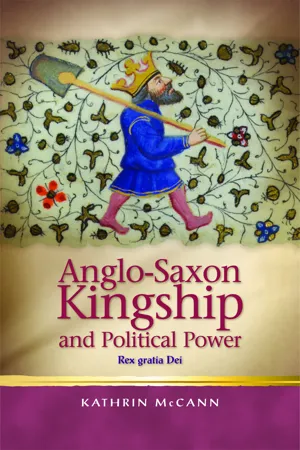
Works on Anglo-Saxon kingship often take as their starting point the line from Beowulf: 'that was a good king'. This monograph, however, explores what it means to be a king, and how kings defined their own kingship in opposition to other powers. Kings derived their royal power from a divine source, which led to conflicts between the interpreters of the divine will (the episcopate) and the individual wielding power (the king). Demonstrating how Anglo-Saxon kings were able to manipulate political ideologies to increase their own authority, this book explores the unique way in which Anglo-Saxon kings understood the source and nature of their power, and of their own authority.
Information
1
Early Anglo-Saxon Politics
The impetus for converting the Anglo-Saxon peoples, if we believe the legend, was Pope Gregory the Great’s conviction and earnest desire that such a fair people should not be left prey to the devil (HE, II.1). Accordingly, he sent missionaries to the angle of the Earth to convert the Anglo-Saxons. As is obvious from reading Bede’s Ecclesiastical History, the focus of this missionary undertaking was the king, thereby acknowledging that the king held responsibility over secular as well as religious affairs.1 The arrival of Augustine and his fellow missionaries led to the establishment of the Anglo-Saxon church with its first archiepiscopal see at Canterbury. The establishment of the church in Anglo-Saxon England can be broadly categorised into two main movements: the strong monastic character of the church in the seventh and eighth centuries and the increase of episcopal power in the eighth and ninth centuries. Since the Augustinian mission was not the overwhelming success anticipated, the subsequent lack of diocesan churches allowed for an abundant establishment of monasteries.2 Their advantages and their success are obvious. On an administrative level, they filled the gap left by an insufficient number of bishops to oversee the large territories of Anglo-Saxon kings.3 On a socio-cultural level, they were centres of learning and wisdom, sponsored by kings and nobles who thus advanced religious endeavours.4 On a personal level, monastic communities were able to supplant or extend one’s kinship group, and ‘private’ monasteries, in particular, became keepers of family and dynastic history as well as symbols of familial pride.5 Towards the end of the seventh century, the foundation and endowment of monasteries experienced an unprecedented high. Bede’s Ecclesiastical History, for example, shows the rise in monastic establishments: although he praises this movement, he is much more critical of it in his letter to Egbert, Archbishop of York (734–766). Indeed, kings and nobles expected a recompense for their generosity and it is thus no wonder that monastic property was very often conceived of as special family property, and that the founders and proprietors of monasteries were perceived as autonomous rulers.6 Royal monasteries, in particular, were often entangled in dynastic power struggles and were at times heavily affected by shifts in the secular power balances. Money and bribery were often the diplomatic means to (re-)gain royal favours; if such were not at hand, communities were suppressed by the secular overlords.7
It is not the intention of this chapter to recount the history of Anglo-Saxon England; instead, it will focus on politics and political structures, and will use a series of case studies to explore this most complex aspect of the Anglo-Saxon past.8 Although Anglo-Saxon political institutions of the various pre-Christian kingdoms had their origin in their continental heritage, it is impossible to say in how far the Anglo-Saxon kingships resembled the continental Germanic institution or in how far the Anglo-Saxon variant was a specific development out of basic Germanic origins. Both correspond in two elementary aspects: military leadership and the execution of various political and religious functions.9 The first aspect was constitutive for Anglo-Saxon kingship: it was through military might that kings were made and unmade, territories conquered and authority ascertained. When reading Bede’s Ecclesiastical History, it seems that the most successful kings were those who exhibited ruthlessness in war instead of able statesmanship. The early entries in the ASC speak of the legendary Germanic ancestors of various Anglo-Saxon royal houses who were continually engaged in battle and thereby ensured the predominance of their kin. Anglo-Saxon royal dynasties thus sprang from powerful war leaders who had established the prominence of their family on the basis of military prowess. A number of royal duties developed out of such military success. A rapidly growing territory required administration, the sustenance of an army required taxation, and the unification of various peoples under one rulership required spiritual leadership. Furthermore, the establishment of a royal dynasty itself brought about new features of kingship: its provision and maintenance was ensured through the practice of itinerant kingship in combination with the royal feorm, and its throneworthiness was ensured through its links to a common spiritual background.
The initial geographical division of Anglo-Saxon England between 400 and 600 AD cannot be retraced fully.10 The arrival of the continental Germanic tribes disrupted the Romano-British structures and the new settlers dispersed the old. Basic Roman infrastructure probably remained unchanged and some of the territorial divisions of the Germanic settlements and early Anglo-Saxon kingdoms might have developed out of older divisions.11 The leaders of such early settlements began to style themselves kings so that by the end of the sixth century several Anglo-Saxon kingdoms were in existence.12 The administrative centre of each province or region was the royal villa, or tun, which was visited by kings on their journey throughout their kingdom on regular intervals.13 At the time of the king’s visit, the royal food-rent, or feorm, had to be rendered, which formed the economical basis of any itinerant kingship.14 The advantages of an itinerant kingship in comparison to one royal centre of administration are twofold: first, the annual journey allowed the king to visit (almost) each part of his kingdom and so to inform himself on local issues, and second, the burden of entertaining the royal retinue was evenly distributed throughout the year and across the country. Its disadvantages are similarly twofold: first, the absence of the king from one region for most of the year allowed local magnates to rule effectively as minor kings which could lead, in turn, to the development of internal factions, and second, the itinerary of other royal households could foster separate loyalties and thus threaten the unity of the kingdom.15 Furthermore, for the sons and daughters of noble families, the annual visit could be a stepping stone for a career at court.
The itineraries of kings also offer insight into the political structure of kingdoms. Those parts that were visited frequently formed the core or ancestral land, while those less frequented either lay on the periphery or were recently acquired areas. The assessment of tribute renders, whether in money, services or food, also provides information on overlordship and power balances in certain regions. One such assessment, the Tribal Hidage, proves the existence of several tribes in the seventh century which were tributary to Mercia and to some degree already incorporated into the Mercian realm, but which still retained their respective tribal identity.16 Such regionalism is a feature of Anglo-Saxon England throughout its history, and a strong sense of ‘national pride’ is visible in several sources. When the Northumbrian king Oswiu defeated the Mercian king Penda in the battle at the river Winwæd in 655, he installed several noblemen to rule over Mercia. The Mercian noblemen rebelled against this overlordship and, after having successfully repelled the Northumbrian earls, chose as their own king the grandchild of Penda, Wulfhere (HE, III.24). The defeat by a foreign king and the subsequent rulership through external earls, and not through an internal sub-king as was common practice, triggered strong regional sentiments that led to the overthrow of such foreign rule.
Given such a context, the political landscape of early Anglo-Saxon England is characterised by a comparative instability of powers. Frequent warfare, throne contentions and territorial expansion all contributed to continuously shifting power balances among the several kingdoms. As a consequence, kingdoms were frequently subjected to the current dominant power, either retaining their status as a separate but tributary kingdom or being demoted to a province before their integration into the superior realm. The question remains, however, whether all regions and provinces that made up an Anglo-Saxon kingdom originally began as separate kingdoms themselves, or whether they began as a loose cluster of tribes with one tribal leader. Bede informs us that there were no kings among the Old Saxons but rather viceroys (Lat. satrap):
Non enim habent regem iidem Antiqui Saxones, sed satrapas plurimos suae genti praepositos, qui ingruente belli articulo mittunt aequaliter sortes et, quemcumque sors ostenderit, hunc tempore belli ducem omnes secuntur, huic obtemperant; peracto autem bello, rursum aequalis potentiae omnes fiunt satrapae.17
It is fair to assume that the very early tribal organisations did not have kings according to later definitions. In due time, they would call themselves kings and proclaim their dynasty as the only throneworthy one. According to Nicholas Higham, it is these smaller regional kingships that formed the starting point for the later larger kingdoms of Northumbria, Mercia and Wessex.18 Centralising forces, fluctuating boundaries and changing foci of power further contributed to the merging of tribal units into larger kingdoms. Not all of these units, however, strove for superiority over others. Higham further states that ‘recurring clusters of kingships exhibit a strong tendency to act in consort when either rejecting or affirming the hegemony either of one of themselves or of an outsider’.19 Many of the smaller tribes are known to us only through the Tribal Hidage and even this document probably does not list all of them. In the course of time, their total number declined, with certain dynasties either becoming extinct or dominant; from the seventh century onwards only the most successful kingdoms survived.
To date many scholars have shied away from writing a comprehensive political history of the early Anglo-Saxon kingdoms, focusing instead on separate kingdoms.20 Arguably, this is a prudent approach. Apart from the simple fact that most Anglo-Saxon kingdoms did not evolve in a straightforward and linear manner, their political conditions are far too diverse to be generalised. What is true for one kingdom at one point in time might not be applicable to another one or might become obsolete with the passage of time. General issues, such as the religious dimension of rulership or the growing antagonism between kings and clergy, can be found throughout all the realms, but there are aspects that are observable only in some kingdoms while negligible in others. The resulting diversity might seem confusing, but it also mirrors the political realities of that time: there simply is not just one theory that can be attributed to all kings. Although the sources do not allow for a conclusive or all-encompassing picture to emerge, they nevertheless shed light on the beginnings of Anglo-Saxon politics and they also show the indebtedness of early Anglo-Saxon political thought to continental concepts. Through the impact of the Conversion, Germanic conceptions of kingship changed but, strikingly, Anglo-Saxon kingship would develop to combine unique political features that differ greatly from their Carolingian and later Ottonian counterparts. The progress of abstract ideas and concepts occurs not lineally but rather in bends and curves, and each king or royal government approaches the tasks ahead differently. It is here that some of the more interesting or curious sides of political development can be found. Only by looking at the characteristics of early political life separately can additional insight be formed and a wider picture gained. It is thus the intention of this chapter to have a closer look at the individual kingdoms and how their kings dealt with particular issues.21 It will use a case study approach as this method of organising the available material offers greater flexibility and interpretative command over the various political aspects in focus here. This also means that discussions are necessarily limited to a specific geographical region; this is not to say, however, that the political feature highlighted did not occur elsewhere or at a later point in time.
There will be seven case studies on the following aspects: joint kingship, overlordship, coinage, legislation, royal education, royal abdication and saint-kings. Case study I discusses joint kingship with regard to the kingdom of Essex. While having two kings might appear problematic, especially when they were in disagreement, it allowed for the younger king to undergo specific royal training supervised by the older and more experienced king. At the time of succession, the junior king would then have the qualifications necessary to take over the government seamlessly, and without the social upheavals that royal successions might entail. The different aspects of subjection and overlordship are illustrated with the fate of the Sussex kingdom in case study II. Subjection could either mean the incorporation of the inferior realm into the superior kingdom, or rendering the inferior one tributary. It would thus retain its administrative structures, even its royal dynasty, but it would depend on an overlord in all major decisions and be obliged to render military and monetary aid. The opposite of that feature, conquest, is exemplified in case study III with the kingdom of Mercia. Here, it is demonstrated how the introduction of a new currency served to establish the new authority, but also how the acceptance and/or rejection of the new money paralleled the success of imposing a new authority onto the conquered kingdom. Case study IV demonstrates the new duty of legislation and its impact on royal authority in regard to the kingdom of Kent. Written laws codify a certain practice but also royal power. Furthermore, the law codes show how the Church was integrated into the king’s judicial dominion by applying the wergild system to ecclesiastical matters. Law thus became a Christian king’s duty. The Conversion necessitated the transmission of Christian political thought, and, in particular, an image of kingship that was specifically Christian. For that purpose, kings needed to be educated before they could be called upon to correct their peoples’ behaviour and morals. The kingdom of East Anglia serves to demonstrate the importance of education and instruction in case study V. Another important impact of the Conversion was the new way of life that Christianity promulgated. As Wessex kings demonstrate, this was attractive to...
Table of contents
- Cover
- Title Page
- Copyright Page
- Contents
- Series Editors’ Preface
- Acknowledgements
- List of Abbreviations
- Timeline of events
- Introduction:
- Chapter 1: Early Anglo-Saxon Politics
- Chapter 2: Diploma Politicum
- Chapter 3: The Anglo-Saxon Regina Gratia Dei
- Chapter 4: Reformers and Rulers
- Chapter 5: Rituals of King-making
- Conclusion
- Appendices
- Tables
- Bibliography
- Notes
Trusted by 375,005 students
Access to over 1.5 million titles for a fair monthly price.
Study more efficiently using our study tools.
Frequently asked questions
Yes, you can cancel anytime from the Subscription tab in your account settings on the Perlego website. Your subscription will stay active until the end of your current billing period. Learn how to cancel your subscription
No, books cannot be downloaded as external files, such as PDFs, for use outside of Perlego. However, you can download books within the Perlego app for offline reading on mobile or tablet. Learn how to download books offline
Perlego offers two plans: Essential and Complete
- Essential is ideal for learners and professionals who enjoy exploring a wide range of subjects. Access the Essential Library with 800,000+ trusted titles and best-sellers across business, personal growth, and the humanities. Includes unlimited reading time and Standard Read Aloud voice.
- Complete: Perfect for advanced learners and researchers needing full, unrestricted access. Unlock 1.5M+ books across hundreds of subjects, including academic and specialized titles. The Complete Plan also includes advanced features like Premium Read Aloud and Research Assistant.
We are an online textbook subscription service, where you can get access to an entire online library for less than the price of a single book per month. With over 1.5 million books across 990+ topics, we’ve got you covered! Learn about our mission
Look out for the read-aloud symbol on your next book to see if you can listen to it. The read-aloud tool reads text aloud for you, highlighting the text as it is being read. You can pause it, speed it up and slow it down. Learn more about Read Aloud
Yes! You can use the Perlego app on both iOS and Android devices to read anytime, anywhere — even offline. Perfect for commutes or when you’re on the go.
Please note we cannot support devices running on iOS 13 and Android 7 or earlier. Learn more about using the app
Please note we cannot support devices running on iOS 13 and Android 7 or earlier. Learn more about using the app
Yes, you can access Anglo-Saxon Kingship and Political Power by Kathrin McCann in PDF and/or ePUB format, as well as other popular books in History & British History. We have over 1.5 million books available in our catalogue for you to explore.