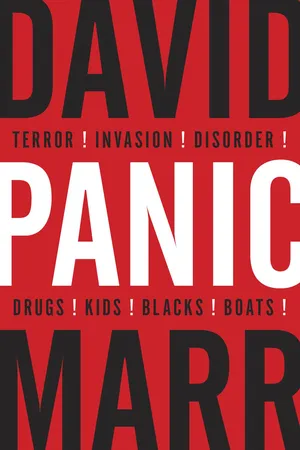
Panic (noun). A sudden uncontrollable fear or anxiety, often causing wildly unthinking behaviour. Australians see themselves as a relaxed and tolerant bunch. But scratch the surface and you'll uncover an extraordinary level of fear.Cronulla. Henson. Hanson. Wik. Haneef. The boats. Panic shows all of David Marr's characteristic insight, quick wit and brilliant prose as he cuts through the froth and fury that have kept Australia simmering over the last fifteen years.'Turning fear into panic is a great political art: knowing how to stack the bonfire, where to find the kindling, when to slosh on a bucket of kero to set the whole thing off with a satisfying roar … These are dispatches from the republic of panic, stories of fear and fear-mongering under three prime ministers. Some chart panic on the rise and others pick through the wreckage left behind, but all grew out of my wish to honour the victims of these ugly episodes: the people damaged and a damaged country.' —David Marr'For those who deplore such panics … this is a good tonic' —Jack Waterford, Canberra Times 'The effectiveness of Marr's writing lies in his ability to stand back and offer sweet reasonableness in the fact of events that other reporters would happily play for populist hysteria.' — Sydney Morning Herald 'David Marr is not on the list of Australian living treasures, but perhaps he should be. Among our best journalists, he stands out as someone who has consistently challenged the powerful, at his best with forensic skill and deep research.' —Dennis Altman, Australian Book Review ' Panic is clever, intelligently exposing the language of Marr's right-wing adversaries while separating political rhetoric from political reality.' — West Australian 'Marr … is robust and high-spirited and his wit and down-to-earth language avoid any taint of self-righteousness.' — Saturday Age 'Less food for thought, more a feast.' — Australian Way David Marr has written for the Sydney Morning Herald, the Age and the Monthly, been editor of the National Times, a reporter for Four Corners, presenter of ABC TV's Media Watch and now writes for the Guardian. His books include Patrick White: A Life, The High Price of Heaven, Dark Victory (with Marian Wilkinson) and five Quarterly Essays: His Master's Voice, Power Trip, Political Animal, The Prince and Faction Man.
eBook - ePub
Panic
About this book
Information
Contents
1. Fear itself
Panic, power and politics in a happy nation. October 2011.
2. Beyond the pale with Pauline
One Nation hits the road. May 1997.
3. Primal fear
Race, politics and respectable Australians. May 1997.
4. Pictures from Wik
Waging war on native title. December 1997.
5. The faithful gather
John Howard decides who comes to this country. October 2001.
6. On the nose
Letting the drug dogs loose. December 2001.
7. The shape of the argument
The scary agenda of the Left. September 2004.
8. Saving the nation
Al-Kateb condemned to everlasting detention. October 2004.
9. The hero of Cronulla
Alan Jones and the business of race riot. December 2005.
10. Pick and stick
Defending the hero broadcaster. December 2006.
11. A dawn sweep through Sydney
Demonstrators today, terrorists tomorrow. March 2007.
12. Cowboys and Indians
The needless ordeal of Mohamed Haneef. July 2007.
13. Scenes from a city under siege
Sydney battens down for APEC. September 2007.
14. Home free
Al-Kateb gets his papers. October 2007.
15. Trust me
The great American mistake of 1791. April 2008.
16. Naked as the day
Bill Henson and his terrifying photographs. May 2008.
17. The wash-up
Children, art and virtue. December 2008.
18. One hot night forty years ago
Stonewall and the politics of hate. June 2009.
19. Time on the island
Our refugee prison far, far away. September 2009.
20. Abbott rising
An underestimated man takes charge. December 2009.
21. Cat and mouse
Error, death and the destruction of SIEV 36. February 2010.
22. My love of drugs
The lost politics of reform. November 2010.
23. Belling the cat
Naming and shaming the enemies of rights. December 2010.
24. The Dark materials
Old fears and the toxic politics of the boats. May 2013.
Notes
About the author
1.
FEAR ITSELF
We are in a panic again. This golden country, so prosperous, so intelligent, so safe and orderly, is afraid of refugees arriving in fishing boats. This is a great Australian fear, one that never really goes away: the fear of being overrun by dusky fleets sailing down from the north. Every time refugee boats appear on the horizon in any numbers, we panic. Facts then count for little. Hearts are hardened. Terrible things are done in the name of protecting the nation. Though this is not the first wave of boats and won’t be the last, the politics are more rancorous than ever.
Panic has been with us from the start. It’s so Australian. Panic over the Chinese was the midwife of Federation and we have been swept by panics ever since. We were terrified of saboteurs in World War One, Wobblies and Reds in the 1920s, anarchy in the Depression, and Communists all over again after World War Two. Drugs, crime and queers have provoked panic forever, it seems, though lately the thousand-year fear of homosexuals has faded away. So has the old Protestant terror of Catholics. What were they all about? It’s a mark of panics that once they die down they seem, looking back, unconvincing and even comic. We used to panic about the novels of D.H. Lawrence and the films of Pasolini. Christians still fight the good fight against smut but unless the victims seem somehow to be children – very much a panic of our time – public alarm has almost entirely died.
It came to me when I was reporting the mad uproar over Bill Henson’s photographs a couple of years ago that I’ve been writing about panics all my career: how they are whipped up, do their worst and disappear leaving only wreckage behind. Perhaps I’m alert to the subject because I’m gay. When I was growing up, preachers, police, politicians and the press were still keeping panic alive about people like me. It has left me despising panic merchants, particularly those Tory fear-mongers who represent themselves as guardians of decency. The politicians I most admire are those who hold their nerve in the face of irrational fear on the rampage. I’ve come to believe the fundamental contest in Australian politics is not so much between Right and Left as panic and calm.
Labor drove the early fear of the Chinese, and Labor has been up to its neck at times in panics about Blacks and Reds, poofs and dirty books. Labor can’t claim to be always on the side of calm. This is an issue that goes deeper than division between the parties. It’s about the odd willingness of Australia’s leaders to beat up on the nation’s fears. They coarsen politics. They narrow our sympathies. They make careers for themselves in this peaceful and good-hearted country by managing, from time to time, to make us afraid. The last fifteen years have seen this country in states of exaggerated alarm over native title, Muslim preachers, Muslim rapists, drugs, terrorists both foreign and home grown, demonstrators in the streets and pictures of naked children on gallery walls. But we end the decade as we began in a full-scale panic over refugees coming here – as they reach countries all over the world – uninvited in little boats.
I was a kid journalist in 1975. My heart was with Whitlam even as I watched his government fall to pieces. His defeat was inevitable but his opponents wanted him out at once. To that end a mighty panic was beaten up in the press, in parliament and at the big end of town. By October 1975, a deeply conservative paper like the Sydney Morning Herald was unashamedly calling on its front page for the overthrow of a government:
It is in the plainest interest of national self-preservation to get rid of a management which has reduced a rich and fortunate country to the verge of economic and social disintegration.
Fantasies of vice-regal power were being promoted everywhere. Lawyers who knew better were calling for the urgent disregard of the constitution. In the midst of that hysteria Whitlam was dismissed by the governor-general. Two lessons were there to be learnt about the politics of panic: how willing conservative politicians in this country are to toy with disorder, and how popular that can be. Whitlam’s fall was endorsed overwhelmingly at the ballot box. But who except a few Liberal Party hacks and monarchists are left willing to defend 1975?
Big political careers have been built in this country on little more than a talent for whipping up fear. Billy Hughes was an absolute master of the art. He blamed Fenians and their Catholic supporters for blocking conscription in 1916 and opened a religious fissure in Australian society that would not heal for half a century. And in the last years of World War One he set off perhaps the greatest panic ever to sweep the country. Ships had begun mysteriously disappearing along the coast of New South Wales. Hughes knew a German raider was responsible but, with no warships to hunt it down and a great clamour for action at home, he furiously blamed German saboteurs at work on land. The Wolf, a riveting account of the raider’s work, details the witch hunts and arrests that followed. Newspapers backed Hughes to the hilt, screaming for the internment of anyone even remotely touched by a German connection. It was pure panic:
Thousands of Australians of German extraction were fired from their jobs and spied on by neighbours, and more than four thousand of them imprisoned in rural concentration camps, often on mere suspicion of disloyalty. More than two and a half thousand companies were identified as suspicious or shut down completely, and up to ten thousand letters a week were intercepted by the censor. The names of dozens of Australian towns – Bismarck, Blumberg, Heidelberg, Germanton – were changed to remove all traces of their origins as German immigrant communities. Even the Australian army general John Monash – later hailed as one of the most brilliant military tacticians of the First World War – was subject to hostility and rumour because his parents were German-speaking Poles.
The authors Richard Guilliatt and Peter Hohnen observe laconically: “In the entire course of the First World War, not a single case of German espionage within Australia would be substantiated.”
In war and peace, panics must have something at their heart that matters. They can’t be whipped up out of nothing. Panics are reasonable fears twisted out of all recognition. A decent face has to be put on the passions aroused. Appearances count. Language matters. Skilled panic merchants find ways of suggesting, however vaguely, that the survival of the nation is at stake – not always the integrity of its territory but its heart, its health, its spirit, its way of life. Such desperate times require tough laws and strong leadership. Panic is a rallying cry for power.
The fall of the Berlin Wall was a low moment for panic-mongers. Communism had been a great gift to panic in this country, keeping the right people in power for a long, long time. There was much to fear in and after World War Two from Communist espionage, treason and industrial mayhem. But fear of the Red Menace was kept alive in this country long after the party was spent. Cold War warriors still had troops to command into the 1980s but the game was up when the wall came down. Energetic attempts in the Howard years to ignite fear about the agenda of the Left – particularly entrenched in the “taxpayer-funded” ABC, universities and museums – caused angst in the commentariat but failed to move the public. The Red Menace was utterly exhausted. In the end, Communism even betrayed its detractors.
Race took its place. Nearly all the panics that gust through our politics start somewhere abroad. We share them with the world. But the source and focus of Australia’s disquiet about race is peculiarly our own. It goes back to the beginning: back beyond Federation, even beyond the gold rushes. The discovery of native title by the High Court in 1992 let loose across the country wild fears and old hatreds that had not died down when the judges delivered a second shock in 1996: first Mabo and then Wik. Pauline Hanson surfed both waves of panic to a series of political victories that briefly turned her One Nation Party into a third force in national politics. John Howard dealt in the same panics, implacably opposed to Mabo and determined to cut Wik to the core. By the time Australia calmed down over native title in the late 1990s, he was more firmly entrenched in power than ever and the redhead from Ipswich was a spent force. When it came to playing the panic game, one was a professional and the other an amateur.
Australians aren’t much impressed by great abstractions like justice and liberty. We are an orderly, practical people. We trust our politicians. We expect them to look after us. When they call for fresh powers to meet fresh dangers we nearly always agree to their demands. The warnings of lawyers and the civil liberties brigade don’t have much traction. On the statute books of this country are ferocious laws barely used and mostly forgotten once the fears that provoked them die down. They are the scar tissue of panics passed.
September 11 and the London bombings in 2005 provoked John Howard to introduce – and Labor to support – a radical regime of secret detention without charge or trial; house arrest and control orders without charge; detention of witnesses for questioning; covert surveillance of non-suspects; blocking the access of lawyers to evidence; criminalising anti-war protest and extending the reach of already shadowy sedition laws. Kent Roach of the University of Toronto recently remarked: “Australia has exceeded the United Kingdom, the United States, and Canada in the sheer number of new anti-terrorism laws that it has enacted since September 11, 2001.”
This assault on fundamental principles provoked opposition from the legal profession, human rights and civil liberties bodies and the now familiar – if still incongruous – alliance of Gough Whitlam and Malcolm Fraser. But at that time, with fears running high, Australians embraced the gutting of old protections and old principles in order, or so it seemed, to save the country from terrorism. Yet using those laws can be dangerous for their backers. Injustices we can’t grasp in the abstract are clear enough to Australians in practice. We didn’t need any convincing that the jailing of the Gold Coast doctor Mohamed Haneef was wrong. Very wrong indeed. It helped unseat a police commissioner and was another blow to the already ragged reputation of the prime minister.
In May 2013 the Gillard government released two reports calling for Howard’s counter-terrorism laws to be sharply pruned back. The reports are cautious, measured and deeply concerned for the security of the nation. The first, by the Independent National Security Legislation Monitor, Bret Walker SC, recommended control orders and preventative detention orders be axed and that ASIO lose its power to detain suspects for questioning, a power Walker called “a drastic interference with personal liberty and freedom”. After studying ASIO’s files for over a year he concluded, “by far the most effective powers in preventing terrorism” were not Howard’s new laws but old-fashioned investigation and surveillance. The second report, by Anthony Whealy QC for the Council of Australian Governments, covered much the same ground. Whealy called for more oversight by judges, more opportunities for appeal and the slashing of some brutal penalties in Howard’s laws. The former NSW Court of Appeal judge backed persistent calls that “praise” not be punished.
The concept of “praise” by an organisation for the doing of a terrorist act is simply too broad and indefinite to warrant the attachment of legal consequences [and it] has the capacity to cast something of an Orwellian blanket over free and democratic discussion of matters of intense public interest in our multi-racial society.
Gillard buried the reports by dropping them on budget day. The prospect of either the government or Opposition acting to fix this mess is remote.
In the face of panic, the courts in this country have a mixed record. When the mob is restless and the shock jocks are howling for action, judges are supposed to stay aloof, focus on the facts and be guided by principle alone. But judges aren’t immune from irrational fears. The noise of the mob too often reaches the courtroom. It didn’t in 1951 when, at the height of post-war alarm over the Red Menace, the High Court struck down Bob Menzies’s Communist Party Dissolution Act designed to give – without any supervision by the courts – power to Coalition min...
Table of contents
- Front Cover
- Copyright
- Praise for David Marr and Panic
- PANIC
- Notes
- About the author
Trusted by 375,005 students
Access to over 1.5 million titles for a fair monthly price.
Study more efficiently using our study tools.
Frequently asked questions
Yes, you can cancel anytime from the Subscription tab in your account settings on the Perlego website. Your subscription will stay active until the end of your current billing period. Learn how to cancel your subscription
No, books cannot be downloaded as external files, such as PDFs, for use outside of Perlego. However, you can download books within the Perlego app for offline reading on mobile or tablet. Learn how to download books offline
Perlego offers two plans: Essential and Complete
- Essential is ideal for learners and professionals who enjoy exploring a wide range of subjects. Access the Essential Library with 800,000+ trusted titles and best-sellers across business, personal growth, and the humanities. Includes unlimited reading time and Standard Read Aloud voice.
- Complete: Perfect for advanced learners and researchers needing full, unrestricted access. Unlock 1.5M+ books across hundreds of subjects, including academic and specialized titles. The Complete Plan also includes advanced features like Premium Read Aloud and Research Assistant.
We are an online textbook subscription service, where you can get access to an entire online library for less than the price of a single book per month. With over 1.5 million books across 990+ topics, we’ve got you covered! Learn about our mission
Look out for the read-aloud symbol on your next book to see if you can listen to it. The read-aloud tool reads text aloud for you, highlighting the text as it is being read. You can pause it, speed it up and slow it down. Learn more about Read Aloud
Yes! You can use the Perlego app on both iOS and Android devices to read anytime, anywhere — even offline. Perfect for commutes or when you’re on the go.
Please note we cannot support devices running on iOS 13 and Android 7 or earlier. Learn more about using the app
Please note we cannot support devices running on iOS 13 and Android 7 or earlier. Learn more about using the app
Yes, you can access Panic by David Marr in PDF and/or ePUB format, as well as other popular books in Social Sciences & Global Politics. We have over 1.5 million books available in our catalogue for you to explore.