- 250 pages
- English
- ePUB (mobile friendly)
- Available on iOS & Android
eBook - ePub
About this book
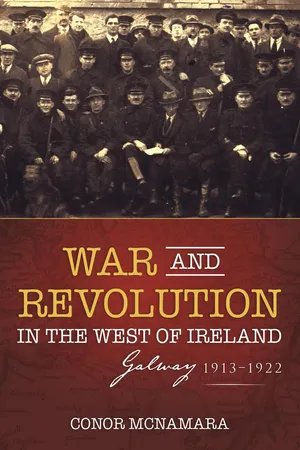
The period 1913–22 witnessed extraordinary upheaval in Irish society. The Easter Rising of 1916 facilitated the emergence of new revolutionary forces and the eruption of guerrilla warfare. In Galway and elsewhere in the west, the new realities wrought by World War One saw the emergence of a younger generation of impatient revolutionaries. In 1916, Liam Mellows led his Irish Volunteers in a Rising in east Galway and up to 650 rebels took up defensive positions at Moyode Castle. From the western shores of Connemara to market towns such as Athenry, Tuam and Galway, local communities were subject to unprecedented use of terror by the Crown Forces. Meanwhile, conflict over land, an enduring grievance of the poor, threatened to overwhelm parts of Galway with sustained land seizures and cattle drives by the rural population. War and Revolution in the West of Ireland: Galway, 1913–1922 provides fascinating insights into the revolutionary activities of the ordinary men and women who participated in the struggle for independence. In this compelling new account, Galway historian Conor McNamara unravels the complex web of identity and allegiance that characterised the west of Ireland, exploring the enduring legacy of a remarkable and contested era.
Information
CHAPTER 1
A Tradition of Violence:
Agrarian Agitation, 1910–18
Agrarian Agitation, 1910–18
This chapter examines land agitation in Galway before the rise of republican militancy and the extent to which elaborate communal and associational structures existed through which the rural poor exerted considerable influence over their social and economic ‘betters’. As Tony Varley has shown, the cessation of land redistribution by the Congested Districts Board (CDB) for the duration of the First World War contributed to the economic desperation of the rural poor and ‘the war impinged greatly on how hard, and by what means, western nationalists were prepared to press for redistributive land reform’.1 Fergus Campbell has highlighted the formative influence of land hunger among the rural poor on the subsequent development and character of the republican movement in County Galway and the transformative role of land agitations.2 It is instructive, therefore, to examine the scale, nature and evolution of land agitation in the years prior to the widespread emergence of militant republicanism.
A common theme of the literature on peasant societies is the dislocation that rural communities experience with the advance of agricultural commercialisation that undermines traditional institutions including bonds between peasants and their economic masters.3 The period covered in this study should have been one of opportunity for the rural poor, many of whom had reason to hope that they would benefit from an acceleration in land division, yet, the suspension of land redistribution during the War heightened the sense of disappointment and desperation among small farmers, just as steadily rising prices increased the profits of middling farmers. This contributed to an acute sense of alienation from and disaffection with the machinations of the state, principally the Estate’s Commission and the CDB, both of which were charged with redistributing estates of land, and the sense of moral outrage felt by many communities was summed up by the refrain of western agitators – the road for the bullock and the land for the people!
In terms of the development of Sinn Féin in rural districts of east Galway, Campbell has asserted that, ‘far from being established on the basis of the “Home Rule tradition”, Sinn Féin emerged from the radical agrarian and republican political culture of [Thomas] Kenny’s secret society’.4 While the Irish Republican Brotherhood (IRB) and agrarian secret societies were separate and distinct phenomena, Campbell’s research has demonstrated how the IRB was closely involved in land agitation in Galway for many years. The police described the main area of IRB influence at this time as, ‘all along the Railway line right up to Tuam and for a few miles on each side of the line. Then again in Galway, just touching places along the line to Clifden and fairly active at Leenane and Letterfrack.’5 Campbell has stated that the ‘Galway Secret Society’ owed its origins to an offshoot of the violent revolutionary movement, The Invincibles, started in Galway in 1881 and was blamed by police for a number of agrarian murders in the county in the 1880s.6 Under blacksmith Thomas Kenny from the village of Craughwell, the society grew to have a presence throughout the county and its influence became considerable. The society’s main aim was the redistribution of grazing land among the rural poor and this represented a continuum in the centrality of agrarian secret society influence in Galway from the land struggle in the nineteenth century through to the struggle for independence in the twentieth. Through all manner of intimidation, including attacks on property and animals, assault and even murder, the society exercised a great deal of control in east Galway, particularly in the hinterland between Athenry, Craughwell and Loughrea.
The defining feature of agriculture in Connacht has always been the scarcity of economically viable land and the 1903 and 1909 Land Acts did not address the prevalence of uneconomic holdings among the rural poor.7 The new legislation did little to further the creation of an economically viable class of small farmers in very impoverished districts because the amount of good land available for distribution was so small and the number of tenants so numerous. The sheer impossibility of satisfying so many land-hungry tenants in areas where land was poor heightened the desperation of potential claimants and fuelled the violence that characterised agrarian disputes.8 As Varley has noted, resolving the inherent blight of rural poverty could not be resolved by large-scale land redistribution as the abundance of uneconomic farms combined with the predominance of poor land meant that despite the vast process of land redistribution which the state had embarked upon, the potential benefits would always be heavily constricted in the west.9
Counties Galway and Clare were exceptional in the opening decades of the twentieth century for the degree of violence over land. The Connacht Tribune declared in an editorial in March 1915:
The second main factor [after drunkenness] that leads to unrest in the County is the delay in the agrarian settlement of certain districts. Unfortunately this leads to evils by no means directly connected with the land problem, for there is no disguising the fact that instances have occurred where reckless irresponsible men have made so-called agrarian emancipation the cloak for acts of outrage that bring disgrace and shame upon the whole community. Men of this class are a distinct danger to the country and can in no way serve the high purpose they protest to advocate. Their spurious patriotism, behind which they shelter personal motives, is by no means new.10
Land redistribution
Galway was remarkable for the volume of land transferred from large landowners to small tenants under consecutive land acts. In terms of the amount of land transferred by the state under the 1903 and 1909 Land Acts, Galway ranks a clear first, when any number of categories is considered. Under the 1903 Land Act, 166,507 acres of land was transferred in the county to small tenants from November 1903 to March 1918.11 This figure equates to just under the entire amount transferred in the province of Munster (169,988) or the amount transferred in all of Ulster and Leinster combined (90,138 and 80,774 acres respectively). In terms of allotments of untenanted land, i.e., grassland previously given over to the grazing of sheep and cattle, the figures are even more remarkable with a total of £731,071 advanced by the state under the combined 1903 and 1909 Land Acts up to March 1918.12 In County Roscommon, where the next highest amount of money was allocated, the government invested £118,188 and in no other county was more than £100,000 allotted, with Galway dwarfing counties like Clare by a figure of roughly ten to one.13
TABLE 4 Summary of Land Acts in Ireland, 1870–96 | |||
Acts | Holdings | Acreage | Purchase Money |
Act of 1870 | 877 | 52,906 | 859,522 |
Act of 1881 | 731 | 30,657 | 355,594 |
Acts of 1885–88 | 25, 367 | 942,625 | 10,162,834 |
Acts of 1891–96 | 46, 834 | 1,482,749 | 13,401,226 |
Total | 73,809 | 2,508,937 | 24,779,176 |
Source: Summary of proceedings for sales of holdings under earlier land purchase acts, 1870–1896: Irish Land Acts, 1903–09: Report of the Estates Commissioners for the Year from 1st April, 1917, to 31st March, 1918, and for the Period from 1st November, 1903, to 31st March, 1918, with Appendix, p. iv, H.C., 1919 (Cmd.; 29), xxiv, p. 137. | |||
The ongoing fracturing of social class facilitated by land redistribution coalesced with the rise of the shopkeeper/grazier as a social and economic force and the displacement of landlords from the upper tiers of the economic structure.14 The land issue became reconfigured as a sizable rural proletariat, who were unable to take advantage of successive land acts, were exploited by the emergence of a new class of graziers who increasingly replaced landlords as the main targets for agitation by the rural poor.15 Graziers were farmers who owned, or more often leased, large grassland farms or ‘ranches’, stocking them with cattle and sheep. This agrarian class had the capital to outbid smaller farmers for available land under the predominant eleven-month lease system and the rural poor blamed graziers for denying them access to land – creating a society, the poor frequently claimed – in which bullocks were valued over people. Many of the old Galway gentry families, such as the Mahons of Ahascragh, who sold their estates to the state over the previous decades, had retain...
Table of contents
- Cover
- Half Title
- About the Author
- Title Page
- Copyright
- Contents
- Acknowledgements
- List of Tables
- Introduction: ‘The Gnarled and Stony Clods of Townland’s Tip’: Galway in 1913
- Chapter 1. A Tradition of Violence: Agrarian Agitation, 1910–18
- Chapter 2. Rural Society and the Outbreak of War, 1914–16
- Chapter 3. A Lost Republic: Liam Mellows and the 1916 Rising
- Chapter 4. The Rise of Sinn Féin and the Volunteers, 1916–20
- Chapter 5. War of Independence I: Fighting for Ireland, 1920–1
- Chapter 6. War of Independence II: Dying for Ireland, 1920–1
- Chapter 7. War of Independence III: Communal Conflict, 1918–22
- Conclusion Forced to be Free?: Violence, Banditry and the Revolution
- Endnotes
- Appendix
- Bibliography
- Index
Trusted by 375,005 students
Access to over 1.5 million titles for a fair monthly price.
Study more efficiently using our study tools.
Frequently asked questions
Yes, you can cancel anytime from the Subscription tab in your account settings on the Perlego website. Your subscription will stay active until the end of your current billing period. Learn how to cancel your subscription
No, books cannot be downloaded as external files, such as PDFs, for use outside of Perlego. However, you can download books within the Perlego app for offline reading on mobile or tablet. Learn how to download books offline
Perlego offers two plans: Essential and Complete
- Essential is ideal for learners and professionals who enjoy exploring a wide range of subjects. Access the Essential Library with 800,000+ trusted titles and best-sellers across business, personal growth, and the humanities. Includes unlimited reading time and Standard Read Aloud voice.
- Complete: Perfect for advanced learners and researchers needing full, unrestricted access. Unlock 1.5M+ books across hundreds of subjects, including academic and specialized titles. The Complete Plan also includes advanced features like Premium Read Aloud and Research Assistant.
We are an online textbook subscription service, where you can get access to an entire online library for less than the price of a single book per month. With over 1.5 million books across 990+ topics, we’ve got you covered! Learn about our mission
Look out for the read-aloud symbol on your next book to see if you can listen to it. The read-aloud tool reads text aloud for you, highlighting the text as it is being read. You can pause it, speed it up and slow it down. Learn more about Read Aloud
Yes! You can use the Perlego app on both iOS and Android devices to read anytime, anywhere — even offline. Perfect for commutes or when you’re on the go.
Please note we cannot support devices running on iOS 13 and Android 7 or earlier. Learn more about using the app
Please note we cannot support devices running on iOS 13 and Android 7 or earlier. Learn more about using the app
Yes, you can access War and Revolution in the West of Ireland by Conor McNamara in PDF and/or ePUB format, as well as other popular books in History & British History. We have over 1.5 million books available in our catalogue for you to explore.