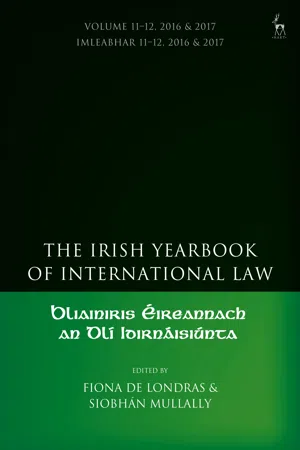
The Irish Yearbook of International Law (IYIL) supports research into Ireland's practice in international affairs and foreign policy, filling a gap in existing legal scholarship and assisting in the dissemination of Irish policy and practice on matters of international law. On an annual basis, the Yearbook presents peer-reviewed academic articles and book reviews on general issues of international law. Designated correspondents provide reports on international law developments in Ireland, Irish practice in international bodies, Ireland and the law of the sea, and the law of the European Union as relevant to developments in Ireland. In addition, the Yearbook reproduces key documents that reflect Irish practice on contemporary issues of international law.
This volume of the Yearbook includes a symposium issue on Brexit, Ireland and international law, bringing together leading academics exploring the international legal-political context of Brexit for Ireland.
eBook - ePub
The Irish Yearbook of International Law, Volume 11-12, 2016-17
- 344 pages
- English
- ePUB (mobile friendly)
- Available on iOS & Android
eBook - ePub
The Irish Yearbook of International Law, Volume 11-12, 2016-17
About this book
Information
Irish State Practice on the Law of the Sea 2015 and 2016
INTRODUCTION
The 1982 united Nations Convention on the Law of the Sea (1982 LOS Convention) and related instruments continue to have a major bearing on Irish state practice on the law of the sea during the report period, which covers the years 2015 and 2016.1 In many ways, the progress development of the law of the sea is inseparable from the development of the law in general. In this regard, there have been many positive developments on the legal landscape, which are tempered by on-going scientific concern about the status of the marine environment and fisheries resources in sea areas adjacent to the island of Ireland.2 In line with international best practice and the European Union’s (EU’s) integrated maritime policy,3 Ireland continues to grow its ocean economy and to implement a distinctive marine plan that is aimed at achieving a more coherent approach to the sustainable development of offshore resources. Other remarkable highlights of the progressive development of Irish law over the two-year review period stem from the case law of the Superior Courts of Ireland, as well as the making of new statutory provisions updating the law on baselines. Specifically, the Supreme Court clarified the meaning of the foreshore in Irish law for the purpose of the planning code. In addition, Ireland’s long-established straight baseline legislation was updated in light of the results of a technical survey of the Irish coast using modern geodetic survey techniques. There was significant reform of the laws pertaining to ports and harbours, largely reflecting the outcome and recommendations of a strategic review of Irish port policy undertaken in 2013.
Similar to previous years, many other regulatory and policy developments in the maritime domain were shaped by requirements arising under EU law and policies pertaining to the marine environment and commercial sea-fisheries. This has proved to be a double-edged sword in some respects with experience over the review period demonstrating that the on-going implementation of EU law pertaining to area based management tools in the form of maritime spatial planning instruments, along with marine protected areas, are continuing to pose a number of regulatory and scientific challenges in Ireland. On the other hand, the practical implementation of the Marine Strategy Framework Directive,4 as well as the rolling out of the nascent national policy on marine debris, appear to be largely on track despite some probing and evaluation by the European Commission. The latter in its capacity as guardian of the EU treaties remains vigilant regarding the implementation of EU law in general by the Member States and it is notable that several law enforcement proceedings were pending against Ireland during the review period, including cases concerning the designation of protected areas and the investigation of maritime accidents. There were further developments in the licensing of offshore hydrocarbon exploration and production activities. The implementation of international instruments on maritime labour and training remains a priority for the Irish Government. Other highpoints of the review period include: the relatively high level of compliance with fisheries law at sea, as evident from Naval Service monitoring, control and surveillance activities; the extensive jurisprudence of the Irish Superior Courts on the statutory penalty points system addressing illegal, unregulated and unreported fishing; a statement by the Minister for Foreign Affairs and Trade on the legal status of Rockall; as well as weighty jurisprudence of the Supreme Court on the voisange arrangement with Northern Ireland that sheds considerable judicial light on a relatively arcane but nonetheless important aspect of bilateral fisheries relations. The Law of the Sea Group at the National University of Ireland Galway hosted the First Range State Workshop on the European Eel, CMS Secretariat and the Sargasso Sea Commission.
Further afield, Ireland continued to influence the contours of the law of the sea through several important international initiatives including: successful humanitarian missions by the Naval Service to the Mediterranean Sea in response to the migrant crises; the adoption of a leadership role by Ireland at the United Nations in the negotiation of the 2030 Agenda on Sustainable Development; and the active engagement by the Irish delegation in shaping the outcome of the preparatory process negotiations of a new legal instrument on the conservation and sustainable use of biodiversity in areas beyond national jurisdiction. Closer to home, less evident perhaps is Ireland’s commitment to the effective implementation of the 2015 Paris Agreement and the climate change regime, despite the increased frequency of extreme weather events and the ever-increasing threat of sea-level rise. Elsewhere, in line with the spirit and letter of Parts XIII and XIV of the 1982 LOS Convention, Ireland continues to engage in a broad range of capacity development initiatives within the wider framework of the law of the sea and ocean governance. We turn first to the status of the ocean economy and the conundrum of sustainable development and the provision of ecosystem services.
BUILDING A SUSTAINABLE OCEAN ECONOMY
Reconciling economic interests with environmental protection is often a contentious consideration in the formulation and implementation of modern law of the sea. In recent years, it is beginning to have a major bearing on the content and shape of regulation that applies to offshore activities in sea areas under Ireland’s sovereignty and jurisdiction. The reasons for this development are numerous, with some of the impetus to balance economic growth with sustainable development derived from European policies such as the European Union’s Blue Growth Strategy and accompanying Roadmap,5 as well as the European Commission’s Action Plan for a Maritime Strategy in the Atlantic.6 There are a number of diverse regulatory methods to balancing and mitigating conflicts between different users of the sea. In particular, economic and social analysis, as well as an assessment of ecological services, must be undertaken under the European Union’s Marine Strategy Framework Directive, which is described in further detail later in the report. The significance of ecological services has also been acknowledged for the first time in the recent adjudication by the International Court of Justice in the case concerning Certain Activities Carried Out by Nicaragua in the Border Area (Costa Rica v Nicaragua).7 The Court held that ‘damage to the environment, and the consequent impairment or loss of the ability of the environment to provide goods and services, is compensable under international law’.8
The prosperity of many coastal communities in Ireland depends on building a sustainable ocean economy. Against this background, Ireland’s marine plan entitled ‘Harnessing Our Ocean Wealth’ accords in general terms with contemporary EU and international law trends in so far as it provides a blueprint for offshore economic development, along with the improvement of governance and environmental protection, while at the same time fostering sustainable coastal communities.9 Under the scheme advanced by the plan, Ireland’s ocean economy continues to grow faster than the overall economy.10 In 2016, the marine economy had a turnover of over €5 billion, amounting to just less than one per cent of gross domestic product (GDP) for the reference year 2014.11 For the purpose of the assessment, the marine sector is made up predominantly of highly regulated sectors including shipping, sea fisheries, aquaculture, offshore hydrocarbons, and to a lesser degree tourism, marine manufacturing and marine retail services.12 There were some noteworthy successes during the report period, with the aquaculture industry employing 85,000 people and the production of aquaculture products increasing by nine per cent to 44,000 tonnes.13 The export of Irish seafood was worth €559 million, with the industry contributing €1.1 billion to Ireland’s GDP.14 Moreover, during the report period, all of the emerging marine industries were reported as growing strongly including marine technology products and services, marine commerce, bio-technology and marine renewable energy.15 The overall objective of the Marine Plan is to double the value of the contribution of ocean economy to GDP by 2030, with an interim target of achieving turnover of €6.4 billion annually by 2020.16
In meeting the ambitious economic targets, there are environmental costs associated with rolling out the economic blueprint underpinning ‘Harnessing Our Ocean Wealth’ and it will become increasingly more difficult to reconcile economic growth with the sustainability objectives set down under various EU and national instruments over the coming decade. According to the Marine Institute, for example, economic development contributes to nutrient and chemical discharges into the marine environment along with the physical disturbance of marine habitats by pollution, litter, noise and light.17 Increased pressures from land-based and offshore activities have the potential to impair the attainment of good environmental status under the Marine Strategy Framework Directive,18 as well as other environmental objectives under the law of the sea more generally.19
In relation to the use of Ireland’s marine space, the environmental risks are considerable because of the abundance of biodiversity found in Irish waters amounting to 7,300 marine species. This includes 25 species of cetaceans, 600 species of seaweed and 24 species of seabirds.20 Moreover, marine biodiversity helps generat...
Table of contents
- Cover
- Title Page
- Table of Contents
- Editorial
- Articles
- Correspondent Reports
- Book Reviews
- Documents
- Copyright Page
Trusted by 375,005 students
Access to over 1.5 million titles for a fair monthly price.
Study more efficiently using our study tools.
Frequently asked questions
Yes, you can cancel anytime from the Subscription tab in your account settings on the Perlego website. Your subscription will stay active until the end of your current billing period. Learn how to cancel your subscription
No, books cannot be downloaded as external files, such as PDFs, for use outside of Perlego. However, you can download books within the Perlego app for offline reading on mobile or tablet. Learn how to download books offline
Perlego offers two plans: Essential and Complete
- Essential is ideal for learners and professionals who enjoy exploring a wide range of subjects. Access the Essential Library with 800,000+ trusted titles and best-sellers across business, personal growth, and the humanities. Includes unlimited reading time and Standard Read Aloud voice.
- Complete: Perfect for advanced learners and researchers needing full, unrestricted access. Unlock 1.5M+ books across hundreds of subjects, including academic and specialized titles. The Complete Plan also includes advanced features like Premium Read Aloud and Research Assistant.
We are an online textbook subscription service, where you can get access to an entire online library for less than the price of a single book per month. With over 1.5 million books across 990+ topics, we’ve got you covered! Learn about our mission
Look out for the read-aloud symbol on your next book to see if you can listen to it. The read-aloud tool reads text aloud for you, highlighting the text as it is being read. You can pause it, speed it up and slow it down. Learn more about Read Aloud
Yes! You can use the Perlego app on both iOS and Android devices to read anytime, anywhere — even offline. Perfect for commutes or when you’re on the go.
Please note we cannot support devices running on iOS 13 and Android 7 or earlier. Learn more about using the app
Please note we cannot support devices running on iOS 13 and Android 7 or earlier. Learn more about using the app
Yes, you can access The Irish Yearbook of International Law, Volume 11-12, 2016-17 by Fiona de Londras, Siobhán Mullally, Fiona de Londras,Siobhán Mullally in PDF and/or ePUB format, as well as other popular books in Law & International Law. We have over 1.5 million books available in our catalogue for you to explore.