Tricky Design responds to the burgeoning of scholarly interest in the cultural meanings of objects, by addressing the moral complexity of certain designed objects and systems.
The volume brings together leading international designers, scholars and critics to explore some of the ways in which the practice of design and its outcomes can have a dark side, even when the intention is to design for the public good. Considering a range of designed objects and relationships, including guns, eyewear, assisted suicide kits, anti-rape devices, passports and prisons, the contributors offer a view of design as both progressive and problematic, able to propose new material and human relationships, yet also constrained by social norms and ideology.
This contradictory, tricky quality of design is explored in the editors' introduction, which positions the objects, systems, services and 'things' discussed in the book in relation to the idea of the trickster that occurs in anthropological literature, as well as in classical thought, discussing design interventions that have positive and negative ethical consequences. These will include objects, both material and 'immaterial', systems with both local and global scope, and also different processes of designing.
This important new volume brings a fresh perspective to the complex nature of 'things', and makes a truly original contribution to debates in design ethics, design philosophy and material culture.
- 248 pages
- English
- ePUB (mobile friendly)
- Available on iOS & Android
eBook - ePub
About this book
Information
Part One
Tricky Thinging
1
Concealed Trickery: Design and the Arms Industry
Tom Fisher
It is strange to think that the same type of machine can carry a love letter or tons of concentrated death.
Fuller (1934)
Eurosatory
I am sitting on a stool, at a high café table. The table is near the entrance to an enormous exhibition space, stretching much further than I can see. The café is slightly above the level of the exhibition space, so I have a broader view of the exhibits than do the people moving among them. If I were setting the scene for a certain sort of narrative, I might call this a ‘commanding’ view. Who can I see? The scene is busy with people, most of whom are male. A lot of these men are wearing dark business suits, some, military uniform. There are females here too, some dressed in a dark suit with a skirt, some wearing more flamboyant outfits. I am wearing a dark business suit. I intend to blend in.
What can I see? A succession of exhibition stands run away into the distance, each designed to create as strong a visual impression as possible, competing with each other in this respect. Some of the products they display are large, some enormous, leading the eye upwards towards the space-frame roof of this vast hangar. The roof belongs to the Parc des Expositions, Paris Nord, Villepinte and while I drink my coffee I am observing the goings on at one of the world’s three largest international arms fairs, Eurosatory. The exhibits that jostle with each other for my attention are showing all the conceivable products of the arms industry. Beyond the brutish outline of military vehicles I can see howitzers, missiles, bombs and drones, with motion provided by film-loops showing warplanes and vehicles in action, soaring over and plunging through desert terrain, accompanied by spectacular explosions.
Introduction
The narrative above summarizes impressions gained from visiting four international arms fairs between 2014 and 2017 in Europe and the Middle East. I have visited these events as a design research academic troubled by an awareness that design is entangled with the arms manufacturing industry, and by extension with the trade in weapons that is the raison d’être of the trade fairs for military and security equipment that take place in many parts of the world every year.1 This chapter unpacks three elements that make the extent and nature of this entanglement relatively obscure: an assumption that design has a moral purpose; the relative secrecy that surrounds the arms industry and trade; design’s role in rendering the industry a ‘normal’ and acceptable part of our culture.
This chapter uses my subjective experience of arms fairs to explore connections between design as we encounter it in everyday, civilian, life and the relatively obscure, but no less designed, world of armaments and military equipment. My intention is to use the experience to help me to show how design’s potential to make a more caring world exists alongside its capacity to make matters that are arguably unreasonable and unacceptable appear normal. Being based on my experience, a sample of one, the chapter relates to qualitative work in the humanities, such as Brewster’s discussion of her use of beach walks to help her to take a critical position on white Australian identity (2009). She is a white Australian trying to see white Australian identity, I am a design academic trying to take a critical position on design.
Weapons raise ethical concerns, and are met with protest based on the fact that both the manufacture and the trade in arms have at least a facilitating and potentially a causative role in armed conflict (Wezeman 2010: 195).2 Weapons require the creative application of technologies through design, and design is also implicated in rendering them ‘normal’ – their aesthetics and the applications of the technologies in question bleed into everyday life. Although we perhaps prefer not to think too hard about this application of creativity through design, this chapter uses my first-hand experience to do so, following work by Arthur Cropley (2005, 2010) on the ‘dark side’ of creativity. The discussion places the moral tone of design historically and draws on some ideas from science and technology studies and the philosophy of technology to think about some examples of designs that cross over between civilian and military applications.
Anecdotal evidence for the entanglement of design with the arms industry includes the number of my engineer and designer colleagues who have worked for it, as well as its scale.3 When its morals are questioned, the arms industry is often justified in political discourse by the employment it generates. Arguments against it focus on the role of the trade in arms in fuelling conflict and diverting resources away from more socially useful purposes, such as healthcare and housing (Holden 2017). The industry, and the moral implications of trade in arms, surfaces in the media occasionally, but mostly it is not news – the arms trade is kept in a conveniently shadowy world (Feinstein 2011).4 The arguments for the arms industry hinging as they do on its role in providing manufacturing jobs5 that use and develop advanced technology, necessarily connect it to design.
Is design beneficent? Does it promise better futures?
Design is all around you, everything man-made has been designed, whether consciously or not. (Hunter 2014)
So says Mat Hunter, former Chief Design Officer at the UK’s Design Council. The weapons and equipment that surrounded me at Eurosatory were all designed. Design was all I could see. On the same web page as the quote above, the Design Council invites its readers to ask ‘how can I use good design to make the world around me better?’, strongly implying that the purpose of design is to do just that. Clearly, ‘good’ here is intended to differentiate design that is ‘good’ because it is effective, from design which is not effective, and therefore ‘bad design’. While ‘good design’ does not in itself point to a moral purpose for design, the quotation connects design with a ‘better world’ – a good that extends beyond effectiveness, perhaps underlying it. The Design Council frames design’s contribution both in terms of making a world that performs better, helping people by providing goods and services that work well, and in terms of adding value that benefits economic performance and makes profit. It is fitting that the Design Council espouses such an ethic, given its history, set up near the end of the Second World War to contribute to physical and economic reconstruction, promoting industrial design to improve human life. However, much of the design I can see at Eurosatory has been carefully thought out and produced to control human life, and a good deal is designed solely to end it. All of it is for sale. In the context of global capitalism, this is the emphasis – arms are for trading and design is about making a sale. All other considerations are subsidiary.
Clearly, we are in a tricky situation if the same way of organizing human capacities – design – can be justly described as both life-improving and life-terminating, able to reshape the world for good and implicated in a destructive global trade in weapons. It is therefore appropriate to indicate what conception of design is in play in this chapter. Rather than seeking its universal properties, it is more useful to think about design as a phenomenon, what it is taken to be, how its properties are invoked and how it works in relationship with other social and cultural phenomena. Apparently defining features of design, processes such as ‘design thinking’, are not relevant. It is sufficient to acknowledge that design has both aesthetic and functional aspects as Cropley and Cropley (2005: 169) recognize, the former of which tends to prioritize imagination and to emphasize visuality. Indeed, efforts to elucidate a ‘design thinking’ that retains the same character independent of its application are problematic in themselves as Kimbell (2011, 2012) has shown, tending to ignore the relationality that is necessary to any particular design process. Design is, in Suchman and Weber’s (2016) science and technology studies terms, a ‘world making practice’ and its manifestation in the arms industry brings into sharp relief their call for critical interventions into that practice.
While design may have no inherent moral character, a progressive purpose is often assumed to be one of its characteristics. In a 2004 article that criticizes design for the lack of a positive ethos, although it sometimes espouses virtuous ethics, Cameron Tonkinwise still asserts that:
Design is the process of trying to make the world friendlier to us clumsy humans; it is the effort to make the world more caring toward us, more accepting of us and so more morally acceptable to us. (2004: 142)
Design may sometimes do this, but it clearly does not always and there has been a tension between its progressive and destructive characteristics through the history of design discourse. Early modernist architecture was associated with direct benefit to human bodies and improved individual and collective health, through hygiene summed up in Alvar Aalto’s tuberculosis sanatorium at Paimio, Finland, of 1933, and Berthold Lubetkin’s 1938 health centre at Finsbury, London. The design of domestic devices was bound up in creating what Hand, Shove and Southerton (2005) call ‘moral technologies’ that relate conceptions of cleanliness to social demarcation. Design historical research (Forty 1986, Lupton and Miller 1992) shows that being embodied in designs these ideas share their somewhat moralizing character with more ambitious twentieth-century urban future fantasies, such as those of the Italian Futurists Sant’Elia and Marinetti of 1914 or the dystopian fantasy architecture of Superstudio in the 1970s (1972). This history complicates a sense we might wish to construct of modernist design as a benign way to envision the future, let alone construct it.
However, design is a powerful means to envision futures, encapsulating our hopes in forms that are buildable, even if not (yet) built. That was the function of futurist fantasy architecture, and continues, much enhanced by computer graphics in the design fantasies that circulate online, such as a proposal for an ‘Urban Skyfarm’ in Seoul, by Aprilli Design Studio (World Architecture News 2014) and the Ring Garden project in Santa Monica, by Alexandru Predonu – a finalist of 2016 Land Art Generator Initiative competition. Beyond providing visions of the future, Design helps construct expectations about those futures, expectations which themselves have agency. These expectations are ‘performative’, both ‘the cause and consequence of material, scientific and technological activity’, as Mads Borup puts it (2006: 286).
Positive visions of the future coexist with themes that reflect perverse expectations of pain and destruction, rather than care. Marshall Berman’s reading of Marx’s account of capitalist political philosophy points to the ‘creative destruction’ that is a defining feature of modernization – ‘all that is solid melts into air’, confounding any sense of care (1982). This sentiment was twisted in the Futurist Manifesto into Marinetti’s famous statement: ‘We will glorify war – the world’s only hygiene – militarism, patriotism, the destructive gesture of freedom-bringers, beautiful ideas worth dying for, and scorn for woman.’ It persisted through the twentieth century and was evident in mid-century discourse that celebrated the ‘cleansing’ potential in nuclear weapons (Hecht: 76).
Of course, design can be used to resist ‘militarism, patriotism etc.’ just as it can serve them, shown by the inventiveness, the design, that goes along with protest (Fisher 2008; Abrams 2014), but we would perhaps prefer not to see clear evidence of design’s implication in its morally problematic consequences, or to not see it clearly. To witness an arms fair is to open up a world that is usually kept out of sight. That concealment perhaps helps us preserve the idea that design places technologies in the world to make the world more caring. Being in an arms fair I can see more than I should, given that I am here under false pretences. I am not here on business, but to observe.
Dassault Designs the Future
I can see the Dassault Aviation stand from where I sit, with two scale model jet fighters the prominent products. I am looking past a couple, a man and a woman sitting on steel framed stools with pink vinyl seats, at a tall table with a pink laminate top that matches the stools. She is wearing a pale pink blouse, with pearls, a heavy silvery watch loose on her wrist, a Eurosatory security pass hangs from a lanyard round her neck.
On the back wall of the Dassault stand is a very large plasma screen showing a continuous video. Warplanes are being made by skilled technicians in a modern factory. They are being flown, refuelled in flight over desert terrain. There are night vision shots from a UAV of a ‘target’ in an active war zone. The target disappears in a huge explosion. Warplanes take off from an aircraft carrier and words appear: ‘Designing the Future’, then a quote from M. Dassault himself ‘every time a plane is beautiful, it flies well’ – ‘we are proud of our DNA to design the future’.
Then comes a segment about an agreement between Italy, Germany and France to collaborate to produce an Unmanned Aerial Vehicle – a drone – illustrated with shots of Computer Aided Design (CAD) stations showing progress in the design studio, with a female CAD operator prominent.
To imply that design is inherently beneficent, or to assert that its purpose is to ‘care’, or to emphasize its progressive history, clearly requires that we ignore its arguably negative manifestations, such as in the arms industry.
This is relatively easy to do, for two reasons. First, the arms industry ‘proper’ keeps itself relatively secret. Second, design as an element in consumption normalizes defence-related motifs and technologies, meaning that when they bleed into everyday life they are rendered as ‘empty signifiers’ (Chandler 2002: 78), without clear connection to their referent in armaments and defence equipment. Everyday motifs such as the ubiquitous camouflage, rendered sweetly as ‘camo’, divert our attention from their referent in the actual arms industry, which keeps a low profile. It is not easy to get access to international arms fairs. A security pass is needed, to exclude individuals who might protest against the connection between arms sales and their effects in what is now a globalized trade, relatively free of governmental control.
As I write this, British-made weapons, such as the ‘Paveway 4ʹ guided bomb (Figure 1.1), are being used by the Saudi Arabian government against Houthis in Yemen, leading to well-documented civilian casualties (CAAT 2017). Among these British-made weapons are cluster munitions sold to Saudi Arabia before an international treaty banning them was signed by the UK, but not by Saudi Arabia. The use of such weapons is grounds for protest, but given the secrecy that surrounds the arms industry it took a good deal of campaigning before the UK government was forced by the evidence to send Defence Secretary Michael Fallon to the House of Commons to admit these illegal, UK-made, weapons have been used by Saudi Arabia in Yemen (HC Deb 19 December 2016). Saudi Arabia is the second biggest market for armaments in the world (Blanchfield, Wezeman and Wezeman 2017) and its role as a customer for our arms is therefore economically as well as geopolitically important.
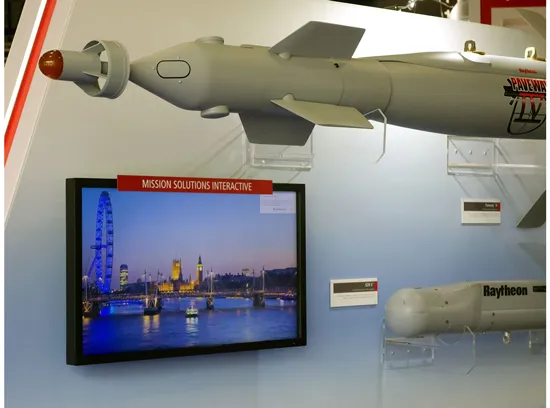
Figure 1.1 ‘Paveway 4’ guided bomb, manufactured by Raytheon in the UK, DSEI2017 (Author’s photograph).
Weapons such as those currently in use in Yemen confound the long-embedded progressive connotation of design evident in the Design Council’s narrative. But both design’s morally progressive and its morally dubious manifestations resonate strongly with its role as a component (and product) of a moderniza...
Table of contents
- Cover
- Halftitle Page
- Title Page
- Contents
- List of Illustrations
- Contributors
- Acknowledgements
- Foreword
- Introduction: Ways of Thinking Tricky Design
- Part 1: Tricky Thinging
- Part 2: Tricky Processes, Tricky Principles
- Part 3: Tricky Policy
- Conclusion: Design’s Tricky Future
- Index
- Imprint
Trusted by 375,005 students
Access to over 1.5 million titles for a fair monthly price.
Study more efficiently using our study tools.
Frequently asked questions
Yes, you can cancel anytime from the Subscription tab in your account settings on the Perlego website. Your subscription will stay active until the end of your current billing period. Learn how to cancel your subscription
No, books cannot be downloaded as external files, such as PDFs, for use outside of Perlego. However, you can download books within the Perlego app for offline reading on mobile or tablet. Learn how to download books offline
Perlego offers two plans: Essential and Complete
- Essential is ideal for learners and professionals who enjoy exploring a wide range of subjects. Access the Essential Library with 800,000+ trusted titles and best-sellers across business, personal growth, and the humanities. Includes unlimited reading time and Standard Read Aloud voice.
- Complete: Perfect for advanced learners and researchers needing full, unrestricted access. Unlock 1.5M+ books across hundreds of subjects, including academic and specialized titles. The Complete Plan also includes advanced features like Premium Read Aloud and Research Assistant.
We are an online textbook subscription service, where you can get access to an entire online library for less than the price of a single book per month. With over 1.5 million books across 990+ topics, we’ve got you covered! Learn about our mission
Look out for the read-aloud symbol on your next book to see if you can listen to it. The read-aloud tool reads text aloud for you, highlighting the text as it is being read. You can pause it, speed it up and slow it down. Learn more about Read Aloud
Yes! You can use the Perlego app on both iOS and Android devices to read anytime, anywhere — even offline. Perfect for commutes or when you’re on the go.
Please note we cannot support devices running on iOS 13 and Android 7 or earlier. Learn more about using the app
Please note we cannot support devices running on iOS 13 and Android 7 or earlier. Learn more about using the app
Yes, you can access Tricky Design by Tom Fisher,Lorraine Gamman in PDF and/or ePUB format, as well as other popular books in Design & Design General. We have over 1.5 million books available in our catalogue for you to explore.