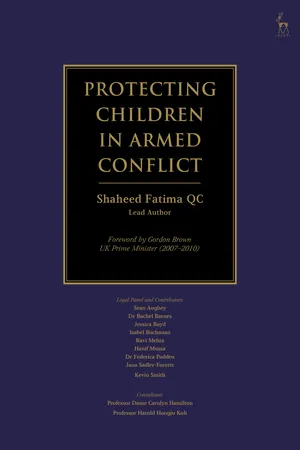
In armed conflicts around the world, children are being killed, raped, abducted and recruited to fight at a shocking scale. In light of this continuing general failure to protect children in conflict, it is questionable whether existing international law norms and institutions provide sufficient protection and accountability. Consideration needs to be given to whether international law can do more – practically and effectively – when moral lines are crossed.
That is the purpose of this book. It reviews the position of children in armed conflict by reference to the 'six grave violations' as identified by the UN Security Council. It analyses the protection offered by international humanitarian law, international criminal law and international human rights law, and also assesses the related adjudicative accountability mechanisms. The analysis concludes with a number of recommendations and proposals for reform, with a view to enhancing accountability and deterring future violations.
The book has been written by a team of lawyers, headed by Shaheed Fatima QC, and has drawn on the input of an expert advisory panel comprising leading academics, policy-makers and activists. It has been written as part of the Inquiry on Protecting Children in Conflict. The Inquiry has been sponsored by Save the Children and Theirworld and chaired by former UK Prime Minister, Gordon Brown.
- 600 pages
- English
- ePUB (mobile friendly)
- Available on iOS & Android
eBook - ePub
Protecting Children in Armed Conflict
About this book
Information
1
General Introduction
‘The only international language we understand is the cry of the child’.1
I.Introduction
II.The Machel Report: Overview
III.Time to Re-assess the Protection of Children
A.The Current Inquiry
B.Overview of the Book
C.The Need for the Inquiry
IV.Children in Armed Conflict: 1923–1996
A.Historical Background and Pre-World War II Developments
B.Post-World War II: A Renewed Focus
C.Convention on the Rights of the Child
D.Beyond the CRC
V.The Impact of Armed Conflict on Children: The 1996 Machel Report
A.Mitigating the Impact of Armed Conflict on Children
B.Relevance and Adequacy of Existing Standards for the Protection of Children
C.Accountability Mechanisms
D.Reconstruction, Reconciliation and Conflict Prevention
VI.Following in Machel’s Footsteps: Developments Since 1996
A.Secretary-General’s Special Representative for Children and Armed Conflict
B.CRC and the OPAC: Increased but not Universal Ratification
C.New Standards
D.Enhanced Criminal Responsibility
E.Revisiting the Machel Report
VII.The Six Issues Considered in this Book
A.Killing and Ill-Treatment of Children
B.Recruitment and Use of Children
C.Sexual Violence
D.Child Abduction
E.Attacks on Hospitals and Schools
F.Denial of Humanitarian Access and Assistance
VIII.Conclusion and Summary
I.INTRODUCTION
1.1We live in an era where a saturation of rolling news coverage and constant exposure to daily tragedies around the globe threatens to inure us to the human dimension of armed conflict. However, despite our diminished collective capacity to be shocked or moved, images of children2 in distress retain their potent power to evoke an emotional response and galvanise us into action.
1.2Perhaps this explains why the world’s awareness of global conflict situations and their consequences for individuals is often framed through unforgettable images of children. From the widely-circulated images of Lizzie Van Zyl, a child victim of the Anglo-Boer War at the dawn of the twentieth century, images of the suffering of children have framed public awareness of, and opposition to, warfare.3 A generation ago, photojournalist Nick Ut’s image of a naked Phan Thi Kim Phuc – the ‘napalm girl’ fleeing a bombing along with other children – showed the human costs of the Vietnam War and forced American audiences to question the justification for that conflict. More recently, US President Donald Trump explained that, after seeing images of children killed and injured in the April 2017 chemical attack in Idlib, the sight of ‘innocent people, including women, small children and even beautiful little babies’ was so repulsive to him that ‘my attitude toward Syria and Assad has changed very much’.4 Tragically, armed conflict has an impact on children extending far beyond the conflict zones themselves: the image of the small, still, body of three-year-old Syrian refugee Alan Kurdi washed up on a Turkish beach in September 2015 is an unforgettable reminder of the consequences of war.
1.3Our emotional response, so justifiably provoked by the suffering and tragedy of our most vulnerable, provides that elusive factor – common ground – and, therefore, an opportunity for inspiring collective action for peace by returning to a basic and universal desire: to protect our children, and future generations, from the horrors of armed conflict. The situation is urgent – but there is room for hope.
II.THE MACHEL REPORT: OVERVIEW
1.4In August 1996, the Secretary-General of the United Nations (UN) presented to the United Nations General Assembly (UNGA) the expert report ‘The Impact of Armed Conflict on Children’, by Mozambican politician and humanitarian advocate Graça Machel (the Machel Report).5 This ground-breaking effort represented more than two years of work by Machel and her team. Pursuant to UNGA Resolution 48/157 of 20 December 1993 the project was supported by the then-United Nations Centre for Human Rights, now the Office of the High Commissioner of Human Rights (OHCHR), the United Nations Children’s Fund (UNICEF), and the United Nations High Commissioner for Refugees (UNHCR). The Machel Report was the result of an international process involving wide-ranging consultation, including with experts in various fields, military personnel, representatives from government and civil society, and children. The recommendations in the report proposed a comprehensive agenda for action by states and the international community aimed at improving the protection, care and rehabilitation of children in situations of armed conflict.
1.5More than 20 years later considerable progress has been made. The situation of children in armed conflict is firmly on the agenda worldwide. This is as a result of the collective drive that brought about the Machel Report and the motivation that it has helped to stimulate since then. Awareness of the issue has spread and frameworks have been established which enable the international community to monitor and report on related violations of international law. However, much remains to be done. Notwithstanding the ostensible legal and practical protections which exist for children, it is questionable, in light of the ongoing violations of their rights, whether they are adequately protected.
1.6Before the Machel Report and since, dedicated advocates have helped promote the need to protect children in armed conflict. It appears that the collective good will and commitment of these individuals and organisations is being undermined by certain factors which combine to leave children that are caught up in armed conflict insufficiently protected by the rule of law.
1.7The principal factor – perhaps evidencing the lack of political will – is the lack of compliance with and implementation of existing laws, including the lack of adequate and effective international adjudicative accountability mechanisms. However, improvements could also be made to the existing substance of international law protections. Thus: (i) existing legal protections are sometimes vague or ambiguous and could be clarified; (ii) existing legal protections are sometimes under-developed or absent and could be strengthened; and (iii) certain international law instruments would benefit from more widespread ratification (and, possibly, greater domestic implementation) in order to enhance the substance of the available protections as well as international accountability.
1.8In addition to these specific factors, there are two systemic problems in relation to international humanitarian law (IHL) and international human rights law (IHRL); these problems do not apply to international criminal law (ICL).
1.8.1The first problem is that the existing IHL and IHRL framework protecting children in armed conflict exists in multiple instruments as well as in customary international law (CIL). This means that it is challenging to identify and understand the relevant legal framework that is applicable in a given situation. This is likely to be particularly difficult for non-state armed groups and victims who are less likely to benefit from access to expert legal advice and representation than states. It is questionable whether any useful purpose is served by maintaining the scattered nature of the existing IHL and IHRL protections (and the distinctions on which they are based). This is especially so where there is overlap in the content of the relevant IHL and IHRL norms. That is why, as developed later in this book, we suggest that consideration is given to collecting, in one international instrument, the protections applicable to children in armed conflict and codifying relevant CIL. This would be a constructive legal improvement to the status quo. Consideration could also be given to consolidating certain IHL and IHRL norms, ie where there is consistent and overlapping legal content in a given IHL rule and IHRL rule then they could be brought together in one consolidated rule. We recognise, as developed in later Chapters, that there may not be adequate political will to support such a proposal to fruition but this is not something we have pre-judged, especially since (i) the debate generated by our proposal may provide renewed political focus and impetus to protecting children in armed conflict in other ways and (ii) our proposals are not time-sensitive. We are also aware that there may be reservations about whether the exercise of collecting, codifying and consolidating existing treaty and CIL protections risks a lowering of standards and consider this further in Chapter 9.
1.8.2The scattered nature of the existing IHL and IHRL protections for children in armed conflict (and the fact that they do not exist in one international instrument) contributes to the second problem: there is no specific, ...
Table of contents
- Cover
- Dedication
- Title Page
- Foreword by Gordon Brown
- Preface and Acknowledgements
- Brief Contents
- Table of Contents
- Table of Cases
- Table of Treaties
- Table of Other International Materials
- 1. General Introduction
- 2. Legal Sources, Structure and Accountability Mechanisms
- 3. Killing and Ill-Treatment of Children
- 4. Recruitment and Use of Children
- 5. Sexual Violence
- 6. Child Abduction
- 7. Attacks Against Hospitals and Schools
- 8. Denial of Humanitarian Access and Assistance
- 9. Conclusion
- Annex I. Unofficial Translation of the 1939 Draft Convention
- Annex II. Unofficial Translation of the 1946 Draft Convention
- Annex III. List of International and Non-Governmental Organisations
- Index
- Copyright Page
Trusted by 375,005 students
Access to over 1.5 million titles for a fair monthly price.
Study more efficiently using our study tools.
Frequently asked questions
Yes, you can cancel anytime from the Subscription tab in your account settings on the Perlego website. Your subscription will stay active until the end of your current billing period. Learn how to cancel your subscription
No, books cannot be downloaded as external files, such as PDFs, for use outside of Perlego. However, you can download books within the Perlego app for offline reading on mobile or tablet. Learn how to download books offline
We are an online textbook subscription service, where you can get access to an entire online library for less than the price of a single book per month. With over 1.5 million books across 990+ topics, we’ve got you covered! Learn about our mission
Look out for the read-aloud symbol on your next book to see if you can listen to it. The read-aloud tool reads text aloud for you, highlighting the text as it is being read. You can pause it, speed it up and slow it down. Learn more about Read Aloud
Yes! You can use the Perlego app on both iOS and Android devices to read anytime, anywhere — even offline. Perfect for commutes or when you’re on the go.
Please note we cannot support devices running on iOS 13 and Android 7 or earlier. Learn more about using the app
Please note we cannot support devices running on iOS 13 and Android 7 or earlier. Learn more about using the app
Yes, you can access Protecting Children in Armed Conflict by Shaheed Fatima KC in PDF and/or ePUB format, as well as other popular books in Politics & International Relations & Human Rights. We have over 1.5 million books available in our catalogue for you to explore.