There's a battle being fought. It's raging on the sports fields, in the newsrooms and behind the scenes at every major broadcaster. Women in sport are fighting for equality with more vigour than ever, but are they breaking down the barriers that stand in their way?
Sarah Shephard looks behind the headlines to see whether progress is really being made and tells the stories that can no longer be ignored. It's time for women to switch their focus from the battlefield to the sports field, once and for all.
This candid and revealing book asks the questions at the forefront of the debate about women in sport:
· Why do the most successful female athletes earn less than their male counterparts?
· Why do so few elite sportswomen have the profile their talent deserves?
· Why are girls still growing up believing that sport is 'for boys'?
With contributions from women involved in sport at the highest level, including Chrissie Wellington, Maggie Alphonsi, Kelly Smith and Nicole Cooke, who reveal their personal experiences of being at the top of their game.
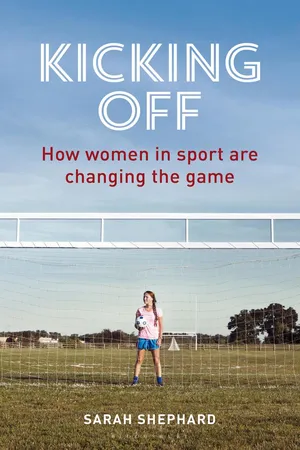
- 304 pages
- English
- ePUB (mobile friendly)
- Available on iOS & Android
eBook - ePub
About this book
Information
1: Who’s that girl?
How do editors decide which sports people are worthy of splashing all over a front cover and which are not? Before entering the publishing industry I – a fresh-faced graduate with very little knowledge of the world I would soon be entering – believed that popularity and success were the key factors in determining who became a ‘cover star’ and who was left in the shadows. But after spending almost a decade writing for a weekly sport magazine, I now know there is a third word that is even more significant: recognisability. Whether that comes as a result of fame or infamy, having it can make all the difference to an athlete who is trying to make a living from their sport.
The key question then is this: How many sportswomen are truly recognisable to the average sports fan? Wherever you are in the world, the Williams sisters, Venus and Serena, are probably among the best-known female faces from the world of sport, with fellow tennis star Maria Sharapova tracking them every step of the way. In Britain, Olympic champions Jessica Ennis-Hill and Nicola Adams have also reached that sweet spot where sport and celebrity become intertwined, while in America it’s the likes of WNBA star Candace Parker, UFC’s Ronda Rousey and NASCAR driver Danica Patrick who have managed to achieve levels of fame to match their sporting achievements.
Ask the same question about sportsmen though, and the list becomes long; too long to include in all its glory here. Success rapidly brings worldwide fame to male football/soccer stars, boxers, tennis players and golfers, whose names and faces appear regularly in newspapers and magazines, as well as in adverts and on TV shows across the globe.
The imbalance in numbers is easily explained. Read any newspaper in the UK on any given day of the week and the back pages will be divided largely like this: 70 per cent Premier League football; 10 per cent cricket; 10 per cent rugby; with the remainder comprising a mishmash of motorsport, golf, tennis, athletics, cycling and any other ‘minority’ sports occurring at that time. Of course, this does alter on occasion. Tennis grabs a larger share of the column inches during each of the season’s four Grand Slams, as does golf for the Majors and cycling for the duration of the Tour de France. There’s also that fortnightly blip that occurs once every four years, when the Olympics gives sports like swimming, equestrian, rowing and hockey their moment in the sun – a moment that can even be prolonged beyond the closing ceremony if Team GB has tasted success.
Although even that does not last for long, according to a study by the University of Birmingham. Researchers there wanted to use the UK’s hosting of the Olympic Games in 2012 to find out whether there was a boom in coverage of women’s sports in the build-up to the Games and, crucially, whether it was sustained afterwards. They looked at six key national publications on weekend days in a three-week period in February 2012 and again in February 2013, counting the numbers of articles devoted to women’s sport and measuring the article areas.
Their findings revealed a decline in coverage across all newspapers. In 2012, articles about women’s sport accounted for 4.5 per cent of specialist sports sections and supplements, but a year later that figure dropped to 2.9 per cent. In terms of space, that meant a drop from 3 per cent of the area in these sections that was allocated to women, to 1.9 per cent. For Senior Clinical Lecturer in Public Health Dr Claire Packer, who led the study, these findings have potentially worrying implications for the numbers of women and girls taking part in sport: ‘Despite the success of our female athletes both at the 2012 Games and since, women’s sport, at least in the eyes of the print media we studied, remains a minority sport. Until we change this perception, the levels of participation of girls and women in sport will continue to suffer – as will public health as a result.’
Although the researchers do recognise the ‘wider societal issues at play’, they claim that such results are evidence of a deep-rooted gender bias in sports reporting – a bias which they believe is not fully understood by sports editors and their colleagues.
To find out how much of this is true, I put the question to the sports editors at the Mail on Sunday and the Guardian, who both said that the disparity in coverage is something they recognise and certainly do understand. They are willing to amend it too, when the time is right. Alison Kervin became Fleet Street’s first female sports editor when the Mail on Sunday appointed her to the role in 2013. When I spoke to her about the calls for newspapers to increase coverage of women’s sport, she said that those asking the question are missing a wider point: ‘Before I started this role, I had this idea that if you just put more women into the papers that would solve things. They would be seen, people would have role models and more women and girls would do sport. But I don’t think that’s true now.’
Kervin is voicing a belief that is shared by many: Put more women’s sports stories in front of more people and the profile of sportswomen will automatically be raised. But her time on Fleet Street has convinced Kervin that coverage isn’t the magical cure-all many believe it to be: ‘It’s more complicated than just putting something in the paper that most people aren’t really interested in. If I put a story in about women’s hockey on a Sunday, I don’t think it makes any difference. It doesn’t have the impact you think it’s going to have. It’s just a patronising effort to give them publicity.
‘It’s the same with women’s rugby. But something like the England women’s rugby team winning the World Cup [as they did in 2014] does make a difference because that’s a proper story. That’s what women’s sport needs: For them to create their own stories. It needs to be a story worth telling before you can tell it.’
The Guardian’s sports editor, Ian Prior, agrees, telling me: ‘Stars make sport, and that’s a fairly organic process from sport itself. There’s no particular mystery to why athletes from the Williams sisters to Jessica Ennis-Hill to Paula Radcliffe have had huge amounts of coverage. They became superstars because they are extraordinary at what they do. They are at the top of their field and are dominant figures in their sport and attract attention accordingly. Nothing drives coverage like stars.
‘For example, look at the coverage in the Irish media of the women’s rugby team during the 2014 Rugby World Cup. Between Ireland beating the Black Ferns [New Zealand] and playing the semi-final against England, there was blanket, wall-to-wall coverage across all outlets for a solid week, purely as a result of their success. That team had been ignored for the past five years, but you beat New Zealand – a team that hadn’t suffered defeat in a World Cup for 23 years – and suddenly everyone wants to know about you.’
But then you lose to England (as Ireland did), and, as quickly as the coverage arrived for them, it disappeared twice as fast. That is something that rings true for most sports outside of the ‘big three’ of men’s rugby, cricket and football, because the media is a fickle beast. The hope is, though, that in those seven short days of blanket coverage earned by Ireland’s stunning victory over the four-time world champions, something will have stuck. Whether it’s the name of the captain (Fiona Coghlan, in case you’re wondering), or simply the memory of a great game of rugby that ended with a historical win, what surely matters most is that women’s rugby will have worked its way into the consciousness of more people in that week than ever before.
Such an audience is invaluable no matter what length of time they hang around for, says Kervin, who edited Rugby World magazine for three years from 1994 to 1997. During her time in charge, Kervin says the publication ‘campaigned like mad’ for women to be allowed to play rugby at Twickenham, either before or after a men’s game. And in 2003, it happened. England played France at HQ as part of the Women’s Six Nations tournament, with the game being played immediately prior to England’s men launching their own Six Nations campaign against the same country on 15 February.
Both England teams won, and Kervin says she’s ‘convinced it made a huge difference’ to have the women’s game on the same bill as the men’s: ‘Normally, half the problem is that people don’t see it. Even when women’s rugby is televised, it’s tucked away because there isn’t the audience for it. But putting it on before or after the men, so people see it and say, actually, this isn’t bad, can really help. People start to recognise players and know what’s going on. It’s the same patriotism, whether women or men are on the field. If England women are playing Wales at Twickenham, the predominantly English crowd will still cheer for England, won’t they? It still has that sporting edge to it. So it’s just being a bit clever about how you present it, really.’
While more people might have seen the game live than they would if it had been held away from Twickenham, there is no evidence of any increase in press coverage, despite the match representing such an historic moment. And the one report that can be found, on espn.co.uk, covers it in just three brief sentences:
‘England’s women’s team marked their Twickenham debut in style with a 57–0 victory over France. England, playing the game as a curtain-raiser to the men’s RBS 6 Nations showdown with France, ran in 10 tries. Sue Day and Chris Diver both scored hat-tricks as France found themselves totally outplayed.’
Still, the Rugby Football Union (RFU) clearly decided this combination approach was the way forward and have continued with it since then, with England’s women playing many of their Six Nations home games on the same day as the men. It doesn’t work for everyone, though. The Guardian’s Sports Editor Ian Prior says he was at HQ in the autumn of 2013 to see England’s men take on the All Blacks. A crowd of 80,000 gathered to watch the world champions pushed hard by England, but when the final whistle blew and it was time for the women’s match to start, not everyone was prepared to hang around. ‘It was a freezing cold day with temperatures hovering around zero’, recalls Prior. ‘By the time the men’s game was finished no one could feel their fingers and toes. You just wanted to get out of there, not hang around for another game.
‘In any sensible system the women’s game would have been a curtain raiser, not on after the main event. If you put it on beforehand, even if you’re not getting half the crowd you’re getting at least a third which in a stadium like Twickenham is 20–25,000 people. You also introduce the possibility that TV will show a decent chunk of it as a preliminary. It really isn’t rocket science. I don’t know what the argument would be for not doing that, it’s certainly not to do with the pitch cutting up, because pitches are much better than that these days.’
Prior’s argument is hard to refute, especially for anyone who has been at Twickenham and observed the mass exodus that takes place at the end of the men’s game, despite the impending kick-off of an England women’s match. It’s something the England and Wales Cricket Board (ECB) seem to understand a little better than the RFU. Women’s Twenty-20 internationals are now played immediately prior to men’s matches, with Sky Sports broadcasting both. Not only has this ensured that cricket fans are given the opportunity to watch the women’s game, but it has also led to the England Women’s team earning a first-ever standalone sponsorship deal. Signed in July 2014, the two-year deal means Kia cars are the sole title sponsor of England women’s home Test matches.
For ECB chief executive, David Collier, it’s a deal that proves how crucial media exposure is when it comes to making the sponsorship case for women’s sport. He made his gratitude clear when announcing the partnership, thanking both Sky Sports and BBC Radio, whose coverage, he said, ‘plays such a vital role in making the sport attractive to potential business partners’.
Another positive step came in November 2014, when the ECB announced that Sky Sports would be showing live coverage of every ball of the 2015 Women’s Ashes for the very first time. The summer of 2015 also marked the first time a women’s Test match was televised. This seems little to shout about given that the first men’s Test match to be televised was in 1938, but for the Head of England Women’s Cricket, Clare Connor, the progress – however slow it has been in coming – is hugely significant. She said: ‘The level of broadcast coverage that the England women’s team now gets is exceptional, and I am thrilled that the ECB, in partnership with Sky Sports, continues to lead the way in this respect within international women’s team sport. It is this level of exposure and support that will ensure that the women’s game continues to grow, and that will inspire the next generation of England women’s cricketers.’
If there is a regret, it is one that is shared with the men’s game: that cricket is no longer the preserve of terrestrial television. Imagine the reach and impact that women’s cricket could have if it was available for all to view instead of being reserved for those with the will and finances to pay an annual subscription to Sky Sports.
Media exposure is something women’s football has traditionally faced a titanic struggle with, particularly at club level where it is constantly overshadowed by the behemoth of the Premier League. It was this overshadowing that led the FA to make a revolutionary decision when they launched the new Women’s Super League (FA WSL), in 2011. Instead of matches being played throughout the winter months, in direct competition with the men’s leagues, they would be played from April until October. It was hoped that this cunning plan would fill the sad emptiness that appears in the lives of football fans between the end of May and the start of August (unless there’s a World Cup or European Championship to get excited about of course).
The FA hoped that this plan would help women’s football to build the audience it had lacked since its halcyon days during the First World War (when thousands would flock to watch the women play). Is it working? Well, the league is now well established and about to enter its sixth season, but it took until its fourth for the first real signs of change to emerge.
The 2014 FAWSL season was the most closely contested one yet. It was also the best attended, with crowd numbers...
Table of contents
- Cover
- Half-Title
- Title
- Contents
- Foreword
- Introduction
- 1: Who’s that girl?
- 2: Girls not allowed
- 3: Money talks
- 4: Culture clash
- 5: Just rewards?
- 6: Mind the (participation) gap
- 7: Body matters
- 8: Guiding lights
- Further Reading
- Acknowledgements
- Index
- Plates
- Copyright
Trusted by 375,005 students
Access to over 1.5 million titles for a fair monthly price.
Study more efficiently using our study tools.
Frequently asked questions
Yes, you can cancel anytime from the Subscription tab in your account settings on the Perlego website. Your subscription will stay active until the end of your current billing period. Learn how to cancel your subscription
No, books cannot be downloaded as external files, such as PDFs, for use outside of Perlego. However, you can download books within the Perlego app for offline reading on mobile or tablet. Learn how to download books offline
Perlego offers two plans: Essential and Complete
- Essential is ideal for learners and professionals who enjoy exploring a wide range of subjects. Access the Essential Library with 800,000+ trusted titles and best-sellers across business, personal growth, and the humanities. Includes unlimited reading time and Standard Read Aloud voice.
- Complete: Perfect for advanced learners and researchers needing full, unrestricted access. Unlock 1.5M+ books across hundreds of subjects, including academic and specialized titles. The Complete Plan also includes advanced features like Premium Read Aloud and Research Assistant.
We are an online textbook subscription service, where you can get access to an entire online library for less than the price of a single book per month. With over 1.5 million books across 990+ topics, we’ve got you covered! Learn about our mission
Look out for the read-aloud symbol on your next book to see if you can listen to it. The read-aloud tool reads text aloud for you, highlighting the text as it is being read. You can pause it, speed it up and slow it down. Learn more about Read Aloud
Yes! You can use the Perlego app on both iOS and Android devices to read anytime, anywhere — even offline. Perfect for commutes or when you’re on the go.
Please note we cannot support devices running on iOS 13 and Android 7 or earlier. Learn more about using the app
Please note we cannot support devices running on iOS 13 and Android 7 or earlier. Learn more about using the app
Yes, you can access Kicking Off by Sarah Shephard in PDF and/or ePUB format, as well as other popular books in Social Sciences & Gender Studies. We have over 1.5 million books available in our catalogue for you to explore.