The world of work is changing dramatically and jobs for life have become a thing of the past. Even people moving up the corporate ladder are questioning their choices and considering new possibilities, such as work/life balance or portfolio working.
If you want to take charge of your career but don't know where to start, change can feel unobtainable - a pipe dream.
This action-oriented and pragmatic book will help you overcome the barriers to deciding on a career and changing career, giving you a proven roadmap to achieve your goals.
Taking Charge of Your Career will lead you step-by-step through the process of building your career strategy and making it happen. Full of exercises and self-assessment tools to help you make the right choices, it also includes real-life stories of successful career changers.
eBook - ePub
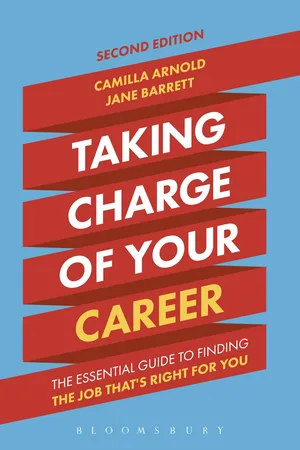
Taking Charge of Your Career
The Essential Guide to Finding the Job That's Right for You
- 328 pages
- English
- ePUB (mobile friendly)
- Available on iOS & Android
eBook - ePub
Taking Charge of Your Career
The Essential Guide to Finding the Job That's Right for You
About this book
Information
Part I: If not now, when? What is holding you back?
Choose a job you love, and you will never have to work a day in your life.
Confucius
Dealing with obstacles may seem an unusual place to start in a book about seizing the moment and making a change in your career – yet when we speak to people for the first time, often the first thing they want to talk about is all the problems that might get in the way of their success.
Those areas of concern include:
•lack of motivation
•limiting beliefs about their ability to find something that works for them
•frustration and anger if a career change has been forced on them (i.e. through redundancy, illness or other life-changing circumstance)
•lack of time
•lack of money or unwillingness to take a drop in salary or retrain
•family and/or friends questioning why they are considering a change.
We have covered each of these areas of concern below to give you some ideas of how you might overcome them and how others who have faced similar concerns have found a way to move forward. If you find that any of these, or indeed other concerns, are slowing you down or stopping you from realizing your potential, you may want to consider finding some professional help to deal with those issues once and for all.
Chapter 1
Overcoming fear and risk
No one can cheat you out of ultimate success but yourself.
Ralph Waldo Emerson
Fear can be paralyzing, but knowing and understanding what your fear is can be the first step to facing it. The best antidote to fear when going through a career change is to work out whether your fear is based in reality or is merely a perception. So, it is reality that you can’t become a brain surgeon without having trained as a doctor, but it is a perception that they don’t accept people over twenty-five on to courses to train as doctors. By naming the fear, you can then gather evidence to ascertain what is real and what is assumed and dismiss the negative perceptions that are holding you back. Many people seem to feel that if they do nothing, it will all work out eventually and they will deal with bumps in the road as they come along. They will do almost anything not to make a choice to move forward. The irony is that deciding to do nothing is also a choice and often means that they are at the whim of factors outside their control.
Calculated risk
There’s no getting around it: at some point, if you are going to move forward, you will have to take a leap of faith, but by basing it on research and knowledge, it will feel less daunting. There’s a moment in Indiana Jones and the Last Crusade when Indiana is faced with a seemingly insurmountable chasm to cross to get to the Holy Grail. He knows his subject and his journey to that point has been reliant on his knowledge to avoid the pitfalls put in his way. At the chasm, he has to trust what he knows and the research that has been done and steps out into the seeming abyss to find a hidden bridge. What would it take for you to take that leap of faith in your search for your career?
If you are getting stuck, it can be useful to highlight the sticking points and come up with an action plan to solve them.
PROBLEM/STICKING POINT |
RESOLUTION OPTIONS |
e.g. |
e.g. |
I won’t make enough money for at least two years to support my current lifestyle |
Review current lifestyle and see where there are potential savings I could sustain for two years
Build up a savings account to cover the difference between the new salary and the amount needed to support my lifestyle
Take out a professional and career development loan for the retraining and use savings for extra living expenses over the next two years |
Chapter 2
Finding the right motivation and attitude
Necessity is the mother of invention.
Proverb
If there is one thing that we have found over and over again as we work with people going through the process of deciding on a career direction or career change, it’s that the ones who are successful are motivated and have the right positive attitude. The people who get to the end of the exercises and research knowing their future career direction are the ones who have soldiered on past obstacles, scepticism, nerves, lack of confidence and time constraints. We know from experience that this is often easier said than done, but we hope this section will help you when you come across some of the hurdles that will surely occur as you work your way through the book.
Finding your motivation
It is so important you find the motivation within yourself to make the change. Just flicking through this book hoping that change will happen by osmosis is sadly not going to work, as only you can put in the work to make it happen. It also rarely works well if you are pushing someone to make a career change, working your way through the book on their behalf (perhaps you’re a well-meaning parent or partner). Once you have found your motivation, it’s important to find and maintain your positive attitude, even when the chips are down. We hope we can help you achieve that attitude by providing case studies of people who have been down this road before you and been successful. Sometimes when you are struggling, this means having to ‘fake it till you make it’ – faking the confidence and self-belief until things start to fall into place. It is surprising how effective that can be as a strategy to keep the momentum going and move through your doubts. There has been plenty of research and even television shows that have taken people out of their comfort zone and taught them how to fake a situation until they have achieved the insider language, the confidence and the basic skills to make people believe in them and their abilities. The faking can be tough to start off with, whether it is convincing people you are confident and positive about the career you have decided upon or overcoming nerves to go along to an information gathering interview. We have seen time and time again that there is a point where you move from being a faker to the person who has made it and it starts to become second nature. You can use the same strategies as we go through this methodology together and it is amazing how effective it can be, especially if you are feeling a little sceptical or lacking in confidence. Once you have some experience – even if it is unpaid or for a relatively short period of time – it can often be ‘enough’ to help you to come across as knowledgeable in that area.
As a relatively new consultant following his career change, James was only ever asked about what he could do for his clients and what examples he had of recent successes. They never asked how long he had been consulting, which definitely helped when he was starting out. James had learnt to be confident in a new area where he had limited experience, although what little he did have was extremely relevant. He never volunteered the information about how little experience he had and he chose to focus on what he could do.
All change is risky and, as human beings, many of us will do almost anything to avoid change until we have no alternative. While you can’t remove all the risk when it comes to progressing or changing your career, sometimes staying where you are may actually be the more risky option and much less satisfying in the long term. For some, it can take years to transition to a new career, retrain or progress within an organization, so it can be a gradual process where you can test the water rather than having to commit too much too soon.
Attitude to change exercise
If you do find your resolve wobbling and worry that perhaps this is just all too much trouble, it’s worth considering the following questions:
If I do nothing at all, where might I be in five years’ time?
How do you ...
Table of contents
- Praise
- Title
- Contents
- Acknowledgements
- Introduction
- Part I: If not now, when? What is holding you back?
- 1 Overcoming fear and risk
- 2 Finding the right motivation and attitude
- 3 Limiting beliefs
- 4 The power of choice
- 5 I didn’t choose to make a change – it’s been forced on me
- 6 Finding the time and momentum to make it happen
- 7 The money question
- 8 Qualifications – or the lack of them
- 9 Finding support
- 10 How to decide on a direction
- Part II: Understanding yourself and what you want
- 11 Defining your top skills and strengths
- 12 What do you value?
- 13 What are your interests and passions?
- 14 What is your ideal working environment?
- 15 Your relationship with previous managers
- 16 Taking care of your needs
- 17 What do I want out of life? Defining your long-term plan
- 18 Putting this together – evaluating options
- 19 Brainstorming options
- 20 Optional extras – psychometric and career tests
- Part III: Now what? How to research, brainstorm and move forward
- 21 Researching – separating perception from reality
- 22 Creating an action plan
- 23 Returning to work
- 24 Retirees and third age workers
- 25 Portfolio careers
- 26 Starting your own business
- 27 How to choose a career coach
- Part IV: Job search strategy: Getting interviews and securing the job
- 28 What is your personal brand?
- 29 What you want from a career versus what an employer wants from you
- 30 Applying for jobs
- 31 Networking
- 32 Job fairs
- 33 Advertising
- 34 The world of recruitment companies
- 35 Covering letters
- 36 CVs/resumés
- 37 Using social media to job search
- 38 Interviews
- 39 Negotiating the job and the salary
- 40 The first 100 days
- 41 Long-term career management
- 42 Final thoughts
- References and Resources
- Bibliography
- Index
- Copyright
Trusted by 375,005 students
Access to over 1.5 million titles for a fair monthly price.
Study more efficiently using our study tools.
Frequently asked questions
Yes, you can cancel anytime from the Subscription tab in your account settings on the Perlego website. Your subscription will stay active until the end of your current billing period. Learn how to cancel your subscription
No, books cannot be downloaded as external files, such as PDFs, for use outside of Perlego. However, you can download books within the Perlego app for offline reading on mobile or tablet. Learn how to download books offline
We are an online textbook subscription service, where you can get access to an entire online library for less than the price of a single book per month. With over 1.5 million books across 990+ topics, we’ve got you covered! Learn about our mission
Look out for the read-aloud symbol on your next book to see if you can listen to it. The read-aloud tool reads text aloud for you, highlighting the text as it is being read. You can pause it, speed it up and slow it down. Learn more about Read Aloud
Yes! You can use the Perlego app on both iOS and Android devices to read anytime, anywhere — even offline. Perfect for commutes or when you’re on the go.
Please note we cannot support devices running on iOS 13 and Android 7 or earlier. Learn more about using the app
Please note we cannot support devices running on iOS 13 and Android 7 or earlier. Learn more about using the app
Yes, you can access Taking Charge of Your Career by Camilla Arnold,Jane Barrett in PDF and/or ePUB format, as well as other popular books in Business & Business Skills. We have over 1.5 million books available in our catalogue for you to explore.