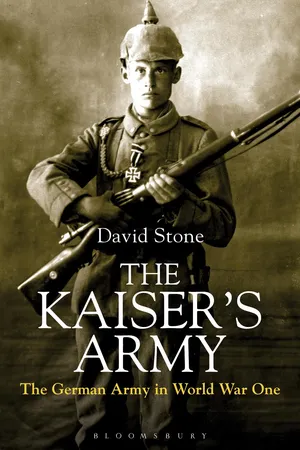
In this comprehensive book, David Stone describes and analyses every aspect of the German Army as it existed under Kaiser Wilhelm II, encompassing its development and antecedents, organisation, personnel, weapons and equipment, its inherent strengths and weaknesses, and its victories and defeats as it fought on many fronts throughout World War I.
The book deals in considerable detail with the origins and creation of the German army, examining the structure of power in German politics and wider society, and the nation's imperial ambitions, along with the ways in which the high command and general staff functioned in terms of strategy and tactical doctrine. The nature, background, recruitment, training and military experiences of the officers, NCOs and soldiers are examined, while personal and collective values relating to honour, loyalty and conscience are also analysed. There is also an evaluation of all aspects of army life such as conscription, discipline, rest and recuperation and medical treatment.
In addition the army's operations are set in context with an overview of the army at war, covering the key actions and outcomes of major campaigns from 1914 to 1918 up to the signature of the Armistice at Compiègne. For anyone seeking a definitive reference on the German Army of the period – whether scholar, historian, serving soldier or simply a general reader – this remarkable book will prove an invaluable work.
- 512 pages
- English
- ePUB (mobile friendly)
- Available on iOS & Android
eBook - ePub
PART I

THE KAISER’S ARMY IN PEACETIME
1871–1914
1. HOME IS THE HERO: BERLIN, 17 MARCH 1871
On the cold, wintry morning of 17 March 1871, King Wilhelm I of Prussia and several regiments of his army returned from the recent battlefields of France to a rapturously enthusiastic reception in the Prussian capital, Berlin. By March 1871 Berlin’s status had changed immeasurably since the start of the war against France the previous summer. No longer was it merely the principal city of Brandenburg-Prussia; it was now the capital of the new German Second Empire, which had been proclaimed to the world in the Hall of Mirrors at Versailles on 18 January. Accordingly, the victorious Prussian ruler and commander-in-chief who now rode along the Unter den Linden at the head of his troops was universally acclaimed and fêted as Kaiser Wilhelm I, the leader of a potentially mighty Germanic empire who had successfully united and then led the disparate German states to an historic victory against France. For the German citizens thronging the streets of Berlin that day in March, the flurries of snow and the bitter wind blowing into the city from the east were of little consequence, for they were witnessing what all believed to be the beginning of a new golden age of international influence, imperial development, national power, prestige and prosperity – and a period of peace and security for the Fatherland and the empire that would henceforth be guaranteed by an army whose proven combat success, organizational efficiency and consummate professionalism made it the best such force in continental Europe.
During the previous autumn and winter, the demands of the general staff for ever more manpower and resources had been set against a steadily mounting toll of German casualties, a situation highlighted in the public consciousness by the regular sight of contingents of wounded and disabled soldiers returning home from France. As the weeks passed, this had precipitated a growing sense of war-weariness and uneasiness in some parts of the German civilian population. Such doubts and uncertainties were speedily dispelled by the triumphant return of the Fatherland’s victorious soldiers that March. Undeniably, the German success against France had been stunning and had generally been achieved in the best traditions of the Prussian military ethos and code of conduct – notwithstanding the severe punitive action taken against French irregular forces (the francs-tireurs) during the winter campaign. The creation of the new empire was a landmark in history, but it also placed Germany at a national and strategic crossroads. This was particularly so for the redoubtable war machine that had enabled the creation of this new empire.
During the years that followed the defeat and humiliation of France, the imperial German army would gradually become a victim of its own success as it sought to consolidate what was already its virtually unassailable position within Germany and to enhance its formidable capability in order to support Germany’s growing imperial ambitions. For the army and the German nation alike, the post-war period would prove to be an unsettling and somewhat unsatisfactory period of history, a period of contrasts during which the glittering military successes of 1870–1, if not actually squandered, were certainly not built upon as effectively as they perhaps deserved. Indeed, it might be argued that the victory against France in 1871 was truly the zenith of the German army’s achievements in history, for none of its later conflicts were underwritten by such a worthy national aspiration as the unification of Germany.2 But all that was very much for the future – in 1871 it was time for the high command to take stock of more recent events and to draw from them the lessons of the war and indicators of the way ahead for what was now the imperial German army.
2. A TIME FOR REFLECTION
The period from the end of the Franco-Prussian War until the outbreak of World War I in 1914 was characterized by four major factors affecting the army. First, there was the continued consolidation and enhancement of its already significant power, status and influence – especially that of the officer corps – both within Germany and beyond. Next, there was Germany’s new status as an imperial power. This would inevitably generate colonial and global aspirations and for the first time would bring the army into direct competition with the navy for funding and resources. Thirdly, while the almost fifty years before 1914 were largely peaceful for Germany, it was during this period that the spectre of France and Russia as the new empire’s potential enemies was raised. The perceived significance of these two threats was such that very detailed plans for countering them occupied the German government and the army general staff directly. Consequently, the need for a future war against one or both of these countries soon achieved an unassailable level of acceptance in the German military consciousness, while making such a conflict virtually inevitable.
The fourth consideration involved personalities and the human element. As had been the case for the previous two and a half centuries, the Prussian heritage of the empire’s leadership affected the nature and development of the army significantly during the five decades prior to the great conflict that finally broke out in 1914. Three German Kaisers (emperors), all of whom were members of the Prussian house of Hohenzollern, ruled to direct and influence the course of imperial German history between 1871 and 1918. In 1888 the well educated, liberally inclined, cultured and militarily astute Friedrich III died of throat cancer after just 99 days on the throne. This particularly cruel turn of fate denied Germany an opportunity to reconcile and moderate the great international and internal influences, ambitions and frictions that gradually transformed the victory and triumph of 1871 into an imperial hubris during the years after Friedrich’s death, when the 30-year reign of Wilhelm II, Friedrich’s eldest son, proved to be excessively imperialistic and militaristic. Consequently, although the regime undoubtedly favoured and supported the army, it also encouraged and reinforced its self-aggrandizement, which progressively de-coupled the high command from governmental control and diluted or removed various essential checks and balances that had been imposed upon it in former times.
In the years that followed the victory of 1871 the German army was reorganized and re-equipped to take full account of its recent experiences in France. Its organization reflected the proven advantages of the regional basing of units, formations and headquarters, as well as the maintenance of a strong regimental system and minimizing organizational change where it was not essential. The post-1871 organization also brought the forces of all of the German states, including the major contingents provided by Bavaria, Saxony and Württemberg, into the formal order of battle of the imperial German army, although various aspects of their organization and peacetime command arrangements maintained the heritage and distinct identities of the military forces provided by these more minor German states. As a result, from 1871 all of these forces joined those of Prussia – always the largest contingent – within a single unified army funded by the states of the North German Confederation, to which all the formerly independent German states now belonged. Despite this, and the fact that the army was controlled centrally from the old Prussian capital, the actual extent of the military dependence of the various German states on Prussia varied and still depended very much on the bilateral agreements and conventions that had previously been concluded with Berlin. From its formal establishment in 1871 this formidable military force was entirely at the disposal of its commander-in-chief, the Kaiser, and as such he was entitled to inspect any part of it virtually at will. However, there were two exceptions to this. The first of these was a diplomatic provision that before the Kaiser visited non-Prussian units he was obliged to inform the relevant head of state of his intentions. The second exception modified the absolute duty of every German soldier to obey the Kaiser as his commander-in-chief by an agreement that Bavarian troops would only be bound by this particular provision in time of war.
3. ORGANIZATION AND INNOVATION
Although the development of strategy, operational doctrine and major policy decisions continued to be controlled centrally, being the everyday work of the senior officers of the high command and the members of the all-powerful general staff, the army’s command and training system in peacetime afforded a large measure of decentralization and autonomy to the various army corps in Germany. Corps commanders enjoyed a great deal of independence, working within a broad remit that included responsibility for their formation’s overall efficiency and preparedness for war, its training and recruiting. Corps areas equated to military districts in peacetime and the locations and command arrangements of the various units within each district generally reflected their initial wartime subordination, as well as facilitating the speedy passage of call-up notices and instructions for the district’s reservists in time of war or crisis. In 1898 there were twenty army corps, of which fifteen (including the Guard Corps) were composed almost entirely of Prussian troops, being administered by the Prussian War Ministry. The remaining five corps were the I and II (Royal Bavarian) Corps, the XII Corps (Royal Saxon No. 1), the XIII (Royal Württemberg) Corps and the XIX Corps (Royal Saxon No. 2).
By the mid-1890s the peacetime establishment of the army was about 23,000 officers and 557,440 non-commissioned officers (NCOs) and men. Including all non-combatants, the peacetime army included 585,490 soldiers and 97,850 horses. On mobilization the army divided into the field army (Feldheer), with four or five army corps combining to form separate deployable armies, and the home army (Heimatheer). The Heimatheer remained in garrisons in Germany to defend the homeland and maintain law and order, with the most important parallel responsibilities of continuing to recruit and provide replacement personnel for those men lost in action by the field army. Once the army was formally mobilized about 1,400,000 men could take the field, with a further 960,000 joining them within four weeks. However, in a situation of extreme crisis Germany could muster as many as seven million men by calling out every reservist, the Landsturm, and men whose military training was still incomplete. By the turn of the century the legacy of the war machine that had served Bismarck and von Moltke so well during the 1870–1 conflict was a much-enhanced German army, which was now designed to satisfy the military and foreign policy requirements of the German empire in the new century.
The German Imperial Army (1880–1900)3
Unit or Formation | c.1880 | c.1895 | 1900 |
Army corps districts | 19 | 20 | 23 |
Infantry regiments | 166 | 215 | 215 |
Infantry battalions | 513 | 605 | 625 |
Jäger or Schützen battalions | 21 | 19 | 19 |
Cavalry regiments | 93 | 93 | 96 |
Cavalry squadrons | 469 | 469 | 482 |
Field artillery regiments | 37 | 43 | 45 |
Field artillery batteries | 364 | 494 | 574 |
Foot artillery battalions | 31 | 37 | 38 |
Pioneer battalions | 19 | 23 | 26 |
Engineer battalions | Nil | 7 | 11 |
Railway regiments | 2 | 3 | 3 |
Table of contents
- Cover
- Title page
- Table of Contents
- MAPS, DIAGRAMS AND COLOUR
- Preface
- Introduction
- PART I. The Kaiser’s Army in Peacetime 1871–1914
- PART II. The Kaiser’s Army at War 1914–1918
- PART III. The Structure of Military Power
- PART IV. Officers and Soldiers
- PART V. Uniforms and Equipment
- PART VI. Combat Arms
- PART VII. Supporting Arms and Services
- PART VIII. Field Training and Operational Procedures
- PART IX. The End of the Kaiser’s Army
- Appendix 1. Weapons and Equipment
- Appendix 2. German–English Glossary
- Notes
- Bibliography
- By the Same Author
- List of Illustrations
- Colour plate section
- Black and white photo section
- eCopyright
Trusted by 375,005 students
Access to over 1.5 million titles for a fair monthly price.
Study more efficiently using our study tools.
Frequently asked questions
Yes, you can cancel anytime from the Subscription tab in your account settings on the Perlego website. Your subscription will stay active until the end of your current billing period. Learn how to cancel your subscription
No, books cannot be downloaded as external files, such as PDFs, for use outside of Perlego. However, you can download books within the Perlego app for offline reading on mobile or tablet. Learn how to download books offline
Perlego offers two plans: Essential and Complete
- Essential is ideal for learners and professionals who enjoy exploring a wide range of subjects. Access the Essential Library with 800,000+ trusted titles and best-sellers across business, personal growth, and the humanities. Includes unlimited reading time and Standard Read Aloud voice.
- Complete: Perfect for advanced learners and researchers needing full, unrestricted access. Unlock 1.5M+ books across hundreds of subjects, including academic and specialized titles. The Complete Plan also includes advanced features like Premium Read Aloud and Research Assistant.
We are an online textbook subscription service, where you can get access to an entire online library for less than the price of a single book per month. With over 1.5 million books across 990+ topics, we’ve got you covered! Learn about our mission
Look out for the read-aloud symbol on your next book to see if you can listen to it. The read-aloud tool reads text aloud for you, highlighting the text as it is being read. You can pause it, speed it up and slow it down. Learn more about Read Aloud
Yes! You can use the Perlego app on both iOS and Android devices to read anytime, anywhere — even offline. Perfect for commutes or when you’re on the go.
Please note we cannot support devices running on iOS 13 and Android 7 or earlier. Learn more about using the app
Please note we cannot support devices running on iOS 13 and Android 7 or earlier. Learn more about using the app
Yes, you can access The Kaiser's Army by David Stone in PDF and/or ePUB format, as well as other popular books in History & World War I. We have over 1.5 million books available in our catalogue for you to explore.