Philosophical Thought in Russia in the Second Half of the 20th Century is the first book of its kind that offers a systematic overview of an often misrepresented period in Russia's philosophy. Focusing on philosophical ideas produced during the late 1950s – early 1990s, it reconstructs the development of genuine philosophical thought in the Soviet period and introduces those non-dogmatic Russian thinkers who saw in philosophy a means of reforming social and intellectual life.
Covering such areas of philosophical inquiry as philosophy of science, philosophical anthropology, the history of philosophy, activity approach as well as communication and dialogue studies, the volume presents and thoroughly discusses central topics and concepts developed by Soviet thinkers in that particular fields. Written by a team of internationally recognized scholars from Russia and abroad, it examines the work of well-known Soviet philosophers (such as Mikhail Bakhtin, Evald Ilyenkov and Merab Mamardashvili) as well as those important figures (such as Vladimir Bibler, Alexander Zinoviev, Yury Lotman, Georgy Shchedrovitsky, Genrich Batishchev, Sergey Rubinstein, and others) who have often been overlooked. By introducing and examining original philosophical ideas that evolved in the Soviet period, the book confirms that not all Soviet philosophy was dogmatic and tied to orthodox Marxism and the ideology of Marxism-Leninism. It shows Russian philosophical development of the Soviet period in a new light, as a philosophy defined by a genuine discourse of exploration and intellectual progress, rather than stagnation and dogmatism.
In addition to providing the historical and cultural background that explains the development of the 20th-century Russian philosophy, the book also puts the discussed ideas and theories in the context of contemporary philosophical discussions showing their relevance to nowadays debates in Western philosophy. With short biographies of key thinkers, an extensive current bibliography and a detailed chronology of Soviet philosophy, this research resource provides a new understanding of the Soviet period and its intellectual legacy 100 years after the Russian Revolution.
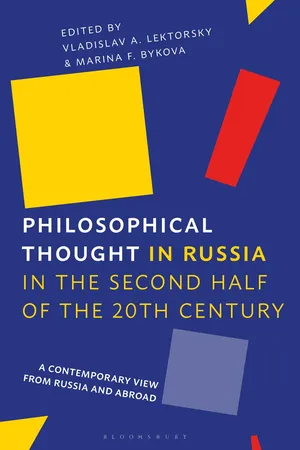
eBook - ePub
Philosophical Thought in Russia in the Second Half of the Twentieth Century
A Contemporary View from Russia and Abroad
- 440 pages
- English
- ePUB (mobile friendly)
- Available on iOS & Android
eBook - ePub
Philosophical Thought in Russia in the Second Half of the Twentieth Century
A Contemporary View from Russia and Abroad
About this book
Information
PART I
Russian Philosophy of the Second Half of the Twentieth Century in the Context of Culture and Science
CHAPTER ONE
The Russian Philosophy of the Second Half of the Twentieth Century as a Sociocultural Phenomenon
VLADISLAV A. LEKTORSKY
Soviet philosophers were either simpletons, or in the service of an impious regime, or both. That is the opinion of many whose idea of Soviet philosophy was drawn from the officially sanctioned manuals they had to read in their student years. Those textbooks left an impression that Marxism-Leninism had easy and simple solutions to the most complex problems of human existence that had puzzled the greatest minds for centuries. Should the above opinion be correct, in the years of the Soviet regime, Russia could not have any philosophy worthy of mentioning. And if contemporary Russia might be in need of philosophy, it would be argued, it has to start anew from the point zero. Two options are usually being considered. One is to revive the tradition of religious idealism broken in 1922 when a group of distinguished Russian thinkers was sent into exile on the “philosophers’ ship.”1 The other is to join one of the popular schools of contemporary Western philosophy.
In fact, “Soviet philosophy” is a term that stands for a variety of things.2 Western sovietologists that dealt with Soviet philosophy proceeded from the assumption that it was not philosophy at all. Philosophy implies a critical attitude and is, indeed, a critical examination of whatever is taken for granted, be it in life or in science. Soviet philosophy, they argued, was in fact an ideology, an attempt at a presumed theoretical justification of the Communist policies and a means of indoctrination. Philosophy of that sort discouraged independent thinking and was duly loathed. It has become customary for some contemporary columnists, including a number of professional philosophers, to disparage the entire Russian philosophy of the Soviet time in this manner. Examples are easily found to justify this attitude. Most textbooks on philosophy and numerous philosophical writings, especially those that dealt with problems of historical materialism and “scientific communism,” deserved no better, as did the official figures of that philosophy: Mark Mitin, Pavel Yudin, Fyodor Konstantinov and the like. In short, the phenomenon that fits the above description of “Soviet philosophy” was certainly present.
However, there was also something else, something that could not, it seemed, exist in the highly ideological Soviet society—it could not, but it did. The Soviet philosophical landscape was both more complex and more interesting than described. Working alongside dogmatists and conformists were remarkable thinkers, brilliant minds, people that felt at home in both Russian and world culture, as well as in human and natural sciences. It is only recently that we have learned to duly understand and value what they did in those years and what has emerged as relevant and topical today.
There are two points I would like to emphasize from the outset. Firstly, the innovative minds of Soviet philosophers belonged to the society in which they lived. Employed by Soviet academic institutions, they wrote for Soviet philosophical journals and sent their books to state publishing houses. Most of them shared Marx’s ideas, even if they interpreted them in their own ways, and endorsed the ideals of humane socialism. This is not to say they formed a team with dogmatists and official ideologues. In fact, both personal and ideological antagonisms between the two parties were sharp, and both were well aware of these opposition and antipathy.
Secondly, the ideas proposed in those years were no prisoners of their time. It would be wrong to view those ideas as inalienable parts of a self-contained system. Some of them are easily taken out of their philosophical and cultural contexts to be included in different contexts and interpreted in a variety of ways. This is what has happened to the activity approaches developed in Soviet philosophy and psychology, to Evald Ilyenkov’s theory of the ideal, not to mention the ideas of Mikhail Bakhtin and Lev Vygotsky.
Trends set in Russian philosophy at that time proved to be promising and productive for both the country’s philosophical development and the cooperation with the world philosophy today. Two periods stand out as particularly important: the 1920s and the second half of the twentieth century, separated, as they were, by decades of an almost unrestrained dogmatism promoted by the Stalinist regime.
* * *
In the 1920s the Russian philosophy and philosophy-based human sciences originated ideas that allowed for new approaches to knowledge, particularly to the study of man. They were, by no means, late echoes of the Russian pre-revolutionary philosophy. On the contrary, some of the most original thinkers of the time conscientiously challenged the pre-revolutionary tradition. Perhaps, Alexei Losev was the only true heir to that tradition. In the 1920s Losev published a number of books in which a novel interpretation of Ancient philosophy was coupled with original philosophy of myth, language, music and mathematics. Such a global approach to the study of symbolic forms was unprecedented in the Russian philosophy.
Alexander Bogdanov, an unorthodox Marxist, developed Tectology, a “universal organization science,” as a methodology of systems understanding alternative to the elementarism and atomism of classical science. Bogdanov’s tectological ideas went unacknowledged during his lifetime and were only appreciated and developed, both in Russia and in the West, in the second half of the twentieth century when the systems approach became a trend in a variety of sciences (Biggart, Glovelli, Jassour 1998). Parallel developments included the structural method in linguistics (Roman Jakobson et al.) and the formal method in literature studies (Boris Eikhenbaum, Viktor Shklovsky, Vladimir Propp and others), both to prove sources of world structuralism in philosophy and human sciences in the second half of the twentieth century.
The 1920s witnessed a philosophical trend characterized by two features (I would not call it a school or even a movement because thinkers associated with it were too different for that). One of the features has to do with the opposition both to religious philosophy predominant in pre-revolutionary Russia and to dogmatized Marxism. The opposition took the form of focusing on spheres peripheral to both religious philosophy and the simplified interpretations of Marxist materialism. These were spheres of culture, language, art, semiotic and symbolic systems. To philosophers exemplifying that trend, culture was a key to problems of anthropology and ontology. The other feature of this philosophical trend was the close connection that existed between philosophical studies and the new ideas in human sciences. Philosophers often came up with innovative ideas in the humanities; on the other hand, students of humanities did not simply adopt new philosophical ideas, but actively used them to substantiate novel approaches.
Worth mentioning here is, first and foremost, Mikhail Bakhtin, who went beyond the simple application of his philosophical ideas to the analysis of literature and language (novels of Dostoevsky, for instance) and substantially elaborated on them in the course of that work. Bakhtin’s ideas concerning the interrelation of the Self and the Other in the process of dialogue, the complex dialectic of the “consciousness for the Self” and “the consciousness for the Other,” the dialogical and polyphonic structure of consciousness and culture, the methodology of humanities were far ahead of his time and would be properly appreciated, studied and understood in our country only in the 1970s and in the West even later. Bakhtin’s legacy is not just a new methodology of humanities, but also and primarily a new philosophical anthropology that synthesizes the traditional Russian anti-individualism with the substantiation of the uniqueness and importance of personality. In the West the Bakhtin studies now amount to a trade of their own (Spektor, Denischenko, et al. 2017).
I should then mention Lev Vygotsky whose ideas, according to some contemporary Western scholars, have marked a turning point in the development of world psychology (some do even speak of “the Vygotsky Boom.”) Vygotsky used a number of Marx’s ideas to develop an original understanding of consciousness as a communicative process and an outcome of the evolution of inter-subject relations, as a social construct included in a cultural historical context. These philosophical ideas formed the basis of a psychological theory that, to a large degree, defined the course of theoretical and experimental psychology in this country and became influential throughout the world (Daniels, Wertsh, Cole 2007).
I must, finally, mention Gustav Shpet, who studied phenomenology under Edmund Husserl and then developed his own theory that was the first attempt to synthesize phenomenology and hermeneutics. Shpet, who was highly critical of the Russian pre-revolutionary religious philosophy (this attitude is evident, for example, in his Outline of the Development of Russian Philosophy) and clearly looked to the West, was, simultaneously, fully aware of his own originality. His ideas influenced Russian psychology (it was Shpet who came up with a project of ethnic psychology), linguistics (for instance, linguistic structuralism), and literature studies. He was one of the pioneers of semiotics as the general science of signs and sign systems.
* * *
In the mid-1950s the Soviet philosophy reached a turning point which proved to be an important part of the complex process of de-Stalinization of the Soviet society. It was the beginning of a new stage in the development of Russian philosophy, the essence of which can be summarized as follows: ph...
Table of contents
- Cover
- Half-Title Page
- Series Page
- Title Page
- Contents
- Notes on Contributors
- Acknowledgments
- Introduction
- Part I: Russian Philosophy of the Second Half of the Twentieth Century in the Context of Culture and Science
- 1 The Russian Philosophy of the Second Half of the Twentieth Century as a Sociocultural Phenomenon
- 2 Main Configurations of Russian Thought in the Post-Stalin Epoch
- 3 Punks versus Zombies: Evald Ilyenkov and the Battle for Soviet Philosophy
- 4 On Soviet Philosophy
- 5 The Philosophy of the Russian Sixtiers in the Humanist Context
- 6 Philosophy From the Period of “Thaw” to the Period of “Stagnation”
- Part II: Philosophy of Science
- 7 The Russian Philosophy of Science in the Second Half of the Twentieth Century
- 8 Systemic Analysis of Science: Ideas of Equifinality and Anthropo-Measurement
- 9 Soviet Philosophy and the Methodology of Science in the 1960s–1980s: From Ideology to Science
- Part III: Philosophy as the History of Philosophy
- 10 Spinoza in Western and Soviet Philosophy: New Perspectives After Postmodernism
- 11 On the Reception of German Idealism
- 12 Ilyenkov’s Hegelian Marxism and Marxian Constructivism
- 13 The Western Reception of Alexei Losev’s Philosophical Thought
- Part IV: The Problem of Activity in Philosophy, Methodology and Human Sciences
- 14 The Activity Approach in Soviet Philosophy and Contemporary Cognitive Studies
- 15 The Activity Theory in Soviet Philosophy and Psychology in the 1960s–1980s
- 16 Activity and the Formation of Reason
- 17 Georgy Shchedrovitsky’s Concept of Activity and Thought-Activity
- Part V: Dialogue and Communication
- 18 Between “Voice” and ‘Code”: Encounters and Clashes in the Communication Space
- 19 A Belated Conversation
- 20 From Historical Materialism to the Theory of Culture: The Philosophy of Mikhail Bakhtin as a Cultural Phenomenon
- 21 On the Role of the Communication Topic in the Discussions of the 1980s–1990s
- Part VI: Philosophical Anthropology
- 22 Human Ontology: On Discussion in Soviet Philosophy in the Late Twentieth Century
- 23 On the Problem of Morality in Soviet-Era Philosophy
- 24 The Individual and the Problem of Responsibility: Merab Mamardashvili and Alexander Zinoviev
- 25 Alexander Zinoviev’s Teaching on Life
- A Chronology of Key Events in the Russian Philosophy (1953–1991)
- Selected Bibliography (1953–1991)
- Subject Index
- Names Index
- Copyright
Trusted by 375,005 students
Access to over 1.5 million titles for a fair monthly price.
Study more efficiently using our study tools.
Frequently asked questions
Yes, you can cancel anytime from the Subscription tab in your account settings on the Perlego website. Your subscription will stay active until the end of your current billing period. Learn how to cancel your subscription
No, books cannot be downloaded as external files, such as PDFs, for use outside of Perlego. However, you can download books within the Perlego app for offline reading on mobile or tablet. Learn how to download books offline
Perlego offers two plans: Essential and Complete
- Essential is ideal for learners and professionals who enjoy exploring a wide range of subjects. Access the Essential Library with 800,000+ trusted titles and best-sellers across business, personal growth, and the humanities. Includes unlimited reading time and Standard Read Aloud voice.
- Complete: Perfect for advanced learners and researchers needing full, unrestricted access. Unlock 1.5M+ books across hundreds of subjects, including academic and specialized titles. The Complete Plan also includes advanced features like Premium Read Aloud and Research Assistant.
We are an online textbook subscription service, where you can get access to an entire online library for less than the price of a single book per month. With over 1.5 million books across 990+ topics, we’ve got you covered! Learn about our mission
Look out for the read-aloud symbol on your next book to see if you can listen to it. The read-aloud tool reads text aloud for you, highlighting the text as it is being read. You can pause it, speed it up and slow it down. Learn more about Read Aloud
Yes! You can use the Perlego app on both iOS and Android devices to read anytime, anywhere — even offline. Perfect for commutes or when you’re on the go.
Please note we cannot support devices running on iOS 13 and Android 7 or earlier. Learn more about using the app
Please note we cannot support devices running on iOS 13 and Android 7 or earlier. Learn more about using the app
Yes, you can access Philosophical Thought in Russia in the Second Half of the Twentieth Century by Vladislav Lektorsky, Marina F. Bykova, Vladislav Lektorsky,Marina F. Bykova, Marina F. Bykova, Vladislav Lektorsky in PDF and/or ePUB format, as well as other popular books in Philosophy & Russian History. We have over 1.5 million books available in our catalogue for you to explore.