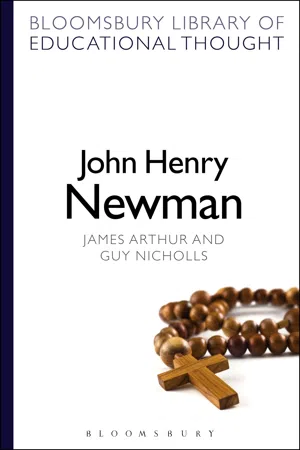
John Henry Newman's writings and his lifelong search for religious truth continue to influence thought within a range of disciplines, most notably theology, philosophy and education. One of his most significant contributions was to the understanding of higher education contained within his nineteenth century writings, in particular his volume of lecturers entitled The Idea of a University, which has helped shape religious and educational thought over two centuries.
Newman's claim that university education, the pursuit of universal knowledge and truth, is as much an education in pure and practical knowledge as in moral life, provides a continuing source of challenge and inspiration to education leaders today much as it did in the nineteenth century. James Arthur examines Newman's key strengths and weaknesses and locates these firmly within the intellectual context of his time, providing an overview of his work that allows students to appreciate the importance of his thought both within and outside the Catholic tradition.
- 256 pages
- English
- ePUB (mobile friendly)
- Available on iOS & Android
eBook - ePub
John Henry Newman
About this book
Information
Part 1
Intellectual Biography
Chapter 1
Newman: Educational Biography
Introduction: Historical Background
John Henry Newman (1801–1890) was one of the most important churchmen of the nineteenth century. In his own lifetime he was recognized as a powerful religious leader and theologian, known both as a man of action and an original thinker. As a clergyman he was involved for most of his life in various forms of pastoral work and in a variety of educational projects. Gifted with a highly original mind, he made significant contributions to many areas of philosophical, theological and educational debate. Not only intelligent and extremely well read, he possessed an intense self-awareness and power of reflection on his own experiences. This influenced him in terms of both his practice and theoretical perspectives, in particular shaping his thought and actions as an educationalist. Most of his written works arose from, or were influenced by, his projects as a priest and educator. Newman continues to have a profound influence on subsequent generations. Today, for instance, we can find numerous tributes to Newman and his educational ideals by scholars from all over the world. His reputation as an educator is such that many institutes of higher education, schools and university chaplaincies are named after him.
Newman spent the first half of his life as an Anglican, principally as a don and clergyman in Oxford, where on account of his preaching and writing he had great influence as one of the founders of the Tractarian Movement in the 1830s, of which he was arguably the greatest exponent and apologist. The Tractarians were so named after the Tracts for the Times which they wrote, printed and distributed to many of the clergy not only in Oxford but around the country, in order to revive a sense of what they claimed to be the original catholicity of the Church of England, obscured by Protestantism and the Enlightenment. Newman’s own interpretation of Anglicanism in the Tracts was not only to be the source of increasing conflict within the Church of England, but also within his own soul and mind. After much prayer, reading and reflection, Newman was received into the Catholic Church in 1845 and left both Anglicanism and Oxford for good. Newman was to remain a controversial figure after becoming a Roman Catholic, both in English society and in the Catholic Church.
Together with several companions who also converted to Catholicism at this time, Newman studied briefly in Rome before his ordination as a Catholic priest. Returning to England in 1847, he set up the first English Congregation of the Oratory, a community of secular priests modelled on that founded by St Philip Neri in Rome in the sixteenth century. Together with his fellow Oratorians, Newman undertook a great variety of pastoral works in Birmingham and the surrounding districts, including the establishing and running of several schools. His own most important contributions to education as a Catholic priest were to be the Catholic University in Dublin which he founded and ran throughout the 1850s, and the school he founded at Edgbaston in 1859 for the sons of his fellow-converts from Anglicanism.
Newman was a prolific writer whose complete list of works is too long to recount in full here. During his Oxford years the most important of his published works include Arians of the Fourth Century (1833) in which he first explored the continuity between ancient and modern forms of Christian faith; the Lectures on Justification (1838) in which he brilliantly expounded scripture and theology in order to try and resolve a major casus belli of the Reformation era. Between 1833 and 1842 he also published eight volumes of Parochial and Plain Sermons, and one volume of University Sermons exploring the relationship between faith and reason. His Essay on the Development of Christian Doctrine (1845) was the work he produced out of the research which finally brought him to conversion from the Anglican to the Roman Catholic Church. From 1833 to 1841 he not only edited but also wrote the greater part of the series of Tracts for the Times (1833–1841).
As a Catholic he continued to write, producing Lectures on Certain Difficulties felt by Anglicans in submitting to the Catholic Church (1850); Lectures on the Present Position of Catholics in England (1851) addressed principally to his Oratorian lay confraternity in Birmingham; Discourses on the Scope and Nature of University Education (1852) which, together with other lectures delivered in Dublin, was published as The Idea of a University (1859); On Consulting the Faithful in Matters of Doctrine (1859) in which he showed how the laity in the Church have a vital role in transmitting the faith; his autobiographical masterpiece, the Apologia pro Vita Sua (1864) which he wrote in self-defence against the charge of dishonesty levelled against him by Charles Kingsley; the Grammar of Assent (1870), his most important philosophical work in which he explored and defended the nature and grounds of religious faith, and besides these major works two novels and countless other lectures, discourses, sermons and articles. He is also remembered as one of the great Victorian letter writers. His edited Letters and Diaries, which contain much important material relating to the development of his opinions and activities, occupy no less than thirty-two volumes.
Newman’s thought can be difficult for a modern reader to interpret. In the first place, his was an age in which religious faith and language could still be taken more or less for granted in debate. In his educational discourses he makes assumptions in both his premises and his conclusions which frequently differ from those of our own time. Newman was unusual as a Catholic thinker in not following a Thomist approach in his writing. Although he had studied Aristotelian logic at Oxford, his religious thinking was influenced more by the method and content of the ancient Church Fathers and by his own intuitive and literary style of analysing and developing arguments. Newman is also recognized as one of the greatest prose writers in English of the nineteenth century. Biographer Ian Ker, even refers to his style of writing in the Idea of a University as ‘Victorian hyperbole’ and says that it would have been read by his contemporaries as a kind of ‘approximation to the truth’.1 Yet Newman actually took great pains to try and express his meaning accurately, frequently writing ‘chapters over and over again, besides innumerable corrections and interlinear additions’ in order to achieve ‘what is so difficult – viz. to express clearly and exactly my meaning’.2 Of all his writings, it was the Idea that cost him the greatest effort in this regard. He continued to adjust and revise it until the year before he died.
In addition to being charged with untruthfulness, Newman was accused of regretting his conversion to Catholicism, of being a sceptic, of being hyper-sensitive, and of being a social elitist in education. Newman vigorously defended himself against all such attacks and his creation as cardinal by the newly elected Pope Leo XIII in 1879 is the mark of his ultimate success in establishing his orthodoxy. By that time Newman had spent most of his life as a priest involved in educational projects, both as teacher and administrator at school and university level. Because of their originality and subtlety his writings have sometimes been misinterpreted posthumously as inclining towards modernism in the Roman Catholic Church. It is therefore appropriate that we begin with a critical review of the kind of education and training that shaped Newman and an account of his educational thought and projects before we proceed to an appreciation of his educational philosophy.
Early Life and Education
John Henry Newman was born in London on 21 February 1801, the eldest of six children. His father, also called John, was a man of modest background who had become relatively wealthy as a banker. His mother, Jemima (née Fourdrinier), was of French Huguenot descent and deeply pious. It was from her that young John imbibed a thorough knowledge and love of scripture as the basis of religious life and faith.
When he was seven years old, Newman was sent to Great Ealing School, which was ‘conducted on the Eton lines’.3 There were two to three hundred boys at the school, and Newman’s schoolmaster, the Revd George Nicholas, recognized that he was unusually bright. He was to say that ‘no boy had run through the school, from the bottom to the top, as rapidly as John Newman’.4 Newman himself writes autobiographically in The Idea of a University, disguising himself as the character Mr Black, ‘At school I was reckoned a sharp boy; I ran through its classes rapidly.’5 Nor should this be taken as indicating that Newman was simply a bright boy at a small school, because it was noted that many of the boys at the school ‘got on’.6 It included two lord chancellors among its past pupils, as well as Thackeray and W. S. Gilbert. Among Newman’s own contemporaries was Philip Westmacott the sculptor, who was to remain a lifelong friend.
Although initially somewhat shy, Newman emerged as a leader among his peers. He founded a club and a satirical magazine, Spy, most of which he wrote himself. He even wrote a counter-blast to Spy, Anti-Spy.7 Newman had an engaging and intriguing personality, and these characteristics were to play an important part in the development of his future work as an educator. It was during his school days that Newman began to keep a diary which he was to continue throughout his life, and to supplement in later years by his collected Autobiographical Writings. Clearly a studious and methodical boy, whom one of his sisters was to describe as ‘very philosophical . . . always full of thought, and never at a loss for an answer’,8 he even kept much material from his school and university days which is still preserved in Birmingham.
What kind of education Newman received at Dr Nicholas’s school can be ascertained from his own notebooks.9 From 1810 he began to study Latin and Greek grammar and literature, and verse and prose composition. Style in writing was to become an important aspect of Newman’s pedagogy. He was not interested in elegance for elegance’s sake, but in clarity of expression and the mark of personality which good Latin style embodied. Newman also took up the violin in 1811, at which he was to become very proficient, and which was to remain a life-long pleasure. Music features in Newman’s own reflections about the nature of thought.10 French he had at least begun by 1814, possibly earlier. He learned mathematics from five of the books of Euclid, and was to become extremely proficient in arithmetic and geometry.11 Although Newman did not study history, geography, biology, chemistry or physics, it should be noted that there was nothing unusual about the method or content of this curriculum at the time, or for many years before or after. Indeed, it seems that Dr Nicholas was able to attract a number of highly capable and interesting members of teaching staff to his school.12
Extracurricular activities also featured in Ealing school life, especially in the form of a Latin play twice yearly on three consecutive evenings known as ‘Grand Nights’. On the third day it was also customary for the boys to deliver speeches for which prizes, chosen by the boys themselves, were awarded. Not surprisingly, Newman excelled in every way. He played leading roles in several plays, and many years later was to include Latin plays edited by himself in the activities of his own school at Edgbaston.13 As prizes for proficiency at speechmaking, Newman chose Lamb’s Tales from Shakespeare, Milton’s poems, Cowper’s translation of Homer, and Travels in Upper and Lower Egypt by Vivant Denon, which indicates the range of his interests at this age.
In addition to all this organized study and play Newman was highly self-motivated. In his spare time he read much eighteenth-century poetry and essays and imitated their style in his own ‘poems, satires, burlesque operas, romantic dramas, and vast cabal...
Table of contents
- Cover-Page
- Half-Title
- Series
- Title
- Contents
- Series Editor’s Preface
- Foreword
- Acknowledgements
- Introduction: Newman the Educator
- Part 1 Intellectual Biography
- Part 2 Critical Exposition of Newman’s Work
- Part 3 The Influence and Relevance of Newman’s Work Today
- Appendix A
- Appendix B
- Bibliography
- Index
- Copyright
Trusted by 375,005 students
Access to over 1.5 million titles for a fair monthly price.
Study more efficiently using our study tools.
Frequently asked questions
Yes, you can cancel anytime from the Subscription tab in your account settings on the Perlego website. Your subscription will stay active until the end of your current billing period. Learn how to cancel your subscription
No, books cannot be downloaded as external files, such as PDFs, for use outside of Perlego. However, you can download books within the Perlego app for offline reading on mobile or tablet. Learn how to download books offline
We are an online textbook subscription service, where you can get access to an entire online library for less than the price of a single book per month. With over 1.5 million books across 990+ topics, we’ve got you covered! Learn about our mission
Look out for the read-aloud symbol on your next book to see if you can listen to it. The read-aloud tool reads text aloud for you, highlighting the text as it is being read. You can pause it, speed it up and slow it down. Learn more about Read Aloud
Yes! You can use the Perlego app on both iOS and Android devices to read anytime, anywhere — even offline. Perfect for commutes or when you’re on the go.
Please note we cannot support devices running on iOS 13 and Android 7 or earlier. Learn more about using the app
Please note we cannot support devices running on iOS 13 and Android 7 or earlier. Learn more about using the app
Yes, you can access John Henry Newman by James Arthur,Guy Nicholls, Richard Bailey in PDF and/or ePUB format, as well as other popular books in Education & Education General. We have over 1.5 million books available in our catalogue for you to explore.