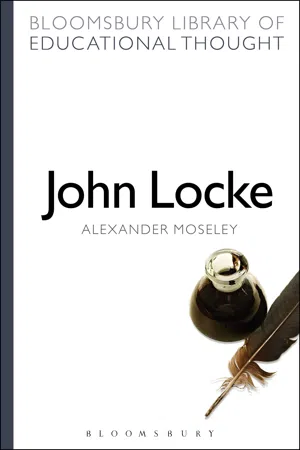
John Locke is one of the great minds in educational history. Drawing on his perceptive observations of families and children he saw the importance of adapting learning to the child's dispositions. Critical of schools, he is the fountainhead of home tutoring, child-centred learning, and the importance of enjoyable learning. But for Locke learning was not about facts: a good education produced gentlemen who could in turn adapt themselves to commerce and politics. Locke's philosophy helped provide rigour to the scientific revolution, the impetus for the expansion of schools for the poor (which should be profitable) and child psychology.
Alexander Mosely sets Locke's educational writings in their context with a sensitive reading of what Locke understood by 'education' and highlights the relevance of the study of Locke's work to our understanding of education today.
- 248 pages
- English
- ePUB (mobile friendly)
- Available on iOS & Android
eBook - ePub
John Locke
About this book
Information
Part 1
Intellectual Biography
1
Introduction
Born in 1632 in the quiet Somerset village of Wrington, into one of the most politically tumultuous and intellectually revolutionary centuries in English history, John Locke rose from the ranks of the minor gentry to become a thoroughly respected scholar of great breadth and insight, a scientist, philosopher, and an influential and respected educationalist.
His educational writings, published in 1693 as Some Thoughts Concerning Education (hereafter Thoughts), remain enjoyable and applicable today. This is partly due to Locke’s enthusiasm for an encouraging education free from fear and pointless subjects but also because of his carefully constructed theory of knowledge in his monumental An Essay on Human Understanding. The Essay synthesized and gave logical credence to the evolving scientific revolution of his day, providing a philosophical defence of empiricism and the importance of the senses in acquiring knowledge. Moreover, his philosophical writings were complemented by his own educational experiences as a tutor at Oxford and private tutor to various families. But Locke was not just a teaching academic turning his thoughts to educational matters: he was also a practising physician with experience as an obstetrician and paediatrician.
John Locke is also famous for his libertarian political work, The Two Treatises, which he kept anonymous until his dying days, but which has arguably fired debate and political change throughout the past three centuries in the clamour for rights and defence against government encroachments. Similarly, his Letters on Toleration helped to foster the eventual legal separation of church and state in the USA and their de facto political separation across much of Europe.
Locke, it can be readily gleaned, was a man of scholarly as well as practical breadth and the student can pick up one of many threads to his life and follow a sufficiently engrossing story. Lockean scholarship is correspondingly huge and it is enmeshed in a similarly pregnant century in which books, manuscripts, correspondence, and memoirs abound addictively for the researcher of the seventeenth century. A fortuitous finding of Locke’s manuscripts in the early part of last century (kept by a descendant of one of his nephews) has attracted historians of thought and there has been much recent academic revision of some of the key points in Locke’s development and maturation. Locke was a diligent organizer – hoarder, one is tempted to say – of his documents: receipts, rents collected, letters, drafts, etc, to the tune of 3,000 letters and documents. In itself, the collection is a good reflection of the assiduous meticulousness of the man, but it also provides a fascinating insight into the times: the student who studies a particular aspect of Locke’s thought is highly recommended to branch out and enjoy another side of it, whether it be his personal letters on education to the Clarke family, his medical notes on childbirth, his purchase accounts at Westminster School, or his political activity during the Restoration. For those desirous of learning about his pedagogic enquiries and prescriptions, this work provides an overview of those significant and pertinent links constructed across his philosophy, exploring how his explicit educational thoughts link to contemporary educational norms, as well as how his reflections on knowledge, science, religion, morality and politics also relate directly and indirectly to a Lockean philosophy of education.
Locke’s life is of great interest and relevance too. Locke moved from his village in the western county of Somerset, close to the important trading harbour of Bristol, to Westminster School in the City of London, and from there to Oxford, where, had he followed a quiet destiny of scholarship and risen to the position of College Don, we would not be surprised. However, an auspicious meeting with the ascending politician, Lord Anthony Ashley Cooper (Earl of Shaftesbury, hereafter Ashley), changed Locke’s life in many areas, providing him with the experience and, arguably, the confidence to write on broader concerns. Their friendship also propelled him into higher political and intellectual circles; he travelled and lived in various places around France and Holland, meeting some of the Continent’s great thinkers and scientists; he even suffered exile in Holland because of his connection to Ashley during the reign of James II. He returned to England following the Glorious Revolution and eventually retired to the county of Essex and the home of a long-time friend and Platonic love, Lady Damaris Masham, where he died in 1704.
Travel provides new experiences and cause for reflection, as Locke himself would teach us in his Thoughts on Education, but his life also coincides with political upheavals that cannot be ignored in piecing together an overview of Locke ‘the man’ and Locke ‘the educator’. Civil war (1642–50) erupted across Britain between Royalists and Parliamentarians in his tenth year, and his county of Somerset, generally Royalist in persuasion, was periodically of military focus and intent for both sides – but more importantly, the war brought to the fore deeper questions concerning the Protestant Reformation and the relationship between the state and church and a man’s conscience, as well as the role and duties of political authority.
Locke’s primary intellectual drive was to seek the truth by understanding how we come to know things and what kind of life we ought to live – both questions replicating into minor and major themes across the span of his scholarship, experiments, and advice on matters ethical, religious, political, and educational. The wars disrupted the career of many an intellectual, theologian, and academic colleague, as did the various political tumults made by both sides, who, when in power, tended to rid institutions of opposing thinkers or influential teachers. Yet Locke managed to steer a very prudential path – or was at times fortunately placed to be protected or defended by well-placed friends – to ensure that he remained in the intellectual and scientific hub. That is, until Ashley finally fell out of power; but again fortune was with Locke, for his temporary exile placed him in circles that proved eminently suitable for the ensuing Glorious Revolution (1688) and the overthrow of James II.
Fortune is naturally capricious, so it is not surprising that Locke’s recommendations and prescriptions on education underline the importance of forming a gentlemanly attitude of good manners and practical education, which provides both a stable yet pragmatic foundation to life and an attractive personality to others in all manners of business. The gentleman’s education ought to enable him to be a man of business as well as possessing a capable personality to secure his ease of passage through life’s tumults and opportunities, when reliance on self and a host of trustworthy friends may become vital not just for expanding wealth and ties but also, we can add, ultimately survival in a changing world. While the seventeenth century presented tumultuous political storms and the violence of civil war, today’s shattering of traditional cultures and the ever-shifting ebbs and flows of commerce and fashion – and hence of personal prospects – can be obviously linked to the kind of life Locke would have us lead: a peaceful and stable life based on a strong education in what is useful as well as in the cultivation of qualities required to engage with peoples of all backgrounds, stations, and trades.
The details will naturally be picked up in this book. This first section presents an overview of Locke’s historical and intellectual context and the relevant and identifiable influences, as far as we may surmise, on the development of his own thinking. First, his own educational experience is of paramount interest and importance for the development of his pedagogy, and we trace his upbringing in Somerset, his removal to Westminster School and culture under its prominent and influential headmaster Richard Busby, and his success in securing a place at Christ Church, Oxford, where Locke rose to become one of the college’s capable academics but, more critically, where he became an enthusiastic participant of the scientific circles quietly developing there.
Second, we chart the sudden change in his political thinking, especially under the patronage and friendship of Ashley, without whom, some commentators contend, there would have been no ‘Locke’, particularly the quiet yet sharply critical mind that developed alongside his libertarian political philosophy. In doing so, we review the wider intellectual context by looking at the dominant thoughts of the humanist renaissance, the scientific revolution, and the general philosophical background to his century, noting the specific influences of Bacon, Descartes, and Montaigne. Accordingly, we draw upon this overview for a look at particular educational methods and schools against which Locke was very much in revolt.
2
Educational Experience
Like several key contemporary writers on education (notably Montaigne), Locke was not encouraged by the educational system which he experienced. Much time, he argued in the Thoughts, was lost learning useless information or practising the art of disputation for no intellectual gain, and the natural love of learning was typically squashed under the threatening rod of the schoolmaster. His disapproving comments on education certainly reflect the critical temper of the times, but his influence did not remain with sympathetic readers: various elements of Locke’s opera form such an integral part of the great cultural and political flow of modern life that his educational ideas still impact on thought, sometimes not in the way he intended or even, in some parts, would have liked. The emphasis on bodily and mental health, the rejection of learning the impractical or what the child has no aptitude for, and the focus on cultivating gentlemanly or virtuous qualities are still with us and detectable through the centuries. But his ideal vision of well-do-do families enjoying the services of a personal tutor with whom they can cooperate to secure the most effective education for the children, designed and adapted to the individual pupil’s intellectual abilities and dispositions, has been swamped by the rise of mass education slavishly following national curricula, which are in turn politically infused with ephemeral fashions: modern mass education is far removed from Locke’s child- and family-centred pedagogy. In the United Kingdom today (2006), many parents certainly employ tutors – but often for assisting their children’s passage through a multitude of tests and exams that Locke would have decried as inept contrivances and distractions that act to put most children off learning for enjoyment.
The Lockean ideal, which Locke accepts can rarely be universal given the varying classes in society, is for what commentators call the middle class – those who are financially comfortable enough to secure the services of a tutor: a service which therefore could not be available to all. Yet it would be wrong to dismiss Locke’s educational thinking as relating only to the Marxist bête-noire – the bourgeoisie: the particularities prescribed can always transcend class and income, for he emphasizes the vital role that any parent can play in their child’s development, and arguably the Lockean ideal resurfaces in the schools of Maria Montessori. But it was not just on academic matters either that Locke enthused: he stressed the need for good nutrition, exercise, and fresh air, as well as for learning a trade. In many respects, Locke advised the gentlemanly class to take a leaf out of the less artificial methods of the yeomanry and farming classes, whose children were seen to be hardier and more self-sufficient mentally and morally and thereby more adaptable and independent for their work too.
It is therefore not an extraordinary conjecture to claim that Locke’s own experience of early childhood – and his later reflections upon that time – were generally happy; his school and university experiences, while certainly developing the man, can be read as contrasting with the simple beginnings in Somerset, but they also opened up Locke’s mind both in the immediate power of the contrast and in the indelible influence of his heads of school and college. We begin his educational experience with Locke’s childhood, and chart its progress.
3
Somerset
Locke was born on 29 August 1632, in the village of Wrington, Somerset in a small cottage belonging to his maternal grandparents on the north side of the church. (In 1868, it was, incidentally, being used as a school house.) His parents apparently only stayed three days in the cottage (it was common for expectant mothers to return to their mother’s house for their ‘lying in’), for they removed ten miles to the east to live in Belluton, a pleasant Tudor farmhouse overlooking the market village of Pensford and having commanding views of the gentle Mendip Hills. The house of his birth was very basic compared to Belluton, a house that had belonged to his grandfather, Nicholas Locke, who had left the place to his son upon the death of his first wife, Frances, and moved to a more spacious home with his second wife, Elizabeth Heale. The house could be described in modern language as having three bedrooms, a kitchen, utility rooms, three reception rooms, and outbuildings: comfortably well appointed for Puritan England, with a library (worth £5/14), and upstairs the bedrooms possessed curtains, flock beds, rugs, and pillows (Cranston 1957, 6–7).
Belluton lies at the northern end of Pensford, and in fact fell under the parish of Stanton Drew, which means that the Locke family would have attended church in either Pensford or in Stanton Drew. Stanton Drew is an ancient place of worship, and even has a druidical stone circle, although Locke, being of a more utilitarian mind, never seems to have been too observant of the history or aesthetics of the places that he visited or lived in, so its peculiarity does not warrant a mention in his writings. While such places typically attract myths and ghost stories, Locke was emphatically deriding of such tales, advising parents to avoid telling their children frightening tales (Thoughts, §138) and remarking on the impact such tales can have on undermining confidence (Essay, II. xxxiii.10–16).
Locke’s family was of good local standing; his uncles Peter and Edward became successful businessmen as a tanner and a brewer respectively, whereas his father lived more modestly as a lawyer to the local magistracy. Somerset was one of the most populous and rich counties of the country, yet despite its affluence gained from hard work and a division of labour, perspicuous social strata (albeit highly flexible since Tudor times) permeated social relations – each individual had a moral superior to look up to in a hierarchy that ended with the monarch, whose sole superior was God (Harris 1994, Ch.1). It is vital to be aware of this social context, for Locke wrote his educational writings explicitly for the gentry class, who, he argued, should deal with inferiors and superiors appropriately and avoiding condescending or humbling themselves.
Locke’s father, also John, had married Agnes Keene, a tanner’s daughter from Wrington. Wrington became historically important, for its incumbent rector, Dr Samuel Crook (see below), managed to attract the legal and political weight of the archbishopric and monarch to his parochial affairs, a story that would not have been missed by the local gentry and may have formed part of Locke junior’s attitude to authority that was released in his later years. Some commentators place much emphasis on Crook’s sermons in Locke’s intellectual development; certainly they reflect the independent spirit of the Puritan movement and we recognize several elements of Locke’s later thoughts in Crook’s passages, but, as Locke had moved to a different parish over ten miles away after his baptism, the influence can only have been indirect – possibly through his father possessing Crook’s published sermons or through local oral channels.
The impact of religion cannot be ignored in Locke’s thinking: he was born a Puritan, became a more tolerant Latitudinarian, and maintained the primacy of religious faith throughout his life. Because he advised both in the Thoughts and in the Essay that the young pupil should be taught faith prior to learning any knowledge of the secular world (direct learning taking a low priority next to religion and becoming a virtuous person), it is appropriate to consider the religious context that so influenced Locke’s youth.
4
Puritanism
The Puritan movement emerged in the sixteenth century as a continuing programme of ecclesiastical reform through the voices of various theologians who sought to purify the Protestant churches of any Catholic remnants.
The German Priest Martin Luther had initiated the Reformation of the Papacy in 1513, with his famous 95 theses criticizing the institution of the Church and the sale of indulgences, while stressing the inner spirituality of Christianity. The papacy had become corrupt and divided over the prior two centuries and criticism had been fomenting; it boiled over with Luther’s tentative requests for much-needed reform. Another branch of the evolving Protestant movement came from Jean Calvin, who influenced those who became Presbyterians in the British Isles; Calvin claimed that only a few, predestined people could be saved by grace of God, a belief that gave followers a belief in their moral supremacy over others. Skipping the details, Henry VIII of England split from the Roman Church in 1534 to found what became the Anglican Church. In Anglicanism, the Head of the Church was no longer to be the Pope but the monarch, which of course meant that problems over ecclesiastical and secular jurisdictions were nominally resolved by the merging of the state and church; however, problems did not disappear as some had hoped (...
Table of contents
- Cover-Page
- Half-Title
- Series
- Title
- Contents
- Series Editor’s Preface
- Foreword
- Part 1 Intellectual Biography
- Part 2 Critical Assessment of Locke’s Educational Theories
- Part 3 The Reception and Influence of Locke’s Work
- Part 4 The Relevance of John Locke Today
- Bibliography
- Index
- Copyright
Trusted by 375,005 students
Access to over 1.5 million titles for a fair monthly price.
Study more efficiently using our study tools.
Frequently asked questions
Yes, you can cancel anytime from the Subscription tab in your account settings on the Perlego website. Your subscription will stay active until the end of your current billing period. Learn how to cancel your subscription
No, books cannot be downloaded as external files, such as PDFs, for use outside of Perlego. However, you can download books within the Perlego app for offline reading on mobile or tablet. Learn how to download books offline
Perlego offers two plans: Essential and Complete
- Essential is ideal for learners and professionals who enjoy exploring a wide range of subjects. Access the Essential Library with 800,000+ trusted titles and best-sellers across business, personal growth, and the humanities. Includes unlimited reading time and Standard Read Aloud voice.
- Complete: Perfect for advanced learners and researchers needing full, unrestricted access. Unlock 1.5M+ books across hundreds of subjects, including academic and specialized titles. The Complete Plan also includes advanced features like Premium Read Aloud and Research Assistant.
We are an online textbook subscription service, where you can get access to an entire online library for less than the price of a single book per month. With over 1.5 million books across 990+ topics, we’ve got you covered! Learn about our mission
Look out for the read-aloud symbol on your next book to see if you can listen to it. The read-aloud tool reads text aloud for you, highlighting the text as it is being read. You can pause it, speed it up and slow it down. Learn more about Read Aloud
Yes! You can use the Perlego app on both iOS and Android devices to read anytime, anywhere — even offline. Perfect for commutes or when you’re on the go.
Please note we cannot support devices running on iOS 13 and Android 7 or earlier. Learn more about using the app
Please note we cannot support devices running on iOS 13 and Android 7 or earlier. Learn more about using the app
Yes, you can access John Locke by Alexander Moseley, Richard Bailey in PDF and/or ePUB format, as well as other popular books in Education & Education General. We have over 1.5 million books available in our catalogue for you to explore.