Aristotle is often underrated in educational circles but the impact of his philosophy and his actions are evident in the schools and universities around us today. Aristotle developed the first proper university that had different departments and vast collections of texts and artefacts. His philosophy has also influenced the greatest minds since his time, from Aquinas to today's logicians, rationalists, and empiricists. The influence of his educational thinking and his philosophy in general helped underpin the Renaissance and the modern era. In a nutshell, Aristotle took our thinking and said, 'make it sharper.'
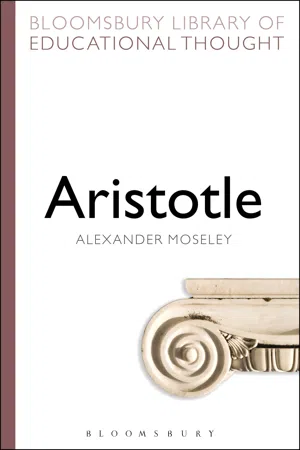
Alexander Moseley offers a thorough and comprehensive overview of the works of Aristotle and explores the influence of his thought and writings and their impact on our education systems today.
- 256 pages
- English
- ePUB (mobile friendly)
- Available on iOS & Android
eBook - ePub
Aristotle
About this book
Information
Part 1
Intellectual Biography
Chapter 1
Heritage and Early Influences
Aristotle (384–322 BC) – il maestro di color che sanno, ‘master of those who know’ (Dante, 1995, IV.131) – stands with Plato at the fountainhead of the Western philosophical tradition that flows into early Arabic thought, European Scholastic thinking in the thirteenth century, the Renaissance, and down into the modern era. In all aspects of philosophy, Aristotle is widely studied and debated today and his thoughts on education have prevailed for over two millennia – they stand as an excellent reminder of the importance of the pursuit of virtues and individual flourishing tethered to the responsibilities of citizenship.
Aristotle was indeed one of the greatest minds ever to have been widely intellectually productive, which a cursory glance at the extant number of works reveals (which is only a fraction of what he is said to have written) or which any in-depth analysis only underlines. Even without any explication of pedagogy, Aristotle’s thoughts would be important in their own right for any educationalist as the wisdom of one of the most wide-ranging and perceptive thinkers to have lived, and even if we disagree with his conclusions or recognize that elements of his scientific investigations lack the rigor or methods of present science and his sexist and racist attitudes rile the modern mind, his ideas would still require our attention, for the parochial particulars can be jettisoned to leave an immensely erudite philosophy. Moreover, what Aristotle does have to say on education is eminently appropriate and has been highly influential. And while we may disregard particulars, through his extant manuscripts we also get to know an erudite thinker who possessed a sensitive, mature, and realistic view of humanity.
In Part I we reach back into the rivulets and rivers of thought that flow into Aristotle’s thinking as well as review some of the known educational programs prior and contemporary to his time. This will take us through the broad milieu of Hellenic education, the Macedonian kingdom to which his career was intimately tied, the medical aesclepiad tradition from which his immediate education was drawn, and the role of Athenian art and theater, which indubitably stirred his mind. In addition, since Aristotle was a philosopher and one of the first we know of to have studied previous philosophers as a historian of ideas, these antecedents are also surveyed relating, where appropriate, how their thoughts can be seen to have affected Aristotle’s pedagogical notions.
Aristotle’s heritage
When reaching back more than two thousand years, the details of a person’s life necessarily become sketchy – yet we do seem to know more about Aristotle than we do Shakespeare; this is due to the scholarship of the classical era, which has also been sustained over much of this period beginning with Roman and Byzantine collectors, Arabic scholars and philosophers, and continuing today with the finds of archaeologists working in Greece and across the routes of the Ancient world from Spain to Afghanistan. Primary biographers from the Ancient world were Diogenes Laertius (dates unknown: third to fourth century AD), and Plutarch (46–120 AD). Diogenes drew upon the Athenian biographer Diocles of Magnesia (fl. second to first centuries BC), Hermippus (c. 250 BC), and Timotheus (dates unknown and whose works no longer exist). Aristotle’s work has enjoyed popularity in the Arabian world and, as we shall see in Part 3, his rediscovery in western Europe had a lasting impact on the Roman Catholic Church being entwined with Scholastic teaching, and the early European public school systems spawning in turn influential educational reforms and schemes whose principles remain evident today. Furthermore, studying Aristotle is to engage in a conversation that has lasted over two millennia; careers are made from his work, so there is a specialization abroad with elaborations, discussions, and arguments to which this present work can only hope to contribute without grave distortion or bias.
According to Diogenes Laertius, the Roman biographer via Hermippus, Aristotle had thin legs, small eyes, and dressed in refined clothes, wore his hair fashionably short, and sported rings on his fingers; but this is not reflected in the busts that have survived the centuries, which show a bearded man with a hooked nose and no refinery. According to Laertius, repeating Timotheus the Athenian, Aristotle had a lisp yet was a man of the greatest industry and ingenuity and of ready wit (Laertius, 1853, II.XIII). For Plutarch, he was ‘the most celebrated and learned of all the philosophers’ (Plutarch, 1878, p. 715). For Thomas Aquinas, he was simply ‘The Philosopher.’ To Adam Smith, he was ‘a man who certainly knew the world’ (Smith, 1982, p. 258); to John Stuart Mill, ‘the most comprehensive, if not the most sagacious of the ancient philosophers’ (Mill, 1884, p. 29). A present Aristotelian, Barnes, summarizes him as ‘perhaps, admirable rather than amiable’ (Barnes, 2000, p. 1), while Randall perceives him as ‘warm and affectionate: he was a kind husband and father, and a true friend, not a mere thinking machine’ (Randall, 1960, p. 20), and Ross as ‘grateful and affectionate’ (Ross, 1977, p. 7).
I find him perennially engaging.
He was born in Stageira, a Greek seaport and colony in between the countries of Thrace, situated to the eastern side of the Chalcidic peninsula, and Macedonia to its west. Stageira, in the Chalcidice peninsula, was founded as an Ionian settlement in 655 BC. The Ionians were Greek colonists who migrated from the Greek mainland following the Dorian invasions of around 1000 BC. They set up trading posts along western Anatolia or modern day Turkey and their towns grew. The Ionians were a relatively advanced people trading between the Greek states and Phrygia and Lydia to the east, and although racially mixed, the Ionian culture insisted on supporting pan-Hellenic culture and attempted to maintain independence against Persian incursions and demands for subservience or tribute, a quasinationalist ideal that encouraged many Hellenic thinkers such as Aristotle to see the Hellenic peoples as superior to their neighbors.
The Chalcidice peninsula got its name from the people of Chalcis, who came from the south of the eastern Greek peninsula; Chalcis had been settled by Ionians, and it was to Chalcis that Aristotle went to retire and die in 322 BC in his mother’s lands. Chalcidice faced threats from Macedonia, Thrace to the northeast, Thessaly to the southwest; to the east it faced the Aegean Sea and the constant political and military pressure from the vast Persian Empire. Moreover, the Spartans, Athenians, and Corinthians all claimed Chalcidice’s cities.
Aristotle was born the son of Phaestias and Nicomachus, who was a court physician to Macedonian King Amyntas III (r. 393–370 BC). Aristotle’s father Nicomachus’ ancestors may have migrated to the Ionian islands and Stageira from Messenia in the southwest corner of the greater Greek peninsula following the putative Dorian invasions (Howatson, 1989, p. 197). As an aesclepiad, Nicomachus trained as a physician, which probably drew him into the Ionic educational circles where the Ionian philosophers’ influence would have been palpable to an educated man. Nicomachus gained employment at the Macedonian court in Pella; it is conjectured that in turn he would have been a dissector of animals and a student of nature (Ellwood, 1938, p. 36), a later pursuit for Aristotle, who effectively founded the science of biology. Aristotle’s father and mother both died when he was young, perhaps around the age of 10, after which Aristotle was brought up by his guardian or uncle, Proxenus, also a physician, who sent the youth at the age of 17 or 18 to study at the Academy. Perhaps it had been his father’s wishes, for Nicomachus (and/or Proxenus) had probably heard of Plato’s Academy through the intellectual grapevines (Dillon, 2005, p. 89). It is an interesting move – the aesclepiad tradition involved mythical-cum-religious elements tied in with a highly practical education of seeking to cure illness and disease, whereas the Academy was intellectual in orientation.
Aristotle’s mother, Phaestias, was from neighboring Chalcis in Euboea, another Ionian settlement, and owned lands there to which Aristotle retired in the last years of his life. Euboea was commercially powerful until the Athenians took control – its weights and measures were used as a Hellenic standard down to Solon’s time, but invasion and domination by others reduced its standing. Chalcis avoided the depredation that its neighboring city, Eretria, suffered under the Persians, securing a relative independence until Philip II of Macedonia defeated a Greek alliance to impose Macedonian hegemony. Aristotle had an elder sister, Arimneste, and a brother, Arimnestus. Arimneste married Proxenus and had two children by him, a son, Nicanor, and a daughter, Hero. On the death of Proxenus, Aristotle took Nicanor under his wing. Hero’s son, Callisthenes – Aristotle’s grand-nephew – was fatefully to follow Alexander’s campaign into Persia as a biographer. Aristotle himself married Pythias and had a daughter, also Pythias; after his wife’s death he had a son, Nicomachus, with Herpyllis, a slave from his home town with whom he passed his last years.
From his parents’ connections and culture, Aristotle was well placed for an exceedingly good education, of which he certainly took, or was encouraged to take, advantage.
Macedonia
Macedonia was to play an integral role in Aristotle’s life. It rose to political prominence during his lifetime and his own fortunes were directly and indirectly tied to its own. In effect, his teachings and philosophizing rode the Macedonian wave to power and hegemony: his father worked for the court and Aristotle was a contemporary and possible close friend of King Philip, returning to the court to tutor Philip’s son, Alexander. As with the life and times of many great thinkers, Aristotle grew up and was surrounded by tumultuous political upheavals and shifts of power: for the most part, he was on the victorious side, which certainly would have made his life easier than otherwise, but when Alexander died and Macedonia looked vulnerable, Aristotle exiled himself from Athens to avoid any anti-Macedonian backlash – such was his dependency on politics.
Despite being hardly known beyond its borders, Macedonia suddenly became important during Aristotle’s lifetime. Its rise under Philip and its meteoric expansion into the east under Alexander left, however, a highly visible cultural and genetic imprint on the world. Macedonia’s inhabitants were warlike and became famed for their victories because of their tightly disciplined phalanxes, wielding long spears, who would withstand ferocious attacks – their discipline and courage were perfected by Aristotle’s contemporary Philip, and enabled his son, Alexander, to subdue people after people in his campaigns.
Philip had taken the opportunity of the political fallout from the Third Sacred War (355–346 BC) and the Athenian Social War (358–355 BC) to expand his kingdom. The Thebans had defeated the Spartans, who had surprisingly allied with the Athenians to check the Thebans, in Aristotle’s youth; in turn, Theban temporary hegemony was lost when their brilliant general, Epaminondas, was killed in his moment of victory at the Battle of Mantinea. Philip idolized the Theban, whom he had known and studied under as a youth; when he took the throne he reformed the Macedonian state and military and in 359 BC began a series of campaigns against Macedonia’s neighbors. Philip eventually rose to dominate the central Greek Amphictyonic Council by crushing the northern Athenian colonies of Thrace and Chalcidice. Unsurprisingly, given the political conditions, Aristotle’s early education could only have given him an acute awareness of faction and shifting allegiances (cf. Laistner, 1947, p. 188). It is a history worth noting, not just because he grew up in the eye of the military hurricane that Macedonia was to become, but also because his philosophy – his wisdom – could not be but reflected in it, hence the noteworthiness of reviewing the relevant part of Macedonian history.
Later Aristotle was to comment in his Politics that some are born to rule over others. It is a provocative and simultaneously interesting assertion, which when added to his thoughts on good breeding stand in contrast to the actual dynastic problems of the Macedonian court: Philip’s mother was Illyrian, a fact that seems to have caused innuendoes and problems for Philip’s reign (O’Brien, 1994, p. 29). Aristotle could boast of good Ionic lineage and may have viewed his employers with some condescension. Weak roots require a powerful compensation and Philip sought this in military power: thoughts of aggrandizement were certainly abroad during his reign: in neighboring Thessaly, Jason of Pherae rose to become a king or tagus with ambitions. He had reformed the Thessalian army and created a 20,000 strong hoplite force with 8,000 cavalry. He brokered an alliance with Amyntas and later wrote to Philip II, who was to employ Aristotle, perhaps speaking of his ambitions to invade Persia. Jason’s ambitions were not unheeded: Philip commenced the plans but Philip’s son, Aristotle’s pupil, was to enact them.
The Hellenic dream of enacting revenge against persistent Persian attacks and interference had been fired by the spectacular victories earned by the Greeks in the early sixth centuries at the battles of Marathon, Salamis, Himera, Mycale, and Plataea. The power of Persia was phenomenal but the history has been written by the Greeks, who wrapped themselves up in a literary, artistic, and philosophical justification of their victories; not that it was all plain sailing, for Persia sacked Athens in 480 BC and the Persians were not so wooden-headed and myopically imperialistic – they altered their policies according to their subject peoples, but as with any empire, power can only stretch so far before it recoils from dissent and grievances among cultures and peoples far removed from the center. The Hellenic responses to Persia were also mixed, with some poleis joining the Persian cause either for protection or to ally against a common enemy.
War between the majority of the Hellenes and Persia originally began in 490 BC. Despite intricate foreign policies and an ostensible pragmatism, the might of Persia was built on an early notion of ‘manifest destiny’– in the religious belief that all nations should submit to Persian rule. ‘No other religion of antiquity,’ writes Burckhardt, ‘was so perfectly adapted to foster the arrogance of perpetual self-righteousness and omnipotence as this version of Zoroastrianism’ (Burckhardt, 1999, p. 216); nonetheless, the peaceful intercourse between the Asian and south European civilizations was immensely fruitful, for Zorastrian thinking influenced the Greek philosophers, but the Greeks may not have become pragmatically contented subject peoples and the Persians would have had to deal with them brutally. Thus in the wars, the Greeks were fighting for their survival. Arrogance (hubris) in victory was later to spur Aristotle’s Alexander into subjugating the Persian Empire: myth wrapped in legend wrapped in history underlay the Hellenic ethos. But victory over the Persians did not produce the pan-Hellenic federation or nation that some wished for – war broke out between the city states across the peninsula and islands. Sparta and Athens formed the main contending parties in the Peloponnesian War that lasted for twenty-seven years, with Sparta eventually defeating Athens, and Sparta then being defeated by the Thebans and all in turn by Philip of Macedonia and his son Alexander.
Politics aside for the moment, let’s look at what explicit pedagogical upbringing Aristotle may have enjoyed as the son of aesclepiads.
Archaic educational influences
Aristotle spent much time learning medicine: he was descended through his mother and father from a line of aesclepiads – early physicians. According to the Roman physician and philosopher Galen (131–201 AD), who studied Aristotle and compiled an enormously influential set of treatises on medical works, the aesclepiads taught their children reading, writing, and anatomy. Aesclepiads saw themselves as either descendants or followers of Aesclepius, the Greek god of healing (Magill, 1998, p. 94); they plied their trade around a territory, moving from village to village setting up to cure whoever bought their services (Grayeff, 1974, p. 15), and as with the medical professions today, they formed a guild to protect their economic interests – knowledge was passed from father to son. As a descendant of aesclepiads, Aristotle would have gained a rudimentary medical education; while he did not enter into the profession himself (although he seems to have penned or edited a medical treatise with drawings), his mind was spurred on to learn biology and zoology, and commentators have noted the strong biological underpinning in his theorizing on people. The aesclepiads, however, were divided over the philosophy of medicine, a legacy that remains with us today (Coulter, 1994, Chapter 1). One school emphasized a rationalist approach that extolled apodictic theories of the world, body, and medicine. As such, di...
Table of contents
- Cover-Page
- Half-Title
- Series
- Title
- Contents
- Dedication
- Series Editor’s Preface
- Foreword
- Abbreviations
- Part 1 Intellectual Biography
- Part 2 Critical Exposition of Aristotle’s Work
- Part 3 The Reception and Influence of Aristotle’s Work
- Part 4 The Relevance of Aristotle’s Work Today
- References
- Index
- Copyright
Trusted by 375,005 students
Access to over 1.5 million titles for a fair monthly price.
Study more efficiently using our study tools.
Frequently asked questions
Yes, you can cancel anytime from the Subscription tab in your account settings on the Perlego website. Your subscription will stay active until the end of your current billing period. Learn how to cancel your subscription
No, books cannot be downloaded as external files, such as PDFs, for use outside of Perlego. However, you can download books within the Perlego app for offline reading on mobile or tablet. Learn how to download books offline
Perlego offers two plans: Essential and Complete
- Essential is ideal for learners and professionals who enjoy exploring a wide range of subjects. Access the Essential Library with 800,000+ trusted titles and best-sellers across business, personal growth, and the humanities. Includes unlimited reading time and Standard Read Aloud voice.
- Complete: Perfect for advanced learners and researchers needing full, unrestricted access. Unlock 1.5M+ books across hundreds of subjects, including academic and specialized titles. The Complete Plan also includes advanced features like Premium Read Aloud and Research Assistant.
We are an online textbook subscription service, where you can get access to an entire online library for less than the price of a single book per month. With over 1.5 million books across 990+ topics, we’ve got you covered! Learn about our mission
Look out for the read-aloud symbol on your next book to see if you can listen to it. The read-aloud tool reads text aloud for you, highlighting the text as it is being read. You can pause it, speed it up and slow it down. Learn more about Read Aloud
Yes! You can use the Perlego app on both iOS and Android devices to read anytime, anywhere — even offline. Perfect for commutes or when you’re on the go.
Please note we cannot support devices running on iOS 13 and Android 7 or earlier. Learn more about using the app
Please note we cannot support devices running on iOS 13 and Android 7 or earlier. Learn more about using the app
Yes, you can access Aristotle by Alexander Moseley, Richard Bailey in PDF and/or ePUB format, as well as other popular books in Didattica & Didattica generale. We have over 1.5 million books available in our catalogue for you to explore.