Alan Cadwallader explores the intricate tensions and conflicts that infused the work of revision of the Authorised Version of the Bible between 1870 and 1885. The Promethean aspirations of the venture actually generated one of the most bitter instances of the political manoeuvres involved in the translation of a sacred book. Cadwallader reveals how the public avowal of unity and fraternal harmony that accompanied the public release and marketing of the New Testament revision in 1881 and the Old Testament revision in 1885, masks fraught historical realities that threatened the realization of the project from the beginning.
Through a thorough examination of private correspondence, notebooks kept by various members of the New Testament Revision Companies in England and the United States, and other previously unstudied primary sources, Cadwallader examines and presents the complexities of the political situation surrounding the translation. He exposes the competing interests of an imperial, sovereign nation and a seriously divided Established Church floundering over its continued relevance; the ambitions and significance of Nonconformity in a nation's highly contested religious environment; the agonistic conflicts that erupted from assertions of national and international prestige and responsibilities; and the ultimate control exercised by publishing houses that fundamentally flawed the process of revision and the public acceptance of the final product.
eBook - ePub
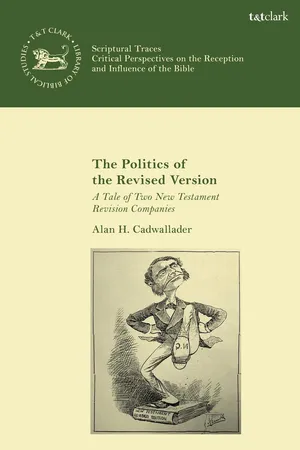
The Politics of the Revised Version
A Tale of Two New Testament Revision Companies
- 256 pages
- English
- ePUB (mobile friendly)
- Available on iOS & Android
eBook - ePub
About this book
Information
Chapter 1
THE CONTESTED PLACE OF THE KING JAMES VERSION IN THE NINETEENTH CENTURY
The English Bible known as the King James Bible, aka ‘the Authorized Version’, was neither a translation nor authorized. Stephen Prickett recognizes that the homogenization of language in the King James Bible – what he dubs the ‘steamroller’ effect – was due to the fact that the work of the translators that became the 1611 publication was both the result of the evaluating scrutiny of committee supervision,1 and the heavy borrowing (enforced by the commissioning edict of King James in 1604) from previous translations – the Geneva Bible, the Bishops’ Bible, the Coverdale, Matthew, Whitchurch and Tyndale translations.2 In a neat twist of history, the ‘heretic’ William Tyndale left a powerful legacy in precisely the Bible attributed by name to royal imprimatur. The King James revisers themselves were keen to accent that their work was simply an improvement. One of their number (Miles Smith), doubtless aware of the muskets levelled at the work, wrote a long explanatory preface (often dropped in later printings of the text) in which full flights of forensic rhetoric defended the efforts: ‘Truly (good Christian Reader) we never thought from the beginning that we should need to make a new translation . . . but to make a good one better, or out of many good ones, one principal good one, not justly to be excepted against.’3 Nonetheless, the shift away from the prescribed benchmark, the Bishops’ Bible, and even to include reference to versions not listed in the guidelines (such as the Rheims Version – a work of English Catholics)4 were sufficient to bring Westcott’s sober verdict ‘that the revisers did not hold themselves to be closely bound by the instructions which were given them . . . If indeed they had not interpreted liberally the license of judgment which was given them, they could not have accomplished their task’.5 Written in 1868, the words had a prescience of the revision to come – and perhaps, with that historical consciousness, a permission to sacrifice the letter of regulation to the goal of accuracy.6
Finding the Basis of Authorization in England
Given the close attention to previous English versions, the language of the King James Bible already had an archaic ring to it.7 Indeed, one of the commissioning guidelines expressly charged that ‘[t]he old ecclesiastical words to be kept’, going on to glaze a window into the ecclesiastical politics of its own day by expressly stating that ‘the word “church” not to be translated “congregation”’, a clear marginalizing of Tyndale’s translation, adding an ‘etc’ that was probably intended to cover any flagship terminology of the Puritans!8 Not only did this traditional tone undermine any accusation of vulgarity or subversion, but, as Owen Chadwick so astutely intimated, it generated an atmosphere that was the aural equivalent to the architectural majesty of an ancient cathedral.9 And the aural was a deliberate artifice, with each line being rehearsed aloud before the final committee, ‘a final quality control check’.10 This Bible became beloved of Nonconformist churches in England and was the staple of Christianity in the United States. It offered a vicarious evocation of a medieval nave for those bench-bound at chapel. David Norton’s efforts to demonstrate the proximate literalism of the King James Bible to its foundational texts apply equally to the translation as it was heard and read, ‘[I]t carries the reader from here to there and from now to then.’11 The King James Bible allowed Nonconformists to forget their Nonconformity, especially given that they could hear something of their own language in the text. This investment would be crucial in preparing the seedbed of their desire to be involved in the work of revision. The Dean of Westminster in 1858, Richard Trench, deemed it ‘the chiefest [bond] that binds the English Dissenters to us and us to them’.12
It was this, ultimately, that authorized the KJB. Even though its front matter declaimed that it was ‘appointed to be read in churches’, there was in fact no convocational, parliamentary or even royal ‘authorization’. This had become the axiomatic designation brought to that Bible by successive generations who had heard that language. Richard Burridge claims that the tag ‘Authorised Version’ only entered the naming of the English Bible in the early nineteenth century, on the heels of the ‘King James Version’; the ‘King James Bible’ had emerged in the previous century.13 Such titular terminology, KJV and KJB, became possible only because of the ubiquity of its use and acceptance, admittedly after a stuttering advance into the populace. The power of such identification has not been lost on subsequent publishers however who rush to have a readily recognized label headlining their cover and readily reduced to an abbreviated tag, such as RSV, NRSV, NIV and so on, along a canyonesque production line.
‘Authorized’, it seemed, was a worthy if not authentic accolade to attach to this Bible, but the term thereby remained malleable in the hands of those who advocated it. ‘The very idea of an authorized translation inevitably involves the concept of representation’, writes the translation theorist Stefano Arduini. Something in the text that is authorized participates in the reality it describes. Language, the language of the AV, participates in sacrality.14 Authorization was formed by the cultivation of ‘Church English’, a result of the appointment of the KJB ‘to be read in churches’. Prickett calls it an ‘idiolect . . . related to everyday speech but also at one remove from it’.15 Add God to that language and the translation becomes inspired. Thomas Hobbes’ caustic tongue long before (in 1668) had captured the result: ‘After the Bible was translated into English, euery man, nay euery boy and wench that could read English, thought they spoke with God Almighty and vnderstood what he said.’16
The hold of that language played powerfully into Gladstone’s claim upon the people. As he is reported as saying in yet another deflation of the RV, ‘You will sacrifice truth if you don’t read it; you will sacrifice the people if you do.’17 It was a fateful bifurcation, indicating that truth was expendable or impressionable in the face of popular devotion. As David Lawton tellingly distils it, and as he tellingly fails to include the AV under its ambit, ‘[T]he Bible that readers prefer is the Bible they wish (or wish not) to believe.’18 Language, the language of ‘authorized’ became subject to a solipsistic authority. The old anti-democratic watchword of ‘the mob’ fed inversely on such populist sentiments,19 exposing the contradiction of paternalistically claiming popular devotion at the same time as distrusting popular autonomy. It would take a bridge built with massive education and marketing to overcome the division that Gladstone had made – and the revisionists certainly tried, even as they had succeeded in bringing on revision through a well-orchestrated campaign. Ironically, the very division orchestrated in such agonistic terminology actually guaranteed the eventual fracturing of the authority of authorization and would secure the multiplication of translations usually called ‘versions’ in the twentieth century, versions that operate as marks of political allegiance as much as conduits to ‘God’s Word’.20 The language of ‘authorized’ became the determinant of a group even as it was determined by that group.
Already by the mid-nineteenth century, the nature of the authorization of the King James Bible was being debated. Neither royal edict nor parliamentary order could be found that would provide the reality for the assumption behind the attribute of ‘authorized’.21 There was nothing imitating Henry’s express ‘auctorysed and apoynted by the commaundemente of oure moost redoubted Prynce and Soueraygne Lorde Kynge’.22 Some pointed out that the likely archive of the documentary sanction, the records of the Privy Council for the relevant period, had been destroyed by fire.23 But such arguments from silence only demonstrate how tendentious the debates over authorization could become.
Even so, there were three elements that helped to cultivate a presumption of approval and sanction from the highest authority. The first was the link between royalty and the promotion of the English-language Bible that predated the King James Version. The Great Bible, a revision of the so-called Matthew Bible (a mixture of Tyndale’s and Coverdale’s respective versions), had gained official royal approval. Henry VIII’s proclamation of 1541 deemed that ‘in al and synguler parysche churches, there shuld be provided . . . Bybles conteynynge the olde and newe Testament, in the Englyshe tounge’ but this was no blanket permission. The elaborate frontispiece of the Great Bible that was already then approaching two years in publication was self-referential and clearly displayed what was authorized. At the apex of the engraving was situated the King, handing the verbum ...
Table of contents
- Cover
- Series Information
- Dedication
- Title Page
- Contents
- Acknowledgements
- A Note on Sources
- List of Abbreviations
- Introduction
- Chapter 1 The Contested Place of the King James Version in the Nineteenth Century
- Chapter 2 Planning and Countering a Revision
- Chapter 3 A Launch and a Near-Abort: The Westminster Scandal
- Chapter 4 Conflicts Over Original Text and Method
- Chapter 5 Identity Formation in Engagement with the New Testament
- Chapter 6 Two Peoples Divided by a Common Language: The Americans
- Chapter 7 Time and Money: The Opening for the Presses
- Chapter 8 The Aftermath
- Appendix A The Members of the Two New Testament Revision Companies
- Appendix B The Resolutions and Fundamental Rules for the Revision of the Authorised Version
- Bibliography
- Index of Biblical References
- Index of Modern Authors
- Index of Subjects
- Copyright Page
Trusted by 375,005 students
Access to over 1.5 million titles for a fair monthly price.
Study more efficiently using our study tools.
Frequently asked questions
Yes, you can cancel anytime from the Subscription tab in your account settings on the Perlego website. Your subscription will stay active until the end of your current billing period. Learn how to cancel your subscription
No, books cannot be downloaded as external files, such as PDFs, for use outside of Perlego. However, you can download books within the Perlego app for offline reading on mobile or tablet. Learn how to download books offline
Perlego offers two plans: Essential and Complete
- Essential is ideal for learners and professionals who enjoy exploring a wide range of subjects. Access the Essential Library with 800,000+ trusted titles and best-sellers across business, personal growth, and the humanities. Includes unlimited reading time and Standard Read Aloud voice.
- Complete: Perfect for advanced learners and researchers needing full, unrestricted access. Unlock 1.5M+ books across hundreds of subjects, including academic and specialized titles. The Complete Plan also includes advanced features like Premium Read Aloud and Research Assistant.
We are an online textbook subscription service, where you can get access to an entire online library for less than the price of a single book per month. With over 1.5 million books across 990+ topics, we’ve got you covered! Learn about our mission
Look out for the read-aloud symbol on your next book to see if you can listen to it. The read-aloud tool reads text aloud for you, highlighting the text as it is being read. You can pause it, speed it up and slow it down. Learn more about Read Aloud
Yes! You can use the Perlego app on both iOS and Android devices to read anytime, anywhere — even offline. Perfect for commutes or when you’re on the go.
Please note we cannot support devices running on iOS 13 and Android 7 or earlier. Learn more about using the app
Please note we cannot support devices running on iOS 13 and Android 7 or earlier. Learn more about using the app
Yes, you can access The Politics of the Revised Version by Alan Cadwallader in PDF and/or ePUB format, as well as other popular books in Theology & Religion & Biblical Studies. We have over 1.5 million books available in our catalogue for you to explore.