Private law enforcement and order maintenance have usually been seen as working against or outside of state authority. A History of Private Policing in the United States surveys private policing since the 1850s to the present, arguing that private agencies have often served as a major component of authority in America as an auxiliary of the state.
Wilbur R. Miller defines private policing broadly to include self-defense, stand your ground laws, and vigilantism, as well as private detectives, security guards and patrols from gated community security to the Guardian Angels. He also covers the role of detective agencies in controlling labor organizing through spies, guards and strikebreakers.
A History of Private Policing in the United States is an overview integrating various components of private policing to place its history in the context of the development of the American state.
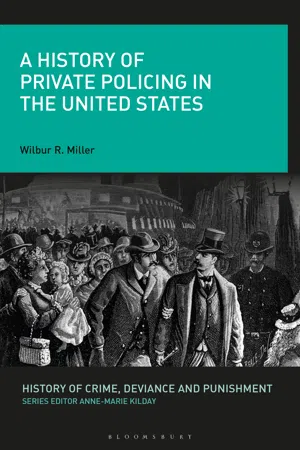
- 248 pages
- English
- ePUB (mobile friendly)
- Available on iOS & Android
eBook - ePub
A History of Private Policing in the United States
About this book
Information
1
Authority in America: Private Policing and the Diffusion of State Power
Private policing in some form is as old as people with property worth protecting or injuries needing redress. It is certainly older than modern public policing, which began in 1829 with London’s Metropolitan Police.1 In its broadest definition, private policing is control by one group over another, often independently of the state, sometimes against it, but also actively or tacitly allied with it in carrying out the same coercive control. Under this broad definition, one type of private policing is individuals defending themselves or groups organizing to protect neighborhoods or drive away people they deem undesirable. The first type includes self-defense, vigilantism, and neighborhood patrols. These are forms of policing, reacting to crime or deviance, but not police. The second type is more obvious: profit-making companies carrying out police functions of order maintenance, detection and prevention of crime. They include private detectives, ranging from individuals in dingy offices to global corporations, from routine investigators of insurance fraud to highly specialized analysts of information related to national security. In greater numbers than detectives, private companies provide armed and unarmed security guards, who protect property in shopping centers, gated communities, concert and sporting events, theaters, factories and warehouses, and docks. Bouncers in bars and clubs and body guards for individuals who think they are important enough to require personal protection are also types of private security. Bail for people pending trial is dependent on a private industry of bondsmen, who hire bounty hunters to track down people who forfeit their bail money by fleeing. Private prisons, while still a minority of American prisons, are influential in shaping public policy to favor mass incarceration.
The context of private policing
Private policing is not unique to the United States, either in the past or in the present. Nevertheless, there are aspects of the American state and ideology especially favorable to it. The structure of the state, with power diffused through different levels—central and local, public and private—is a major factor. The development of representative democracy before consolidation of an administrative state influenced the way public policing developed, creating an opening for private police. Political appointment or control led to corruption, which led many reformers to turn to private policing for areas, such as vice, the police were unwilling or unable to control. Most people tolerated arbitrary exercise of police power as long as it was directed against minority groups or marginal individuals, an attitude not greatly different from vigilantism. The dominant American political ideology of individualism influenced a common preference for private action over governmental action—many people see private policing as less threatening to their freedom than public policing and as cheaper and more efficient. Finally, there were specific historical developments such as the late creation of detective forces in American police departments, which gave an opportunity for private detectives, and the fierce class conflict of the late nineteenth and early twentieth centuries encouraged many employers to rely on private control of labor union organizing and strikes. More recently, the privatization of public services movement of the 1980s and later encouraged entrepreneurial private security and private prison firms to seek government contracts. Many elements, from the nature and structure of the state to more specific or practical aspects, made the United States a favorable national context for private policing.
The American state and private policing
Compared to centralized, bureaucratized European states, many people have seen the American central state as weak. A closer look, though, reveals a state with power diffused through many public jurisdictions but also shared with private organizations. One factor commonly seen as weakening the American state is the division of the nation into multiple jurisdictions and the absence of authority in frontier regions. Scholars who analyze the nature of the American state usually focus on the national government, but a great deal of government, including policing, occurs within individual states and localities. The US Constitution creates a federation, dividing sovereignty among the national government and state governments. Within states, there are counties, urban areas, and other jurisdictions. Although there have been a growing number of federal crimes over the years, state governments define basic crimes like robbery, burglary, and murder and are free to assign punishments for them. Local governments, counties or cities, are responsible for policing. A national police force, the Federal Bureau of Investigation (FBI), was not created until 1908 and is primarily a detective force. There is no equivalent to a European gendarmerie, although individual states maintain state police forces for rural areas and highways. States also are responsible for regulating private policing within their boundaries. Legislatures define such powers as citizen arrest, self-defense, and the circumstances under which private police may exercise powers of arrest and use deadly force. States set licensing and training requirements for guards and detectives. There are no national requirements for private police to meet. Generally, then authority in America over crime and policing is divided among many jurisdictions, which vary considerably, outside of essential crimes like murder and burglary, in defining what is criminal and how public and private police are regulated.
Because police forces cannot exercise their authority outside their own jurisdiction, they were limited especially in the nineteenth century when criminals operated throughout a state or even the nation, taking advantage of railroads to evade arrest. Railroads were the first to turn to private policing to protect their own property, but they also enabled private detectives to follow people they were seeking because their power was not limited by any jurisdiction. Private police sometimes had to adjust to requirements and regulations imposed by states and localities; but if they worked for national businesses like railroads or security service corporations, they were not confined by jurisdictional boundaries. Occasionally in the past, they did not hesitate to extradite a person from one state to another by kidnapping. This national scope enabled large detective agencies like the Pinkertons to serve virtually as a national police force, conducting criminal investigations over a wide area.
The significance of private detectives suggests another aspect of diffused state power, public–private partnerships. The Federal Government and states have long officially delegated or tacitly ceded authority to private institutions either as contractors or as public–private partnerships like the old Bank of the United States, the construction of the transcontinental railway, or more recently the postal service and Amtrak. The state is not necessarily “weak” but is diffuse and exercises authority at many levels.2
Diffusion can demonstrate the ability of the state to penetrate to the local level, not only with its own resources but by enlisting private resources for its purposes. This enlistment combines the public motive of, say, building a transcontinental railroad, with the private motive of profit for the builders (mostly through land donated to the railroads by the government).3 Similarly, private police institutions can be enlisted to fulfill public as well as private purposes as contributors to order maintenance. Such partnerships assume the purposes are not contradictory. As already indicated, public officials often consulted with or hired private investigators instead of the police. In addition, police officials joined or formed private agencies, and private detectives became public officials, as did William Burns when he became head of the FBI. Government alliance with private detective and strikebreaker agencies, overt or tacit, achieved the purpose of controlling labor demands, shared by most government officials at all levels and the employers. Government support of anti-vice and patriotic crusades strengthened the state’s coercive abilities through private means. As William Novack observes, “Rather than monopolize power, property, and policy in the hands of a central public sovereign, the American state less visibly distributed public goods and powers widely through the private sector—enforcing its public capabilities, expanding its jurisdiction, and enhancing its legitimacy in the process.”4 It is only fairly recently that scholars have come to understand the American state as not necessarily weak because it operates through many levels of government and in conjunction with private organizations. Authority in the United States, they suggest, is not only a mix of national and local action but also private activity.
As an alternative view of the American state, some historians have argued that it was limited because it developed after political democracy was achieved. In contrast, European nations had established an administrative bureaucracy and central state long before democracy asserted itself in the nineteenth century. In addition, European states effectively disarmed ordinary citizens well before democracy established citizens’ rights. In the United States, individual states achieved universal white male suffrage in the 1820s and 1830s, a time when there was hardly any centralized bureaucratic administrative apparatus and before establishment of modern police forces.5 The democratic insistence on political and social equality, even if only rhetoric, actually influenced American state institutions as they developed. Distrust of a standing army kept the military voluntary until the Civil War. Such distrust had earlier delayed development of a military academy, West Point. Fear of a professionalism extended to other occupations: government service, medicine, and law. Andrew Jackson famously declared that every intelligent citizen could serve in government agencies; experts or professionals would become self-interested bureaucrats. Many formerly appointive offices became elective. States actually repealed earlier licensing requirements for physicians and lawyers. Medical and law schools developed slowly and did not achieve their modern significance until the early twentieth century. Both professions depended on apprenticeship with practitioners for learning their basics. It is not surprising that this egalitarian anti-bureaucratic, anti-professional attitude shaped development of modern police in the United States and left important openings for private policing.
The New York City Police, the first modern force established in 1845, is an illustration of representative democracy’s effect on state institutions. Its creators wanted the police to reflect American democracy. Consequently, police, who had become recognized as necessary to control disorder, should not be above or distant from the citizens. The police were made responsible to elective officials, rather than independent professionals. They were directly appointed by city council members, who were elected annually. Consequently, they were originally expected to live in the same district they patrolled, and at first did not wear uniforms. Reform in 1853 made the police responsible to a commission of elected officials, allowed them to live where they pleased when off duty, and uniformed them. Even under this reform, the police remained tied to politicians and parties. Not until well into the twentieth century did professionalization finally remove this direct political control.
These democratic attitudes led to two unanticipated consequences: corrupt political party control of urban police forces and arbitrary, extralegal behavior. Both provided openings for private policing during the nineteenth century. Democratic views led first to political party control of the police as a safeguard against police oppression. In practice, though, political control meant that the police were responsible to politicians and enforced laws according to their interests or needs. This was especially true in the control of vices such as gambling or prostitution, which constituents patronized and which served as lucrative sources of payoffs to the police and the politicians they served by not enforcing laws against them.
Many middle- and upper-class citizens protested politicization and corruption of the police. Their concerns led them to form private organizations to suppress vice, and sometimes district attorneys who shared their attitudes hired private detectives to expose vice operations because they could not trust the police. Democracy in the form of political party control of the state apparatus both shaped public policing and fostered the pattern of sharing power with private organizations.6
A second opening, or more appropriately blurring the line between public and private policing, was widespread toleration of arbitrary police behavior. Alexis de Tocqueville suggested that ability to elect “magistrates” allowed nineteenth-century Americans to be comfortable with their authority. They tended to give elected officials broad personal discretion in carrying out their duties, because if dissatisfied they could defeat them or those responsible for their conduct at the next election.7 This could lead to officials’ arbitrary conduct as long as the voters supported them. An Alabama sheriff recently stated this point succinctly: she operates her office “based on what the public wants or likes.” That is, what the voters who elected her expected of her. Civil libertarians are concerned that is “simply license for sheriffs to act as if they are above the law.”8 The sheriff’s attitude is by no means new.
Tocqueville was writing before creation of modern police forces, but his point applies to the new police as well as to judicial and other law enforcement officials. Reflecting this view that voters tolerated wide discretionary power in elected officials, most people tolerated or ignored arbitrary police behavior as long as it was directed against marginal members of society. Police themselves were not elected, but they were directly or indirectly responsible to elected officials as the structure of the New York force indicated. Police often acted out the perceptions or prejudices of a majority of the population when they arrested drunken Irish laborers or African-American street vendors. Profiling is as old as the police themselves. Having made the police a democratic institution, “respectable” Americans could tolerate arbitrary power against “disreputable” Americans.
The police themselves, and those who favored control of socially marginal people, were frustrated because judges often let people go when politicians intervened on behalf of supporters.9 This frustration fed the police’s tendency toward “street corner justice,” punishment of suspects when arrested or in the station house. As long as such behavior was confined to “the dangerous classes,” there were few people who spoke up for the rights of arrestees or suspects in the nineteenth century. The police were granted great power and could exercise it with minimal legal or policy constraints. Police arbitrariness or brutality, as long as it reflected the attitudes of influential citizens, is not very much different from vigilantism in uniform. Attitudes toward public police were similar to attitudes toward private policing, as long as they were concentrated against socially marginal groups. Citizens did not hold the public police to a higher standard of conduct or expect them to be impartial law enforcers. The heads of the London police, the model for New York, tried to maintain such standards, although they were not always followed by men on the beat.10
Political ideology and private policing
Ideology about the state as well as the state’s structure has created a favorable climate for private policing. However nuanced historians’ view of the American state, a limited national state is part of American ideology. Many Americans believe that a weak state means more personal freedom and that private enterprise is better than government activity. The state should be weak, and many Americans consider assertion of governmental, especially federal, authority in the realm of business or environmental regulation a form of tyranny. “Our political tradition has virtually identified freedom and autonomy with the private sphere, and posed them in opposition to the public sphere of state power.” That the state has no business interfering with individual autonomy “has been central to the American conceptions of freedom and limited government.”11 Jennifer Nedelsky’s point echoes Tocqueville’s famous invention of American “individualism,” a form of self-centeredness that excluded people outside one’s own small circle of family, friends, or fellow workers, and prevented much sense of the public good as higher than individual or group interests. In the early twentieth century, H.G. Wells described “state blindness,” a similar lack of identification with a public interest, and...
Table of contents
- Cover
- Halftitle Page
- Title Page
- Dedication Page
- Contents
- List of Figures
- Preface
- 1. Authority in America: Private Policing and the Diffusion of State Power
- 2. Self-defense and the “Armed Citizen”
- 3. Varieties of Vigilantism
- 4. Security Guards and Patrols
- 5. Private Detectives
- 6. Policing Labor
- 7. Prisoners for Profit
- 8. What Should Be the Relation between the State and Private Policing?
- Notes
- Selected Bibliography
- Index
- Imprint
Trusted by 375,005 students
Access to over 1.5 million titles for a fair monthly price.
Study more efficiently using our study tools.
Frequently asked questions
Yes, you can cancel anytime from the Subscription tab in your account settings on the Perlego website. Your subscription will stay active until the end of your current billing period. Learn how to cancel your subscription
No, books cannot be downloaded as external files, such as PDFs, for use outside of Perlego. However, you can download books within the Perlego app for offline reading on mobile or tablet. Learn how to download books offline
Perlego offers two plans: Essential and Complete
- Essential is ideal for learners and professionals who enjoy exploring a wide range of subjects. Access the Essential Library with 800,000+ trusted titles and best-sellers across business, personal growth, and the humanities. Includes unlimited reading time and Standard Read Aloud voice.
- Complete: Perfect for advanced learners and researchers needing full, unrestricted access. Unlock 1.5M+ books across hundreds of subjects, including academic and specialized titles. The Complete Plan also includes advanced features like Premium Read Aloud and Research Assistant.
We are an online textbook subscription service, where you can get access to an entire online library for less than the price of a single book per month. With over 1.5 million books across 990+ topics, we’ve got you covered! Learn about our mission
Look out for the read-aloud symbol on your next book to see if you can listen to it. The read-aloud tool reads text aloud for you, highlighting the text as it is being read. You can pause it, speed it up and slow it down. Learn more about Read Aloud
Yes! You can use the Perlego app on both iOS and Android devices to read anytime, anywhere — even offline. Perfect for commutes or when you’re on the go.
Please note we cannot support devices running on iOS 13 and Android 7 or earlier. Learn more about using the app
Please note we cannot support devices running on iOS 13 and Android 7 or earlier. Learn more about using the app
Yes, you can access A History of Private Policing in the United States by Wilbur R. Miller in PDF and/or ePUB format, as well as other popular books in History & 20th Century History. We have over 1.5 million books available in our catalogue for you to explore.