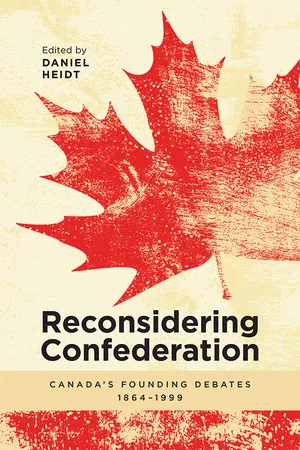
July 1st 1867 is celebrated as Canada's Confederation - the date that Canada became a country. But 1867 was only the beginning. As the country grew from a small dominion to a vast federation encompassing ten provinces, three territories, and hundreds of First Nations, its leaders repeatedly debated Canada's purpose, and the benefits and drawbacks of the choice to be Canadian. Reconsidering Confederation brings together Canada's leading historians to explore how the provinces, territories, and Treaty areas became the political frameworks we know today. In partnership with The Confederation Debates, an ongoing crowdsourced, non-partisan, and non-profit initiative to digitize all of Canada's founding colonial and federal records, this book breaks new ground by integrating the treaties between Indigenous peoples and the Crown into our understanding of Confederation.Rigorously researched and eminently readable, this book traces the unique paths that each province and territory took on their journey to Confederation. It shows the roots of regional and cultural grievances, as vital and controversial in early debates as they are today. Reconsidering Confederation tells the sometimes rocky, complex, and ongoing story of how Canada has become Canada.
- 320 pages
- English
- ePUB (mobile friendly)
- Available on iOS & Android
eBook - ePub
About this book
Information
5
The Maritimes and the Debate
Over Confederation
Phillip Buckner
On 1 September 1864 fifteen delegates from Nova Scotia, New Brunswick, and Prince Edward Island met in Charlottetown, ostensibly for the purpose of discussing a proposal for Maritime Union. In reality, the delegates were aware that their chances of working out a scheme of Maritime Union acceptable to the three Maritime legislatures were negligible. Quite probably they would not have met at all, if a delegation from the Province of Canada had not asked to attend the meeting in order to present a proposal for a larger union of British North America. Within just over a week the delegates at Charlottetown agreed to the general outline for the creation of a continental union that would ultimately stretch from the Atlantic to the Pacific. In October nineteen delegates from the Maritimes met in Quebec City with delegates from the Province of Canada and Newfoundland and hammered out seventy-two resolutions designed to provide a framework for the constitution of the union. The Maritime delegates then returned to their respective provinces to attempt to get legislative approval for the Quebec Resolutions (or the Quebec Scheme, as it was called by its opponents).
The Negotiations
In recent historiography it has become an article of faith that the Maritimes were persuaded to enter a union that they neither needed nor wanted, a union that was essentially designed to favour the interests of the Province of Canada. It is certainly true that the levels of trade between the Maritimes and Canada in the early 1860s were low. It is also true that many Maritimers could see few benefits from increased economic activity between two regions that had very similar economies, based primarily upon agriculture and the extraction of raw materials for export markets in Britain and the United States. Moreover, during the early 1860s the Maritimes were experiencing comparatively rapid economic growth, generated by the Reciprocity Treaty of 1854 with the United States and the increased demand for raw materials created by the American Civil War. There were, however, fears that the end of the War would also mean an end to the prosperity of the region, especially if the United States abrogated the Reciprocity Treaty.
There were other signs of a bumpy economic future. The population of the Maritimes continued to grow during the 1860s, reaching a total of 768,000 in 1871. But this growth disguised an important underlying reality that some Maritimers recognized. Population growth in the 1860s was generated largely by natural increase as the number of immigrants to the region began to decline and a growing number of the native-born emigrated, mainly to the United States. This was a sign that the limits for the expansion in the Maritimes of a traditional economy based upon the production of raw materials and the wooden ships built and operated by local merchants would soon be reached. Some members of the economic and political elites (and there was considerable overlap between the two) had already begun to see the economic future of the region in terms of the development of railways to the south to Maine and to the west to Canada. These railway links, the railway enthusiasts hoped, would increase the potential for trade and lead to the development of secondary manufacturing industry. Yet the building of long-distance railways involved more capital investment than any of the Maritime colonies could raise on their own. The attempt to build a railroad (usually described as the Western Extension) linking Saint John, the largest city in the Maritimes, with Bangor, Maine, floundered because of the failure of New Brunswick to find a partner in Maine willing to undertake any construction. The construction of an intercolonial railway linking the Maritimes with Canada also floundered because of the failure to reach an agreement with the Canadian and British governments over how the railway should be financed. Increasingly, it seemed obvious that the Intercolonial would never be built unless the British North American colonies united and made a firm commitment to the project.
The enthusiasm for railways was not universal. It was strongest in the larger urban centres that were likely to be on the route of the Intercolonial or could easily be connected by feeder lines, and in the areas that had substantial coal reserves and deposits of iron and therefore the greatest industrial potential. There was much less enthusiasm for vastly expanded expenditures on railways in communities that relied on agriculture, the fisheries, and the traditional seaborne trades and that preferred to keep taxes and tariffs as low as possible, and it was in these areas where Confederation had the least appeal. Without doubt for the Maritimes the decision to join what was designed to become a continental union involved a far greater risk than it did for the Canadas. The Maritime delegates at Quebec hoped that the economic advantages of the central provinces could be partly offset by the building at federal expense of the Intercolonial railway, but many Maritime merchants and bankers feared that the railway would lead to increased Canadian domination of their regional economy and many farmers, fishers, and shipowners feared that it would lead to increased taxation.
Confederation was, however, about a great deal more than trade. The English-speaking population in both the Maritimes and the Province of Canada may have been separated (as the opponents of Confederation pointed out) by a vast expanse of wilderness, but they still had a great deal in common. They had a sense of a shared ancestry and a deep commitment to the British Empire, to the British monarchy, to the British constitution, and to British liberal values. It was this shared cultural identity that enabled the delegates from Canada and the Maritimes at the Charlottetown Conference to accept the need for a confederation of the British North American Colonies and to agree at Quebec City upon a detailed plan of union. The timing of the conferences was critical. In 1862 the removal of two Confederate envoys to London from a British ship, the Trent, by the American navy, had brought America and Britain perilously close to war and aroused fears across all of British North America. As the American Civil War gradually drew to a close and the victory of the North became inevitable, it was increasingly clear that the balance of power on the North American continent had permanently shifted and that the political and economic viability of the British colonies on the northern half of the North American continent was threatened. The belief that British Americans had to choose between continued membership of the British Empire or gradual absorption into an expanding American Empire was the strongest force driving the movement for Confederation.1 Initially the anti-Confederates played down these fears, insisting that the end of the war would mean an end to tensions along the American-Canadian border. But the decision of the American government in 1865 to abrogate the Reciprocity Treaty, a decision made on political, not on economic, grounds, seemed a clear sign of American hostility to the long-term survival of British North America. These fears were intensified by the raids on British North American soil from across the American border by the Fenians, an Irish nationalist movement with substantial support among Irish Americans and even some, very limited support, among Irish Canadians. The Fenian Raids have traditionally been viewed as something of a joke rather than a serious threat, a threat the pro-Confederates exaggerated in order to arouse anti-American and anti-Catholic sentiment and gain support for Confederation. There is some truth in this argument, but it greatly underestimates how seriously the Fenian threat was viewed throughout British North America and how worried British Americans were that the raids might provoke an incident that could lead to another Anglo-American War.
Recent scholarship on Anglo-American relations emphasizes that the aftermath of the American Civil War would lead to a growing rapprochement between the United States and Great Britain, culminating in the Treaty of Washington in 1871. But this is an interpretation based largely upon hindsight, for contemporaries both in Britain and British North America took the threat of American expansionism seriously. Even the Treaty of Washington did not bring an end to tensions in the Anglo-American relationship. It is also a myth that the Imperial Government was looking for a way to abandon its commitment to defend its North American colonies. If a war should take place (and the Imperial Government certainly hoped it could be avoided through diplomacy), the British were confident that they could rely on the Royal Navy to win it. But the Imperial Government was seeking to devolve more of the expense of defending its North American colonies on the British Americans themselves. The belief that the British North American colonies would be better able to protect their borders and survive American continental dominance if they were united was the primary reason why the Imperial Government strongly supported Confederation. Without Imperial support Confederation could not have taken place in the 1860s, but the extent of Imperial influence should not be exaggerated (as it has been in much of the recent literature).2 British Americans could not have been coerced into Confederation. If a majority, or in the case of Nova Scotia at least a majority in the existing Assembly, had not been convinced that it was in the long-term interests of the British North American colonies to unite against the American threat in order to preserve their connection with the British Empire, Confederation could never have taken place. If anything showed that clearly, it was Prince Edward Island’s refusal to join Confederation until it was ready to do so on its own terms, despite the Imperial Government bringing to bear all the pressure it could.
Some anti-Confederates in the Maritimes argued that the colonists would be better off if they abandoned the imperial tie and were annexed to the United States rather than to Canada. But this was the view of a small minority. Some anti-Confederates actually argued the opposite case, that the danger in the creation of a new national state was that it would weaken the loyalty of the colonists to the Empire and lead to independence (which it would eventually, but not in the lifetime of anyone living in 1864). But the majority, even of the anti-Confederates, in the Maritimes accepted that British American union was both necessary and desirable in the long run to preserve the imperial tie. Some of them objected to the timing of Confederation, arguing that union was premature and should not take place until the Intercolonial was built and closer links were forged between Canada and the Maritimes. But the primary objection of many, if not most, Maritimers (certainly of the Maritime political elites) was to the terms upon which union was to take place. Their objection was not to a union, but a union on the basis of the Quebec Resolutions.
With the hindsight of 150 years, it is easy to accept the argument made by the anti-Confederates that the Maritime delegates to the Quebec Conference had made a bad deal which led to the Maritimes entering an unequal union in which the interests of the region were inadequately protected. Again, there is an element of truth in this argument. Clearly the much larger colony of Canada was bound to have a disproportionate influence in the negotiations leading to union and in the politics of the nation that was being created—a nation that symbolically would be called Canada. Yet, as the leading pro-Confederates from the region recognized, the Maritimes were negotiating from a position of increasing weakness. The Imperial Government clearly intended to devolve more of the responsibility for defending and for governing its North American territories on the colonists. Without a union this would mean placing effective control in the hands of the largest and most powerful colony, the Province of Canada. In negotiations over the renewal of reciprocity with the United States, the regulation of the fisheries, the settlement of Western Canada, and many other important issues with serious consequences for the Maritimes, the Imperial Government was almost certain to follow Canadian advice and pay limited attention to the concerns of the Maritimes. The pro-Confederate leadership also believed that unless the Intercolonial was built and the Maritimes were able to become a part of a rapidly expanding Canadian economy, the region would fall behind and languish. If Canada survived and if it did gain control over the vast imperial territories in the West (and it was in the long-term interests of the Maritimes that both of these things should happen), the Maritimes might be at an even greater disadvantage if it sought to enter Confederation at a later date. The Maritime delegates at Quebec were also aware of the fragility of the Canadian coalition and that there were limits to the compromises the Canadians could accept over the terms of union.
Nonetheless, the delegates from the Maritimes at Quebec did seek to ensure that the interests of the region would be protected as best they could within the new federal structures. The measure that was hardest for the anti-Confederates to accept was the decision to establish representation by population as the basis of representation in the proposed House of Commons, thus ensuring that the Canadians would inevitably form a substantial majority in the new House of Commons, a majority likely to grow even larger over time. But it was clear from the beginning that no other system would be acceptable to the Upper Canadians and the anti-Confederates failed to come up with an alternative that was not patently self-serving and unrealistic. In any event the belief of the anti-Confederates that the Canadians would form a united bloc in the new House of Commons was rather ridiculous in light of the political history of the United Province of Canada and the obvious divisions between the English-speaking majority and the French-speaking minority. Indeed, George Brown, the political leader of the majority party in Canada West, tried to persuade the Maritime Liberals to support Confederation in order to create a majority in the Canadian House of Commons which would put an end to French-Canadian domination of the united Province. That alliance did not take place, but astute Maritime politicians like Samuel Leonard Tilley and Charles Tupper were right in the assumption that the Maritime contingent to Ottawa would have the ability to play a major role in federal politics, at least during their lifetim...
Table of contents
- Contents
- Illustrations
- Acknowledgments
- Introduction: Reconsidering Confederation
- Compact, Contract, Covenant: The Evolution of First Nations Treaty-Making
- Ontario: The Centre of Confederation?
- Quebec and Confederation: Gains and Compromise
- The Maritimes and the Debate Over Confederation
- Resisting Canada’s Will: Manitoba’s Entry into Confederation
- “The interests of Confederation demanded it”: British Columbia and Confederation
- “It is better to have a half loaf than none at all”: The Yukon and Confederation
- Creating New Provinces: Saskatchewan and Alberta
- Newfoundland and Canada: Confederation and the Search for Stability
- “A More Accurate Face on Canada to the World”: The Creation of Nunavut
- Confederation Quotes: Sources and Further Reading
- Contributors
- Index
Trusted by 375,005 students
Access to over 1.5 million titles for a fair monthly price.
Study more efficiently using our study tools.
Frequently asked questions
Yes, you can cancel anytime from the Subscription tab in your account settings on the Perlego website. Your subscription will stay active until the end of your current billing period. Learn how to cancel your subscription
No, books cannot be downloaded as external files, such as PDFs, for use outside of Perlego. However, you can download books within the Perlego app for offline reading on mobile or tablet. Learn how to download books offline
Perlego offers two plans: Essential and Complete
- Essential is ideal for learners and professionals who enjoy exploring a wide range of subjects. Access the Essential Library with 800,000+ trusted titles and best-sellers across business, personal growth, and the humanities. Includes unlimited reading time and Standard Read Aloud voice.
- Complete: Perfect for advanced learners and researchers needing full, unrestricted access. Unlock 1.5M+ books across hundreds of subjects, including academic and specialized titles. The Complete Plan also includes advanced features like Premium Read Aloud and Research Assistant.
We are an online textbook subscription service, where you can get access to an entire online library for less than the price of a single book per month. With over 1.5 million books across 990+ topics, we’ve got you covered! Learn about our mission
Look out for the read-aloud symbol on your next book to see if you can listen to it. The read-aloud tool reads text aloud for you, highlighting the text as it is being read. You can pause it, speed it up and slow it down. Learn more about Read Aloud
Yes! You can use the Perlego app on both iOS and Android devices to read anytime, anywhere — even offline. Perfect for commutes or when you’re on the go.
Please note we cannot support devices running on iOS 13 and Android 7 or earlier. Learn more about using the app
Please note we cannot support devices running on iOS 13 and Android 7 or earlier. Learn more about using the app
Yes, you can access Reconsidering Confederation by Daniel Heidt in PDF and/or ePUB format, as well as other popular books in History & North American History. We have over 1.5 million books available in our catalogue for you to explore.