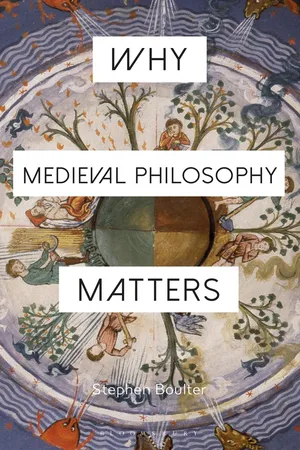
Tackling the question of why medieval philosophy matters in the current age, Stephen Boulter issues a passionate and robust defence of this school in the history of ideas. He examines both familiar territory and neglected texts and thinkers whilst also asking the question of why, exactly, this matters or should matter to how we think now.
Why Medieval Philosophy is also provides a introduction to medieval philosophy more generally exploring how this area of philosophy has been received, debated and, sometimes, dismissed in the history of philosophy.
- 216 pages
- English
- ePUB (mobile friendly)
- Available on iOS & Android
eBook - ePub
Why Medieval Philosophy Matters
About this book
Information
CHAPTER ONE
Scholasticism and common sense
This chapter begins the case for medieval philosophy by highlighting the fact that scholastic metaphysics and epistemology are quite consciously developed with an eye to saving common sense beliefs. While Thomas Reid and G. E. Moore also defend common sense, their efforts are largely confined to combating the views of other philosophers who would deny or go beyond common sense, while the scholastics focus rather on the construction of an elaborate conceptual framework which takes common sense beliefs as axiomatic. These points are illustrated by focusing on two classic problems: the problem of universals, and the problem of change. The thrust is that the scholastic solution to these problems will prove attractive to the philosophical layperson, while the alternatives will strike her as paradoxical. The scholastic solutions also provide the basis for the sciences, the topic of the next chapter.
Introduction
In the concluding section of Book I of A Treatise of Human Nature David Hume (1989) makes some remarkable admissions. After several pages in which he acknowledges the difficulties facing those who would venture out onto troubled philosophical seas, after admitting his own worries about falling into philosophical error and his lack of success in finding followers, after admitting that his own reflections have led him to ‘the most deplorable condition imaginable, inviron’d with the deepest darkness, and utterly depriv’d of the use of every member and faculty’, after all this he confesses that ‘nature’ cures him of his ‘philosophical melancholy and delirium’:
I dine, I play a game of back-gammon, I converse, and am merry with my friends; and when after three or four hour’s amusement, I wou’d return to these speculations, they appear so cold, and strain’d and ridiculous, that I cannot find in my heart to enter into them any farther. (p. 268)
Here Hume attests to the fact that the spell cast by his own philosophical reflections is broken once he gets back to the humdrum of everyday life. This passage is likely to strike a chord with many who have studied philosophy. All too often what is discussed in all seriousness in a philosophy class appears fanciful once one leaves the lecture hall. But the really curious aspect of this passage is what Hume makes of the fact that his philosophical reflections appear ‘strain’d and ridiculous’ after a few hours spent with friends. Rather than revisiting his sceptical conclusions with the scepticism they themselves deserve, Hume sees here a sign of the considerable powers of our passions and non-rational nature to override the paradoxical conclusions he thinks are rightly drawn by our reason. Thus a sharp cleavage opens up between how Hume thinks one proceeds qua philosopher and how one thinks qua normal person. And since Hume is one of the great names in the philosophical canon, the take-home message for students being introduced to Hume is that there is a special set of rules one is supposed to follow when doing philosophy, rules one would not dream of applying in any other truth-directed discipline.
Hume is not the only philosopher so enamoured with the niceties of a philosophical argument as to be willing to overlook the fact that its conclusion is ridiculous. But if philosophy is to matter outside of academe, if it is to be more than a clever parlour game, then we philosophers must curb our enthusiasm for the paradoxical. Too much philosophy is ‘strain’d and ridiculous’ once the aura of the lecture hall recedes.
But it hasn’t always been this way. True, like most of the pre-Socratics, Parmenides and Heraclitus had some peculiar ideas about the fundamental structure of reality: the one denying that change ever occurs in the natural order, the other denying that anything is ever the same from one moment to the next. And while Plato did not follow either Parmenides or Heraclitus entirely, his attempt to reconcile these two thinkers led him to posit a realm of abstract entities existing ‘outside’ space and time, entities no one had ever previously imagined. But Plato’s most famous student would have none of this. Aristotle was convinced not only that a philosopher should start their reflections with beliefs shared by the majority of one’s contemporaries but that they should end there as well. That is, Aristotle maintains that a philosopher has a credible solution to a philosophical problem only if that solution is consistent with common sense. If that means abandoning a thesis defended by an illustrious philosopher, then so be it.1 We will have occasion to consider this meta-philosophy in more detail in Chapter 4. But the point for our present purposes is that Aristotle’s philosophical system draws out and develops the implicit metaphysics, epistemology and ethics of ordinary life. This means that fundamental Aristotelian principles retain their plausibility long after one has left the lecture theatre, sparing us the institutionalized schizophrenia that defenders of much pre-Aristotelian and post-Cartesian philosophy must endure.
Aristotle is not the only important philosopher to respect common sense. Thomas Reid, the uncompromising critic of his contemporary Hume, and the key figure of the Scottish School of Common Sense Philosophy, worked tirelessly to overcome the philosophical mindset and conclusions popularized by Descartes. And in the early days of the twentieth century Moore once again took up the baton in defence of the views of the philosophical layperson. He in turn inspired the ordinary language philosophers associated with the Oxford of the 1950s and 1960s. But the most sophisticated thinkers to follow Aristotle’s lead were the scholastics.
There is a reason why the scholastics achieved such heights of sophistication, for there is an important difference between their intellectual tasks and those of the defenders of common sense who arrive on the scene after the advent of Descartes. Reid and Moore spend much of their time defending common sense views from the attacks of other philosophers. They turned their considerable skills to the task of diagnosing the errors in the arguments of other philosophers. Now this necessary but time-consuming defensive work was never undertaken by the scholastics because it never occurred to anyone that such a defence was needed. They took common sense beliefs for granted and then set to work on the puzzles that arise once we take these beliefs seriously from a philosophical point of view. But the advent of Descartes’s ‘epistemological turn’, inaugurated in Discourse on Method and the First Meditation, changed the programme.2 From now on philosophers had to offer proofs for beliefs that used to be taken for granted, hence the differences in the tasks facing the scholastics and a Reid or a Moore, who find themselves on the other side of the Cartesian historical divide. While the efforts of Reid and Moore are largely confined to combating the views of other philosophers who would deny or go beyond common sense, thereby arguing to common sense beliefs, the scholastics were free to focus on the positive task of constructing an elaborate conceptual framework which takes common sense beliefs as axiomatic; that is, they argued from common sense beliefs towards a metaphysical account of what is implicit in everyday life. A result was that the best minds of Europe worked collaboratively on a common, overarching philosophical project, within a largely shared philosophical framework, over the course of several centuries. There has been nothing like it since. The level of professionalism and sophistication achieved was extraordinary. And their basic framework, the main topic of this book, continually surprises by its ability to withstand scrutiny in the light of our considerable advances in the sciences.3
These points are illustrated in this chapter by focusing on two classic problems: the problem of universals, and the problem of change. The moral of the story is that the scholastic solution to these problems will prove attractive to the philosophical layperson, while the alternatives will strike them as paradoxical. So if we are keen to find a philosophical voice that might get some traction outside of academe, then the scholastics have something to offer.
But first, it would be wise to pause for a moment to clarify what is meant by the terms ‘common sense’ and ‘common sense belief’.
What counts as a common sense belief?
The term ‘common sense’ as employed here is something of a term of ‘art’.4 Having a common sense belief is not about having ‘street smarts’, for example, or having a general ability to deal with a tricky set of circumstances without proper preparation or warning, although in a looser, more colloquial sense this way of speaking is perfectly acceptable. Common sense beliefs in the sense which I use the term here, and in which Reid understood the term, are the fundamental elements, principles or cornerstones of the conceptual scheme lying behind the views and actions of the ordinary person. More precisely, common sense beliefs are those views regarding the nature of things which are presupposed by ordinary everyday beliefs and abilities. It is these ‘principles of common sense’, as Reid calls them, that ‘massive central core of human thinking which has no history’, as Strawson has it,5 which are the common sense philosopher’s main concern. Now these principles might never be explicitly entertained by the ordinary person, not because common sense beliefs are obscure, difficult or arcane but because they are so obvious that they ordinarily pass entirely unnoticed. Nevertheless, these principles must be true if the sorts of things we commonly and consciously accept as true are true.
Some examples will help fix ideas. The following are taken from Moore’s first lecture in Some Main Problems of Philosophy. Moore claims that common sense would have it that
1 There are in the universe an enormous number of material objects (e.g. our bodies, other people, animals, plants, stones, mountains, rivers, seas, planets, tables, chairs).
2 Human beings have minds inasmuch as we have a variety of mental states, including acts of consciousness. We see, hear, feel, remember, imagine, think, believe, desire, dislike, will, love and so forth.
3 All material objects are located in space inasmuch as they are located at a distance from each other.
4 Mental acts are attached to – contained within – certain kinds of bodies (human bodies and perhaps those of the higher animals).
5 Mental acts are ontologically dependent upon bodies.
6 Most material objects have no acts of consciousness attached to them.
7 Material objects can and do exist when we are not conscious of them.
8 There was a time when no act of consciousness was attached to any material body.
9 All objects and acts of consciousness are in time.
10 We know (1)–(9) to be true.
Now the principal contention of common sense philosophy is that any philosophical argument, thesis or system which is inconsistent with any of this set of beliefs is almost certainly wrong, and so no lasting philosophical achievement is to be expected if these beliefs are not accommodated. But the main point for our present purposes is that the scholastics – despite their historical distance, and despite their forbidding technical language – embrace (1)–(10), and so they speak fundamentally the same language and inhabit fundamentally the same metaphysical world as today’s philosophical layperson. This important point is best seen by considering two of philosophy’s deepest metaphysical problems, the problem of universals and the problem of change.
The problem of universals
No period in history saw a more sustained attack on the problem of universals than the Middle Ages. For some it is the quintessential issue of the period. Although the problem fell out of fashion in the early modern period, it has regained prominence amongst metaphysicians of the twentieth-century analytic tradition. Curiously there is nothing particularly ‘medieval’ about the problem since it does not presuppose any distinctly theological considerations, and it had been extensively discussed by the ancient Greeks. In fact the problem arises for anyone who would try to understand the relationship between thought and extra-mental reality. The problem, which takes the form of an aporia, emerges whenever one finds a commitment to the following plausible but apparently incompatible propositions:
11 Explanatory knowledge of the natural order is possible.
12 Such knowledge is expressed in statements containing general terms and not just names of singulars.
13 A necessary condition of knowing that p is that p is true.
14 Truth is correspondence.
15 Reality contains only singulars.
These propositions need some unpacking before the problem becomes perfectly clear. One has explanatory knowledge of p when one knows not just that p is the case, but why p is the case. And one knows why p is the case when one knows the causes that brought about p. Proposition (11) says that knowledge of this type is possible regarding the natural or real order. The ‘natural order’ is the term used by the scholastics for what we would now refer to as the domain of the natural sciences. The natural order is that system of entities whose existence and nature is independent of what humans happen to think about it. That is, such entities can and do exist even when we humans are not conscious of them, as Moore’s seventh proposition has it. The items listed in the chemist’s table of elements, for instance, existed long before humans identified them, and their properties are there to be discovered, not invented, by us.6 Now because our social order has signed up to science being the source of explanatory knowledge of how the world works, we are collectively committed to Proposition (11).
Proposition (12) says that explanatory knowledge claims are impossible to formulate without employing general terms or terms for ‘natural kinds’. Some examples will help. ‘Bill’ and ‘Betty’ are proper names for singulars. Assume they are names for particular, concrete, discreet human beings. Proper names like ‘Bill’ and ‘Betty’ are different in kind from general terms like ‘Homo sapiens’. ‘Homo sapiens’ is the name of a natural kind of which Bill and Betty are only two of many instances. ‘Homo sapiens’ is called a general term because it can be applied to all human beings, not just to Bill or Betty, Paul or Patty. Now the important point for us is that explanatory knowledge trades in natural kind terms. (In fact all thought about the natural order, scientific or otherwise, trades in such terms.) For example, if I want to know why this particular piece of metal has rusted, I will advert to different kinds of elements and their interactions, iron and oxygen, say, both of which are natural kinds. I will say that this piece of metal has rusted because the metal is of a certain kind, iron, and whenever iron is brought into contact with a gas of a certain kind, oxygen, a result of a certain kind, iron oxide, is produced. Of course there is more to be said about these particular kinds and why they have these characteristic interactions, but the point is that the explanation employs terms for natural kinds. Scientific theories abound in natural kind terms: ‘electron’, ‘proton’, ‘gene’, ‘DNA’, ‘cell’, ‘proteins’ are only a few examples. By contras...
Table of contents
- Cover
- Half-Title
- Series
- Title
- Contents
- Preface
- Introduction: Why philosophy matters
- 1 Scholasticism and common sense
- 2 Scholasticism and the sciences
- 3 The meta-philosophy of scholasticism
- 4 Scholasticism on the various kinds of distinction
- 5 The scholastics and arguments for the existence of God
- 6 Scholasticism and Western ‘disenchantment’
- Notes
- Epilogue
- Some Useful Latin Terms and Phrases for Philosophers
- Appendix I: When were the Middle Ages?
- Bibliography
- Index
- Copyright
Trusted by 375,005 students
Access to over 1.5 million titles for a fair monthly price.
Study more efficiently using our study tools.
Frequently asked questions
Yes, you can cancel anytime from the Subscription tab in your account settings on the Perlego website. Your subscription will stay active until the end of your current billing period. Learn how to cancel your subscription
No, books cannot be downloaded as external files, such as PDFs, for use outside of Perlego. However, you can download books within the Perlego app for offline reading on mobile or tablet. Learn how to download books offline
Perlego offers two plans: Essential and Complete
- Essential is ideal for learners and professionals who enjoy exploring a wide range of subjects. Access the Essential Library with 800,000+ trusted titles and best-sellers across business, personal growth, and the humanities. Includes unlimited reading time and Standard Read Aloud voice.
- Complete: Perfect for advanced learners and researchers needing full, unrestricted access. Unlock 1.5M+ books across hundreds of subjects, including academic and specialized titles. The Complete Plan also includes advanced features like Premium Read Aloud and Research Assistant.
We are an online textbook subscription service, where you can get access to an entire online library for less than the price of a single book per month. With over 1.5 million books across 990+ topics, we’ve got you covered! Learn about our mission
Look out for the read-aloud symbol on your next book to see if you can listen to it. The read-aloud tool reads text aloud for you, highlighting the text as it is being read. You can pause it, speed it up and slow it down. Learn more about Read Aloud
Yes! You can use the Perlego app on both iOS and Android devices to read anytime, anywhere — even offline. Perfect for commutes or when you’re on the go.
Please note we cannot support devices running on iOS 13 and Android 7 or earlier. Learn more about using the app
Please note we cannot support devices running on iOS 13 and Android 7 or earlier. Learn more about using the app
Yes, you can access Why Medieval Philosophy Matters by Stephen Boulter in PDF and/or ePUB format, as well as other popular books in Philosophy & Ethics & Moral Philosophy. We have over 1.5 million books available in our catalogue for you to explore.