Most die-hard Brazilian music fans would argue that Getz/Gilberto, the iconic 1964 album featuring "The Girl from Ipanema," is not the best bossa nova record. Yet we've all heard "The Girl from Ipanema" as background music in a thousand anodyne settings, from cocktail parties to telephone hold music. So how did Getz/Gilberto become the Brazilian album known around the world, crossing generational and demographic divides?
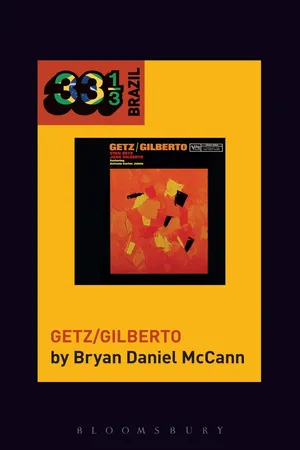
Bryan McCann traces the history and making of Getz/Gilberto as a musical collaboration between leading figure of bossa nova João Gilberto and Philadelphia-born and New York-raised cool jazz artist Stan Getz. McCann also reveals the contributions of the less-understood participants (Astrud Gilberto's unrehearsed, English-language vocals; Creed Taylor's immaculate production; Olga Albizu's arresting, abstract-expressionist cover art) to show how a perfect balance of talents led to not just a great album, but a global pop sensation. And he explains how Getz/Gilberto emerged from the context of Bossa Nova Rio de Janeiro, the brief period when the subtle harmonies and aching melodies of bossa nova seemed to distill the spirit of a modernizing, sensuous city.
33 1/3 Global, a series related to but independent from 33 1/3, takes the format of the original series of short, music-based books and brings the focus to music throughout the world. With initial volumes focusing on Japanese and Brazilian music, the series will also include volumes on the popular music of Australia/Oceania, Europe, Africa, the Middle East, and more.
- 152 pages
- English
- ePUB (mobile friendly)
- Available on iOS & Android
eBook - ePub
João Gilberto and Stan Getz's Getz/Gilberto
About this book
Information
1 Introduction
Getz/Gilberto is the album people think of when they think of bossa nova. (People outside of Brazil, at least—Brazilians tend to have a more complicated relationship to the record.) How did it achieve this iconic status? And why did the album—particularly the single “The Girl from Ipanema”—become a global pop smash in 1964 and 1965? The answer to the first question is João Gilberto. The answer to the second is Astrud Gilberto.
João Gilberto, as both singer and guitarist, was the most important figure in creating the sound of bossa nova. Getz/Gilberto captured his sound more completely than his previous Brazilian recordings had, and introduced him to a broad, international audience. Gilberto made several other great albums, and his many fans may quibble about which is his best. But there is no question that Getz/Gilberto is his best known, the one he is identified with in most of the world.1
João Gilberto’s importance in creating the definitive sound of bossa nova notwithstanding, it was Astrud Gilberto who made the album a smash hit. A record featuring João Gilberto along with tenor sax player Stan Getz might have climbed the jazz charts on its own. But it was the participation of Astrud that enabled it to cross over to pop success. Astrud provided the ineffable allure that made the album irresistible.
This is unsettling for many bossaphiles. Astrud was by far the least experienced participant at A&R Studios on W 48 St in Manhattan for the recording session, on March 18 and 19, 1963. (The album was not released until March of the following year.) She was twenty-two (b.1940), had been married to João for three years, had sung in public only a few times, and had never made a record. João, born in 1931, had been a star since 1958, when he recorded the 78 rpm single “Chega de Saudade,” widely considered the first bossa nova recording. Antonio Carlos Jobim, better known as Tom, composed “Chega de Saudade,” along with lyricist Vinicius de Moraes. Jobim was nearly as decisive as Gilberto himself in creating the genre of bossa nova. Jobim played piano on Getz/Gilberto, composed six of its eight songs, and served as musical director. At thirty-six (he was born in 1927 and died in 1994), he was an experienced hand in all aspects of the recording industry and had a long string of popular successes in Brazil to his name.
Stan Getz was the best known of the participants in the United States. He had emerged as a soloist in the big bands of the 1940s and gained prominence as a leader in the cool jazz scene of the 1950s. He was only thirty-six (he was born in 1927 and died in 1991), but was already on his second comeback. Producer Creed Taylor had already demonstrated his own keen ear and made a name for himself by founding the cutting-edge Impulse! jazz label in 1960. And he had a recent commercial success under his belt with his production of the 1962 album Jazz Samba, featuring Getz and guitarist Charlie Byrd playing bossa nova, backed by a band of US jazz musicians.
The other musicians on Getz/Gilberto were little known outside the nightclubs and recording studios of Rio de Janeiro, but were experienced professionals. Milton Banana was one of the drummers who had defined the sound of bossa nova percussion on the drum kit. Sebastião, or Tião, Neto was the go-to bass player on Rio’s bossa scene. (As a curiosity, Tommy Williams, who did not play on the session, was credited on the original album, instead of Neto.) Both were known for their unerring, restrained accompaniment.
It was the relatively inexperienced Astrud who caught the public’s attention, however, and who made the record instantly recognizable. Listeners all over the United States, and then around much of the world, called their local radio stations to request the record by that Brazilian girl. Not everyone was happy about this. Many established Brazilian musicians never accepted Astrud’s success. They portrayed her as lucky rather than talented, in the right place at the right time. They said it could have been any girl from Ipanema in the studio that day. (Astrud Gilberto was originally from Bahia, in Northeastern Brazil, but the hit single marked her as the girl from Ipanema, nonetheless.)
In retrospect, it is clear that Astrud Gilberto’s apparent lack of polish contributed to her appeal. She sounds fresh and unrehearsed on the record. She presents a blank canvas for the projection of the listener’s fantasies—fantasies about Rio and its sensual delights, and about Astrud herself. Those who resented her success mistook her simplicity for lack of talent. But simplicity was her talent. She knew what not to do.
Her simplicity also fed rumors that her participation was accidental, including the legend that João refused to sing the English lyrics for “Girl from Ipanema,” forcing the amateur Astrud to step in, and a star was born. This is not exactly true. Taylor may not have had Astrud in his initial plans for the record, but Astrud had been an aspiring singer for several years. She had already performed at celebrated bossa nova concerts in Rio de Janeiro, and she lived with the world’s most exacting bossa nova performer. Rehearsing with João Gilberto must have been akin to studying karate with Bruce Lee: perfection expected, not for the faint of heart. If Astrud sounded unrehearsed on the record, that was the sound she wanted, not evidence of lack of prowess. (Though, to be sure, she may have been a bit nervous in a New York recording studio.)
It was Astrud who made the album a chart-topper, and who accounts for its place in the pop memorabilia of the mid-1960s. But Astrud only sang on two of the album’s eight songs. She accounts for approximately two-and-a-half minutes of the thirty-three-minute masterpiece. It was the brilliant setting that allowed her to shine, and that made the album an enduring touchstone of Brazilian popular music. Most pop hits fade away quickly and are remembered, if at all, as markers of their moment. Does anyone remember “Rag Doll,” by the Four Seasons, which topped the Billboard charts the week “Girl from Ipanema” first reached the top ten?
But you probably remember all the Beatles songs that hit the top ten that year, including “I Want to Hold Your Hand,” “She Loves Me,” “A Hard Day’s Night,” and “Love Me Do.” And you probably remember “Where Did Our Love Go” by the Supremes and “Dancing in the Streets” by Martha and the Vandellas, hits of that same year. “The Girl from Ipanema” and Getz/Gilberto have that kind of endurance. That continuing relevance requires the complete package: great material, great performance and great production. Getz/Gilberto has all three, and that is why it remains the iconic bossa nova album.
Again, not all are pleased by this status. Getz/Gilberto was not widely celebrated in Brazil. When it came out in March of 1964, it seemed behind the times. It captured a sound typical of the first wave of bossa nova, which lasted in Brazil roughly from 1958 to 1962. By early 1964, Brazil was in full scale political crisis, leading to a right-wing military coup on March 31 of that year. That crisis changed the world of popular music. For those who opposed the military regime—which included the majority of those who made a living in the world of popular music—anyone still singing about girls walking along the beach was seen as having something other than a swimsuit-clad bottom stuck in the sand. As a result, Getz/Gilberto attracted relatively little attention in Brazil itself. Jobim’s album with Frank Sinatra, recorded three years later, in 1967, was seen as a bigger achievement in Brazil. Recording with Stan Getz, no big deal. Recording with Frank Sinatra: timeless.
For international fans, Brazil’s political crisis passed largely unnoticed. It may even have helped that the Rio evoked on the album—sensual, relaxed, a garden of tropical delights—did not match the latest news reports from Brazil. The fantasy of Rio mattered more than the reality. It did not matter to international listeners that this particular version of the fantasy was crafted in A&R recording studios on West 48th Street in Manhattan. (On that note, producer Creed Taylor and recording engineer Phil Ramone, who also owned A&R, deserve much of the credit for the album’s warm, crystalline sound.)
At the same time, the fantasy was not a work of sheer invention. It grew out of a remarkably fertile and optimistic, if brief, period in Brazilian history. Bossa Nova Rio existed. In the late 1950s and early 1960s, Rio de Janeiro was a place of endless musical invention and visual delight. It was a place where old social hierarchies seemed to be crumbling, where racial relations seemed not only amicable but generative, where winning the World Cup and making brilliant music was something Brazilians did because they couldn’t help themselves. Even at the time, this was partly an illusion. Rio was then, as now, a city of catastrophic inequality and racial injustice. But the musicians who created bossa nova were not wrong in seeing the late 1950s and early 1960s as a moment of cultural invention and real social achievements. Bossa nova grew out of and expressed the aspirations of that brief, golden period.
Understanding Getz/Gilberto requires understanding not just what happened in the studio in March 1963 and after release of the record in early 1964. It also requires understanding Bossa Nova Rio and its evanescent promise. To that end, the chapters that follow intersperse close analysis of the music on Getz/Gilberto, biographical sketches of the participants, and an investigation of the context in which bossa nova initially emerged. The fantasy version is preserved forever on Getz/Gilberto. The real version is even more interesting, if slightly less lovely.
2 What Is Bossa Nova?
Bossa nova is a popular musical genre characterized by samba rhythm, chromatic harmony, moments of apparent dissonance or tension between melody and harmony, softly sung vocals lacking in vibrato, and lyrics in Brazilian Portuguese, often evoking aspects of life in Rio de Janeiro, with particular emphasis on sun, sea, and sand. Not all characteristics need to be present for a song to be considered bossa nova. Two or three in the right proportion will often do. Like any popular musical genre, bossa nova has a strong core and indeterminate boundaries.
Bossa nova can be played with any instrumentation but is typified by arrangements featuring nylon-string acoustic guitar or piano and vocals, often with additional accompaniment. All the material on Getz/Gilberto is classic bossa nova, embodying the salient characteristics of rhythm, harmony, melody, vocal style and lyrical subject matter, in typical instrumentation.
Bossa nova is often characterized as a combination of samba and jazz, and this is true, in part. But bossa also draws on other sources for its harmonic inspiration, such as the Impressionist music of Debussy. And not all samba-jazz is bossa nova: various combinations of samba and jazz existed before the emergence of bossa nova. As the term “bossa nova” became common in the early 1960s, it occasionally subsumed some of these preexisting combinations of samba and jazz, such as big-band arrangements of samba standards. But it would be more accurate to say that bossa nova emerged from a period of fruitful experimentation with combinations of samba and jazz in Rio de Janeiro in the late 1950s, and then characterized this experimentation between 1958 and 1964. (From 1964 on, bossa nova splintered into various branches, some of which doubled back on earlier formulations of samba and other Brazilian rhythms, in a loosely defined genre known as Música Popular Brasileira, or MPB.)
Bossa nova started as a style and cohered into a genre. João Gilberto and Tom Jobim originated the style with innovations they made in 1957–58—Gilberto as guitarist and vocalist, Jobim as composer. Their innovations influenced other composers and performers in Rio de Janeiro’s music scene. By 1959 there was a growing musical cohort playing in this style. The early cohort included singer Nara Leão, who hosted informal jam sessions in her family’s Ipanema living room, as well as composers Carlos Lyra, Ronaldo Bôscoli, and Roberto Menescal. The importance of Newton Mendonça and Vinicius de Moraes as lyricists was also fundamental. As bossa nova’s elements became part of a shared musical vocabulary, the style cohered into a genre, characterized not just by a way of playing, but by a body of work and a way of thinking and talking about the music.
That body of work and the way participants thought and talked about it were firmly rooted in the context of late 1950s and early 1960s Rio de Janeiro. It was a period of economic growth and of the expansion of a middle class with new acquisitive appetites and opportunities. Brazil’s domestic automobile industry began a long period of rapid growth. Construction of middle-class apartment towers in the beachside neighborhoods of Rio de Janeiro, served by new highways and tunnels, reshaped the city. Brazilian modernist architecture, defined by swooping curves of unadorned, poured concrete, determined the new look of public buildings and captured international attention.
It was also a period of social mobilization and debate about race and inequality. Within Rio de Janeiro, attempts to evict favela residents in the mid-1950s provoked backlash and the emergence of a strong favela land rights movement. Cultural groups like the Teatro Experimental Negro (Black Experimental Theater) pushed for openings in the city’s insular high-cultural circles. Brazil’s government had promoted a semi-official assertion of racial democracy since the late 1930s, denying the existence of racism in Brazil. But in the late 1950s, university scholars began to question this assertion, demonstrating the persistence of racial inequality in a society strongly shaped by the legacy of African slavery. In the countryside, landless farmers pushed for agrarian reform, a mobilization greatly invigorated by the Cuban Revolution of 1959.
Traditional gender relations changed. Brotinhos, or sprouts—young women in their late teens—ventured into the streets and onto the beaches of the city without male accompaniment. They engaged with the risks and delights of city life on their own terms. Rio’s swimsuit fashions changed in the 1950s to emphasize secondary sexual characteristics: form-fitting maillots with daring décolletage and hip lines for women, tight square-cut shorts for men. (Bikinis did not become common on Rio’s beaches until the mid-1960s.) Display of the body and physical manifestations of health, youth, and exuberance were paramount. Despojado—relaxed, informal, unpretentious, lacking unnecessary adornment—was the ideal state, in fashion and in social relations more generally. The trendy, upper-middle-class South Zone beach neighborhoods of Ipanema and Leblon were understood to represent the cutting edge of this style.
All of these trends shaped Bossa Nova Rio. And the music reflected each, in different ways. This is a streamlined history of the emergence of bossa nova and its social context. For each of these characteristics and trends there is a complicating factor or relevant nuance to be considered. Regarding the music, specifically, one can point to figures like pianist and composer João Donato, to composer and vocalist Johnny Alf, or to vocalists Dick Farney and Lúcio Alves, all of whom were performing music with some of the key attributes of bossa nova before 1958. Donato, Alf, Farney, and Alves helped set the stage for bossa nova, influencing both the music and the performance style of figures like Jobim and Gilberto. Brazilian guitarist Laurindo Almeida, who had been playing jazz in Los Angeles since 1947, recorded pioneering collaborations with American saxophonist and flutist Bud Shank in 1953. Almeida’s work was relatively unknown in Brazil, but later was taken to be a precursor of bossa. Composer Luiz Bonfá forged a path intersecting with th...
Table of contents
- Cover
- Half-Title
- Series
- Title
- Contents
- Acknowledgements
- 1 Introduction
- 2 What Is Bossa Nova?
- 3 “The Girl from Ipanema”
- 4 The Siren Song
- 5 “Doralice”
- 6 Backstage at Orfeu da Conceição
- 7 “Para Machucar Meu Coração”
- 8 Woe Unto You, Copacabana
- 9 Stan Getz
- 10 Bossa, Race, and Politics
- 11 “Desafinado”
- 12 The Cusp of Greatness
- 13 “Corcovado”
- 14 Bossa Nova on the Car Radio
- 15 “Só Danço Samba”
- 16 Happiness Is a Drop of Dew
- 17 Dancehall Memories
- 18 “O Grande Amor”
- 19 Haroldo Costa as Orfeu
- 20 Olga Albizu and “Alla Africa”
- 21 Two, Three, Many Girls from Ipanema
- 22 “Vivo Sonhando”
- 23 Bossa and Bicycles
- 24 Afterlife of the Girl from Ipanema
- Notes
- Index
- Copyright
Trusted by 375,005 students
Access to over 1.5 million titles for a fair monthly price.
Study more efficiently using our study tools.
Frequently asked questions
Yes, you can cancel anytime from the Subscription tab in your account settings on the Perlego website. Your subscription will stay active until the end of your current billing period. Learn how to cancel your subscription
No, books cannot be downloaded as external files, such as PDFs, for use outside of Perlego. However, you can download books within the Perlego app for offline reading on mobile or tablet. Learn how to download books offline
Perlego offers two plans: Essential and Complete
- Essential is ideal for learners and professionals who enjoy exploring a wide range of subjects. Access the Essential Library with 800,000+ trusted titles and best-sellers across business, personal growth, and the humanities. Includes unlimited reading time and Standard Read Aloud voice.
- Complete: Perfect for advanced learners and researchers needing full, unrestricted access. Unlock 1.5M+ books across hundreds of subjects, including academic and specialized titles. The Complete Plan also includes advanced features like Premium Read Aloud and Research Assistant.
We are an online textbook subscription service, where you can get access to an entire online library for less than the price of a single book per month. With over 1.5 million books across 990+ topics, we’ve got you covered! Learn about our mission
Look out for the read-aloud symbol on your next book to see if you can listen to it. The read-aloud tool reads text aloud for you, highlighting the text as it is being read. You can pause it, speed it up and slow it down. Learn more about Read Aloud
Yes! You can use the Perlego app on both iOS and Android devices to read anytime, anywhere — even offline. Perfect for commutes or when you’re on the go.
Please note we cannot support devices running on iOS 13 and Android 7 or earlier. Learn more about using the app
Please note we cannot support devices running on iOS 13 and Android 7 or earlier. Learn more about using the app
Yes, you can access João Gilberto and Stan Getz's Getz/Gilberto by Bryan Daniel McCann in PDF and/or ePUB format, as well as other popular books in Media & Performing Arts & Ethnomusicology. We have over 1.5 million books available in our catalogue for you to explore.