- 248 pages
- English
- ePUB (mobile friendly)
- Available on iOS & Android
eBook - ePub
About this book
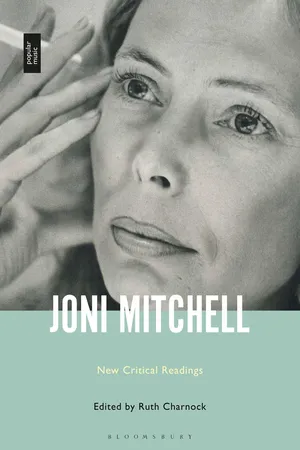
Joni Mitchell: New Critical Readings recognizes the importance and innovativeness of the musician and artist Joni Mitchell and the need for a collection that theorizes her work as musician, composer, cultural commentator and antagonist. It showcases pieces by established and early career academics from the fields of popular music and literary studies on subjects such as Mitchell's guitar technique, the politics of aging in her work, and her fractious relationship with feminism. The collection features close readings of specific songs, albums, and performances while also paying keen attention to Mitchell's wider cultural contributions and significance.
Information
Part One
“The Breadth of Extremities”: Voice, Instrument, Feeling
1
“The Hexagram of the Heavens, the Strings of My Guitar”: Joni Mitchell’s Crip Virtuosity
Matthew J. Jones
Joni Mitchell’s musical “voice” has been described by critics and fans as idiosyncratic, innovative, and even visionary, but never as disabled. Mitchell (née Roberta Joan Anderson) is a survivor of childhood polio and has lived with post-polio syndrome (PPS) since the 1980s. A degenerative condition, PPS exacerbates the muscle weakness in her lower back, arms, and hands left by poliovirus; it also causes intermittent nerve inflammation that manifests as chronic pain. Polio and PPS directly impact Mitchell’s musicianship in specific ways. When first she started to play baritone ukulele, then later the guitar, Mitchell lacked the dexterity necessary to produce complex chords and intricate fingerpicked accompaniment. Instead, she relied on “an adaptability and resourcefulness that is often underdeveloped in those whose bodies fit smoothly into the prevailing, sustaining environment” (Garland-Thomson 2011, 604). Mitchell cultivated a novel approach to the guitar comprising many alternate tunings; unorthodox chord voicings (the exact arrangement and register of pitches in a chord); chord sequences more like jazz and classical music than the folk genre with which she is so often (mis)identified; a repertoire of simplified left-hand chord shapes; and an idiosyncratic right-hand technique that incorporates a plectrum, detailed fingerpicking, rhythmic strumming, pizzicato, and other effects. By changing its physical properties, Mitchell adapted the guitar to her body, queering the fretboard and creating a new idiom which constitutes one form of what I call crip virtuosity (Straus 2006, 2008, 2011; Lerner and Straus 2006).
Crip virtuosity is a queer concept with necessarily stretchy boundaries that must be adapted to the bodies of individual musicians. In academic-activist parlance, crip/cripping is akin to queer/queering inasmuch as both function as more radical forms of the identities “disabled,” “gay,” or “lesbian,” active processes of progressive social-political transformation, and strategies for interpreting a variety of cultural texts, including the “text” of instrumental techniques.1 One happy result of all this cripping is the expansion of our notion of musical virtuosity. By closely attending to styles of musical expression and the role of the body in performance, composition, and listening, crip virtuosity reminds us that, in Tobin Siebers’s memorable phrase, “situated knowledge adheres in embodiment” (2008, 23).
From an ablest perspective, crip virtuosity seems like an oxymoron. How could persons with disabilities (PWDs)—so often numbered among those bodies that do not matter—perform virtuosically?2 How do we understand crip musicianship without resorting to cliché narratives of heroism (the Beethoven model), romanticized suffering (the Schubert model), or pejorative exceptionality (greatness in spite of disability) (Straus 2011)? A one-size-fits-all answer to these questions belies the intertwined political projects of disability activism and theory which attend to bodily specificity in nuanced ways. Therefore, this chapter focuses on a single case study—the guitar technique of singer-songwriter and multi-instrumentalist Joni Mitchell—in the hopes of initiating a broader discussion of crip virtuosities.
To date, there have been few critical analyses of Mitchell’s music and none from a disability studies perspective. As Carl Wilson recently surmised, “the few books on Mitchell have been limited, either too hagiographic or subsuming her under second-wave feminism or California lifestyle-ism.”3 With a few exceptions, writing about Mitchell tends to plumb her work for autobiographical trivia, matching this song to that ex-lover or life event, without engaging with critical questions about her compositional, performance, or recording practices or issues like race, gender, sexuality, or politics.4 My examination of Mitchell’s guitar technique is, therefore, intended to move away from facile biography or uncritical diva worship. Nevertheless, certain events in her life remain important, so I begin with a brief “pathography” to contextualize my later comments about Mitchell’s crip virtuosity.5 Second, I examine the history of two seemingly antithetical terms: “crip” and “virtuoso.” Third, I analyze one of the most striking elements of Mitchell’s music—harmony—using the lens of crip virtuosity. Finally, I discuss Mitchell’s novel guitar technique as a form of crip virtuosity that attends to the particularities of her disabled body.
Pathography: Joni Mitchell
Joni Mitchell contracted polio in October of 1952. Decades later, she recalled falling ill with a painterly eye to detail:
I dressed myself that morning in pegged gray slacks, a red and white gingham blouse with a sailor collar, and a blue sweater. I looked in the mirror, and I don’t know what I saw—dark circles under my eyes or a slight swelling in my face—but I said to myself, “You look like a woman today.”
After I got outside, I was walking along with a school friend, and at the third block, I sat down on this little lawn and said “I must have rheumatism,” because I’d seen my grandmother aching and having to be lifted out of the bathtub. I complained a bit more but still went and spent the day in school. Next day, I woke and my mom said, “Get up, come!” I said, “I can’t.” She didn’t believe me and yanked me out of bed, and I collapsed. (White 1995, 13–16)
Alone in North Castleford’s children’s polio ward, 100 miles from her home in Saskatoon, the self-described “broken doll” endured blistering compresses wrapped tight around her paralyzed legs to prevent muscular atrophy and fell asleep each night to the mechanical rhythms of iron lungs.6 Her mother came to visit just once and wore “a mask over her face and a haunted look in her eye,” and her father never came.7
Her mother left a small Christmas tree on a bedside table in the polio ward, which young Joan was allowed to keep illuminated for an hour after the official lights-out. To the consternation of her nurses, she entertained herself by singing Christmas carols, loudly. When her doctor, himself a polio survivor who used a wheelchair, told Joan that she would be unable to return home for Christmas because she could not walk, the precocious child resisted. One night, Mitchell told the angel atop her Christmas tree, “ ‘I am not a cripple,’ and [she] said a little prayer, some kind of pact, a barter with God for [her] legs, [her] singing.”8 With a determination that shocked and surprised her doctors, the young girl regained use of her legs through grueling physical therapy and eventually returned to her home and family. However, her body bore the stigmata of polio. Her spine was “twisted severely forward in a curvature called lordosis, and then back to the right in a lateral curve called scoliosis [ . . . ] One leg was impaired, but the muscles didn’t atrophy, so there was no withering,” and the muscles of both hands, especially the left, were weakened (White 1995, 15–16).
Although Mitchell was “born too soon [ . . . ] to benefit from the imminent introduction of [polio] vaccines, [she was] born at just the right time to feel the beat of the rock and pop worlds of youth music, the counterculture, and beyond” (McKay 2013, 23). As a teenager, she caught the rock-and-roll bug, excelled at various dance fads, and scandalized her conservative peers by sneaking off to the “wrong” side of town where the music was better for dancing. If polio and rock and roll “shaped (misshaped) [her]; the 60s shaped [her] again” (McKay 2013, 31). During her brief stint at the Alberta College of Art, Mitchell bought a copy of Peter Seeger’s How to Play Folk-Style Guitar and “went straight to the [Elizabeth] Cotten picking. Your thumb went from the sixth string, fifth string, sixth string, fifth string.”9 However, polio-related muscle weakness made her clumsy on the fretboard. Her left hand could not move between chord shapes easily, and her right hand “ended up playing mostly the sixth string but banging it into the fifth string.”10 A few years later, friend and singer-songwriter Eric Andersen introduced Mitchell to open-chord guitar tunings which proved to be the catalyst that launched decades of musical exploration and innovation.
Mitchell seldom writes songs about her own disability. In fact, the only such reference occurs in a relatively late song, “Come in from the Cold” (1991). The evocative line, “I feel disabled by these bonfires in my spine,” could index either a physiological experience or describe being overwhelmed by emotional intensity. She makes passing references to physical disabilities in other songs: an “aging cripple selling Superman balloons” (“Nathan La Franeer,” 1968), and bluesman Furry Lewis, “propped up in his bed with his dentures and his leg removed” (“Furry Sings the Blues,” 1976). “A Chair in the Sky” (1979) captures jazz bassist Charles Mingus’s paralysis from amyotrophic lateral sclerosis (ALS). In other songs, like “Big Yellow Taxi” (1970), “Sex Kills” (1994), and “This Place” (2007), illness and disability serve as conceits for ecological, political, and cultural conditions while, in the song “Dog Eat Dog” (1985), Mitchell paraphrases Nietzsche to anthropomorphize corruption, singing “Money is the road to justice, and power walks it on crooked legs.”11 While disability is not a substantial trope in Mitchell’s lyrics, it is the defining characteristic of her guitar technique.
Cripping virtuosity
In the late twentieth century, a remarkable era of disability activism culminated with the passing of the Americans with Disabilities Act of 1990. Following the tradition of feminist, queer, and antiracist activism, some disability activist-intellectuals resignified terms like “crip” (a variant of “cripple” that functions as both...
Table of contents
- Cover
- Half Title
- Dedication
- Title Page
- Contents
- Permissions
- Preface: Everything’s Backwards, or Joni, Chase that Butterfly!
- Acknowledgments
- Introduction
- Part One “The Breadth of Extremities”: Voice, Instrument, Feeling
- Part Two “The Only (Black) Man in the Room?” Mitchell’s Milieu
- Part Three “Busy Being Free”: Love, Time, Feminism
- Contributors
- Index
- Copyright Page
Trusted by 375,005 students
Access to over 1.5 million titles for a fair monthly price.
Study more efficiently using our study tools.
Frequently asked questions
Yes, you can cancel anytime from the Subscription tab in your account settings on the Perlego website. Your subscription will stay active until the end of your current billing period. Learn how to cancel your subscription
No, books cannot be downloaded as external files, such as PDFs, for use outside of Perlego. However, you can download books within the Perlego app for offline reading on mobile or tablet. Learn how to download books offline
Perlego offers two plans: Essential and Complete
- Essential is ideal for learners and professionals who enjoy exploring a wide range of subjects. Access the Essential Library with 800,000+ trusted titles and best-sellers across business, personal growth, and the humanities. Includes unlimited reading time and Standard Read Aloud voice.
- Complete: Perfect for advanced learners and researchers needing full, unrestricted access. Unlock 1.5M+ books across hundreds of subjects, including academic and specialized titles. The Complete Plan also includes advanced features like Premium Read Aloud and Research Assistant.
We are an online textbook subscription service, where you can get access to an entire online library for less than the price of a single book per month. With over 1.5 million books across 990+ topics, we’ve got you covered! Learn about our mission
Look out for the read-aloud symbol on your next book to see if you can listen to it. The read-aloud tool reads text aloud for you, highlighting the text as it is being read. You can pause it, speed it up and slow it down. Learn more about Read Aloud
Yes! You can use the Perlego app on both iOS and Android devices to read anytime, anywhere — even offline. Perfect for commutes or when you’re on the go.
Please note we cannot support devices running on iOS 13 and Android 7 or earlier. Learn more about using the app
Please note we cannot support devices running on iOS 13 and Android 7 or earlier. Learn more about using the app
Yes, you can access Joni Mitchell by Ruth Charnock in PDF and/or ePUB format, as well as other popular books in Media & Performing Arts & Music. We have over 1.5 million books available in our catalogue for you to explore.