- 344 pages
- English
- ePUB (mobile friendly)
- Available on iOS & Android
eBook - ePub
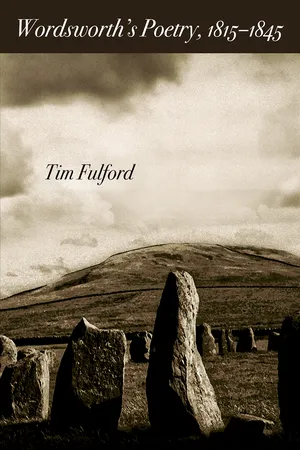
Wordsworth's Poetry, 1815-1845
About this book
The later poetry of William Wordsworth, popular in his lifetime and influential on the Victorians, has, with a few exceptions, received little attention from contemporary literary critics. In Wordsworth's Poetry, 1815-1845, Tim Fulford argues that the later work reveals a mature poet far more varied and surprising than is often acknowledged. Examining the most characteristic poems in their historical contexts, he shows Wordsworth probing the experiences and perspectives of later life and innovating formally and stylistically. He demonstrates how Wordsworth modified his writing in light of conversations with younger poets and learned to acknowledge his debt to women in ways he could not as a young man. The older Wordsworth emerges in Fulford's depiction as a love poet of companionate tenderness rather than passionate lament. He also appears as a political poet—bitter at capitalist exploitation and at a society in which vanity is rewarded while poverty is blamed. Most notably, he stands out as a history poet more probing and more clear-sighted than any of his time in his understanding of the responsibilities and temptations of all who try to memorialize the past.
Information
Publisher
University of Pennsylvania PressYear
2018Print ISBN
9780812250817
9780812250817
eBook ISBN
9780812295788
Topic
LittératureSubtopic
Critique littéraire anglaisePART I
Producing a Poet for the Public
HERE I EXAMINE THE WAYS in which Wordsworth fashioned himself as a poet in his first collected works—the Poems of 1815. Chapter 1 shows how, in this edition, he defined himself for the first time in public as a “poet of imagination” to give himself finally, aged forty-five, the authority that readers and critics had refused him. Thus, “imagination” was no transcendent term neutrally applicable to the poems of the Great Decade, but an 1815 category that Wordsworth adopted for the self-interested purpose of escaping his reputation as a poet concerned with trivial matters unworthy of poetry. It had not featured strongly in the collections he published in 1800, 1802, and 1807; it did not play an important role in the volumes he issued in 1820 and after. In 1815, however, it was central to his effort to fashion himself as a different kind of poet, and to this end it involved the revision of old poems to fit a new agenda. I examine the textual history of one of these poems, “Yew Trees”—first drafted in 1804 but first published only in 1815—revealing how Wordsworth revised so as to occlude its relationship to contemporary contexts and to fellow poets. The result was a more impersonal and mysterious text, a text apparently independent of current political debates, of others’ verse and even of its author’s own subjectivity—a text revered by no less a critic than Hartman as the height of mythic power.1 Produced as such, it was the successful outcome of a rebranding strategy that came with a cost.
A striking feature of the post-1814 Wordsworth is his changed rural politics, as epitomized by the dedication of The Excursion and the 1815 Poems to great landowners. Distancing himself from Jacobinical solidarity with the rural poor, the poet began in 1803 to accept the patronage of gentlemen and aristocrats. By 1815 a new poetic style, no longer close-up and personal but marked by distance and by overlooking (in both senses of that word), accompanied this changed social position. Focusing on Wordsworth’s relationship with Sir George Beaumont, Chapter 2 traces the development of this later style to the politics of landscape in which the poet became uneasily involved at the landowner’s country estate in Coleorton. Investigating the material context of labor relations between Beaumont and his employees, I show that Wordsworth’s increasing use of the traditional genre of the inscription was an attempt to contain, by adoption of a formal and distant voice, the conflicting sympathies and viewpoints produced when an independent poetic laborer found himself working for a patron. Containment was not repression:2 the remarkable achievement of the inscriptions that Wordsworth published in 1815 was to use his own ambiguous position as an independent yet patronized poet to dramatize, if not resolve, the tensions between landowner, land agent, and laborer that the capitalization and industrialization of the country were bringing to a crisis. These were the issues that occupied Jane Austen in the early years of the nineteenth century. Wordsworth’s new embrace of an impersonal voice, distant viewpoint, and traditional genre can be compared with her novels—also apparently affiliated to the tastes and views of the landowning classes yet revealing their limitations by registering the tensions that they ignored.3
Chapter 1
Learning to Be a Poet of Imagination
Wordsworth and the Ghost of Cowper
Packaging for Posterity
In 1815 the bookseller Longman, Hurst, Rees, Orme, and Brown issued two volumes that were more significant for what they showed about their author’s view of his career than they were for their sale. Poems by William Wordsworth, Including Lyrical Ballads, and Miscellaneous Pieces of the Author. With Additional Poems, a New Preface and a Supplementary Essay was the first collected edition and, as such, a publication designed to establish its author as a mature poet whose canon was substantial enough to be gathered as a whole.1 It was a public bid for authority—a bid that seemed speculative to many, since the poet of Lyrical Ballads and Poems, in Two Volumes was more belittled than admired. The massive Excursion of the previous year had been brutally dismissed by Francis Jeffrey, the leading reviewer of the day, for its perverse egotism, while the White Doe of Rylstone, issued alongside the collected poems in an expensive format to demonstrate its importance, was termed “the very worst poem we ever saw imprinted in a quarto volume.”2 Wordsworth, in short, had neither the reputation nor the popularity to make the publication of his collected edition an uncontroversial sign of an established cultural significance: the volumes, carefully arranged for effect and prefaced with advice about how they should be read, embodied their author’s anxious aspirations rather than acknowledged achievements.
Collected editions are a mark of lateness to the extent that, on the one hand, they require retrospection and reordering and, on the other, they look to futurity—to one’s posthumous reputation.3 Wordsworth surveyed his old poems and sorted them into aesthetic categories of his own devising, aiming to fulfill the promise he had made when, prefacing The Excursion, he had written that his “minor pieces, which have been long before the public, when they shall be properly arranged, will be found by the attentive reader to have such connection with the main work as may give them claim to be likened to the little cells, oratories, and sepulchral recesses” of a Gothic church, parts of which were not yet complete (Excursion, p. 38). Now, making that proper arrangement, he went further toward finishing the Gothic edifice of his oeuvre, pitching his collection as far beyond the moment of its issue as was one of the great monumental abbeys that survived—built and maintained over centuries—from England’s earliest recorded history.4
Arranging poems into categories was a business as timebound as it aimed to be timeless.5 It was part of a makeover designed to redeem Wordsworth’s damaged reputation in a contemporary print culture of which he had learned to be suspicious. He had been criticized for his Jacobinical ballads, and still more for the 1800 Preface that argued that his model was the speech of rustic villagers—“the best part of language” (LB, p. 744). He had been ridiculed for the confessional poems that philosophized about his feelings for everyday objects: in the eyes of critics and parodists, such poems as “I wandered lonely as a Cloud” revealed him as a perverse oddball who invested trivial things with far greater emotional significance than they merited and who then assumed that his feelings must be important to others.6 Resenting this response and suffering its consequences (poor sales left him unable to support his family), Wordsworth knew he could not escape the power of reviews and magazines: the literary world, in the wake of Scott and Byron, was now a marketplace subject to fashion—an “age of personality”7 in which mass sales could be achieved if reviews were favorable and if an author presented a public image that fascinated consumers.8 The new poem groupings were a modest attempt to transform his public image by demonstrating his seriousness and his centrality—none more so than the one entitled “Poems of the Imagination.” This category sounded the collection’s keynote, for it was justified in a preface in which Wordsworth set out his claim to be a poet of the highest class—not a “namby pamby” eccentric but a worthy successor to Spenser and Milton. It was here that Wordsworth first publicly staked his reputation on being a poet of imagination; it was also here that imagination was first announced, in print, as the central feature of the Romantic aesthetic.
“Imagination” had not featured strongly in the Prefaces to Lyrical Ballads;9 the concept did not appear in the 1807 Poems, in Two Volumes. Although Coleridge had used the concept, he had not yet published his extensive discussion of it in Biographia Literaria. In the 1815 Poems, Wordsworth used it to depict his writing as philosophical and scientific: poetry of imagination “denot[ed] operations of the mind . . . and processes of creation or of composition, governed by certain fixed laws.” Imagination provided its own validation: it fulfilled the old philosophical injunction “know thyself,” for it was “conscious of an indestructible dominion;—the Soul may fall away from it, not being able to sustain its grandeur; but, if once felt and acknowledged, by no act of any other faculty of the mind can it be relaxed, impaired, or diminished” (1815, I, pp. xx–xxi; xxxv). The poet of imagination, therefore, was sublime, and his work was the highest expression of the mind’s ability to exert itself upon the world and upon itself. Wordsworth was unexpectedly revealing about his motives in making the claim: if, he declared, he was “justified by recollection of the insults which the ignorant, the incapable, and the presumptuous, have heaped upon these and my other writings, I may be permitted to anticipate the judgment of posterity upon myself, I shall declare (censurable, I grant, if the notoriety of the fact above stated does not justify me) that I have given in these unfavourable times evidence of exertions of this faculty upon its worthiest objects, the external universe, the moral and religious sentiments of Man, his natural affections, and his acquired passions” (1815, I, p. xxxi). Here Wordsworth’s self-congratulation emerges directly from his resentment of criticism: it is a self-defensive formation that indicates the depth of his need for acknowledgement and reveals the self-interested nature of his arguments.10
Despite the polemical context of its first expression, “imagination” was endorsed by professional literary critics in the twentieth century as a disinterested, generally valid, characterization of Wordsworth’s poetry—and often of all poetry. Some made it the criterion for deciding whether particular poems were of the highest class; others explored how it operated in Wordsworth’s account of his own mental development. Consequently, The Prelude became the defining work, although never published by Wordsworth because he considered it incomplete without the epic to which it was a preface. Critics defined and redefined imagination in relation to German philosophy,11 to psychoanalysis,12 to deconstruction,13 and to phenomenology:14 it was the means by which Wordsworth voiced the freedom of his mind from nature, his oedipal relation to his dead father and his surrogates,15 his dependence on figuration, and his being in a universe of death.16 But few of the critics who elevated the concept as the subject of investigation considered that Wordsworth was neither publicly a poet of imagination nor necessarily thought of himself as a poet of imagination until 1815—years after many of the poems they discuss had been drafted and/or published. The contemporary purpose of the concept as a means of rebranding an unpopular poet was (at least before the work of McGann17) ignored.
In this chapter I examine imagination as a situated, self-interested repackaging of an unpopular poet by investigating the textual history and prehistory of a poem first published in the 1815 collection. “Yew Trees,” first drafted in 1804, was not born a “poem of imagination” but had imagination thrust upon it. It was a key part of Wordsworth’s 1815 effort to be a poet of imagination, and it was reworked in order to play this role. It was made more gnomic and less personal by a poet who was trying to live down a reputation for garrulous subjectivity. Its imaginative qualities were accentuated by acts of revision that altered it so as to efface its relationship to another poet’s text, to which it was indebted and with which it was in conversation. With that effacement, the poem’s relationship to a tradition of political symbolism was also all but removed. In desubjectivizing his poem, Wordsworth increased what Geoffrey Hartman called its “mythic” power18 by highlighting a trope that late twentieth-century critics singled out as a hallmark of imaginative lyric verse—prosopopoeia, calling the dead into imagined life by giving them a face or voice. This highlighting, however, came at the cost of mystifying the poem’s relation to Wordsworth’s poetic forebears as well as his readers and quietening its political resonance. Imagination stood alone, summoning the absent into textual voice, only because of acts of concealment made by doctoring an old text so it served a new agenda. In this process, I shall show, the poem was made to turn its back on the text that, when Wordsworth encountered it in 1804, had galvanized him, offering him a way out of a poetic quandary caused by his political disenchantment and social isolation. “Yew Trees” had begun as a response to “Yardley Oak”: William Cowper’s posthumously published poem was responsible for a significant turn in Wordsworth’s poetic language and in his conception of the poet’s responsibility to history.
The Context for “Yew Trees”: 1804 and Earlier
When “Yew Trees” first germinated, Wordsworth was still, to the few who had read him, the Jacobin balladeer of Lyrical Ballads. He was not yet a byword for childish egotism, nor did he predicate his writing on his “imagination.” He faced different problems, and sought other solutions, because the social sources and private audience on which his work depended were in a state of collapse. A tour of Scotland in the autumn of 1803 had revealed as much: he, Dorothy, and Coleridge had traveled together in an effort to renew the fertile companionship they had enjoyed in 1797–98. But Coleridge had left the party after days of tension, caused, in part, by his frustration that Wordsworth was content to write short poems about tiny objects instead of working on his great philosophical epic. To produce slight verses attributing great significance to encounters with daisies, celandines, and the like was to continue in the vein that had led to public criticism; it was to neglect his true vocation and to give his enemies further opportunities to attack him.19 There were political tensions too: the rustic diction of Lyrical Ballads had been received as poetic Jacobinism, but Wordsworth now became disconcerted by the kind of Jacobinical speech he heard in rural Scotland. Napoleon’s revolutionary armies were amassed on the French coast, and the Highland clansmen welcomed the planned invasion: one of them, Dorothy recorded, “speaking of the French, uttered the basest and most cowardly sentiments” (Coleridge called him a “Jacobin traitor of a boatman”).20 Wordsworth found himself disgusted by the rural speech on which he had modeled his radical poetry; recoiling from their professions of enthusiasm for a French revolutionary liberty he had come to distrust, he could not henceforth be a poet of the common people. But neither could he simply dissociate himself from them. Though shocked that the clansmen would refuse to fight the French, the Wordsworths understood their reasons:
In talking of the French and the present times, their language was what most people would call Jacobinical. They spoke much of the oppressions endured by the Highlanders further up, of the absolute impossibility of their living in any comfort, and of the cruelty of laying so many restraints on emigration. Then they spoke with animation of the attachment of the clans to their lairds: “The laird of this place, Glengyle, where we live, could have commanded so many men who would have followed him to the death; and now the...
Table of contents
- Cover
- Half title
- Title
- Copyright
- Contents
- List of Abbreviations
- Introduction
- Part I. Producing a Poet for the Public
- Part II. Spots of Space: Materializing Memory
- Part III. The Politics of Diction
- Part IV. Late Genres
- Coda. Elegiac Musing and Generic Mixing
- Notes
- Bibliography
- Index
- Acknowledgments
Trusted by 375,005 students
Access to over 1.5 million titles for a fair monthly price.
Study more efficiently using our study tools.
Frequently asked questions
Yes, you can cancel anytime from the Subscription tab in your account settings on the Perlego website. Your subscription will stay active until the end of your current billing period. Learn how to cancel your subscription
No, books cannot be downloaded as external files, such as PDFs, for use outside of Perlego. However, you can download books within the Perlego app for offline reading on mobile or tablet. Learn how to download books offline
Perlego offers two plans: Essential and Complete
- Essential is ideal for learners and professionals who enjoy exploring a wide range of subjects. Access the Essential Library with 800,000+ trusted titles and best-sellers across business, personal growth, and the humanities. Includes unlimited reading time and Standard Read Aloud voice.
- Complete: Perfect for advanced learners and researchers needing full, unrestricted access. Unlock 1.5M+ books across hundreds of subjects, including academic and specialized titles. The Complete Plan also includes advanced features like Premium Read Aloud and Research Assistant.
We are an online textbook subscription service, where you can get access to an entire online library for less than the price of a single book per month. With over 1.5 million books across 990+ topics, we’ve got you covered! Learn about our mission
Look out for the read-aloud symbol on your next book to see if you can listen to it. The read-aloud tool reads text aloud for you, highlighting the text as it is being read. You can pause it, speed it up and slow it down. Learn more about Read Aloud
Yes! You can use the Perlego app on both iOS and Android devices to read anytime, anywhere — even offline. Perfect for commutes or when you’re on the go.
Please note we cannot support devices running on iOS 13 and Android 7 or earlier. Learn more about using the app
Please note we cannot support devices running on iOS 13 and Android 7 or earlier. Learn more about using the app
Yes, you can access Wordsworth's Poetry, 1815-1845 by Tim Fulford in PDF and/or ePUB format, as well as other popular books in Littérature & Critique littéraire anglaise. We have over 1.5 million books available in our catalogue for you to explore.