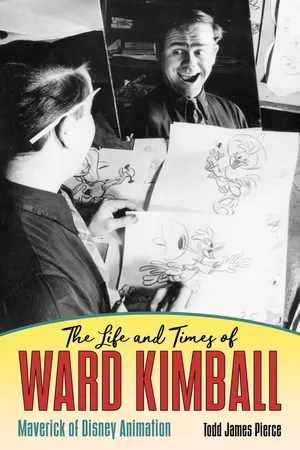
Besides Walt Disney, no one seemed more key to the development of animation at the Disney Studios than Ward Kimball (1914–2002). Kimball was Disney's friend and confidant.
In this engaging, cradle-to-grave biography, award-winning author Todd James Pierce explores the life of Ward Kimball, a lead Disney animator who worked on characters such as Mickey Mouse, Donald Duck, Jiminy Cricket, the Cheshire Cat, and the Mad Hatter. Through unpublished excerpts from Kimball's personal writing, material from unpublished interviews, and new information based on interviews conducted by the author, Pierce defines the life of perhaps the most influential animator of the twentieth century.
As well as contributing to classics such as Snow White and the Seven Dwarfs and Pinocchio, from the late 1940s to the early 1970s, Kimball established a highly graphic, idiosyncratic approach to animation alongside the studio's more recognizable storybook realism. In effect, Ward Kimball became the only animator to run his own in-studio production team largely outside of Walt Disney's direction. In the 1950s and 1960s, he emerged as a director and producer of his own animation, while remaining inside Disney's studio.
Through Kimball, the studio developed a series of nonfiction animation programs in the 1950s that members of Congress pointed to as paving the way for NASA. The studio also allowed Kimball's work to abandon some ties to conventional animation, looking instead to high art and graphic design as a means of creating new animated forms, which resulted in films that received multiple Academy Award nominations and two awards.
Throughout his life, Kimball was a maverick animator, an artist who helped define the field of American animation, and a visionary who sought to expand the influence of animated films.
- 320 pages
- English
- ePUB (mobile friendly)
- Available on iOS & Android
eBook - ePub
About this book
Information
Topic
ArtSubtopic
Film & VideoPart One
EARLY YEARS, 1914–1939

I always believed there are two paths you take: I chose the artist path.
—Ward Kimball
Chapter One
The Three Passions of Ward Kimball
The three passions of Ward Kimball are easy to define: art, antique vehicles, and music. Though he is best remembered for his animated contributions to the Disney canon, in the 1950s and 1960s he was far better known as the front man for the Firehouse Five Plus Two, a revival Dixieland band that became a national sensation. Also as the only person in America to establish a full-size working railroad in a residential backyard. The railroad had, at its peak, 900 feet of track zippered across the scrubby two-acre lot. “Ward is the one man who works for me,” Walt Disney once said in an interview, “I am willing to call a genius. He can do anything.”1
The first of Ward’s passions, according to his mother, Mary Kimball, arrived slightly before his birth, in the early days of March 1914, as she struggled with a difficult labor. “My mother always said I was a marked baby,” Ward once explained, “because when she was in labor she could look out the hospital window [and watch]e a very slow freight train going across a high trestle.”2 The bridge, she knew, had been condemned. “It worried her that she might be witness to a catastrophic train wreck”—so much so that she believed her anxiety must have traveled into the body of Ward, not yet born.3 She felt such a strong connection to the baby she gave him her name. Her maiden name had been Mary Nancy Walrath, and her son would be Ward Walrath Kimball. To friends, she would later explain that her son’s first experience with trains somehow entered him as she watched that engine grind across that high, perilous bridge, passing from her eyes to his tiny mind.
As a boy, Ward grew up in a train family, with two of his uncles and his grandfather working for the Missouri-Kansas-Texas Railroad. At his first Christmas, when he was only nine months old, he received a model train, a Hafner clockwork engine, a toy that worked with a windup motor. The Hafners were equipped with a large key, probably large enough for a toddler to grasp, but the train wasn’t so much for Ward as it was for his father, Bruce Kimball. “So here I was, a nine-month-old kid, having to be held up to stand, and all these [adults] were on their hands and knees playing with my toys.”4 Around the Christmas tree, his father set up the track and even made a tunnel out of a white bedsheet, a sight that likely held Ward’s interest for hours.
But train love wasn’t limited to Ward’s home life. With his family, he regularly took trips to visit relatives, using the Rock Island Line.5 “I’ve even ridden on a train by myself,” Ward said, “with a note on my sleeve so the conductor could put me off at the right station.”6 During summer months, he rode the rails with his father, a salesman, through the Midwest, from Minneapolis to Kansas City and down to Oklahoma. Even as an old man, at the age of seventy-six, Ward vividly remembered the first time he met an engineer on a steam train: “There was this great grimy guy, his clothes covered with grease and his face covered with soot. He took off his glove—you know the ones with the star on the gauntlets—and then he lifted his goggles up and put them on top of his hat. Finally, he looked at me with those big, raccoon eyes, grinned, and shook hands with me.”7
Ward’s first recognizable drawing, his family told him, completed when he was three, was of a “choo-choo.”8 The following year, Ward made a complete train out of empty strawberry boxes, “on which I drew windows and wheels.”9 During his youth his family owned a small O-gauge tabletop electric train, with a little cast-iron engine made by the Ives Manufacturing Company. But Ward wanted something larger, the type of train in the front pages of toy catalogues, a train his family could never afford: “How many times I opened and opened the catalogue and dreamed of having a big standard-gauge Ives set, with real lights in the cars.”10 He would gaze at the catalogues for hours, the engines and coach cars, the advertising images almost always accompanied by the company’s slogan: Ives Toys Make Happy Boys.
Later in life, Ward’s mother would recount these experiences to him, saying, “That’s where you get your railroading.”11
The second of Ward’s passions appeared when he was six. His parents, struggling through hard times, sent him to live with his widowed grandmother at the Hastings Hotel in Minneapolis. On Sundays young Ward loved to read the funny pages in the Minneapolis Journal, and in thoughtful imitation he penciled out his own comics, clever imitations of The Gumps and Gasoline Alley.12 He called his hand-printed publication the Little Minneapolis Journal and later claimed that it had a grand “subscription list of three persons.”13
On weekdays Ward and his grandmother would ride about town on yellow trolleys to buy groceries. From the start he was fascinated by the mechanics of these lovely yellow-skinned streetcars: “I always sat on a seat close to the motorman, so I could watch his every move as with both hands he manipulated the various control levers … also rang the trolley bell with his foot. The motorman was my hero, a father figure, no doubt, especially when once he acknowledged my existence with a knowing wink and a wave of his gloved hand.”14
On weekends Ward and his grandmother took these same trolleys out to the lake, sometimes for a picnic, sometimes for errands. In a scrapbook Ward collected all of his transfer stubs, a personal history of where he had gone in the world. With his weekly allowance of twenty-five cents, he bought toy trolley cars, which on the nights when his grandmother was out at a ladies’ card game, he set up on the floor, with little pieces of string tied between chairs to approximate the path of aerial wires. In all he owned eleven of these Chein & Co. miniature trolleys, which he used to push across the tile while lying on the floor, mouthing the sounds of a streetcar in action.
For a while the two of them fell into a type of happiness: Ward needed stability, and his grandmother needed to mend her past. Decades earlier she had lost her first son, Reese, who had died when he was six. Without doubt, some of the lingering affection she felt for her lost son was now directed at her grandson.15
One night while his grandmother was out, Ward fell asleep on the floor, next to his trolleys, with lines of string webbing low spaces between chairs. “When she opened the door to enter the darkened room, she unfortunately caught her foot,” Kimball recalls. “Chairs flipped over in all directions and a small dining table crashed to the floor, scattering broken teacups.”16 She came to rest on some of the trolleys, damaging them a little, which to Ward was the real tragedy.
“I cried in anguish. [But] Grandma, being such a patient and understanding person, didn’t let on that her ankle was bruised. Later, when I asked her how come she was walking so funny-like, she put her arm around me and explained that she had hurt her leg playing cards with [the ladies].”17
But the trolley expeditions—and the toy purchases—didn’t stop. They continued, and even expanded. At about this time, Ward’s interest in drawing deepened as well. He was no longer interested in the daily “antics of ‘The Gumps,’ ‘Barney Google,’ [or the characters in] Gasoline Alley.’”18 He became interested in how cars and streetcars were presented in the comics, particularly an expressive cartoon trolley featured in a strip called Toonerville Folks.
Using his tin toys as models, Ward drew trolley-cars for hours, often on hotel bond, coloring in their sides canary yellow and their roofs russet red. For the duration of the year, his grandmother always made sure that Ward had enough paper for his endless drawings and homemade comics. Sometimes it was stationery and sometimes it was end-of-the-spool wrapping sheets from the butcher’s shop. With this, two of his grand passions were up and running—trains and drawing, twin hearts beating inside his boyish chest.
By the time Ward was nine, his father, who had once wanted to be a lawyer and an inventor, had fallen into a series of odd jobs: he managed an indoor swimming pool in Oklahoma; he also worked at the Good Pastry Shoppe bakery where a machine pressed dough into donuts; but eventually, he took to sales, traveling for the National Cash Register Company. He focused his efforts on territory in the Midwest, but he wasn’t a strong closer, at least not in Oklahoma. For a while he settled in Parsons, Kansas.19 But as the family grew—with a daughter, Eleanor, and another son, Webster—so did his impatience with the difficulty of finding a good life in the Midwest. “We got up one morning when it was nine below zero,” Ward recalls, “and Dad said, ‘That’s enough of this stuff. Let’s go to California.’”20
They traveled by rail to the West Coast, believing the move would improve their financial prospects. “I slept all the way west in an upper berth with my little brother and sister,” Kimball later joked.21 As his parents were Episcopalians, they found connections in California through their church. The family rented a home in Ocean Park, not far from the coast, but even here his father’s luck remained lukewarm at best. Rarely did he keep a sales job for more than a year, and to find new work he moved his family from town to town.
During this nomadic period Ward’s interest in art is fairly easy to chart. After he left his grandmother, his interest slipped for a while. But in the fifth grade, a traveling art teacher came to his class once a week and rekindled his passion. During each visit she awarded a ten-cent chocolate bar to the student with the best drawing. For weeks Ward worked on his drawings, hoping for the prize. One day his father showed him how to draw an ocean liner, with smokestacks and waves and a horizon line to give the image depth. “I was fascinated by this,” Ward recalls, “how he got this perspective. So I drew one…. The ocean liner was red [with] stripes on the portholes. And then I drew birds.”22 The birds, under a light pencil, appeared as an arrangement of Vs angling through the sky. For this, he received ten cents’ worth of chocolate, a Hershey bar with nuts.
That same year Ward applied for a W. L. Evans correspondence course in cartooning and was informed that, even though he was a kid, they would accept him, so long as he sent them twenty-five dollars, which he raised by selling soda pop. He completed all of the assignments and sent them in, waiting patiently for an art instructor to offer him guidance. He also sent a few drawings to his grandmother, who did something unexpected with them.
“My grandmother submitted some drawings of mine to [New York animation producer] Paul Terry.” At the time, Terry was producer and part-owner of Aesop’s Fables Studio, though he is better remembered for his later effort, TerryToons, where he produced the series Mighty Mouse and Heckle and Jeckle. In his reply Terry offered soft encouragement: “Yes, the lad shows a lot of talent. After he’s finished with school, you tell him to come to New York and look me up.”23
Terry’s praise, even if it was general, stayed with Ward as confirmation of some future, yet-to-be-defined success. “From that point on,” he would later say, “there was no stopping me.”24
In California, beyond Ocean Park, his family lived in West Covina, then Glendale, then Baldwin Park. In all, he attended over a dozen public schools by the time he was a teenager, spending less than “half a semester” at some of them.25 In early interviews he suggested that it was fourteen schools,26 but in later interviews he suggested it was closer to twenty. He also attended about as many churches. Though later in life Kimball would sharply turn away from religion, as a boy he enjoyed stories found in the Bible, if nothing more than as pieces of historical narratives.
Without doubt, the frequent moves left identifiable marks on Ward: he was a small, spritely boy, a boy drawn to art and trains. In a more stable environment, his personality might have settled toward solitude, but with his nomadic family, he developed strong skills as an extrovert. He knew how to make friends quickly. He was funny, sometimes subversive. People described him as a ball of energy, a puckish youth who was impossible to ignore, a student whose name occasionally graced the newspaper. At one school, likely in Tustin, he was pigeon-holed as a poor kid, an outcast, a boy not special enough to have a part in the school play or other artistic productions.27 When asked if his childhood was difficult, he replied, “Well, it was because sometimes silently I would cry.” But also he was learning how to project the image of a likeable, funny boy when in public.28
In 1928 Ward designed many covers for his school’s weekly paper. “I mastered the use of the stylus on those waxy mimeo sheets where if you pressed too hard you made a hole, and if you didn’t press hard enough, you got nothing.”29 For his work, the Los Angeles Times listed his name, along with a dozen other junior high students, as making the “honor roll” for the art workers club.30 That same year he created lanternslides for a local theater in Baldwin Park.31 He also earned a little money lighting smudgepots in local orange groves to save the fruit from frost.33
But when jobs soured in the area, his father went north, hoping to find work in appliance sales.33 They settled again, in Ventura, California, a beach town filled with farms and oil fields. It was there that Ward’s eyes first lifted with interest from the funny pages to cartoons at the local theater. Perhaps in December 1929 and surely by 1930, each week he attended meetings of the local Mickey Mouse Club. These meetings were held at theaters throughout the country, dozens and dozens of them showing matinee performances of cartoons and live-action comedy shorts, such as the Our Gang series, with additional sponsorship by local stores and restaurants. Kids, accompanied by their parents, needed to visit one of the sponsoring businesses to obtain a Mickey Mouse Club membership card that would admit them into the theater. “Regular weekly meetings will be held at 2 o’clock every Saturday,” one ad began.34 Beyond the films, matinees often featured local talent, such as a band or a singing act, to create a full program of family-friendly entertainment. But Ward himself was primarily interested in the cartoons, the Mickey Mouse shorts in particular, as he felt the drawing style in them was more sophisticated than in other cartoons, such as Felix the Cat.
He also felt that the Disney cartoons were more technically advanced than other efforts: “To take advantage of the frantic switch to sound so many of the other studios were reaching in their bag of old silent [cartoons] and quickly re-releasing them out with new [jazzy] soundtracks [with] a few ratchets and honks and slide whistles, and that was supposed to be a sound cartoon. But Disney cartoons made a real honest attempt to integrate sound and picture. So these early Mickey and Silly Symphony cartoons really began to impress me.”35
Inspired by the movies, Ward entered an art contest that pitted his work against that of high school students from all over Ventura County, including seniors planning to attend art school in the fall. Yet Ward, as a freshman, walked away with first prize in cartooning.36 The accomplishment told him that he had more talent and determination than older boys, those with money and private tutors. At best, his education in art was intermittent, lessons from correspondence schools and occasional encouragement from a teacher. Yet here he was, first-place winner in the category of cartooning.
At home, Kimball looked to combine his various interests into unique projects. In 1930 he set about to build his own wooden streetcar, large enough to seat five or six kids. It was modeled after a car he’d once admired in the newspaper comics—the Toonerville Trolley—yet it also touched on memories of the year he spent with his grandmother in Minneapolis ...
Table of contents
- Cover
- Title Page
- Copyright
- Contents
- Part One Early Years, 1914–1939
- Part Two Unrest, 1938–1941
- Part Three Music, Motion, and War, 1941–1951
- Part Four Experimentation and Space, 1952–1959
- Part Five Finales, 1959–2002
- Acknowledgments
- Notes
- Index
Trusted by 375,005 students
Access to over 1.5 million titles for a fair monthly price.
Study more efficiently using our study tools.
Frequently asked questions
Yes, you can cancel anytime from the Subscription tab in your account settings on the Perlego website. Your subscription will stay active until the end of your current billing period. Learn how to cancel your subscription
No, books cannot be downloaded as external files, such as PDFs, for use outside of Perlego. However, you can download books within the Perlego app for offline reading on mobile or tablet. Learn how to download books offline
Perlego offers two plans: Essential and Complete
- Essential is ideal for learners and professionals who enjoy exploring a wide range of subjects. Access the Essential Library with 800,000+ trusted titles and best-sellers across business, personal growth, and the humanities. Includes unlimited reading time and Standard Read Aloud voice.
- Complete: Perfect for advanced learners and researchers needing full, unrestricted access. Unlock 1.5M+ books across hundreds of subjects, including academic and specialized titles. The Complete Plan also includes advanced features like Premium Read Aloud and Research Assistant.
We are an online textbook subscription service, where you can get access to an entire online library for less than the price of a single book per month. With over 1.5 million books across 990+ topics, we’ve got you covered! Learn about our mission
Look out for the read-aloud symbol on your next book to see if you can listen to it. The read-aloud tool reads text aloud for you, highlighting the text as it is being read. You can pause it, speed it up and slow it down. Learn more about Read Aloud
Yes! You can use the Perlego app on both iOS and Android devices to read anytime, anywhere — even offline. Perfect for commutes or when you’re on the go.
Please note we cannot support devices running on iOS 13 and Android 7 or earlier. Learn more about using the app
Please note we cannot support devices running on iOS 13 and Android 7 or earlier. Learn more about using the app
Yes, you can access The Life and Times of Ward Kimball by Todd James Pierce in PDF and/or ePUB format, as well as other popular books in Art & Film & Video. We have over 1.5 million books available in our catalogue for you to explore.