An ethnographic investigation into the dynamics between space and security in countries around the world
It is difficult to imagine two contexts as different as a soccer stadium and a panic room. Yet, they both demonstrate dynamics of the interplay between security and space. This book focuses on the infrastructures of security, considering locations as varied as public entertainment venues to border walls to blast-proof bedrooms.
Around the world, experts, organizations, and governments are managing societies in the name of security, while scholars and commentators are writing about surveillance, state violence, and new technologies. Yet in spite of the growing emphasis on security, few truly consider the spatial dimensions of security, and particularly how the relationship between space and security varies across cultures.
This volume explores spaces of security not only by attending to how security is produced by and in spaces, but also by emphasizing the ways in which it is constructed in the contemporary landscape. The book explores diverse contexts ranging from biometrics in India to counterterrorism in East Africa to border security in Argentina. The ethnographic studies demonstrate the power of a spatial lens to highlight aspects of security that otherwise remain hidden, while also adding clarity to an elusive and dangerous way of managing the world.
eBook - ePub
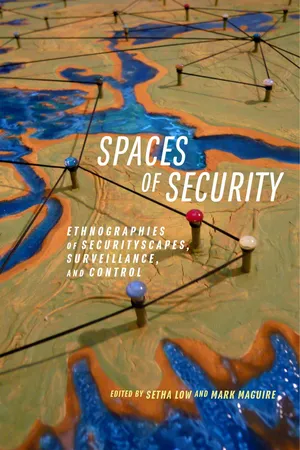
Spaces of Security
Ethnographies of Securityscapes, Surveillance, and Control
- 280 pages
- English
- ePUB (mobile friendly)
- Available on iOS & Android
eBook - ePub
Spaces of Security
Ethnographies of Securityscapes, Surveillance, and Control
About this book
Information
1
Security Urbanism and the Counterterror State in Kenya
Zoltán Glück
The city [is] not just the site, but the very medium of warfare—a flexible, almost liquid medium that is forever contingent and in flux.
—Eyal Weizman
Ibrahim tells me: “personally, I know about 30 people who lost their homes in the demolitions.” It’s early October 2014 and I’ve come to meet Ibrahim, an elder, community leader, an imam at a local mosque in Eastleigh where he teaches neighborhood children at his madrasa.1 Eastleigh is a predominantly Somali and Muslim neighborhood in Nairobi, home to a large refugee population of Somalis and Ethiopians who have fled war and conflict in their home countries. It is also at the epicenter of the Kenyan government’s counterterrorism policing operations. As Ibrahim describes to me: “The government decided that they wanted to remove all of the structures that were not ‘permanent’ in Eastleigh. . . . my madrasa was one of these semi-permanent structures, so it was demolished. It used to be made of mabati (iron sheets).” The official pretext for the neighborhood-wide demolitions was that the structures were built illegally, yet the police who carried them out were operating in the context of “Operation Usalama Watch,” the infamous counterterrorism policing initiative that swept the neighborhood in the spring and summer of 2014. Among neighborhood residents, the demolitions were understood to be a kind of retaliation and collective punishment for the terrorist attack carried out against the Westgate shopping mall by the Somali militant group, Al-Shabaab, in September 2013.
There were no advance warnings before the demolition crews arrived in Eastleigh, and many people lost all of their belongings, either unable to get to them in time or forbidden by the police to retrieve them. As Ibrahim recounts, “people were crying about their property, but there were police everywhere and there was nothing you could do. . . . when I saw my madrasa, I sat in the street there for three hours. Three hours. All I could do was cry.” Yet Ibrahim tells me that he was lucky: with much community support and many donations, he was able to open the madrasa at a new location across the street from where his demolished school once stood. His rent is higher now and he struggles every month to stay open, but compared to what many people in the community have suffered his plight is, as he tells me, minor. In the hours that I spent talking with Ibrahim, he and his friends told me harrowing stories about what they had witnessed during the police raids. Under the auspice of rooting out “terrorists,” the Kenyan police engaged in widespread human rights abuses: beating, robbing, extortion, rape, and intimidating residents while destroying property (often smashing and stealing from people’s homes during the raids) (Balakian 2016).
Operation Usalama Watch worked like a battering ram on Eastleigh. Semi-permanent mabati structures were torn down en masse, putting many people out of homes and work. Police roundups punctuated the days, placing thousands in jail cells, and draining family and community resources to pay off bail and bribes (Henry 2014; Human Rights Watch 2014a, 2014b). To date these operations have not led to any major conviction of suspects on terrorism-related charges, but they have deeply affected the communities and neighborhoods within which they were carried out. Within the first week of Usalama Watch, 4,000 people were arrested, caught in the seemingly indiscriminate dragnet of policing raids that pulled people out of their homes at night and swept up whole crowds from the city streets by day (Henry 2014). Over the next months, thousands of refugees were forcibly relocated from their homes in Nairobi to overcrowded refugee camps in the Northern desert region of the country. Deportation and forced “relocation” split up families, while hundreds were also kept for weeks under inhumane conditions at the now infamous Kasarani stadium in Nairobi. While such security operations have left their indelible physical and psychological marks on the neighborhood, they also stand as an index of the increasingly urban tactics and spatial strategies employed by the Kenyan state in its “war on terror.”
This chapter looks at the socio-spatial impacts of Kenya’s War on Terror through the prism of the urban transformations it has precipitated and what such processes may tell us about the changing nature of state power in contemporary Kenya. Over the past three years, the War on Terror has transformed and remade spaces across East Africa, pulverizing slums and marginalized urban areas, galvanizing the construction border walls, and precipitating larger international interventions in the Horn of Africa which are transforming regional governance and regional space (Anderson and McKnight 2015; Al Bulushi 2014). Building on Stephen Graham’s (2010) theorization of “military urbanism,” I offer an analysis of processes of militarization and securitization of urban space in Nairobi. I begin from the premise that as security increasingly becomes a dominant concept and discourse in political and social life in Kenya, it also becomes an important mechanism through which space is produced. By providing an analysis of the “production of security space” (Glück 2015) through the case of security practices and urban imaginaries in Nairobi, this chapter offers a grounded theorization of what I am here calling “security urbanism.”
First I analyze the “state spatial strategies” (Brenner 2004) of counterterrorism, placing policing operations such as Usalama Watch in a broader context of how state space is produced. I argue that policing practices and urban interventions are pivotal moments in the formation of the Kenyan “counterterror state” (Masco 2014). In the second section I draw upon several ethnographic vignettes to illustrate how “security” has become a dominant urban imaginary in Nairobi, affecting the way securitized urban subjects articulate their fears and politics and experience urban spaces. Taken together, these arguments provide a grounded theorization of how security urbanism is co-produced by state strategies and the everyday practices of urban residents.
Spatial Strategies of the Counterterror State
Each new form of state, each new form of political power, introduces its own particular way of partitioning space, its own particular administrative classification of discourses about space and about things and people in space. Each such form commands space, as it were, to serve its purposes.
—Henri Lefebvre
Counterterrorism operations have left many Eastleigh residents traumatized, fearful of the police and scared to even leave the neighborhood. As one woman who had been detained at Kasarani stadium told me during an interview: “Even last night someone called me and told me not to leave me house, because there were police men here [in the streets].” Meti is an Oromo Ethiopian refugee who has made her home in Eastleigh for the past ten years; she tells me that everything changed in 2014. Refugees had long faced discrimination and intermittent police harassment in Kenya, but the past year represented a dramatic shift in the scale and brutality of the violence. Meti fled Ethiopia after her father was killed ten years ago and, as she explains: “I can’t go home unless I want to be killed . . . but here [after this past year] my heart is so broken.” When I ask about how things have changed in her daily life in the city she replies, “I don’t leave Eastleigh if I don’t have to . . . I don’t feel safe other places.” This sentiment, which was echoed by other refugees that I met in the neighborhood, also stands as an index of some of the less visible ways that Nairobi is being transformed by the War on Terror. As whole groups of people become fearful of leaving their neighborhood, it is the affective and immaterial boundaries within the city that are hardening. Residents of Eastleigh are not only dispossessed of the homes in large-scale, highly visible demolitions. They are also excluded in less visible ways, as everyday harassment, trauma, and fears impact the way they move around the city.
Urban counterterrorism interventions, such as Operation Usalama Watch, in Nairobi neighborhoods have become key spatial strategies of Kenya’s “war on terror.” As an extraordinary means through which the Kenyan state seeks to intervene in the social life of the city, counterterrorism policing both reshapes urban space and produces new relations between the state and its subjects. We may read such interventions as particular “state spatial strategies” (Brenner 2004) through which the emergent Kenyan “counterterror state” (Masco 2014) is actively constructing itself and through which state power makes itself visible and tangible in the everyday lives of citizens (Mitchell 2006). Counterterrorism can thus be understood as a set of material practices through which the state is spatialized and new forms of “state space” are constructed (Ferguson and Gupta 2002; Brenner and Elden 2009). In this respect, urban security operations are key sites in which the Kenyan state spatiality is re-negotiated, re-scaled, and reconstructed under the auspices of the war on terror.
While it has become an accepted theoretical axiom in the critical social sciences that urban space is “produced” through social, political, and economic forces (Harvey 2007; Smith 1984; Massey 2005), there is decidedly less consensus about how to understand the state and its spatiality (Jessop 2001, 1990; Ferguson and Gupta 2002; Brenner 2004). Building on urban-focused theories of spatial production, critical geographers have begun to theorize “state space” as an outcome of conflicting social forces (Brenner and Elden 2009; Brenner 2004; Smith 1984; Cowen and Gilbert 2008). “Much like the geography of the city,” writes Neil Brenner, “the geography of state spatiality must be viewed as a presupposition, an area, and an outcome of continually evolving political strategies” (2004, 75–76). By viewing the state as a social process, a critical theory of state space focuses on the concrete strategies through which the state is materially articulated in social life. Rather than taking idealized spatial abstractions at face value—such as maps, laws, treaties, or policy documents—this critical state-space approach attends to the practices through which states constantly produce and reproduce their economic and juridico-political claims on space. Anthropological approaches to the study of states have often begun from similar theoretical points of departure: namely, that states can be studied through the practices and interactions in which they are made material in social life (Sharma and Gupta 2006; Aretxaga 2003; Das and Poole 2004). As such, the anthropology of the state has helped to give ethnographic flesh to the fairly abstract statement that the “state is a social relation” (Poulantzas 1978; Jessop 1990). Whereas critical geographers have been helpful in theorizing state spatiality, they have been less adept at studying the concrete social practices through which states enact such spatiality in everyday life. Ethnographers by contrast have successfully documented the social relationships and interactions through which states enact their power, yet their ambit of theorization has often been too modestly curtailed by the horizons of their ethnographic scope. In what follows, I strive to stitch together the insights of these two fields in order to develop an ethnographically grounded treatment of state spatiality through the case of the Kenya counterterror state and its urban security strategies.
Just as it would be difficult to imagine a city existing apart from its material extension in space, states themselves can be analyzed through their spatial practices, projects, and material practices of reproduction. Such an approach understands states as unfinished projects of socio-political domination that are constantly in need of renewal. As Jessop writes:
There is never a point when the state is finally built within a given territory and thereafter operates, so to speak, on autopilot according to its own definite, fixed and inevitable laws [ . . . ] Whether, how and to what extent one can talk in definite terms about the state actually depends on the contingent and provisional outcome of struggles to realize more or less “specific” “state projects.” (Jessop 1990, 9)
As projects of political domination, states must constantly reproduce themselves through material and symbolic practices (such as bureaucratic repetition, public spectacle, or violent intervention) which are often realized as attempts to organize, regulate, abject, or destroy facets of social life at given geographic scales. It is through such practices that relations of power and domination are institutionalized and organized spatially in society: put another way, states achieve and reproduce power through spatial strategies of domination. In its classic formulation, social theory has traditionally treated the “space” of a state as coextensive with its territorial boundaries (Elden 2013; Foucault 2004). Indeed, the production of national territories has historically been an important strategy and geographic scale at which states organize relations of power and accumulation. Yet territory is far from the only scale at which spatial strategies are enacted. Rather than the highwater mark of state’s capacity to control “sovereign” space, territory can be “analyzed as a historically specific strategy of spatial enclosure and as an evolving multi-scalar institutional configuration” (Brenner 2004, 70). From this vantage point, state spatiality is perhaps better thought of through Lefebvre’s image of a mille-feuille, that is, as a collection of overlapping layers and scales of social integration, with national territory being but one of the geographic scales at which states seeks to enclose and manipulate space (Lefebvre 1991, 86). Particularly with the rise of new forms of decentralized governmentality, inter-urban competition, global counterinsurgency, and everyday securitization, cities have become pivotal sites through which state spatiality is being renegotiated and re-scaled in the contemporary period (Graham 2010; Brenner 2009; Smith 1992).
It is in this sense that the violent production of urban spaces as unevenly “securitized” zones of danger, variously targeted for intervention or fortification, can be read as part of a broader array of state spatial strategies employed by the Kenyan government in its ongoing War on Terror. Such spatial strategies have included: the partial construction of a border wall along stretches of its North Eastern border with Somalia, a new Security Laws bill which sought to remove all refugees from urban areas, attempts to close refugee camps, counterinsurgency operations in national parks and forests which are seen as potential terrorist havens, and a protracted military campaign in Southern Somalia which has grown into a de facto occupation of the region under the auspices of AMISOM (Anderson and McKnight 2015). Taken on their own such state actions seem to be a piecemeal set of events—or “worse” (as critics of Kenyan government often claim), they can be interpreted as symptoms of the government’s allegedly inept, inefficient, and chaotic response to terrorism. I would propose a different reading, namely, that such interventions can be read as part ...
Table of contents
- Cover
- Title Page
- Copyright Page
- Dedication
- Contents
- Introduction: Exploring Spaces of Security
- 1. Security Urbanism and the Counterterror State in Kenya
- 2. Comparative Surveillance Regimes: A Preliminary Essay
- 3. Borderization and Public Security in Argentina
- 4. From Panopticon to Panasonic: The Architecture of Fear in Mega-Events
- 5. Securing Security: Recursive Security Assemblages in South Africa
- 6. Domesticating Security: Gated Communities and Cooperative Apartment Buildings in New York City and Long Island, New York
- 7. Domesticating Spaces of Security in Israel
- 8. The Political Economy and Political Aesthetics of Military Maps
- 9. Enigmatic Presence: Satellites and the Vertical Spatialities of Security
- 10. Re-Spatializing Social Security in India
- About the Editors
- About the Contributors
- Index
Trusted by 375,005 students
Access to over 1.5 million titles for a fair monthly price.
Study more efficiently using our study tools.
Frequently asked questions
Yes, you can cancel anytime from the Subscription tab in your account settings on the Perlego website. Your subscription will stay active until the end of your current billing period. Learn how to cancel your subscription
No, books cannot be downloaded as external files, such as PDFs, for use outside of Perlego. However, you can download books within the Perlego app for offline reading on mobile or tablet. Learn how to download books offline
Perlego offers two plans: Essential and Complete
- Essential is ideal for learners and professionals who enjoy exploring a wide range of subjects. Access the Essential Library with 800,000+ trusted titles and best-sellers across business, personal growth, and the humanities. Includes unlimited reading time and Standard Read Aloud voice.
- Complete: Perfect for advanced learners and researchers needing full, unrestricted access. Unlock 1.5M+ books across hundreds of subjects, including academic and specialized titles. The Complete Plan also includes advanced features like Premium Read Aloud and Research Assistant.
We are an online textbook subscription service, where you can get access to an entire online library for less than the price of a single book per month. With over 1.5 million books across 990+ topics, we’ve got you covered! Learn about our mission
Look out for the read-aloud symbol on your next book to see if you can listen to it. The read-aloud tool reads text aloud for you, highlighting the text as it is being read. You can pause it, speed it up and slow it down. Learn more about Read Aloud
Yes! You can use the Perlego app on both iOS and Android devices to read anytime, anywhere — even offline. Perfect for commutes or when you’re on the go.
Please note we cannot support devices running on iOS 13 and Android 7 or earlier. Learn more about using the app
Please note we cannot support devices running on iOS 13 and Android 7 or earlier. Learn more about using the app
Yes, you can access Spaces of Security by Mark Maguire, Setha Low,Mark Maguire, Setha Low in PDF and/or ePUB format, as well as other popular books in Social Sciences & Anthropology. We have over 1.5 million books available in our catalogue for you to explore.