Global Pentecostalism is a twenty-first century phenomenon. Yet in North America, where the movement was born, it has stalled. Courey uncovers the cause of this plateau in the triumphalism that is characteristic of both North American Protestantism and Pentecostalism. Through the identification of parallels between Martin Luther and contemporary Pentecostals, Courey detects in Luther's Theology of the Cross a potent remedy for this tension. Utilising this insight, Courey reflects on other faith traditions, and provides a counterpoint to the triumphalism that inhibits the development of Pentecostalism in North America and around the world.
This work comprises of three parts. The first is historical, charting the antecedents and development of Pentecostal triumphalism. The second is an experiment in historical theology, seeking basic resonances between Luther and early Pentecostals, and examining the Theology of the Cross as a means of probing Pentecostalism. The final section is an effort in constructive theology, applying the theologia crucis to some of the central aspects of Pentecostalism.
eBook - ePub
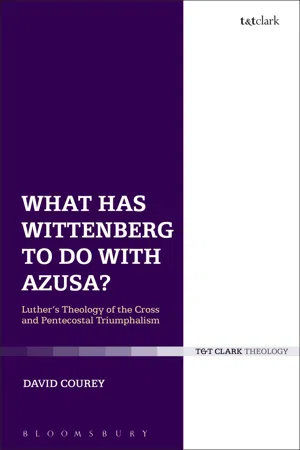
What Has Wittenberg to Do with Azusa?
Luther's Theology of the Cross and Pentecostal Triumphalism
- 304 pages
- English
- ePUB (mobile friendly)
- Available on iOS & Android
eBook - ePub
What Has Wittenberg to Do with Azusa?
Luther's Theology of the Cross and Pentecostal Triumphalism
About this book
Information
Part I
PROBING THE PENTECOSTAL PROBLEM: THE SOURCES AND DEVELOPMENT OF PENTECOSTAL TRIUMPHALISM
Chapter 1
‘’TIS A GLORIOUS CHURCH’: ANTECEDENTS OF PENTECOSTAL TRIUMPHALISM
’Tis a glorious Church without spot or wrinkle
Washed in the blood of the Lamb.
—Ralph E. Hudson (1843–1901), ’Tis a Glorious Church’
Here the church is looked on as already cleansed when saved, but not yet perfectly holy, or without spot or wrinkle. So the Lord desires it to go on in holiness or sanctification so that he might ‘present the church to himself a glorious church, not having spot or wrinkle or any such thing; but that it should be holy and without blemish’, Eph. 5.27.
E. N. Bell, Assemblies of God General Superintendent, 1914, 1920–23
‘Questions and Answers’, WE, No. 216 (27 November 1917), 8.
I. Introduction: The Sources of Pentecostal Triumphalism
Pentecostals intended to be that ‘glorious church’. By sheer dint of determination they would be among the wise virgins whose lamps were trimmed and ready for the Bridegroom’s coming.1 This strain of the Pentecostal urgency to ‘be ready’ and all that it implied for the life of the Spirit-filled believer runs deep in the Pentecostal ethos and informs the underlying triumphalism that infects contemporary Pentecostalism. Triumphalism, I contend, is not an essential feature of Pentecostal experience, though it seems ubiquitous in its North American manifestation. In order to properly assess Pentecostal triumphalism, in this chapter I locate it in the larger context of American religious history, then in the next I will determine its essence at the earliest stratum of Pentecostal experience, and trace its institutional development historically from there. The discussion takes place within the context of a significant debate regarding the relationship between Pentecostalism and Evangelicalism. On the one side are those who propose a kind of Pentecostal exceptionalism, that is, a sufficient uniqueness of the Pentecostal ethos that it should not primarily be considered a subset of Evangelicalism. On the other are those who perceive Pentecostalism as being thoroughly built upon evangelical presuppositions, but offering a fresh perspective informed by pneumatological experience.2 One of this book’s goals is to provide an analysis of Pentecostal triumphalism as a case in point of the larger evangelical story. A measure of its usefulness will be lost if its insights are limited to Pentecostalism alone. Underlying this assertion, however, is a fundamental assumption regarding the essential nature of Pentecostalism and its relationship to Evangelicalism.3 A core premise of this study is that Pentecostalism is a specific variety of North American Evangelicalism.
Though understanding Pentecostalism as a form of Evangelicalism has become a disputed issue in the area of Pentecostal studies, this chapter will explore the continuities between the two, showing how Pentecostalism came to inherit triumphalism from its evangelical heritage. Again, definitions are crucial: it may be better to speak of Evangelicalisms, just as the global situation has required scholarship to discern between Pentecostalisms. Neo-Evangelicalism as currently experienced is a broad coalition of theologically conservative Christian groups, and while intentionally including Pentecostalism, is, in fact antedated by Classical Pentecostalism.4 Still, both had their roots in the soil of the American Christianity that culminated with the Evangelical Alliance of the late nineteenth century.5 First, I will raise serious questions about the assertion of Pentecostal exceptionalism. I will then elaborate the broad historical background of evangelical triumphalism, and the specific antecedents of its Pentecostal variety as they emerged towards the end of the nineteenth century. Though revisiting these may seem to be covering old territory, they are essential to uncovering the undergirding restorationism and perfectionism which give rise to Pentecostal triumphalism. Next, I will argue, by exploring its antecedents, that Pentecostalism shares much in common with the very movements from which some seek to distinguish it. I will relate the development of Radical Evangelicalism and Pentecostalism to the emergence of Fundamentalism and neo-Evangelicalism. Pentecostalism, it will be asserted, fits very centrally in the taxonomy of Evangelicalism, and for that reason, solutions for the problem of Pentecostal triumphalism will have significant ramifications for contemporary Evangelicalism.
II. Triumphalism and the Question of Pentecostal Exceptionalism
Pentecostal triumphalism, I assert, is a species of the larger genus of evangelical triumphalism. Its essence, though in some ways unique, and perhaps, extreme, does not arise separately from its antecedents, nor has it developed over time in a way unconnected to its fellow travellers. Considerable energy has been spent in Pentecostal academia to distance Pentecostalism from two other historically significant movements: Fundamentalism and Evangelicalism. William Faupel, for instance, claimed in 1992 that Pentecostalism was at a crossroads. It must choose between two ‘competing visions:’ one seeing Pentecostalism as a subgroup of Evangelicalism, the other as a movement with ‘its own mission, its own hermeneutic, and its own agenda’, separate from Evangelicalism.6 The novice to Pentecostal studies may be bewildered by this insistence, because without fully understanding the reasoning behind such clear assertions of independence, the superficial historical connections will appear decisively to the contrary. But solutions to this quandary are not simple. They depend on shifting definitions, and nuanced understandings of the terms employed.7 First I will inquire as to the reasons for stressing Pentecostal exceptionalism, and then turn to an exploration of its historical basis.
At some point one might inquire as to the use to be made of the conclusion drawn in the matter of Pentecostal exceptionalism. Is the question simply one of historical accuracy, or is there some teleological point that the conclusion serves? Does one’s interpretation of the historical data depend on some utilitarian application to be made of the conclusion? Arguments along several trajectories have made use of the notion of Pentecostal exceptionalism, that is, that Pentecostalism is primarily neither a form of Fundamentalism nor of Evangelicalism, but is, at its heart, something essentially different than either. The earliest Pentecostal historiography tended to explain the Latter Rain outpouring with reference to prophecy and eschatology. From B. F. Lawrence’s The Apostolic Faith Restored, the first ‘history’ of Pentecostalism, published by the Assemblies of God (AG) in 1916, to Carl Brumback’s suggestively titled Suddenly . . . from Heaven, published in 1961, the notion was perpetuated that the Pentecostal revival was simply an act of God, entirely discontinuous from historical or social factors, to restore primitive Christianity.8 Clearly the point of Pentecostal exceptionalism in these accounts was to underscore that this was God’s movement, and no one else’s. However, as time moved on, other agendas also made the claim. Robert Mapes Anderson’s 1979 book Vision of the Disinherited found in Pentecostal exceptionalism a case in point for his elaboration of the church-sect hypothesis, demonstrating that Pentecostalism could be understood primarily as a movement of the socially deprived and discontented.9 The remarkable flattening of historical and religious realities made by such a reductionist approach is stunning, but it is supported by an appeal to Pentecostal exceptionalism.10
Another example of the ideological need to invoke some sort of Pentecostal exceptionalism is found in the work of Margaret Poloma. In her effort to assess the knife-edge balancing act the Assemblies of God (AG) has performed to maintain intact the tension of charisma and institution, she has emphasized as a danger signal the growing ambiguity that pastors feel between their Pentecostal identity and their self-identification as Evangelicals. The ultimate threat for Pentecostalism, it seems, would be an uncritical drift into Evangelicalism in which case it would obviously have sustained the loss of the charisma.11 ‘These cultural Pentecostals’, Poloma states, ‘are proclaiming a distinct identity but looking more and more like evangelicals in their beliefs and religious practices’. This is a common concern shared by observers, participants and leaders including Harvey Cox, Walter J. Hollenweger, Russell Spittler and former General Superintendent Thomas Trask, who exclaimed, ‘The Assemblies of God was raised up to be a Pentecostal voice. I have great respect and love for evangelical churches, but we are more than evangelical; we are Pentecostal!’12
Perhaps the most ideologically driven use of Pentecostal exceptionalism is in the discussion surrounding Pentecostal hermeneutics, which will be considered more fully in the next chapter. In this debate much is made of certain features of early Pentecostalism such as the use of narrative theology, particularly with regard to the Latter Rain but also with its preoccupation with the Book of Acts; the centrality of personal experience of the Spirit, orality, and the function of testimony; and the role of the community in regulating experience and interpretation. Among theologians and biblical scholars who see in these marks of early Pentecostalism the beginnings of a postmodern hermeneutic, Kenneth Archer has made the most complete statement of early Pentecostal exceptionalism.13 He implies that early Pentecostalism lost its way when, in the period of institutional development, Pentecostals first entertained the presuppositions of Fundamentalism and entered evangelical seminaries where they imbibed the more rationalist and modernist assumptions of historical-critical scholarship. For Archer, it is the modernist search for authorial intent and objective meaning from the text which must be eschewed if Pentecostals are going to be true to their roots, and return to a truly Pentecostal reading of the text which places meaning in a dance between the Spirit, Scripture and the Pentecostal community. This, he claims, was the way of the first Pentecostals.14 But easy parallels between early Pentecostals and the emerging concerns of postmodern hermeneutics are both anachronistic and deceptive. Such comparisons are superficial at best. For instance, Timothy Cargal’s assertion that the truth claims of a Pentecostal hermeneutic lie on a higher ‘pneumatic’ level without necessary reference to historicity, would scandalize early Pentecostals who, despite their narrative theology, and less rationalistic paradigms, had a remarkably literal sense of what actually took place in the Bible.15
Often, then, what is assumed regarding Pentecostal exceptionalism drives an ideological agenda. Whether the spiritual schema of a heaven-sent revival; social and historical models of class deprivation; a sociological paradigm of institutionalism; or issues of postmodern hermeneutics, Pentecostal exceptionalism serves a chief functional role in making the argument. I wish neither to defend nor deny the reality of Pentecostal exceptionalism. The issue is far from clear to adjudicate. If there was no difference between Pentecostals and Fundamentalists or Evangel...
Table of contents
- Cover
- Half-Title
- Introduction: Evaluating Contemporary Pentecostalism
- Part I: Probing the Pentecostal Problem: The Sources and Development of Pentecostal Triumphalism
- Part II: Luther and the Theology of the Cross: Synthesizing a Resource for Pentecostal Theology
- Part III: A Pentecostal Theology of the Cross: Listening to Luther with Pentecostal Ears
- Bibliography
- Person Index
- Subject Index
- Copyright Acknowledgements
- Copyright
Trusted by 375,005 students
Access to over 1.5 million titles for a fair monthly price.
Study more efficiently using our study tools.
Frequently asked questions
Yes, you can cancel anytime from the Subscription tab in your account settings on the Perlego website. Your subscription will stay active until the end of your current billing period. Learn how to cancel your subscription
No, books cannot be downloaded as external files, such as PDFs, for use outside of Perlego. However, you can download books within the Perlego app for offline reading on mobile or tablet. Learn how to download books offline
Perlego offers two plans: Essential and Complete
- Essential is ideal for learners and professionals who enjoy exploring a wide range of subjects. Access the Essential Library with 800,000+ trusted titles and best-sellers across business, personal growth, and the humanities. Includes unlimited reading time and Standard Read Aloud voice.
- Complete: Perfect for advanced learners and researchers needing full, unrestricted access. Unlock 1.5M+ books across hundreds of subjects, including academic and specialized titles. The Complete Plan also includes advanced features like Premium Read Aloud and Research Assistant.
We are an online textbook subscription service, where you can get access to an entire online library for less than the price of a single book per month. With over 1.5 million books across 990+ topics, we’ve got you covered! Learn about our mission
Look out for the read-aloud symbol on your next book to see if you can listen to it. The read-aloud tool reads text aloud for you, highlighting the text as it is being read. You can pause it, speed it up and slow it down. Learn more about Read Aloud
Yes! You can use the Perlego app on both iOS and Android devices to read anytime, anywhere — even offline. Perfect for commutes or when you’re on the go.
Please note we cannot support devices running on iOS 13 and Android 7 or earlier. Learn more about using the app
Please note we cannot support devices running on iOS 13 and Android 7 or earlier. Learn more about using the app
Yes, you can access What Has Wittenberg to Do with Azusa? by David J. Courey in PDF and/or ePUB format, as well as other popular books in Theology & Religion & Christian Theology. We have over 1.5 million books available in our catalogue for you to explore.