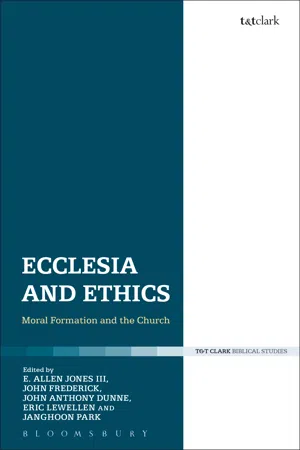
eBook - ePub
Ecclesia and Ethics
Moral Formation and the Church
- 240 pages
- English
- ePUB (mobile friendly)
- Available on iOS & Android
eBook - ePub
Ecclesia and Ethics
Moral Formation and the Church
About this book
Ecclesia and Ethics considers the subject of Ecclesial Ethics within its theological, theoretical and exegetical contexts. Part one presents the biblical-theological foundations of an ecclesial ethic – examining issues such as creation, and Paul's theology of the Cross. Part two moves on to examine issues of character formation and community. Finally, part three presents a range of exegetical applications, which examine scripture and ethics in praxis. These essays look at hot-button issues such as the 'virtual self' in the digital age, economics, and attitudes to war. The collection includes luminaries such as N.T. Wright, Michael J. Gorman, Stanley Hauerwas and Dennis Hollinger, as well as giving space to new theological and exegetical voices. As such Ecclesia and Ethics provides a challenging and contemporary examination of modern ethical debates in the light of up-to-date theology and exegesis.
Information
Part I
BIBLICAL-THEOLOGICAL FOUNDATIONS FOR ECCLESIAL ETHICS
Chapter 1
CREATION: THE STARTING POINT OF AN ECCLESIAL ETHIC
Dennis P. Hollinger
Christian faith is Trinitarian: the mysterious oneness of God as three persons – Father, Son and Holy Spirit. Despite this creedal affirmation, Christian history, and particularly Christian Ethics, has tended towards a functional Unitarianism. In an article many years ago H. Richard Niebuhr pointed out that though ‘Christianity has often been accused of being a polytheism with three Gods …, it seems nearer the truth to say that Christianity as a whole is more likely to be an association …, of three Unitarian religions’.1 He refers to these three as a Unitarianism of the Father, a Unitarianism of the Son and a Unitarianism of the Holy Spirit. Despite the creedal affirmation, key individuals and movements throughout the Church have tended to accentuate one person of the Trinity, sometimes in reaction to an exclusive emphasis of the others. For example, ‘The Unitarianism of the Spirit arises in protest and reaction against exclusive concern with rational and historical knowledge of God as he is known in nature and in history.’2
Niebuhr’s observation is particularly evident in the history of Christian Ethics, in which theologians and ethicists have frequently forged an ethic of the Father, over against or in neglect of the Son and Spirit; or an ethic of the Son over against or in neglect of the Father and Spirit; or an ethic of the Spirit over against or in neglect of the Father and the Son.3 If we are truly Trinitarian both the foundations and content of our ethic should embody all three persons. As Barth reminds us, ‘God is one and indivisible in His working. That He is Creator, Reconciler and Redeemer does not imply the existence of separate divine departments and branches of authority.’ This is particularly true with regards to the command of God, for ‘If we consider it in its different spheres, and therefore if we here ask particularly about the command of God the Creator, this cannot and must not mean that beside this first there is a second and separate command, that of God the Reconciler and then a third, that of God the Redeemer’.4
Just as ‘Christians play favourites with the members of the Trinity’, Christians also play favourites with regards to the various key parts of the Christian narrative: creation, fall, redemption and consummation.5 As a result we have had and continue to have Christian Ethics of one of these four, frequently to the neglect or minimization of the others. Thus, an ethic of creation has often accentuated a creation orders model in which redemption in Christ and his life and teachings are neglected; an ethic of the fall or sin appeals to a realism in which the way things are is the way things must be; an ethics of redemption focuses on Jesus’ life and example with virtually no reference to creation; and an ethics of the Kingdom trumps the coming reign of God over all other dimensions.
As Christian Ethics is flawed when it separates Father, Son and Holy Spirit, so it is flawed when creation and redemption are separated into differing and opposing spheres of ethical appeal. God the Creator and God the Redeemer are one, and thus an ethic of redemption can neither negate nor neglect creation, just as an ethic of creation cannot negate or neglect redemption in Christ, including his life and teachings. Throughout the whole of canonical Scripture the links between creation and redemption are explicit. As Sean McDonough puts it in Christ as Creator, ‘God had created in a definitive act, and had done mighty works of salvation or re-creation in the history of his people Israel. In the eyes of the early Christians these mighty acts had reached their climax in God’s work through his Messiah Jesus.’6 The logos text of John 1 is perhaps the most well-known example:
In the beginning was the Word, and the Word was with God, and the Word was God. He was with God in the beginning. Through him all things were made; without him nothing was made that has been made. In him was life, and that life was the light of all mankind. … The Word became flesh and made his dwelling among us. We have seen his glory, the glory of the one and only Son, who came from the Father, full of grace and truth. (Jn 1.1-4, 14)7
In similar fashion, Paul holds Christ as Creator and Redeemer together when he says of the Son, ‘In him all things were created; things in heaven and on earth … . He is before all things and in him all things hold together. And he is the head of the body, the Church … . For God was pleased to have all his fullness dwell in him, and through him to reconcile to himself all things … by making peace through his blood’ (Col. 1.16-17, 19-20).8
Thus, when it comes to Christian Ethics, Barth is certainly right to maintain that ‘the God who meets man as Creator in His commandment is the God “who is gracious to him in Jesus Christ.” He is not then, a new and strange God who could require from man as his Commander something new and strange and even perhaps in conflict with what is asked of him by the God who is gracious to him in Jesus Christ.’9 Theologian Jonathan Wilson has recently suggested that we understand a dialectic of creation and redemption, and thus the doctrine of creation cannot be used to avoid the particularity of Jesus and redemption through him. ‘Any Christian theology is defective if it seeks to find in the doctrine of creation an escape from the scandal of particularity and an escape to a realm that does not require the fullness of knowledge that comes by faith and the hope that looks to the eschaton.’10 Wilson goes on to argue:
When the order of creation is separated from the order of redemption and treated as if its purpose and meaning could be discerned apart from redemption, we end up with a bifurcated account of the Christian life, on the one hand, and life within an imagined order of creation that does not bear witness to Jesus Christ, on the other hand. We interpret the way things are now as part of the order of creation and simply try to make the best of the circumstances instead of realizing that the present situation is the way of the world, which has been publicly humiliated and defeated by Christ.11
But just as creation cannot neglect redemption, so redemption cannot neglect creation. Any ethic of Jesus or ethic of the Kingdom must be in continuity with creation, since the work of Christ and his Kingdom is a restoration of creation, a re-creation. Thus, Jesus of Nazareth or his work on the cross does not overturn what God established in creation as a paradigm for humanity. The dialectic of creation and redemption means continuity between creation, redemption and the Kingdom restoration. The only discontinuity resides with sin and the Fall, so that the anomalies and fallen propensities of our world should never become the norm. The fallen condition of humanity and the cosmos yields not a normative realism, but rather a pastoral realism for how we seek to strategically connect fallen humanity to the creational/redemptive norms.
The starting point then of an ecclesial ethic is creation. This in no way sets aside the fuller understandings that may come in redemption and eschaton, but the latter fills out and makes more visible the creation paradigms.12 In what follows I seek to explore five major themes or paradigms from the creation narrative that serve as essential, though not exhaustive ethical frameworks, for believers and the Church. I will, furthermore, seek to briefly show that the creation paradigms13 are affirmed by redemption, eschaton and frequently even the teachings and life of Jesus.
A Good World
One of the most striking features of the Genesis account of creation is the repetitive refrain after each day of creation, ‘It is good.’ Then after the creation of humankind in God’s own image, ‘God saw all that he had made and it was very good’ (Gen. 1.21). The pronouncement of the created world’s goodness is most remarkable because it is the material, physical world, and not some soulish, otherworldly sphere of reality. No other ancient account of creation renders this same judgement about the created world. This pronouncement is at the heart of Archbishop William Temple’s statement, ‘Christianity … is the most avowedly materialistic of all the great religions’.14 The affirmation of the material, temporal world is affirmed by three great doctrines of biblical faith: creation, the incarnation and the resurrection of the body. Together these affirm that the created, physical world is not a sphere from which we escape, but a realm to which God calls us in the human vocation and through which we live redeemed lives.
Immediately of course one can raise the challenge of the Fall of Genesis 3 in which God’s good world gets distorted. But even after the Fall and the entrance of sin there is still a quality of goodness that inheres in the created world. Thus, as Albert Wolters describes it in Creation Regained, ‘A human being after the fall, though a travesty of humanity is still a human being, not an animal. A humanistic school is still a school. A broken relationship is still a relationship. Muddled thinking is still thinking. In each case, what something in fallen creation still is points to the enduring goodness of creation.’15 Though moral evil now enters the human world and the entire cosmos is affected by the Fall, there remains a metaphysical goodness to what God has created.
This is perhaps most e...
Table of contents
- Dedication
- Title
- Contents
- List of Contributors
- Preface
- List of Abbreviations
- Part I Biblical-Theological Foundations for Ecclesial Ethics
- Chapter 1 Creation: The Starting Point of an Ecclesial Ethic Dennis P. Hollinger
- Chapter 2 The Cross in Paul: Christophany, Theophany, Ecclesiophany Michael J. Gorman
- Chapter 3 The Church as Temple and Moral Exhortation in 1 Corinthians Brian Rosner
- Chapter 4 Learning from Paul: Centred Ethics that Avoid Legalistic Judgementalism and Moral Relativism Mark. D. Baker
- Part II Virtue Ethics, Character Formation, and Ecclesial Ethics
- Chapter 5 Habit Matters: The Bodily Character of the Virtues Stanley Hauerwas
- Chapter 6 Paul, Ethics and the Church N. T. Wright
- Part III Exegesis and Application – Scripture and the Praxis of Ecclesial Ethics
- Chapter 7 Did Saint Paul Take Up the Great Commission?: Discipleship Transposed into a Pauline Key Nijay Gupta
- Chapter 8 An Ethical Reading of the Story of Gideon-Abimelech for the Korean Church S. Min Chun
- Chapter 9 Pride and Prejudice: Community Ethics in James 4.1-12 Mariam J. Kamell
- Chapter 10 Discerning, Disarming and Redeeming the Digital Powers: Gospel Community, The Virtual Self, and the Html of Cruciform Love John Frederick
- Chapter 11 ‘DE MANIBUS GLADIUS CORPORALIS ABLATUS EST’: Absolute Pacifism in the Early Church and its Relevance in the Twenty-First Century Aaron C. Manby
- Chapter 12 ‘Follow Us as We Follow Moses’: Learning Biblical Economics from the New Testament’s Appropriation of Old Testament Narratives, Practices and Liturgies Michael Rhodes
- Chapter 13 ‘You Will Fill Me with Joy in Your Countenance’: Engaging the North American Ecclesial Context with a Narrative Ethical Reading of Acts 2.41-47 and 4.32-35 Douglas A. Hume
- Index
- Copyright
Trusted by 375,005 students
Access to over 1.5 million titles for a fair monthly price.
Study more efficiently using our study tools.
Frequently asked questions
Yes, you can cancel anytime from the Subscription tab in your account settings on the Perlego website. Your subscription will stay active until the end of your current billing period. Learn how to cancel your subscription
No, books cannot be downloaded as external files, such as PDFs, for use outside of Perlego. However, you can download books within the Perlego app for offline reading on mobile or tablet. Learn how to download books offline
Perlego offers two plans: Essential and Complete
- Essential is ideal for learners and professionals who enjoy exploring a wide range of subjects. Access the Essential Library with 800,000+ trusted titles and best-sellers across business, personal growth, and the humanities. Includes unlimited reading time and Standard Read Aloud voice.
- Complete: Perfect for advanced learners and researchers needing full, unrestricted access. Unlock 1.5M+ books across hundreds of subjects, including academic and specialized titles. The Complete Plan also includes advanced features like Premium Read Aloud and Research Assistant.
We are an online textbook subscription service, where you can get access to an entire online library for less than the price of a single book per month. With over 1.5 million books across 990+ topics, we’ve got you covered! Learn about our mission
Look out for the read-aloud symbol on your next book to see if you can listen to it. The read-aloud tool reads text aloud for you, highlighting the text as it is being read. You can pause it, speed it up and slow it down. Learn more about Read Aloud
Yes! You can use the Perlego app on both iOS and Android devices to read anytime, anywhere — even offline. Perfect for commutes or when you’re on the go.
Please note we cannot support devices running on iOS 13 and Android 7 or earlier. Learn more about using the app
Please note we cannot support devices running on iOS 13 and Android 7 or earlier. Learn more about using the app
Yes, you can access Ecclesia and Ethics by Edward Allen Jones III, John Frederick, John Anthony Dunne, Eric Lewellen, Janghoon Park, Edward Allen Jones III,John Frederick,John Anthony Dunne,Eric Lewellen,Janghoon Park in PDF and/or ePUB format, as well as other popular books in Theology & Religion & Biblical Studies. We have over 1.5 million books available in our catalogue for you to explore.