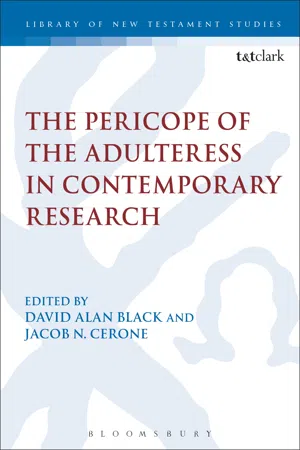
The contributors to this volume (J.D. Punch, Jennifer Knust, Tommy Wasserman, Chris Keith, Maurice Robinson, and Larry Hurtado) re-examine the Pericope Adulterae (John 7.53-8.11) asking afresh the question of the paragraph's authenticity. Each contributor not only presents the reader with arguments for or against the pericope's authenticity but also with viable theories on how and why the earliest extant manuscripts omit the passage.
Readers are encouraged to evaluate manuscript witnesses, scribal tendencies, patristic witnesses, and internal evidence to assess the plausibility of each contributor's proposal. Readers are presented with cutting-edge research on the pericope from both scholarly camps: those who argue for its originality, and those who regard it as a later scribal interpolation. In so doing, the volume brings readers face-to-face with the most recent evidence and arguments (several of which are made here for the first time, with new evidence is brought to the table), allowing readers to engage in the controversy and weigh the evidence for themselves.
eBook - ePub
The Pericope of the Adulteress in Contemporary Research
- 224 pages
- English
- ePUB (mobile friendly)
- Available on iOS & Android
eBook - ePub
The Pericope of the Adulteress in Contemporary Research
About this book
Information
1
THE PIOUSLY OFFENSIVE PERICOPE ADULTERAE
Textual critics are well aware of the questions regarding the PA, as are the parishioners who look at the footnotes in their study Bibles to discover that the PA is not found in the earliest manuscripts, that there is little to no discussion of the PA in the early Patristic writings, and that the PA is found in multiple locations among New Testament manuscripts, which some believe to be a telltale sign of a spurious text. Accordingly, many commentators choose to ignore it, and those who engage the text often treat it like it is the black sheep of the Johannine family.1 Even though many consider it to be “authentic Jesus material,”2 they accept the foregone conclusion that the PA does not belong in John’s Gospel. With so many heavy hitters arguing forcefully for this conclusion—Bruce Metzger, Raymond Brown, and three of my fellow panelists, Drs. Keith, Knust, and Wasserman—one might ask, “Why would anyone argue for its inclusion in John?”
Arguing in favor of the PA’s inclusion is, admittedly, a very tenuous position, particularly suggesting that well-meaning but perhaps misinformed early church leaders removed the PA for moral reasons.3 Though many questions remain at the conclusion of this study, this essay will examine a theory of “ecclesiastical suppression,” to borrow a phrase that Dr. Knust has coined,4 and will argue in favor of including this passage in the gospel according to John.
Even if the majority opinion about the PA is correct, the concerns raised here are worthy of being considered in deciding how to treat it.5 My argument for the inclusion of the PA in the Gospel of John proceeds in three parts: Part 1 will explore contextual compatibility, Part 2 will detail grammatical and syntactical congruity, and Part 3 will summarize the external evidence. Part 3 will not present an exhaustive discussion of the external evidence, but instead will pose a few questions around this evidence.
1. Context
We begin with a look at how the PA fits within the context of John’s Gospel. It is often claimed that the traditional placement of this passage at John 7:53–8:11 breaks the flow of the Tabernacles Discourse,6 yet to my knowledge no one actually discusses how it breaks the flow. In contrast, I would like to consider ways that the PA contributes to the flow of this discourse, both with thematic ties and with its contributions to the narrative structure.
The first half of the Tabernacles Discourse ends with a scene that begins in 7:45, one that allows the reader to overhear a private discussion about proper interpretation of the Law. Temple guards have failed to arrest Jesus, and the Pharisees, who ordered the arrest, angrily accuse the guards of being deceived by Jesus just as the common people are. This leads Nicodemus, one of their own, to respond, “Does our Law judge a man without first hearing him to find out what he is doing?” (7:51). The Pharisees try to suppress this comment by claiming no prophet comes from Galilee, but this only further reveals their misunderstanding. Nicodemus is correct about the due process of the Law, and the Pharisees are incorrect about Galilean prophets. Jonah, Elijah, and Nahum all hail from the region.7 They are likewise incorrect about Jesus and his proper interpretation of the Law.
This theme continues into the second half of the Tabernacles Discourse as well. It begins with the Pharisees questioning Jesus’ testimony in v. 13. Jesus, in turn, responds about what is written “in [their] Law” in v. 17 in a manner reminiscent of Nicodemus’ comment in 7:51. In 8:34ff., Jesus claims the Pharisees are violating the Law by attempting to kill him, a man who is not guilty. Finally, the chapter climaxes when Jesus says, “Before Abraham was born, I AM,” claiming for himself the name of God, the Lawgiver, revealed in the Pentateuch.
The PA blends remarkably well with the theme of interpreting the Law. The scribes and Pharisees present a woman accused of adultery to Jesus and declare, “In the Law Moses commanded us to stone such women. What do you say?” (8:5, emphasis mine). They claim to know what the Law says, but they want to know how Jesus interprets it. It is even possible that this mock trial may have found its origin in the discussion that concluded Chapter 7. Jesus, however, does not take the bait. In fact, he appears not only to properly interpret the Law but also to properly apply it. Adultery is not a sin that you can commit by yourself, and Torah demands that both parties guilty of it are to be stoned.8 Yet only the woman is brought to trial. The man’s absence should be a clear sign that there is no real intention to uphold the Law of Moses, which Jesus exposes by his restraining actions in the PA.
In addition to the theme of the Law, the PA blends well with the setting of the Feast of Tabernacles in general. In 7:53, worshippers “go to their own homes,” which is what they would be expected to do if, as 7:37 suggests, the festival is coming to a close.9 In contrast, Jesus goes to the Mount of Olives (8:1), but there may be more at play than a mere acknowledgement of Jesus’ homelessness. The Mount of Olives is the subject of several verses in Zechariah 14.10 Is it a coincidence the book of Zechariah served as part of the lectionary readings assigned to the Feast of Tabernacles?11
Still, even more significant may be Jesus’ actions at the feast. Two great images featured prominently in worship at this Jewish festival: (1) a water ritual, which Jesus appears to draw inspiration from when he makes his claim about “living water” in 7:37-38, and (2) giant menorahs provided light for the festival, which Jesus may have in mind when he declares himself to be “the light of the world” in 8:12. It seems that the PA provides connection to another focal point of the feast: Moses and the Law.12 Twice in this pericope, Jesus writes on the ground: John 8:6 explicitly says he writes “with his finger” and verse 8 simply says he stooped to write. Together, these references provide a strong connection with Moses’ reception of the Law in Exodus.
The first time he received the Decalogue, they are said in Exodus 31:18 to be written on stone “with the finger of God”; after Moses smashes these original tablets, however, a new set is provided, which is described both as being written by God in Exodus 34:1 and as being inscribed by Moses in 34:28. Twice the commandments are written by God, but only in the first instance are they said to be written with his finger. Throughout John’s Gospel, Jesus is contrasted with Moses (cf. 1:17, 5:45-47, 6:1-21, 9:28) and Jesus is always shown to be superior. This will be discussed in more detail below, but it should be noted that Jesus’ superiority is on display again in the PA. God is the only one described in the biblical canon as writing with his finger until Jesus does so. John presents Jesus not simply as a recipient of the Law—he shows him to be the author of it. The significance is not what Jesus writes with his finger, but that he writes with his finger, just as God wrote with his.
But there are more than just thematic ties provided by the inclusion of the PA. There are also narratival connections. If one moves directly from John 7:52 to 8:12, there is a very abrupt transition. Chapter 7 concludes with a private conversation between the Pharisees and the temple guards, but 8:12 says, “Again Jesus spoke to them.” Who is “them”? It can’t be the Pharisees since Jesus was not present for their discussion in 7:45-52. The last group Jesus is said to speak to in John 7 is the people in general; it is safe to assume that the Pharisees or at least their representatives may have likely been within earshot. In contrast when the PA, specifically 7:53–8:2, is included, Jesus resumes speaking with “them,” which would likely include both the people in general and those lurking in the shadows. The Pharisees may have been dismissed from Jesus’ presence in 8:9, but our own human curiosity is enough to suggest that they remained close enough to see what happened next. They remained close enough to respond to Jesus’ claim in 8:12.
Still, some like Daniel Wallace have claimed that the awkwardness between 7:52 and 8:12 is reminiscent of other “awkward” transitions where two parties resume speaking “again” (πάλιν) in the Fourth Gospel.13 The examples Wallace proposes include 1:34-35, 8:20-21, 9:8-15, 10:6-7, 18:4-7, 20:19-21. However, these additional examples of “awkward” transitions all have the same two parties resuming dialogue. This is not the case if we remove the PA, which J. P. Heil argues forcefully for including in the Gospel.14 For example, John the Baptist testifies in v. 34 and then speaks again to two of his disciples in v. 35. The reader is not told to whom John is speaking in 1:34, but it is presumably his disciples. Similarly, the Pharisees speak to Jesus again (8:21) after they had failed to seize him (8:20). Whil...
Table of contents
- Library of New Testament Studies
- Dedication
- Title
- Contents
- List of Abbreviations
- List of Tables
- List of Contributors
- Foreword Gary M. Burge
- Preface David Alan Black
- Introduction Jacob N. Cerone
- 1. The Piously Offensive Pericope Adulterae John David Punch
- 2. The Strange Case of the Missing Adulteress Tommy Wasserman
- 3. “Taking Away From”: Patristic Evidence and the Omission of the Pericope Adulterae From John’s Gospel Jennifer Knust
- 4. The Pericope Adulterae: A Theory of Attentive Insertion Chris Keith
- 5. The Pericope Adulterae: A Johannine Tapestry with Double Interlock Maurice A. Robinson
- 6. The Pericope Adulterae: Where From Here? Larry Hurtado
- Bibliography
- Index of Ancient Sources
- Index of Names
- Copyright
Trusted by 375,005 students
Access to over 1.5 million titles for a fair monthly price.
Study more efficiently using our study tools.
Frequently asked questions
Yes, you can cancel anytime from the Subscription tab in your account settings on the Perlego website. Your subscription will stay active until the end of your current billing period. Learn how to cancel your subscription
No, books cannot be downloaded as external files, such as PDFs, for use outside of Perlego. However, you can download books within the Perlego app for offline reading on mobile or tablet. Learn how to download books offline
Perlego offers two plans: Essential and Complete
- Essential is ideal for learners and professionals who enjoy exploring a wide range of subjects. Access the Essential Library with 800,000+ trusted titles and best-sellers across business, personal growth, and the humanities. Includes unlimited reading time and Standard Read Aloud voice.
- Complete: Perfect for advanced learners and researchers needing full, unrestricted access. Unlock 1.5M+ books across hundreds of subjects, including academic and specialized titles. The Complete Plan also includes advanced features like Premium Read Aloud and Research Assistant.
We are an online textbook subscription service, where you can get access to an entire online library for less than the price of a single book per month. With over 1.5 million books across 990+ topics, we’ve got you covered! Learn about our mission
Look out for the read-aloud symbol on your next book to see if you can listen to it. The read-aloud tool reads text aloud for you, highlighting the text as it is being read. You can pause it, speed it up and slow it down. Learn more about Read Aloud
Yes! You can use the Perlego app on both iOS and Android devices to read anytime, anywhere — even offline. Perfect for commutes or when you’re on the go.
Please note we cannot support devices running on iOS 13 and Android 7 or earlier. Learn more about using the app
Please note we cannot support devices running on iOS 13 and Android 7 or earlier. Learn more about using the app
Yes, you can access The Pericope of the Adulteress in Contemporary Research by David Alan Black, Jacob N. Cerone, David Alan Black,Jacob N. Cerone in PDF and/or ePUB format, as well as other popular books in Theology & Religion & Biblical Studies. We have over 1.5 million books available in our catalogue for you to explore.