Whilst aesthetics as a discipline did not exist before the modern age, ancient philosophers give many insights about beauty and art. In Late Antiquity Plotinus confronted the problem of beauty and the value of the arts. Plotinus' reflections have an important role in the development of the concept of the value of artistic imagination during the Renaissance and the Romantic era, but he also influenced the artistic taste of his time.
Aesthetic Themes in Pagan and Christian Neoplatonism reconstructs the aesthetic philosophical views of Late Antiquity, and their relation to artistic production of the time. By examining the resonance of Plotinus' thought with contemporary artists and with Christian thinkers, including Gregory of Nyssa, the book demonstrates the importance of Plotinus' treatise On Beauty for the development of late ancient aesthetics. The Cappadocian fathers' interest in Plotinus is explored, as well as the consequent legacy of the pagan thinker's philosophy within Christian thought, such as the concept of beauty and the narration of the contemplative experience.
Uniquely utilising philological and philosophical insight, as well as exploring both pagan and Christian philosophy, Aesthetic Themes in Pagan and Christian Neoplatonism represents the first comprehensive synthesis of aesthetic thought of Late Antiquity.
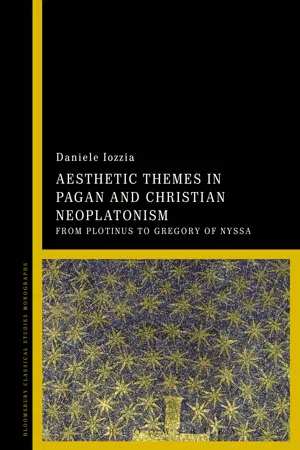
eBook - ePub
Aesthetic Themes in Pagan and Christian Neoplatonism
From Plotinus to Gregory of Nyssa
- 160 pages
- English
- ePUB (mobile friendly)
- Available on iOS & Android
eBook - ePub
Aesthetic Themes in Pagan and Christian Neoplatonism
From Plotinus to Gregory of Nyssa
About this book
Information
1
Rhetoric and Aesthetics in Plotinus
The expressive purpose of the metaphor in Plotinus
The use of metaphors in Plotinus has a methodological role akin to that of dialogue for Socrates and Plato. As for them, dialogue is the correct way to conduct a philosophical search, as is, for Plotinus, metaphorical expression the tool to convey the realities which lie beyond human language. The metaphor operates an emotional short-circuit in the reader,1 in that it activates different levels of the psyche with an eminently anagogic goal. In this sense, like dialogue for Socrates and Plato, metaphors and the images for Plotinus are not merely a form of expression but are chosen due to an internal necessity of his philosophy.2
For this reason it is necessary to discuss first the role of Plotinus’ metaphors, and particularly those related to visual arts, in his philosophical system. A metaphor connected to a specific form of poetic art, that of life as theatre and of the soul as an actor, will then be analysed as an example of the philosophical efficacy of Plotinus’ rhetorical devices. The many levels of Plotinus’ image of theatre and the different degrees of beings that it includes are a significative example of his ability to convey philosophical content through the rhetorical use of metaphor of art.
Many metaphors and images adopted by Plotinus are inspired by visual arts. These date back to rhetorical traditions well before him,3 and can be reconnected to the interest that even from the archaic period the epic tradition showed for productive activities. It should also be noted that, conforming to Greek and Roman culture, many of the metaphors related to artistic activities are used from the point of view of the material production and equiparate to any craft, although in some cases the attention of Plotinus is specifically addressed to that we can define as artistic creation.
Maria Di Pasquale Barbanti explained how the metaphor has a specific function within philosophical expression: ‘The metaphor, far from being a mere figure of speech, is full of philosophical meaning. It constitutes an innovation in the linguistic code, is an instrument of knowledge and, therefore, […] rather than to the “syntax” it belongs to semantics and to philosophy.’4
Aristotle had already indicated, both in the Poetics5 and in the Rhetoric,6 the elements to define the logical-philosophical role of metaphor, giving to logic the function of identifying the verisimilitude through which the rhetorical persuasion can operate. If, as Derrida argues,7 the use of metaphors is necessary to philosophical expression, it is particularly inevitable in the case of the thinkers whose horizon is specifically metaphysical, and of the mystical writers.
The use of metaphor exerts a protreptic function through its didactic properties, when the semantic gap between the real meaning and the figurative one in the metaphoric term is neutralized. An important element of a metaphor is surprise, which captures the attention of the reader and excites the imagination, charging the metaphor with an emotional power.8
There are in Plotinus many metaphors related to the visual arts but, as Ferwerda explains,9 they are mainly traditional and not original enough to convey key elements of the thought of Plotinus. Nevertheless, although not always innovative (which can be said of many other metaphors in Plotinus), they often have great beauty of expression.
Usually the references and the metaphors related to statuary are adopted in an anti-Aristotelic context to indicate the opposition between matter and form in the relationship between body and soul. In a statue, its material is distinct from its form, for example in Enn. II 5 (25) 1, 12–20, or Enn. VI 3 (44) 22, 1–12, where the the statue is considered to clarify the passage from potency to act.10
Surprisingly, the interest of Plotinus towards the arts is less affected by Plato’s condemnation of them and more connected to later reflections in Hellenistic rhetoric and Cicero.11 In Enn. V 8 (31) 1, Plotinus notoriously gives one of the more decisive considerations about the nature of artistic production and its epistemological value, in contrast with the position of Plato.12 When talking about the statue of Zeus made by Phidias13 he confers to the sculptor the ability to contemplate the eidos of the god without referring to a visible model, and to represent him as he would appear if he decided to manifest himself, because the arts can give beauty to matter: Εἶτα καὶ ὅτι πολλὰ παρ᾽ αὑτῶν ποιοῦσι καὶ προστιθέασι δέ, ὅτῳ τι ἐλλείπει, ὡς ἔχουσαι τὸ κάλλος. Ἐπεὶ καὶ ὁ Φειδίας τὸν Δία πρὸς οὐδὲν αἰσθητὸν ποιήσας, ἀλλὰ λαβὼν οἷος ἂν γένοιτο, εἰ ἡμῖν ὁ Ζεὺς δι᾽ ὀμμάτων ἐθέλοι φανῆναι.14 In fact, as demonstrated by Oiva Kuisma,15 the difference of Plotinus from Platonic thought must be considered in a less accentuated way, since the artistic representation in Plotinus’ view still remains on the material level, and if the artist has the ability to grasp the intelligible form of his model, it is always the form that the divine model would take if he decided to manifest himself to mortal eyes. This is, in fact, Proclus’ view,16 as demonstrated by Anne Sheppard.17 It is also true, on the other hand, as Kuisma emphasizes, that we do not even know if Plotinus ever saw Phidias’ work, because we do not have any documentation about him visiting Olympia.18 We must therefore assume that he adopts the common conception about the excellence of Phidias’ Zeus in Olympia, and it is not correct to attribute to the philosopher a specific interest in this work of art.
It is also clear, however, that the appreciation of the arts in Plotinus is testified by the use he makes of metaphors. It seems that sculpting is a preferred image for Plotinus, but painting and architecture are also present in the metaphors adopted by him. Plotinus’ metaphors are fuelled by a power of expression that is independent from the strictly philosophical understanding of artistic activity, and confer a high literary value to his words. In this sense, Plotinus’ writing could be compared to the kind of impressionistic painting that developed around the second and third century AD, in the sense that it is the overall effect, rather than refinement of the detail, which qualifies the expressive strength of the sentences. Porphyry tells that Plotinus did not revise what he had written, entrusting it to his disciple and biographer, who would then operate a degree of correction. Porphyry also highlights how Plotinus’ specific accent led him to spelling errors. In general, however, it seems that Porphyry’s intervention in the texts was marginal, which explains certain inconsistencies and sometimes the lack of an immediately visible structure in the treatises.19 If it can be said that Plotinus’ writing is impressionistic, then this is in the sense that his lack of interest in a clean formal expression aims to enhance precisely the emotional impact on the listener and reader.
Plotinus tends to consider the artist and the image he creates in the context of the Platonic tradition and in general of the ancient conception of productive activity.20 If we leave aside Enn. V 8, his view on art has not, at least at first glance, distinguished theoretical elements that stand out among the conceptions of antiquity. For the most part, the metaphors and the images related to art present the artistic product as an imitation, and they have their roots, in one way or another, in earlier authors, which is also true for the exaltation of Phidias and of artistic creation, which in fact is a literary convention. Plotinus’ thought, however, is imbued with new elements despite his belief of recovering the true Platonic tradition. Plato remains the starting point, but Plotinus’ exegesis and his exclusive concentration on certain issues lead to a different system, more respondent to the needs of his time.21 This correspondence led to the influence of Plotinus on the culture of late antiquity, including Christianity.
But it is not always in relation to art that Plotinus had an impact on artistic production. As will be analysed further, the reflection on the beauty of gold, for example, is not connected in his thought to artistic production because it is focused on the philosophical problem of why simple beings are beautiful; it nevertheless mirrors the new sensibility of late antiquity.
Among the passages with metaphors or images related to artworks, Plotinus sometimes refers to the portrait of Socrates, in the obvious sense of the portrait of an individual. Despite the traditional reflection on the portrait of the philosopher and the philosophical value of the dycotomy between Socrates’ physiognomy and his interiority22 as theorized in Symp. 215a-b, in fact these passages focus on ontological problems. In Enn. VI 2 (43), On the genera of being II, 1, 23, Plotinus argues that it would be absurd to put under the same genus being and non-being, because it would be like uniting under the same genus Socrates and his portrait: Γελοῖον γὰρ ὑφ′ ἓν θέσθαι τὸ ὂν τῷ μὴ ὄντι, ὥσπερ ἂν εἴ τις Σωκράτη ὑπὸ τὸ αὐτὸ θεῖτο καὶ τὴν τούτου εἰκόνα.
In the third treatise On the genera of being, Enn. VI 3 (44) 15, 30, about the relationship between the logos and the individual, the portrait is mentioned as made of mere pigments and nevertheless called by the same name as the real person: Οἷον εἰ ἀνθρώπου ὄντος τοῦ Σωκράτους τοῦ ὁρωμένου ἡ εἰκὼν αὐτοῦ ἡ ἐν γραφῇ χρώματα καὶ φάρμακα ὄντα Σωκράτης λέγοιτο.
Plotinus refers to the portraits of Socrates also in Enn. V 7 (18), On whether there are ideas of particular beings, 1, 22 to question the existence of a single archetype for all individuals: οὐ γὰρ ὡς αἱ εἰκόνες Σωκράτους πρὸς τὸ ἀρχέτυπον, ἀλλὰ δεῖ τὴν διάφορον ποίησιν ἐκ διαφόρων λόγων. He therefore refers to the portrait of Socrates as an individual always in connection with metaphysical questions on the relationship between form and matter and not for its artistic value nor for its paedagogical significance.
The anamnestic and anagogic role of art
Another text deals with the issue of the mere materiality of the work of art, which confuses and misleads, but with a different focus on its superior ability to refer to the intelligible archetype. Says Plotinus in Enn. II 9 (33) (Against the Gnostics) 16, 36–56:
οὐδὲ τὸ ζητεῖν περὶ τούτων ἔμφρονος, ἀλλὰ τυφλοῦ τινος καὶ παντάπασιν οὔτε αἴσθησιν οὔτε νοῦν ἔχοντος καὶ πόρρω τοῦ νοητὸν κόσμον ἰδεῖν ὄντος, ὃς τοῦτον οὐ βλέπει. Τίς γὰρ ἂν μουσικὸς ἀνὴρ εἴη, ὃς τὴν ἐν νοητῷ ἁρμονίαν ἰδὼν οὐ κινήσεται τῆς ἐν φθόγγοις αἰσθητοῖς ἀκούων; Ἢ τίς γεωμετρίας καὶ ἀριθμῶν ἔμπειρος, ὃς τὸ σύμμετρον καὶ ἀνάλογον καὶ τεταγμένον ἰδὼν δι’ ὀμμάτων οὐχ ἡσθήσεται; Εἴπερ οὐχ ὁμοίως τὰ αὐτὰ βλέπουσιν οὐδ’ ἐν ταῖς γραφαῖς οἱ δι’ὀμμάτων τὰ τῆς τέχνης βλέποντες, ἀλλ’ ἐπιγινώσκοντες μίμημα ἐν τῷ αἰσθητῷ τοῦ ἐν νοήσει κειμένου οἷον θορυβοῦνται καὶ εἰς ἀνάμνησιν ἔρχονται τοῦ ἀληθοῦς· ἐξ οὗ δὴ πάθους καὶ κινοῦνται οἱ ἔρωτες. Ἀλλ’ ὁ μὲν ἰδὼν κάλλος ἐν προσώπῳ εὖ μεμιμημένον φέρεται ἐκεῖ, ἀργὸς δὲ τίς οὕτως ἔσται τὴν γνώμην καὶ εἰς οὐδὲν ἄλλο κινήσεται, ὥστε ὁρῶν σύμπαντα μὲν τὰ ἐν αἰσθητῷ κάλλη, σύμπασαν δὲ συμμετρίαν καὶ τὴν μεγάλην εὐταξίαν ταύτην καὶ τὸ ἐμφαινόμενον ἐν τοῖς ἄστροις εἶδος καὶ πόρρωθεν οὖσιν οὐκ ἐντεῦθεν ἐνθυμεῖται, καὶ σέβας αὐτὸν λαμβάνει, οἷα ἀφ’ οἵων; Οὐκ ἄρα οὔτε ταῦτα κατενόησεν, οὔτε ἐκεῖνα εἶδεν.
The very question can be entertained by no intelligent being but only by one so blind, so utterly devoid of perception and thought, so far from any vision of the Intellectual Universe as not even to see this world of our own. For how could there be a musician who sees the melody in the intelligible world and will not be stirred when he hears the melody in sensible sounds? Or how could there be anyone skilled in geometry and numbers who will not be pleased when he sees right relation, proportion and order in his eyes? For, indeed, even in pictures those who look at works of art with their eyes do not see the same things in the same way, but when they recognize an imitation on the level of sense of someone who has a place in their thought they feel a kind of disturbance and come to a recollection of truth; this is the experience from which passionate love arises. But if someone who sees beauty excellently represented in a face is carried to that higher world, will ...
Table of contents
- Cover
- Series Page
- Dedication
- Title Page
- Contents
- List of Illustrations
- Foreword, by Maria Di Pasquale Barbanti
- Preface
- Introduction: The Heritage of Classicism in Late Antiquity
- 1 Rhetoric and Aesthetics in Plotinus
- 2 Philosophy and Culture of Gregory of Nyssa
- 3 Sculpting and Painting Between Metaphor and Didacticism
- 4 Gold and Light
- 5 The Paradoxes of Beauty
- Conclusion: Aesthetics and the Ineffable Beauty
- Notes
- Bibliography
- Acknowledgements
- Index
- Copyright
Trusted by 375,005 students
Access to over 1.5 million titles for a fair monthly price.
Study more efficiently using our study tools.
Frequently asked questions
Yes, you can cancel anytime from the Subscription tab in your account settings on the Perlego website. Your subscription will stay active until the end of your current billing period. Learn how to cancel your subscription
No, books cannot be downloaded as external files, such as PDFs, for use outside of Perlego. However, you can download books within the Perlego app for offline reading on mobile or tablet. Learn how to download books offline
Perlego offers two plans: Essential and Complete
- Essential is ideal for learners and professionals who enjoy exploring a wide range of subjects. Access the Essential Library with 800,000+ trusted titles and best-sellers across business, personal growth, and the humanities. Includes unlimited reading time and Standard Read Aloud voice.
- Complete: Perfect for advanced learners and researchers needing full, unrestricted access. Unlock 1.5M+ books across hundreds of subjects, including academic and specialized titles. The Complete Plan also includes advanced features like Premium Read Aloud and Research Assistant.
We are an online textbook subscription service, where you can get access to an entire online library for less than the price of a single book per month. With over 1.5 million books across 990+ topics, we’ve got you covered! Learn about our mission
Look out for the read-aloud symbol on your next book to see if you can listen to it. The read-aloud tool reads text aloud for you, highlighting the text as it is being read. You can pause it, speed it up and slow it down. Learn more about Read Aloud
Yes! You can use the Perlego app on both iOS and Android devices to read anytime, anywhere — even offline. Perfect for commutes or when you’re on the go.
Please note we cannot support devices running on iOS 13 and Android 7 or earlier. Learn more about using the app
Please note we cannot support devices running on iOS 13 and Android 7 or earlier. Learn more about using the app
Yes, you can access Aesthetic Themes in Pagan and Christian Neoplatonism by Daniele Iozzia in PDF and/or ePUB format, as well as other popular books in Philosophy & Aesthetics in Philosophy. We have over 1.5 million books available in our catalogue for you to explore.