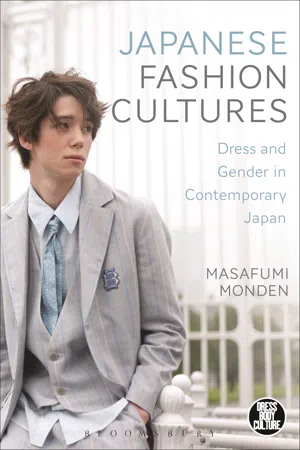
From Rococo to Edwardian fashions, Japanese street style has reinvented many western dress styles, reinterpreting and altering their meanings and messages in a different cultural and historical context. This wide ranging and original study reveals the complex exchange of styles and what they represent in Japan and beyond, contesting common perceptions of gender in Japanese dress and the notion that non-western fashions simply imitate western styles.
Through case studies focussing on fashion image consumption in style tribes such as Kamikaze Girls, Lolita, Edwardian, Ivy Style, Victorian, Romantic and Kawaii, this ground-breaking book investigates the complexities of dress and gender and demonstrates the flexible nature of contemporary fashion and style exchange in a global context. Japanese Fashion Cultures will appeal to students and scholars of fashion, cultural studies, gender studies, media studies and related fields.
- 216 pages
- English
- ePUB (mobile friendly)
- Available on iOS & Android
eBook - ePub
About this book
Information
1
INTRODUCING JAPANESE FASHION, PAST AND PRESENT
There is a certain enigmatic air surrounding the images of Japanese fashion culture conceptualized by those ‘outside’. On one hand it is a culture ruled by regimental uniformity and patriarchal values, perhaps best exemplified by the figures of the ‘salaryman’ or the ‘high school student’, where freedom of individual expression is a luxury.1 On the other hand, however, there is a recurrent flowering of youth adorned in vivid, flamboyant fashion styles, showcasing their creativity and individuality in such fashion magazines as FRUiTS. The kaleidoscope of these enthralling images might mirror certain aspects of Japanese culture. But understanding the culture only through such extreme binaries signals a danger of creating and sustaining an imagined ‘distance’. They are so different that they seem to be of no relevance to non-Japanese culture. Is a fleeting trace of Orientalist ideas, which predominantly appreciate the ‘exotic’, the ‘authentic’, and by implication, the ‘different’ qualities of foreign culture, still present? Or are these images and perceptions fruit of Japan’s conscious construction of pure ‘Japaneseness’ in order to differentiate the culture from any non-Japanese cultures?2 Even as far back as 1891, Oscar Wilde wrote that ‘[t]he Japanese people are the deliberate self-conscious creation of certain individual artists’ and thus ‘the whole of Japan is a pure invention’.3 In either case, clothes play a crucial role in the construction of such images and the workings of visuality.
In our contemporary world with its advanced media technologies, the increased presence of Japanese popular culture outside Japan is evident. A number of excellent studies of Japanese fashion and beauty practices have also been published. Works such as Brian J. McVeigh’s Wearing Ideology: State, Schooling and Self-presentation in Japan (2000), Laura Miller’s Beauty Up: Exploring Contemporary Japanese Body Aesthetics (2006), Toby Slade’s Japanese Fashion: A Cultural History (2009) and Valerie Steele’s Japan Fashion Now (2010) are scholarly indications of a growing desire for a more accurate picture of the intellectual history of the subject, while Tiffany Godoy’s Style Deficit Disorder: Harajuku Street Fashion (2007) offers a vivid picture of what is happening in the streets of Japan’s most dazzling fashion district. Despite this notability, however, only a selected portion of the cultural and art objects of everyday Japan have received comprehensive scholarly attention in the English-speaking world.4 How clothes are represented in contemporary Japanese culture, such as films, magazines and music videos, for example, remains to be studied in great detail. This ‘absence’ has contributed to the further flow of the clichéd images of the culture mentioned above.
With the intention of ameliorating this situation, what I demonstrate through this book is that individuals in Japan engage with fashion in culturally significant ways. These ways might differ from how individuals are assumed to engage with clothes in European and American mainstream cultures. Not only that, I argue that using the lens of fashion reveals the complexities of gender relations in Japan. Four contemporary case studies position this argument: young men’s fashion publications, female performers’ use of Lewis Carroll’s Alice in music videos, Lolita fashion and Tetsuya Nakashima’s film Shimotsuma monogatari (Kamikaze Girls, 2004), and the continuing remarking of ‘Ivy League’ style in Japan. These four examples are notable for their adoption of historic European and American clothing forms. Their relatively ‘mainstream’ stature in contemporary Japanese culture comes with a ‘twist’ or unconventional characteristics. The ‘mainstream’ standing of these types of popular culture indicates their reach, consumed by a great number of individuals within Japan. Certain qualities they manifest, on the other hand, impose a subtle, almost delicate kind of revolt against a set of idées fixes surrounding the relationship between clothes and gender. Sociologist Diana Crane has argued that mainstream texts, which are generally directed toward large and heterogeneous audiences, tend to be stereotypical, unlike texts with smaller audiences. This is because ‘more stereotyped products are communicated more readily to heterogeneous audiences with diverse backgrounds and outlooks’.5 The subtle combination of mainstream and atypical characteristics of the selected texts for this research is thus significant.
What needs to be recognized here is that we should avoid falling into a simple orientalist idea that ‘they’ are ‘different’ and hence are of minor, if any, importance to non-Japanese culture. This is because, as global anthropologist Jan Nederveen Pieterse has convincingly argued, an anthropological definition of culture narrates that there are no territorial limitations of culture. It is both sharable and learnable. According to him:
Culture refers to behaviour and beliefs that are learned and shared: learned so it is not ‘instinctual’ and shared so it is not individual. Sharing refers to social sharing but there is no limitation as to the boundaries of this sociality. No territorial or historical boundaries are implied as part of the definition. This understanding of culture is open-ended. Leaning is always ongoing as a function of changing circumstances and therefore culture is always open. To sharing there are no fixed boundaries other than those of common social experience, therefore there are no territorial limitations to culture. Accordingly culture refers as much to commonality as to diversity.6
Perhaps more cautiously than Nederveen Pieterse, dress historian Margaret Maynard argues that, to a certain extent, clothes are ‘a form of informational exchange’.7 If clothes operate as a form of informational exchange, certain experiences and aesthetics of dress might be transmitted, shared or understood cross-culturally. Japanese fashion is a good example for looking at this hypothesis because this is where, particularly since the country’s re-engagement with Euro-America in 1868, European sartorial styles have been actively promoted, both politically and aesthetically.8 Consequently, Japan has become an ethnographically unique space where the subtle marriage of European dress style and Japanese aesthetics has taken place.
The theory of ‘format’ and ‘product’, as articulated by sociologist Keiko Okamura, also reinforces the relevance of the study of Japanese fashion to other cultures. This theory allows a cultural form to be seen as a ‘format’ when becoming transculturally accepted.9 This standardized ‘format’ becomes a carrier of a local culture, making its qualities visible and hence comparable with those of other cultures. This theory, when applied to the study of Japanese fashion, demarcates characteristics both culturally specific to and shared by Japanese and non-Japanese cultures. In other words, a critical examination of a range of cultural representations of fashion and gender identity in contemporary Japan can underscore how conceptions and representations of fashion and gender identities are circulated in other cultures, including those of Europe, North America and Australia. As illustrator Kazuo Hozumi states in his now classic IVY Illustrated (1980), there is a certain degree of universality ascribed to fashion and clothes.10 Thus, how clothes are worn, represented and understood in the Japanese cultural context is important for understanding non-Japanese cultures, and vice versa.
One of the prominent aspects of dress as an object of study is its ability to amalgamate with other research matters. It could be used in order to calibrate the ways in which our conceptions of gender manifest, or to interpret the psychological state of a character in literature. The significance of academically examining fashion is enhanced by ‘the cultural stereotype that suggests that fashion has always been more closely connected with the domain of women’.11 This cultural stereotype then renders fashion to be ‘almost automatically judged as less important, less worthy, less “great” than more “masculine” kinds of art’.12 However, dress is, as feminist scholar Elizabeth Wilson beautifully puts it, ‘the cultural metaphor for the body, it is the material with which we “write” or “draw” a representation of the body into our cultural context’.13 Indeed, representations of gender within the four cultural arenas that this book analyses largely manifest through, and are intertwined with, clothes. The discourses of dress in the case studies selected for this book are, then, a vehicle for understanding constructions of gender, identity and the Japanese cultural milieu.
Layers of Japanese aesthetic history
Dress is a useful instrument in order to calibrate Japanese cultural and aesthetic history. For example, in the Heian court (794–1185), the art of matching colours was especially important in men’s and women’s dress, and a woman’s skill in selecting clothes, and particularly in combining colours, was considered a fundamental measure in determining her character and charm, much more important than the physical features with which she was born.14 The colour combination of layers called ‘cherry blossom’, for instance, was created by wearing a white kimono over a red kimono, the layer...
Table of contents
- Cover
- Series
- Title Page
- Contents
- List of illustrations
- Acknowledgements
- 1 Introducing Japanese fashion, past and present
- 2 Lost in a gaze: young men and fashion in contemporary Japan
- 3 Boy’s elegance: a liminality of boyish charm and old-world suavity
- 4 Glacé wonderland: cuteness, sexuality and young women
- 5 Ribbons and lace: girls, decorative femininity and androgyny
- 6 An Ivy boy and a preppy girl: style import-export
- 7 Concluding Japanese fashion cultures, change and continuity
- Notes
- References
- Index
- Copyright
Trusted by 375,005 students
Access to over 1.5 million titles for a fair monthly price.
Study more efficiently using our study tools.
Frequently asked questions
Yes, you can cancel anytime from the Subscription tab in your account settings on the Perlego website. Your subscription will stay active until the end of your current billing period. Learn how to cancel your subscription
No, books cannot be downloaded as external files, such as PDFs, for use outside of Perlego. However, you can download books within the Perlego app for offline reading on mobile or tablet. Learn how to download books offline
We are an online textbook subscription service, where you can get access to an entire online library for less than the price of a single book per month. With over 1.5 million books across 990+ topics, we’ve got you covered! Learn about our mission
Look out for the read-aloud symbol on your next book to see if you can listen to it. The read-aloud tool reads text aloud for you, highlighting the text as it is being read. You can pause it, speed it up and slow it down. Learn more about Read Aloud
Yes! You can use the Perlego app on both iOS and Android devices to read anytime, anywhere — even offline. Perfect for commutes or when you’re on the go.
Please note we cannot support devices running on iOS 13 and Android 7 or earlier. Learn more about using the app
Please note we cannot support devices running on iOS 13 and Android 7 or earlier. Learn more about using the app
Yes, you can access Japanese Fashion Cultures by Masafumi Monden in PDF and/or ePUB format, as well as other popular books in History & Fashion Design. We have over 1.5 million books available in our catalogue for you to explore.