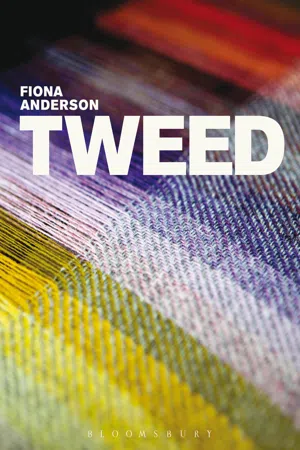
The story of tweed is tied to a series of social, economic and cultural shifts that have molded its development. This book considers the historical factors that helped to shape the design characteristics and social meanings of the group of fabrics that we call tweed, from their emergence in the 1820s to the present day. Including significant new research on tweeds, from Harris Tweed to the type used by Chanel, this book follows the history of these fabrics from the raw fiber to the finished garment in men's and women's fashion.
Exploring rural and urban contexts, this book reveals the important physical and conceptual relationships of tweed with landscape. Anderson shows that, contrary to their strong popular associations with tradition, tweeds emerged in the Romantic era as a response to the dramatic changes associated with industrialization and urbanization. Progressive changes in gender relations are also explored as a major factor in tweed's evolution, from associations with particular ideals of masculinity into what is now a truly adaptable fashion textile worn by both sexes. This is the first book of its kind to recognize the importance of tweed to fashion innovation today.
eBook - ePub
Tweed
About this book
Information
1
INTRODUCTION
Contemporary perceptions about the cultural history of tweeds have largely centered on the idea that these textiles were exclusively worn in the past by the British upper classes in rural contexts.1 Tweed challenges these mythologized and overly simplistic notions by pursuing an in-depth historical and cultural analysis of these textiles from their emergence in Scotland of the 1820s to the present. This investigation of the history of the group of cloths known as tweeds includes examining their origins, technical characteristics, manufacture, design and consumption within UK and international contexts. The book follows the development of these cloths from the raw fiber to the finished garment, worn on both male and female bodies. It begins in the 1820s, when the long-established Scottish woolen products of shepherd’s checks were first adopted by fashionable, urban male consumers. From that decade, these coarse woolens began to evolve into the “family” of modern, fashionable commodities, which by the 1830s had acquired the collective name of tweed, as discussed in Chapters 2 and 3.
This volume incorporates significant new research about all types of tweeds, from Harris Tweed to the type of novelty, or fantaisie tweeds that have famously been used by Chanel. The study begins at a much earlier stage in the fashion cycle than is usually pursued within studies of dress, which has facilitated the development of new, broader perspectives about the processes of fashion change and innovation. Tweed adds to research by a limited number of authors, which has also considered fashion textiles and garments in a holistic way.2 Through the example of tweed, this approach has also yielded new insights into how the cultural and social connotations of fashion objects evolve, because textiles have a “life” and acquire meanings long before they become part of a garment. Tracing the diverse and shifting factors that have shaped the history of tweeds has involved the use of interdisciplinary approaches. Material culture methods have also been at the core of this study and researching objects such as textile samples and garments has yielded invaluable insights only available from those sources.
International perspectives are embraced in this publication by focusing primarily on the study of British-made cloths and their worldwide export. Donegal tweeds are included in Chapter 2, because although these woolens originally derived from that Irish county, the name is now widely used as a generic term. In addition, research about the export of British tweeds in the archives of Chanel, Dior and Balenciaga, as well as Paris museum collections has involved comparative examples of French woolens. These investigations have informed the arguments presented about the existence of a design dialogue between Scottish and French woolen textiles, which influenced the development of novelty, or fantaisie tweeds for womenswear, as discussed in Chapters 5, 7 and 8.
The scant amount of academic publications about the history of tweeds means that preparing this volume has principally involved original research. Clifford Gulvin’s The Tweedmakers: A History of the Scottish Fancy Woollen Industry 1600–1914 was the last major academic book on that subject. His important study of 1973 follows a typical methodology of an economic historian of the period in that few connections are made between the production of the cloth and the consumers who wore the cloth made up into garments. Furthermore, Gulvin’s research focuses almost exclusively on the mill-based tweed industry in the Scottish Borders.3 Since 1973, there have been a small number of publications related to the history of tweed that have focused either on specific types of tweed, or on a limited time period.4 This includes The Islanders and the Orb: the History of the Harris Tweed Industry 1835–1995 by Janet Hunter, which embraces a major focus on the legal aspects of that textile’s history. It also involves Janice Helland’s research about the important role of female philanthropists in encouraging the manufacture and sale of domestically produced handwoven tweeds between 1880 and 1914.5 The specific focus of these two publications on cloths woven in the home, means that they do not address the fact that most British tweeds have been mill-woven since the mid-nineteenth century. The history of the vast majority of tweeds produced in the UK in the twentieth and twenty-first centuries has therefore never been researched. In this book, the interconnections between the histories of cloths woven in domestic and industrial contexts are thus examined in depth for the first time.
The vast majority of publications on the British wool textiles industry take economic history approaches to the English trade in the period up until 1830. However, Beverly Lemire and Miles Lambert have argued that in addition to their economic importance between 1660 and 1820, English woolens also had social and cultural significance and they symbolized masculinity, tradition, Englishness and Britishness.6 Tweed extends that research by locating itself within the broad context of developing new interdisciplinary approaches to the study of Scottish, as well as English wool textiles after 1830.
TWEED: INVESTIGATING MYTHS AND MEANINGS
Exploring contemporary fashion imagery shows that the mythical or stereotypical connotations of tweeds form a useful starting point for a deeper investigation into their history. For example, an advertisement in Vogue for Ralph Lauren’s autumn/winter 2012 womenswear collection featured outfits that were strongly influenced by British country clothing and 1920s fashion, including fitted jackets and jodhpurs in tweed, worn with “mannish” shirts, ties and Fair Isle style knitwear. These garments were designed and styled in a way that was deeply historicized, but the fact that a herringbone tweed overcoat inspired by 1930s menswear was worn with a 1920s-style cloche hat and a fake fur leopard skin scarf reveals that this was a mythical, re-interpretation of period, country house style. The strong influence of film and television on Lauren’s re-imagining of British upper-class style is shown by the fact that this campaign was shot at Highclere Castle, the English location for the internationally popular ITV series Downton Abbey. This advertisement reveals that tweeds have retained associations of traditional elite British lifestyles, which are resonant enough with a contemporary consuming public that they remain part of the brand identity of a globally successful fashion business such as Ralph Lauren. It also helps to show that film and television have played an important role in keeping these largely mythical, but partly historically accurate, connotations of tweeds present in the contemporary cultural imagination.7
Chapter 2 of this volume addresses the origins of the term tweed and the principal characteristics of the group of cloths that have been known by that name since the 1830s. That text is followed by a series of chronological chapters, which explore new evidence about the historical relationships of tweeds with notions of class, gender, tradition, innovation, authenticity and urban and rural contexts. This book also investigates the interconnections of tweeds with shifting ideas about Scottish, English and British identities. The volume thus presents a historically nuanced picture which contests the stereotypical connotations of these textiles while simultaneously revealing their roots of development. In Chapter 3, for example, the book shows that from the 1840s tweeds were worn in urban contexts by men at social levels ranging from Royalty to the lower middle classes. Furthermore, up until the 1870s tweeds were primarily worn for rural sports by elite men and this meant that they acquired strong connotations of land ownership, wealth and leisure, as discussed in Chapters 3 and 4.
Tweed also investigates the fact that these textiles have had important relationships with changing social conventions and sartorial practices relating to gender from the early nineteenth century to the present day. The majority of publications on dress deal with the self-fashioning of either men or women. This book provides innovative perspectives about gender identities, fashion textiles and fashionable dress by considering the design and manufacture of tweeds and their consumption by both sexes. Since the 1990s, important advances have been made in the study of men’s fashion by authors including Christopher Breward, Paul Jobling, Frank Mort, and Laura Ugolini.8 These publications have primarily focused on the consumption of masculine clothing and related representations. Published research about the history of textiles used in men’s dress after 1830 has been extremely limited.9 Tweed has begun to bridge the large gap between the scant research on fashion textiles for menswear and the excellent studies about men’s fashion consumption. It also builds on previous research by Lou Taylor, Janice Helland and the author, by exploring new, primary evidence about shifting gender relationships and the increasing adoption of tweeds by women from the late nineteenth century onwards.10
A further aim of this book is to challenge the notion that tweeds may simply be related to nostalgic visions of past, traditional, country lifestyles. That view is contested with reference to work by the cultural geographer David Matless and literary historian John Glendening, which suggests that nostalgia, authenticity and tradition are far from simple concepts and that they often have an intrinsic and complex rather than simple and oppositional relationship to modernity.11 Tweeds emerged in the Romantic era and they eloquently expressed the tensions and contradictions of a time in which industrialization and urbanization were having a transformative effect on British society. As Glendening states: “Although the romantic sensibility asserts itself in opposition to the modern world, it is the direct outgrowth of that world.”12 Chapter 3 of this book posits that the emergent fashion for tweeds of the early nineteenth century was strongly connected to the romantic search for authenticity and idealization of nature. It also argues that through their consumption by fashionable, metropolitan consumers from the 1820s, the coarse, Scottish woolens that were soon to be called tweeds were transformed into modern fashion textiles.
Tweed further pursues this enquiry by investigating the physical and conceptual relationships of these textiles with country and city landscapes between the 1820s and the present day. It argues that from the beginning of the tweed trade onwards, rural and urban influences and contexts have been deeply intertwined in the making, designing, selling and wearing of tweed cloths. Previous research about menswear tweeds in the late nineteenth century has problematized what has been the dominant paradigm within fashion history over the last thirty years, that is the pivotal relationships between fashion and the urban within the era of modernity.13 In Tweed, that investigation into the relationships between fashion in modernity and rural and urban landscapes has been extended by exploring the history of tweeds in men’s and women’s dress since the 1820s. I do not wish to contest the view that modern fashion is principally an urban phenomenon. Instead, this book is informed by the ideas of Matless, which suggest that because of the intrinsic relationships between modernity, industrialization and urbanization, notions of the rural are often understood in opposition to this, in other words as being traditional and anti-modern.14 These views have undoubtedly influenced the fact that tweeds have often been perceived as being “classic”, traditional, or heritage fabrics. In contrast, Tweed focuses on approaches to landscape and modernity, which conceive of both urban and rural landscapes as subject to change and as dynamic processes that are pivotal to the development of modern sartorial identities.15 In this book, Chapters 3 to 9 reveal that people’s imagining of their identity and the phenomenon of fashion within modernity has not been strictly ordered into the exclusively defined categories of the country and the city.
In 2011, the journalist A. A. Gill described tweeds as a “stereotype of Britishness.”16 This quote confirms that within recent media these textiles still have strong associations with enduring ideas about a fixed and unchanging sense of British identity. In contrast, researching the history of tweeds reveals the historical complexities and mythologies linked to Scottish, English and British identities in an era of massive change within Britain and its global contexts. For example, the history of these textiles is integrally related to radical changes in landownership and usage in the Scottish Highlands, which developed from the late eighteenth century onwards. By the mid-nineteenth century much land in northern Scotland had been cleared of small tenants to make way for a huge expansion in sheep farming and the development of deer forests. From the 1830s onwards, the growing fashionabil...
Table of contents
- Textiles that Changed the World
- Title
- Contents
- List of Illustrations
- Acknowledgments
- 1 Introduction
- 2 Tweed: Terms, Descriptions, and Characteristics
- 3 Origins and Early Development of Tweed to 1850
- 4 Tweed, Male Fashion, and Modern Masculinities, 1851–1918
- 5 Tweed, Femininity, and Fashion, 1851–1918
- 6 Suits You: Men and Tweed, 1919–1952
- 7 Sportswear Chic: Tweed in Womenswear, 1919–1952
- 8 Couture to Pop and Nostalgic Fashion, 1953–1980
- 9 Tradition and Innovation, 1981–2014
- Notes
- Bibliography
- Index
- Plates
- Copyright
Trusted by 375,005 students
Access to over 1.5 million titles for a fair monthly price.
Study more efficiently using our study tools.
Frequently asked questions
Yes, you can cancel anytime from the Subscription tab in your account settings on the Perlego website. Your subscription will stay active until the end of your current billing period. Learn how to cancel your subscription
No, books cannot be downloaded as external files, such as PDFs, for use outside of Perlego. However, you can download books within the Perlego app for offline reading on mobile or tablet. Learn how to download books offline
Perlego offers two plans: Essential and Complete
- Essential is ideal for learners and professionals who enjoy exploring a wide range of subjects. Access the Essential Library with 800,000+ trusted titles and best-sellers across business, personal growth, and the humanities. Includes unlimited reading time and Standard Read Aloud voice.
- Complete: Perfect for advanced learners and researchers needing full, unrestricted access. Unlock 1.5M+ books across hundreds of subjects, including academic and specialized titles. The Complete Plan also includes advanced features like Premium Read Aloud and Research Assistant.
We are an online textbook subscription service, where you can get access to an entire online library for less than the price of a single book per month. With over 1.5 million books across 990+ topics, we’ve got you covered! Learn about our mission
Look out for the read-aloud symbol on your next book to see if you can listen to it. The read-aloud tool reads text aloud for you, highlighting the text as it is being read. You can pause it, speed it up and slow it down. Learn more about Read Aloud
Yes! You can use the Perlego app on both iOS and Android devices to read anytime, anywhere — even offline. Perfect for commutes or when you’re on the go.
Please note we cannot support devices running on iOS 13 and Android 7 or earlier. Learn more about using the app
Please note we cannot support devices running on iOS 13 and Android 7 or earlier. Learn more about using the app
Yes, you can access Tweed by Fiona Anderson in PDF and/or ePUB format, as well as other popular books in Design & Fashion Design. We have over 1.5 million books available in our catalogue for you to explore.