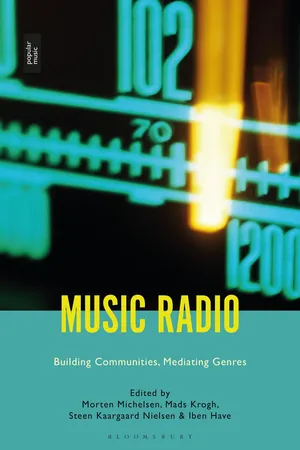
Why is music so important to radio? This anthology explores the ways in which musical life and radio interact, overlap and have influenced each other for nearly a century. One of music radio's major functions is to help build smaller or larger communities by continuously offering broadcast music as a means to create identity and senses of belonging. Music radio also helps identify and develop musical genres in collaboration with listeners and the music industry by mediating and by gatekeeping.
Focusing on music from around the world, Music Radio discusses what music radio is and why or for what purposes it is produced. Each essay illuminates the intricate cultural processes associated with music and radio and suggests ways of working with such complexities.
eBook - ePub
Music Radio
Building Communities, Mediating Genres
- 344 pages
- English
- ePUB (mobile friendly)
- Available on iOS & Android
eBook - ePub
Music Radio
Building Communities, Mediating Genres
About this book
Information
Part One
Sounding Minority Radio
Despite national broadcasting corporations and commercial networks dominating the airwaves, radio studies has demonstrated the seminal importance of community radio and other independent and non-commercial stations. Since the great wave of deregulation in Europe in the 1980s, public service institutions have become still more challenged by competition from commercial operators focusing on music radio and by political parties accepting the changing rules of the media market. Simultaneously, deregulation made room for a large amount of non-commercial community radio operators addressing more or less specific communities, be they defined by place, interest, ethnicity, taste, or something entirely different. Although the changes may be described as a wave, it is also necessary to point out that they happened quite differently and along different time scales (from the 1970s to the 2000s) in different parts of Europe, and that the tripartite structure of public service, commercial, and community radio stations seems to be a nearly global phenomenon.
Among the many reasons for the re-emergence of radio as something worth studying may be the advent of community radio. Not least to academics, community radio was interesting for political reasons because it afforded citizens to work with mass media. This was interpreted as a positive step in the direction of increased democratization and a more equal access to the media. Research in this area has fostered a long list of interesting results, often with a focus on marginalized communities gaining a voice and, hereby, the possibility of strengthening the ties of the community and to speak to others on behalf of the community. Such research has often been closely related to activism (cf. Gordon 2009 and 2012), while other researchers have used their research on community radio as examples in order to discuss more general questions concerning media uses.
According to Bessire and Fisher, ‘Anthropologists did not begin to develop their tacit knowledge of radio into a systematic analytical project until the 1990s ushered in the rise of “the anthropology of media”’ (2012, 9). But as it happened it became a fruitful way to understand how radio worked, and in addition, how anthropologists contributed to the understanding of radio as an aural phenomenon by involving music, voices, and other sounds in the research and drawing upon ethnomusicology, linguistic anthropology, and sound studies. Since then the field has grown immensely and studies of community radio around the world abound. Bessire and Fisher’s edited volume Radio Fields: Anthropology and Wireless Sound in the 21st Century (2012) demonstrates this interest while Born’s Uncertain Vision: Birt, Dyke and the Reinvention of the BBC (2004) is among the few works to engage with national public service institutions from an anthropological point of view.
In this first part, three chapters add to the anthropology of music, voice, and sounds as produced by minorities, specifically migrants or Indigenous people, on commercial radio, public service national radio, and community radio. The first, Pedro Moreira’s ‘Migrant Radio, Community, and (New) Fado: The Case of Radio ALFA’, is concerned with Portuguese migrants and people of Portuguese descent broadcasting specifically to the Portuguese migrant community in and around Paris (and to many other, non-related communities and individual listeners). The second, Daniel Fisher’s ‘On Sonic Assemblage: Indigenous Radio and the Management of Heteroglossia’, analyses two different Indigenous community broadcasting stations in Darwin, Australia, while the third, Kristine Ringsager and Sandra Lori Petersen’s ‘Voicing Otherness on Air: Theorizing Radio through the Figure of Voice’, presents two radio hosts belonging to migrant communities in France and Denmark, respectively.
To all four authors a production perspective is important, and questions concerning why planners and presenters do what they do and what their intentions are inform the chapters. Also, questions on the movement from general programming strategies to actual playlists and how the music is discursively framed are being debated. Developing from such problematics, questions concerning audiences are included, mainly on how they are constructed and imagined by radio producers and hosts, but also on how the stations and hosts promote various notions of community through their programming.
How radio broadcasting is a way of gaining a voice and negotiating identity is important to all. Moreira focuses on Radio ALFA’s uses of fado as a way of negotiating different ways of belonging: as young or as old, as first-generation or as second-generation migrants, as descendants of migrants or as French – and as mediated by a commercial radio station. Today, fado is a stylistically diverse phenomenon, and the various mediations of fado and its contributions to migrant identity work all contribute to conjoin the diversity within the community and to demonstrating the complexities of fado as a genre.
Building on the work of, among others, Bakhtin, Gofmann, and Gell, Fisher thinks of Radio Larrakia and Yolngu Radio/ARDS as fragile juxtapositions of sounds, talk, and music which taken together as an assemblage ‘allow us to hear the unfinished character of the Aboriginal voice as a contested space’ demonstrating the heteroglossia and actual diversity of Indigenous cultures. This ‘voice’ is described as an avatar of a valued social person, a non-personal, but voiced position with social agency within communities. Ringsager and Petersen continue the discussion of voice as sounding and as othered in a double sense: as female and as migrant. While relations between voice and agency are in some ways obvious, mediated voices instantly engender analytical challenges due to their multilayered contexts, among them institutional and technological aspects as well as linguistic ideologies. The two hosts discussed are found to be entangled in such complexities including the ‘liberty’ of the radio voice and a series of contextual restraints on the self-same liberty.
References
Bessire, Lucas, and Daniel Fisher, eds. 2012. Radio Fields: Anthropology and Wireless Sound in the 21st Century. New York and London: New York University Press.
Born, Georgina. 2004. Uncertain Vision: Birt, Dyke and the Reinvention of the BBC. London: Secker & Warburg.
Gordon, Janey, ed. 2009. Notions of Community: A Collection of Community Media Debates and Dilemmas. Bern: Peter Lang.
Gordon, Janey, ed. 2012. Community Radio in the Twenty-first Century. Bern: Peter Lang.
1
Migrant Radio, Community, and (New) Fado: The Case of Radio ALFA
Pedro Moreira
When I decided, in 2014, to study Radio ALFA – a radio station based in Paris broadcasting to the Portuguese community residing in this area through FM, the internet, and a digital cable channel – I was curious about the way it was promoted as ‘The Voice of Lusophony’, its actual slogan, as well as values and discourses associated to it. As an ethnomusicologist I wondered how music was mediated and wanted to identify discourses about it on radio programmes. When radio programmers promote a certain notion of ‘community’, why do they choose specific music genres and artists over others? What is the relation between radio producers, the specific context, radio policy, and musical choices? Do certain musical choices and discourses reveal the broadcasting station’s policy and strategy in defining its target audience and a broader sense of community?
After some preliminary research my first interest was in defining the relationship between programming policies, in a broader sense, and the construction of an idea of a ‘Portuguese community’ imagined and mediated through the radio. I soon realized that the focus of the research would be on media production. As Peterson points out:
Just as ethnographies of media consumption have needed to move beyond reception to the creative spaces where people integrate media texts into their lives, so ethnographies of production must recognize the fundamental relationship between the production of texts, the construction of identity, and the connections between production cultures and the larger cultural worlds in which they are embedded. (Peterson 2003, 162)
Analysing production itself as a social process, mainly through its actors, institutions, and cultural products, discloses how discourses are normalized or negotiated, who produces them, and their relationship with the larger cultural world, with economic and political contingencies. The study of media and expressive culture from the perspective of production allows us to go beyond causal and direct assumptions that may interfere with a crystallized perspective on the usage of concepts like community or identity, not taking them for granted. These are the reasons why, in this article, the interlocutors’ discourses are important if we are to understand how the community is imagined and how it defines the radio station’s policies. The intense fieldwork allowed me to do several interviews with Radio ALFA’s staff, historical research, mainly in newspapers, and listen to several of Radio ALFA’s broadcasts.
The main questions I will address in this article are the following: What is the role of Radio ALFA in the Portuguese migrant context in the Paris area? What role does broadcasted ‘Portuguese’ music play in the construction of a notion of community? What is the role of fado in Radio ALFA broadcasting, and why was it so prominent in the interlocutor’s discourses? What role does fado play in negotiating identity in this migrant radio context?
For this purpose I have divided the chapter into four sections: (1) covering the state of the art concerning the role of radio in migrant communities from an anthropological and ethnomusicological perspective; (2) providing a brief historical overview of the relation between the Portuguese community and radio in France; (3) exploring the establishment of Radio ALFA and its broadcasting policy; and (4) analysing fado’s role in the radio station in defining and negotiating identity and experience.
The role of radio in migrant communities
Recently fields such as anthropology (Ferreira 2013; Kosnick 2007, 2012; Peterson 2003; Cottle 2000; Dayan 1999) and ethnomusicology (Toynbee and Dueck 2011) have begun to take an interest in media in the context of migrant communities. The existing ethnographies seek mainly to study the processes of self-representation in the media, focusing on the culture of origin and reception in the new country. As stated by the anthropologist Kosnick, ‘Migrant media are of prime importance as arenas for producing and circulating identity claims in order to intervene in the politics of representation’ (2007, 2–3).
The reterritorialization of migrant groups and the way they express themselves in ethnic minority media (Riggins 1992) reveal the construction of their mediated identities and communities as well as the negotiations of memories and cultural practices they adopt as a way of self-representation. An overview of the international media groups reveals the emergence of small-scale media that claim a space and affirm their values, expressive practices, and ideology through radio, print media, the internet, television and so on (Cottle 2000).
The space they occupy mainly reveals an affirmation of values of authenticity, ethnicity, and identity that aim to respond to their limited representation in the major and hegemonic media. As Cottle notes,
The media occupy a key site and perform a crucial role in the public representation of unequal social relations and the play of cultural power. It is in and through representations, for example, that members of the media audience are variously invited to construct a sense of who ‘we’ are in relation to who ‘we’ are not, whether as ‘us’ and ‘them’, ‘insider’ and ‘outsider’, ‘colonizer’ and ‘colonized’, ‘citizen’ and ‘foreigner’, ‘normal’ and ‘deviant’, ‘friend’ and ‘foe’, ‘the west’ and ‘the rest’. (2000, 2)
The impact of human mobility on a large scale, with people carrying expressive practices with them through media (e.g. audio and image), has been central to studies of music practices and their uses. As the ethnomusicologist Bruno Nettl states regarding migration and music in general, ‘There have been large numbers of musical results: preservation of old forms in new venues, but with changed functions; development of mixed, hybrid, syncretic forms of music; changed concepts of ethnic, national and personal identity; and lots more’ (2005, 335).
That is why studying music and its uses in the context of migrant groups enables us to move away from discourses that crystalize ethnicity. Riggins highlights how these voluntary minorities, in this case emigrants (one of the four groups he defines), produce this mediascape and shape their actions in the specific context of the host country and in relation to ethnicity: ‘The term ethnicity has been defined in a variety of ways, but there is general agreement that it refers to people who perceive themselves as constituting a community because of common culture, ancestry, language, history, religion, or customs’ (Riggins 1992, 1)...
Table of contents
- Cover
- Half-Title
- Title
- Contents
- List of Illustrations
- Preface
- Introduction: Complexities of Genre, of Mediation, and of Community Mads Krogh and Morten Michelsen
- Part One Sounding Minority Radio
- Part Two Music Radio and Nation Building
- Part Three Music Radio: Genre and Mediation
- Part Four Music Radio Convergences
- Notes on Contributors
- Index
- Copyright
Trusted by 375,005 students
Access to over 1.5 million titles for a fair monthly price.
Study more efficiently using our study tools.
Frequently asked questions
Yes, you can cancel anytime from the Subscription tab in your account settings on the Perlego website. Your subscription will stay active until the end of your current billing period. Learn how to cancel your subscription
No, books cannot be downloaded as external files, such as PDFs, for use outside of Perlego. However, you can download books within the Perlego app for offline reading on mobile or tablet. Learn how to download books offline
Perlego offers two plans: Essential and Complete
- Essential is ideal for learners and professionals who enjoy exploring a wide range of subjects. Access the Essential Library with 800,000+ trusted titles and best-sellers across business, personal growth, and the humanities. Includes unlimited reading time and Standard Read Aloud voice.
- Complete: Perfect for advanced learners and researchers needing full, unrestricted access. Unlock 1.5M+ books across hundreds of subjects, including academic and specialized titles. The Complete Plan also includes advanced features like Premium Read Aloud and Research Assistant.
We are an online textbook subscription service, where you can get access to an entire online library for less than the price of a single book per month. With over 1.5 million books across 990+ topics, we’ve got you covered! Learn about our mission
Look out for the read-aloud symbol on your next book to see if you can listen to it. The read-aloud tool reads text aloud for you, highlighting the text as it is being read. You can pause it, speed it up and slow it down. Learn more about Read Aloud
Yes! You can use the Perlego app on both iOS and Android devices to read anytime, anywhere — even offline. Perfect for commutes or when you’re on the go.
Please note we cannot support devices running on iOS 13 and Android 7 or earlier. Learn more about using the app
Please note we cannot support devices running on iOS 13 and Android 7 or earlier. Learn more about using the app
Yes, you can access Music Radio by Morten Michelsen,Mads Krogh,Steen Kaargaard Nielsen,Iben Have in PDF and/or ePUB format, as well as other popular books in Media & Performing Arts & Music Theory & Appreciation. We have over 1.5 million books available in our catalogue for you to explore.