Mute Records is one of the most influential, commercially successful, and long-lasting of the British independent record labels formed in the wake of the late-1970's punk explosion. Yet, in comparison with contemporaries such as Rough Trade or Stiff, its legacy remains under-explored.
This edited collection addresses Mute's wide-ranging impact. Drawing from disciplines such as popular music studies, musicology, and fan studies, it takes a distinctive, artist-led approach, outlining the history of the label by focusing each chapter on one of its acts. The book covers key moments in the company's evolution, from the first releases by The Normal and Fad Gadget to recent work by Arca and Dirty Electronics. It shines new light on the most successful Mute artists, including Depeche Mode, Nick Cave, Erasure, Moby, and Goldfrapp, while also exploring the label's avant-garde innovators, such as Throbbing Gristle, Mark Stewart, Labaich, Ut, and Swans. Mute Records examines the business and aesthetics of independence through the lens of the label's artists.
eBook - ePub
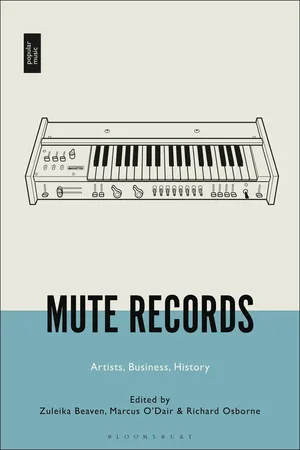
Mute Records
Artists, Business, History
- 256 pages
- English
- ePUB (mobile friendly)
- Available on iOS & Android
eBook - ePub
Mute Records
Artists, Business, History
About this book
Information
1
‘Let’s Make Love Before You Die’: ‘Warm Leatherette’, Boredom and the Invention of the 1980s
S. Alexander Reed
Anatomy
The Normal’s ‘Warm Leatherette’, released in November 1978 as the AA-side of MUTE 001, is anatomical. Breaking glass, steering wheel, handbrake: unsentimental parts.
A voice. A low drilling sound and a high one. Two octaves of a Korg 700s’s D natural. Noise sculpted to resemble a kick and snare. Exactly 128 words, 44 unique. Twenty-eight statements of ‘Warm Leatherette’. Ten sentences. Two hundred seconds of 4/4 across 167 measures, changelessly looping, played by hand at tempos drifting between 195 and 207 BPM. Repetition.
The hook works like this:

Figure 1.1 Structure of the title hook in ‘Warm Leatherette’, S. Alexander Reed.
The snare’s two-beat cycle delineates quarter notes. The kick’s cycle is four beats. Synthesizer octaves repeat every eight. The drill sounds and the ‘Warm Leatherette’ lyric return every sixteen. Daniel Miller, the Normal’s sole member and founding kingpin of Mute Records, explains, ‘The best punk rock … is very tightly structured’ (‘Classic Album Sundays’ 2017). The song is a grid. Powers of two.
There’s no harmony. D simply repeats. Flip the record to hear the Normal’s only other studio creation ‘T.V.O.D.’ and it is also in D minor. Dm. Daniel Miller. Discoverer of Depeche Mode. The Normal’s live album with Robert Rental is an improvisation in D. Five of the first six songs on Miller’s subsequent Silicon Teens album are in D.
Timbre, next. In alternating octaves and colours, a single pitch revs with each downbeat – first a sizzle blistering with noise above 6000 Hz, then a bestial gnarl, with bottom-heavy humming below 600 Hz.
Listen closer and the sounds play roles. The percussion’s thwap ripples: a meaty gutpunch, the Doppler swoop of something big coming fast. Then and now, analogue synthesizers connote physicality: wood and metal, knobs and plugs, the way sawtooth waves cut jagged while sinusoids undulate, bass notes’ body-rumbling infrasound, visibly pumping loudspeaker membranes, the way timbres are sculpted by adding on and scooping out. Contrast this with the crystalline sounds of computer synthesis and sampling: ‘digital’ and ‘trigger’ are thin words – fingers, not whole bodies. Jonathan Sterne observes of sound playback, ‘critics have written of digital audio recording – in its myriad formats – as less “live” or less “natural” than analogue recording’ (2006: 338). But electronic music audiences understand this extends to sound production too. (When science fiction writers of this era saw our inevitably digital real-world future – Le Guin, Dick, Delaney – they abandoned technological what-ifs in favour of embodied and behavioural ones. Digital is dull.)
‘Warm Leatherette’ is material, then: feel the gear of a speeding V8 shift from high-torque third into smooth-riding fourth, and with every repetition comes the suggestion of ever-higher overdrive.
You can also hear sex in these two octaves. A wet-mouthed intake of air through clenched teeth, then a moan on ‘O’. Exhilaration and ecstasy. Gutter-minded synth-pop fans might connect that first sonic spurt’s oscillated noise with the climax of Frankie Goes to Hollywood’s later ‘Relax’ (ZZT 1983), where it manifests the imperative lyric ‘come’. The sonic upshot is polymorphous perversity, an orgy of robots, people and cars.
And that’s before we even hear the words. ‘Warm Leatherette’ is just one in the convoy of car-themed synth-pop records at the turn of the 1980s. Yes, back in 1974 Kraftwerk’s ‘Autobahn’ had imagined a serene post-postwar Germany of endless freeways and parallel-universe Beach Boys tunes. But ‘Warm Leatherette’ shares more with Gary Numan’s paranoid ‘Cars’ (Beggar’s Banquet 1979) and John Foxx’s back-to-back crash-themed singles ‘No-One Driving’ (Virgin 1980), ‘Underpass’ (Virgin 1980) and ‘Burning Car’ (Virgin 1980). Bowie’s ‘Always Crashing in the Same Car’ (RCA Victor 1977) is cut from the same Naugahyde.
These numbers owed a lot to punk, but represented a new perspective – one that looked cagily to a dystopian future. They contrast with the retrospection of songs like the Clash’s ‘Brand New Cadillac’ (CBS 1979) (a remake of Vince Taylor’s original (Parlophone 1959)): ‘Welcome to the spirit of 1956’ bellows ‘Roadrunner’ (recorded by the Modern Lovers (Beserkly 1977) and the Sex Pistols (Virgin 1979)), reminding us of trad-punk’s greaser roots.1
In ‘Warm Leatherette’ and its ilk, driving indicates neither self-actualization (like ‘Roadrunner’) nor bourgeois oppression (like the Jam’s ‘London Traffic’ (Polydor 1977)). Instead, cars are escape capsules from the world and ourselves. (Christoph Döring’s 1979 punk film 3302 Taxi literalizes this: a taxi repeatedly driving into the Berlin Wall.) Even Numan’s insistence that he feels ‘safest of all’ in his car is undermined when the narrator of ‘Cars’ proves unreliable, admitting ‘nothing feels right’.2
Specifically, ‘Warm Leatherette’ highlights the violent power of wrecks to yank us from reality. In glorious freeze-frame, we ‘see the breaking glass’, not the ‘broken glass’: here’s the actual moment of impact, wherein our whole-body disorientation frees us from rationality and self-control.3 As Ben Highmore writes, ‘The crash releases the body from the constraint of a certain attitude’ (2003: 59) – the attitude of being in and of modernity. For an orgasmic instant we are shocked out of a universe designed to pre-empt shock.
Crash I
It is fitting that the word ‘leatheret te’ originated in bookbinding, because ‘Warm Leatherette’ is literary: a rewrite of J. G. Ballard’s 1973 Crash. Ballard’s plot concerns a fetishistic social circle whose scarred and joylessly wealthy members crash their cars, seeking jouissance in mangled flesh and bent metal.
Miller read it in 1977 and was inspired. ‘I’d been working on a film script for Crash with a friend. Nothing came of it, but through working on that, I had a lot of visual ideas, and I condensed what was in my head into that song’ (Majewski and Bernstein 2014: 133). (Bookmark, incidentally, how he uses the word head – it will come up shortly.) For all that Miller’s ideas may have been visual – he was an assistant editor at the independent channel ATV – some key wordings persist across the adaptation from book to script to lyric.
Miller sings of the car’s ‘luminescent dash’, and correspondingly, of Ballard’s four uses of ‘luminescent’ in the whole novel, three precede the word ‘dials’, an alliterative synonym for ‘dash’. More forensically, when Miller wrote, ‘The handbrake penetrates your thigh’, he was looking at page 178: ‘I moved my hand from her pubis to the scars on her thighs, feeling the tender causeways driven through her flesh by the handbrake’ (Ballard 1973: 178). Furthermore, in that same paragraph on that same page, the word ‘leatherette’ makes one of three appearances in Crash. Verbal suggestibility is part of Miller’s artistry: even in christening his label, ‘I was working in a cutting room, an editing room, I saw this word Mute everywhere. I liked it’ (Gates 2015).
Lyrical genealogy matters here because it underscores a resonance between Miller’s idioms and Crash’s language. Reviewers of the novel consistently note its relentlessly clinical tone (Ballard studied medicine); as Jean Baudrillard writes, ‘all the erotic terms are technical … a functional language’ (1994: 115–16). Feeling lies only in the triangulation of human anatomy and machine parts. So it is remarkable that Miller uses this same code when he describes playing his synthesizer: it affords a ‘direct connection between your head and the tape’ (Dynaudio Professional 2016). Elsewhere he speaks of the ‘very direct[ness] between the brain and the instrument’ (Ableton 2016). Bodily metonyms for musical ideas – ‘head’, ‘brain’ – link with mechanical metonyms for the execution of those ideas – ‘tape’, ‘instrument’.
Perhaps more remarkable than Miller’s creative impulse are the countless others then and now who have found the product of this resonance so appealing – those who’ve joined ‘the car crash set’. ‘Warm Leatherette’ is a curious hit. The story: Miller brought a tape to the counter of Rough Trade records, and when Geoff Travis listened to it on the store’s tape deck, journalist Jane Suck, who was standing nearby, ‘just went berserk when she heard it – she thought it was Lou Reed’s new record’, according to punk historian Jon Savage (King 2012: 25). She later called it ‘single of the century’ in Sounds (Majewski and Bernsteein 2014: 133). On the spot, Travis offered Miller a £300 deal to press 2,000 records, which grew to 10,000, and eventually the song moved 30,000 copies – not including sales of the 60-plus compilations it appears on. ‘Warm Leatherette’ (and its A-side ‘T.V.O.D.’) outpaced comparable 1978 releases by Cabaret Voltaire and Throbbing Gristle (whom the Normal supported live). Cover versions proliferate – most famously Grace Jones (Island 1980), but also in live performances by Duran Duran, Nine Inch Nails and Mute’s own Laibach. And the Normal spawned countless rip-offs (the best is the Distributors’ ‘TV Me’ (Distributors Records 1979)).
The reasons for ‘Warm Leatherette’’s endurance go beyond anatomy and ancestry. This chapter argues that the song locates an attitudinal tipping point in genre, tone and time. In its dance floor cool, it has allowed audiences to make wordless but meaningful claims about their individual and subcultural roles in a changing world.
A central concern here is boredom. The song’s structure, topic and posture performatively stage boredom as an experience. Miller’s vocal affect is a good index; his thudding ‘let’s make love’ is the most deadpan romantic overture in pop history. ‘I wanted it to be as dispassionate as possible’, he says (Majewski and Bernstein 2014: 133), and indeed the boredoms circulating in ‘Warm Leatherette’ connect to musical questions of history and style. The song collides two circa – 1978 strains of cultural boredom: an introspective engagement with nothingness (pioneered in mid-century art) and pent-up youthful nihilism – the genesis of Mute Records is the avant-garde crashing into punk. At stake is how young people were adapting to a future both hyper-stimulating and hypnotically dull: the 1980s and everything after.
Boredoms
To call something ‘interesting’ situates it near a border: on one side lies the bewildering (too unknown) and on the other, the boring (too known). Experiencing the interesting, we...
Table of contents
- Cover
- Half-Title
- Title
- Contents
- List of Plates and Figures
- Acknowledgements
- List of Contributors
- Introduction: Mute Records Richard Osborne and Zuleika Beaven
- 1 ‘Let’s Make Love Before You Die’: ‘Warm Leatherette’, Boredom and the Invention of the 1980s S. Alexander Reed
- 2 ‘One Man’s Meat’: Fad Gadget’s Social Commentary and Post-Punk Giuseppe Zevolli
- 3 Depeche Mode and Soft Cell: Redefining the Synth-Pop Prologue Leon Clowes
- 4 Fans of Faith and Devotion: Obsession, Nostalgia and Depeche Mode Andy Pope
- 5 Throbbing Gristle’s Early Records: Post-Hippie/Pre-Punk/Post-Punk John Encarnacao
- 6 ‘Join That Troubled Chorus’: Nick Cave, the Bad Seeds and the Blues Ross Cole
- 7 Mark Stewart, ‘Somewhere’ Edward George
- 8 ‘Sometimes, Always’: Erasure, Mute and the Value of Independence Brenda Kelly
- 9 Outside Mute? Ut, No Wave and Blast First Ieuan Franklin
- 10 The Mash-Up of Aesthetics, Theory and Politics in Laibach’s Meta-Sound Aténé Mendelyté
- 11 The Blessed Glow of Labour: Independence, Style and Process in the Music of Swans Dean Lockwood
- 12 Moby, Minstrelsy and Melville Richard Osborne
- 13 Country Girl: Rural Feminism in the Performance of Alison Goldfrapp Lucy O’Brien
- 14 Twist: Goldfrapp’s Genre Perversion Glyn Davis
- 15 Arca: Mute’s Mutant Michael Waugh
- 16 Composing in Circuitry: Sonic Artist Dirty Electronics Lourdes Nicole Crosby García
- Index
- Plates
- Copyright
Trusted by 375,005 students
Access to over 1.5 million titles for a fair monthly price.
Study more efficiently using our study tools.
Frequently asked questions
Yes, you can cancel anytime from the Subscription tab in your account settings on the Perlego website. Your subscription will stay active until the end of your current billing period. Learn how to cancel your subscription
No, books cannot be downloaded as external files, such as PDFs, for use outside of Perlego. However, you can download books within the Perlego app for offline reading on mobile or tablet. Learn how to download books offline
Perlego offers two plans: Essential and Complete
- Essential is ideal for learners and professionals who enjoy exploring a wide range of subjects. Access the Essential Library with 800,000+ trusted titles and best-sellers across business, personal growth, and the humanities. Includes unlimited reading time and Standard Read Aloud voice.
- Complete: Perfect for advanced learners and researchers needing full, unrestricted access. Unlock 1.5M+ books across hundreds of subjects, including academic and specialized titles. The Complete Plan also includes advanced features like Premium Read Aloud and Research Assistant.
We are an online textbook subscription service, where you can get access to an entire online library for less than the price of a single book per month. With over 1.5 million books across 990+ topics, we’ve got you covered! Learn about our mission
Look out for the read-aloud symbol on your next book to see if you can listen to it. The read-aloud tool reads text aloud for you, highlighting the text as it is being read. You can pause it, speed it up and slow it down. Learn more about Read Aloud
Yes! You can use the Perlego app on both iOS and Android devices to read anytime, anywhere — even offline. Perfect for commutes or when you’re on the go.
Please note we cannot support devices running on iOS 13 and Android 7 or earlier. Learn more about using the app
Please note we cannot support devices running on iOS 13 and Android 7 or earlier. Learn more about using the app
Yes, you can access Mute Records by Zuleika Beaven, Marcus O'Dair, Richard Osborne, Zuleika Beaven,Marcus O’Dair,Richard Osborne in PDF and/or ePUB format, as well as other popular books in Medien & darstellende Kunst & Musikgeschichte & -kritik. We have over 1.5 million books available in our catalogue for you to explore.