Casuistry, the practice of resolving moral problems by applying a logical framework, has had a much larger historical presence before and since it was given a name in the Renaissance. The contributors to this volume examine a series of case studies to explain how different cultures and religions, past and present, have wrestled with morality's exceptions and margins and the norms with which they break. For example, to what extent have the Islamic and Judaic traditions allowed smoking tobacco or gambling? How did the Spanish colonization of America generate formal justifications for what it claimed? Where were the lines of transgression around food, money-lending, and sex in Ancient Greece and Rome? How have different systems dealt with suicide?
Casuistry lives at the heart of such questions, in the tension between norms and exceptions, between what seems forbidden but is not. A Historical Approach to Casuistry does not only examine this tension, but re-frames casuistry as a global phenomenon that has informed ethical and religious traditions for millennia, and that continues to influence our lives today.
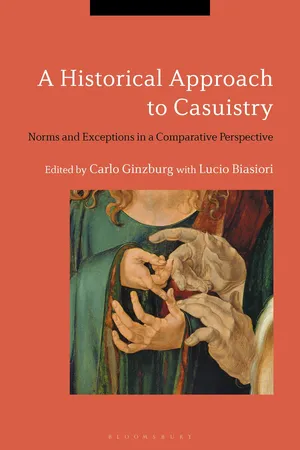
eBook - ePub
A Historical Approach to Casuistry
Norms and Exceptions in a Comparative Perspective
- 376 pages
- English
- ePUB (mobile friendly)
- Available on iOS & Android
eBook - ePub
A Historical Approach to Casuistry
Norms and Exceptions in a Comparative Perspective
About this book
Information
Part One
Casuistry and Medicine across Time and Space
1
A Framework for Casuistry: The Royal College of Paediatrics Guidance for Decision Making at the End of Life (2004–2015)
Avishay Sarfatti
On April 15, 1989, an FA Cup semifinal between Liverpool and Nottingham Forrest at Hillsborough football ground turned disastrous as police mismanagement of the crowd ended in the death of ninety-six Liverpool fans and the injury of hundreds. The Hillsborough disaster, infamous for police cover-up with the support of Thatcher’s government, has also gained its place in English medical and legal history. Anthony Bland, at the time an eighteen-year-old Liverpool supporter, suffered severe brain damage as a result of the injuries he sustained at Hillsborough. After four years of existence in a “persistent vegetative state” the hospital, with the support of his parents, applied for a court order that would allow him to “die with dignity.” In 1993, following an appeal to a higher court, their wish was granted and Anthony Bland became the first patient in English legal history to be allowed to die by the courts through withdrawal of life-prolonging treatment.1
The Bland case brought to public attention wider ethical and legal issues that needed to be addressed for some time. A committee of the House of Lords called upon the medical and other caring professions to draw up an agreed code of practice regarding withholding or withdrawing life-supporting treatments.2 One of those responding to the call was the newly formed Royal College of Paediatrics and Child Health (RCPCH), with a document titled Withholding or Withdrawing Life Saving Treatment in Children: A Framework for Practice.3 The document followed a series of workshops, public meetings, discussions, and consultations with a wide range of clinicians, representatives of faith groups, parents, and individuals with disabilities. It acknowledged the impossibility of achieving total consensus but was able to identify a commonly agreed-upon framework within which choices and judgments regarding withholding or withdrawing treatment could be discussed and decisions could be reached in the best interests of the child. The second edition, published in 2004, changed the title, from “life-saving treatment” to “life-sustaining treatment” to reflect the idea that the treatment given in these circumstances is of a supportive rather than a curative nature, but overall, it retained the same ethical and legal principles described in the first publication. The most recent edition, published in 2015, regrouped the five criteria previously used into two categories based, so the document asserts, on the quantity or quality of life. It also added a third category, formally acknowledging “the wishes and preferences of those young people who are able to make decisions for themselves, albeit with the support of their families and professionals.”4 These revisions—the president of the RCPCH writes—reflect the advances in the practice of pediatrics and in medical technologies; they also reflect the growing accessibility to internet-based knowledge and the widespread use of social media that entail families and patients to be involved in decisions regarding the options available for treatment.5
The title of the 2015 document changed as well, placing emphasis on the process of decision making: Making Decisions to Limit Treatment in Life-Limiting and Life-Threatening Conditions: A Framework for Practice. It incorporated the developments in palliative care provision and the growing documentation provided by ethical and other groups that support decision making, such as the General Medical Council 2010 document Treatment and Care Towards the End of Life: Good Practice in Decision Making. It acknowledged time and again that these decisions are often made in “a context where absolute certainty over outcomes does not exist,” that unqualified “agreement may be neither practical nor achievable,” but emphasized the obligation to seek “as much common ground as possible” when changing the goal of treatment from cure to symptom relief. The circumstances under which the withdrawing, withholding, or otherwise restricting life-sustaining treatment might be ethically permissible did not change from the previous editions. The circumstances were regrouped into two categories: one category assessing “quantity of life” and the other “quality of life,” with brief explanations. A third independent category that did not appear as such in previous editions described circumstances when “the wishes and preferences of those young people who are able to make decisions for themselves, albeit with the support of their families and professionals” were formally acknowledged.6
The sequence of events I have just relayed pertains to England, but the questions addressed are similar in all countries with modern medical systems. The advancements in medicine and medical technology have enabled physicians working within these systems to maintain life in ways that sometime blur the demarcation between life and death. These advancements have also brought forward the question whether the role of the physician as a preserver of life, when pushed to the extreme and sought after at all cost, did not clash with other ethical principles. The physician’s obligation is not only to preserve life, but also to try and alleviate pain and suffering, and more generally, to act in the best interests of the patient. Hand in hand with the appreciation of technological and therapeutic developments, the medical community has also increasingly understood the need to recognize when individual patients have reached their limits of trauma.
Medicine is practiced at the interface between scientific knowledge based on the experimental method and the mathematization of natural phenomena and the subjective observation of the patient, his history, the history of his disease, and the realities of the symptoms. Medical judgments are based on research and experimental methods, but also on subjective experience and assessments; they follow universal knowledge but are also case specific and are presumptive and revisable. In ambiguous and complex cases, this presumptive dimension implies the existence of reasonable divergences in ways of treatment between doctors. The ongoing negotiation between generally accepted scientific knowledge and case-specific factors is part of all medical practice, but it is dramatically experienced in end-of-life situations. In hospitals and in intensive care units, in the space between the seemingly omnipotent presence of medical technology and the ill individual and her family, physicians are practicing casuists. It is there that they are often forced to make difficult choices that are case specific and circumstance specific, based on probabilities and subjective assessments rather than certainties, decisions that sometimes demonstrate the contradictions inherent in the physician’s code of conduct and therefore cannot appear as a general written rule. It is there, when taking decisions regarding end-of-life treatment, that a casuist approach becomes a necessity. It is important to emphasize from the start that these decisions regarding an individual case are not taken by the individual physician, but are the end result of a consensus reached within the caring team in dialogue with the patient and the family. The casuistic method is practiced collectively in an effort to serve what we understand to be the best interests of our patients.
An example will clarify this point. In 2005, 14,022 children under the age of sixteen were admitted to pediatric intensive care units (PICUs) across the UK; 701 (5 percent) of them died. Approximately 80 percent of these deaths (560 children) occurred following a decision of the medical staff to limit or withdraw life-sustaining treatment.7 Most deaths in the UK’s PICUs follow withdrawal or limitation of life-sustaining treatment rather than failed resuscitation, the overall proportion increasing in recent years. A similar pattern is seen in the neonatal intensive care environment.8 There is growing acceptance that such practices are ethically acceptable and that medical treatment can legally and ethically be withdrawn when it is unable to provide overall benefit in continuing treatment. The RCPCH publication—in its three editions—provides the medical staff with the institutional support and with a widely agreed-upon framework within which to make these case-by-case decisions.
The document declares that it does not support euthanasia, a practice which is illegal in the UK. It begins by positing the general rule, one that describes medicine as it should be practiced: “The RCPCH acknowledges that all members of the child health team, in partnership with parents, have a duty to act in the best interests of the child. This includes sustaining life, and restoring health to an acceptable standard.”9 It then presents a reservation to the general rule, thus acknowledging the realities of the medical practice: “However, there are circumstances in which treatments that merely sustain ‘life’ neither restore health nor confer other benefit and hence are no longer in the child’s best interest.”10 Determination of the best interests of the child in a clinical setting remains vague and is said to “involve balancing benefits and burdens (of whatever type) of treatments and outcomes, whilst considering the ascertainable wishes, beliefs and values and preferences of the child and their family, the cultural and religious views of the latter, the views of those providing care for the child and what choice is least restrictive of future options.”11
As said above, the 2015 document has replaced the five criteria previously used to identify situations in which withdrawal or withholding of treatment is ethically permissible with “a more formal classification based on quantity or quality of life.”12 The first set describes a limited quantity of life: “If a treatment is unable or unlikely to prolong life significantly, it may not be in the child’s best interests to provide it.”13 While the words “formal classification” and “quantity” imply a situation that is measurable and possibly less ambiguous, the difficulties, ambiguities, and practical questions remain. In what follows, I will elaborate some of the uncertainties and problems the casuist pediatrician working on intensive care units encounters all too often. The quantity-of-life situations range from situations diagnosed as brain death to imminent death (continued deterioration irrespective of treatment) and inevitable death (not immediate but expected in the very near future).
Brain death is medically and legally clearly defined: “When death is diagnosed following formal confirmation of brain stem death by agreed medical criteria, intensive technological support is no longer appropriate and should be withdrawn, unless organ donation is being considered.”14 One should emphasize that in the UK, once the brain stem testing has been completed, the patient is considered medically and legally dead. As a result, this scenario should be the least casuistry prone. However, despite the existence of a clear and objective testing process, this relatively new definition of death is not universally accepted and requires the medical staff to accommodate a variety of family responses.
Until the 1960s, death was defined based upon cardiopulmonary criteria. ...
Table of contents
- Cover
- Half-Title
- Title
- Contents
- List of Figures
- Notes on Contributors
- Preface
- Acknowledgements
- Part One Casuistry and Medicine across Time and Space
- Part Two Religious Anomalies in the Ancient and Medieval World
- Part Three Legal Casuistry between Judaism and Islam
- Part Four Casuistry between Reformation and Counter-Reformation
- Part Five Norms and Exceptions in the Early Modern Global World (Sixteenth and Seventeenth Centuries)
- Part Six Inside and outside Port-Royal
- Sources
- Bibliography
- Index
- Copyright
Trusted by 375,005 students
Access to over 1.5 million titles for a fair monthly price.
Study more efficiently using our study tools.
Frequently asked questions
Yes, you can cancel anytime from the Subscription tab in your account settings on the Perlego website. Your subscription will stay active until the end of your current billing period. Learn how to cancel your subscription
No, books cannot be downloaded as external files, such as PDFs, for use outside of Perlego. However, you can download books within the Perlego app for offline reading on mobile or tablet. Learn how to download books offline
Perlego offers two plans: Essential and Complete
- Essential is ideal for learners and professionals who enjoy exploring a wide range of subjects. Access the Essential Library with 800,000+ trusted titles and best-sellers across business, personal growth, and the humanities. Includes unlimited reading time and Standard Read Aloud voice.
- Complete: Perfect for advanced learners and researchers needing full, unrestricted access. Unlock 1.5M+ books across hundreds of subjects, including academic and specialized titles. The Complete Plan also includes advanced features like Premium Read Aloud and Research Assistant.
We are an online textbook subscription service, where you can get access to an entire online library for less than the price of a single book per month. With over 1.5 million books across 990+ topics, we’ve got you covered! Learn about our mission
Look out for the read-aloud symbol on your next book to see if you can listen to it. The read-aloud tool reads text aloud for you, highlighting the text as it is being read. You can pause it, speed it up and slow it down. Learn more about Read Aloud
Yes! You can use the Perlego app on both iOS and Android devices to read anytime, anywhere — even offline. Perfect for commutes or when you’re on the go.
Please note we cannot support devices running on iOS 13 and Android 7 or earlier. Learn more about using the app
Please note we cannot support devices running on iOS 13 and Android 7 or earlier. Learn more about using the app
Yes, you can access A Historical Approach to Casuistry by Carlo Ginzburg, Lucio Biasiori, Carlo Ginzburg,Lucio Biasiori in PDF and/or ePUB format, as well as other popular books in History & Social History. We have over 1.5 million books available in our catalogue for you to explore.