![]()
SECTION 1
What Is Research?
Section guide
Before you begin to construct your own project, you need to understand what research is, what the research project is all about, and how you can start to build a high-quality research project.
In this section you will work your way through to the answers to the following questions:
1. Why is the research project important to me?
2. What will I get out of it?
3. Why do I need to know about it in the first and second years when I only get to do it in the final year?
4. What is research all about?
5. What happens if it all starts to go pear shaped?
6. How will I be able to tell if my project is any good?
7. How relevant is this project to working in the real world?
Ready then? The great adventure begins here!
![]()
Chapter objectives
By completing the work in this chapter, you should be able to:
• understand the basic nature of research
• appreciate the importance and significance of your research project to you
• relate the research you will do to research undertaken in the real business world
• see a rough outline of the road ahead of you.
Introduction
Of course it’s tempting to start work on your project by opening a new Word file, called Project.docx, and typing away. To be honest, that’s a bit like jumping into the driving seat of a car for the first time ever and expecting to start driving off on a long journey. It isn’t going to work, and pretty rapidly you’d come to the conclusion that driving is an impossible skill to acquire. The normal way to learn to drive would begin with learning something about cars and how they are actually operated through their controls, and some basic roadcraft, all well away from the steering wheel.
In this chapter, you will learn the corresponding background information for writing your project, and start to acquire the skills and competences you will need.
If you are suffering from an almost overwhelming urge to dash off a questionnaire and rush out into the street with it, pressing it onto startled and unsuspecting passers-by, resist it! It’s the equivalent of heading out onto the motorway on your first ever trip driving a car.
Why is the research project important to me?
The chances are that you bought this book because you have no choice over your business project – at most universities you have to do one to get your degree, or at least to get an Honours degree. Of course, business degrees at different universities have different regulations, and for this book to work for you at your university you will need to customise it. So the very first thing for you to do is answer the following straightforward questions. If you are not already sure of the answers, ask your tutor or, better still, check out the module descriptor from your university intranet (Blackboard, Moodle or whatever).
| Is the business project compulsory in my degree programme? | YES / NO |
| Is it essential if I want to get an Honours degree? | YES / NO |
Whenever you see the pencil in this book, it means you have to customise – this is what will produce your project for you.
If you answered ‘Yes’ to either or both questions, it’s clear why you will want to pass the project. But is a ‘pass’ all that you are looking for?
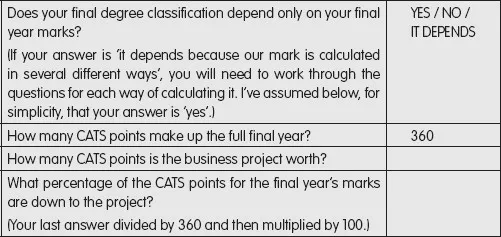
To answer that question with any degree of seriousness, you will need to work out how much the marks for the project count towards your final degree classification. Here there is very great variety across the project modules in different degrees at different universities, so you will need to do some basic calculations to fill in the next part.
Once you’ve reached that answer, it should be clear that in all probability the project carries significant weighting in determining your final degree classification. A good project is, for example, enough to pull your classification up to a 2:1 from a 2:2, but, on the other hand, a poor project is enough to drag a potential 2:2 down to a Third. So, it’s pretty important, and, given that it’s all still to play for, you have some power to improve your classification if you put the effort into it.
Regular modules don’t have the same power of affecting your classification, so why is it that the project has this special status? It all comes down to why the project is in your degree programme.
When universities design their degree programmes, they have certain benchmarks, defined by a body called the Quality Assurance Agency for Higher Education, or QAA for short. They are not allowed to just bung any old thing into the syllabus – there are certain basics that must be there to justify the name of the degree, whether it be Business Studies, or Business Administration, or even other degrees with the word ‘Management’ in their name, such as Sports Management, Events Management or Tourism Management.
Degrees in business have the following requirements to meet included in the QAA Benchmark Statement for general business and management degrees:
(Quality Assurance Agency for Higher Education, 2007)
Data
Systematically gathered bits of information. ‘Data’ is actually the plural of ‘datum’, but most people don’t use the word ‘datum’ any more.
Most universities have retained the project, which complies with this benchmark, in a format that complied with earlier versions, which specifically required a demonstration that students were capable of conducting sustained, independent research (my emphasis).
It is the sustained and independent elements that make the project module so different from other modules. All your other modules operate within a standard timeframe of either a semester or an academic year. Although the project may officially take place within the confines of your final year, there will probably be either parts of earlier modules, or even entire modules, devoted to preparing you for it. In an ideal world you will have been thinking more and more about how you are going to set about your project before you reach your final year.
This may all seem a bit airy-fairy, but now is the time for a dose of hard reality: that is, the time to think about exactly how far away the dreaded hand-in date is. I know you are avoiding thinking about it, but you do need to seriously think about pacing yourself. The work you put into it is after all supposed to be sustained, and leaving it to the last minute is a sure-fire way of getting a bad mark.
When is the hand-in date? (The answer will be in your module descriptor. If you are currently in your second or even first year, you can, for the moment, work with your best guesstimate based on this year’s hand-in date, but remember to update what you have written here when you hit your final year!)
What is the date today?
How many days are there from now until hand-in? (You can use a handy gizmo available at www.timeanddate.com/date/duration.xlink.html to do this calculation easily.)
It’s very important to keep this ever-diminishing timeframe in mind. To help you do this, there is a natty countdown gizmo which you can personalise at www.timeanddate.com/countdown/create.
By the way, if you’ve just spent the last twenty minutes on timeanddate.com, seeing how long it is until Christmas, your cat’s birthday or when the next leap year day is, you’ve discovered that very natural but not very helpful phenomenon known as ‘displacement activity’ – doing something which is an enjoyable way of avoiding doing something of a higher priority. To be honest, displacement activity isn’t necessarily all bad. The problem is when it gets out of control. There’s no harm in getting into the habit of taking a break from working on your project for five minutes every hour or so. In fact, I would recommend it. Just ...