![]()
Chapter 1
Introduction
The case for outdoor adventure and the need for risk management
Generation upon generation of our ancestors lived freely upon the earth in forest and desert, tundra and savannah, the survival of the species, of their small bands, utterly dependent on the skill and enterprise of individuals and small groups. Life revolved and evolved around seeking shelter, finding food plants, hunting, fishing. Imagine the hunter poised, spear in hand, at one with the forest, a prey animal in view; the hunter completely engaged with his own destiny, a free agent aware of every sense and every muscle, totally absorbed in the moment when the spear is released.
Life has become constrained, controlled and commoditised to a point where many have forgotten what it is like to have this intensity of experience with nature, with oneself. Such moments are often called peak experiences and it is no coincidence that the metaphor draws on the ancient and powerful symbol of the mountain, the epitome of wilderness, of challenging, elusive but desirable goals.
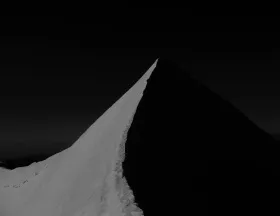
The symbol of mountains: the summit of Castor, Zermatt.
As an adolescent, my own life was so transformed by an encounter with crags and mountains that, it seems to me now, most of the truly valuable lessons that I learnt came, not from a good education and a good family, but from this exciting hands-on school of climbing. Any sense of aesthetics that I possess has grown from travel in dramatic landscapes, an instinctive sense of ecology from upland habitats and an affinity for the literature of challenge from the urge to make sense of the intensity of my own experience. But these are merely valuable by-products beside the glowing core of self-knowledge and self-reliance that grew from the adventure itself.
This first experience has completely shaped the rest of my life. I still have a passion for the mountains and am lucky enough to have been able to make my career in adventure, yet many people whose experience of rock climbing or kayaking or sailing has been limited to a few intense hours still look back on these as a touchstone of adventurous experience, of life as it might be lived.
Adventure education can change lives, can intensify experience and extend its ripples far into a life. But its purpose is not to make lifetime sailors or skiers, climbers or paddlers, any more than the purpose of an education in literature is primarily to produce novelists or that in music to produce composers. A knowledge of all of these opens the doors of perception; a life denied music, literature and adventure is a life sold short.
Education in music and in literature may each have its own difficulties, but there is little doubt that the future of adventure education is under threat from a misapprehension of risk, its importance and its management. This book aims to help adventurous opportunities, especially those for young people, to flourish despite frequent hostility in the prevailing climate of opinion.
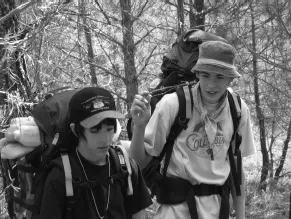
Journeying is a great experience for youngsters.
Public expectations and risk aversion
We are exposed to risk from the moment of our conception to our death. Although, in the developed world, knowledge and technology enable us to control, or at least defend against, the external hazards of climate, disease and starvation more effectively than ever before, we are, paradoxically, becoming more and more risk averse. It is easy to swallow the worm of thinking that the elimination of gratuitous risk can only be for the good but there is a hidden hook.
At an individual level many of us remember as the intense high points of life the occasions when we have faced and overcome great difficulties. Few would doubt that many of our most valuable lessons have grown from uncertainty and anxiety. Where would we be, what flaccid personalities would we have become, if all that discomfort, ambiguity and uncertainty had been removed at source?
For society as a whole there will always be a need for adventurousness of thought, deed and outlook. If we bring up children to believe that physical, emotional or intellectual risks are to be avoided we can hardly be surprised if the future does not bring successors to Captain Cook, to Darwin and to Shakespeare.
Others have written more eloquently about the philosophical and societal pitfalls of the apparently desirable elimination of risk. This book concerns itself with the more prosaic matter of the provision of outdoor activities and experiences. To set the ascent of a few hills against the wider decline of adventurousness may seem faintly ridiculous, yet those who journey in wilderness, who climb or sail, are privileged to enjoy an unrivalled practical training in risk management. We become expert in the necessary balancing act between what is desirable and what is reasonably possible to an extent where the balancing itself becomes central.
All of life is uncertain, but the engine of public opinion is inconsistent in its judgement of risk. Risks which are at a very low level, such as that from Creuzfeld-Jacob Disease, can be fanned into major public concern while daily exposure to very much higher levels of real risk do not attract proportionally greater concern. One must be sympathetic to the genuinely unfortunate individuals who find themselves the victims of statistically unlikely risks, but such sympathy does not necessarily lead to sound public policy.
We all deplore serious accidents in adventure activities or in any out of school learning. Such events, mercifully rare, justifiably raise great public concern and highlight the need for teachers, instructors and providers continually to aspire to the highest standards of risk management, but a public obsession with safety and blame and an ever greater aversion to any kind of risk threatens the availability of adventure in any meaningful form. The waste of young lives through lack of purpose and lack of self-esteem barely registers on the scale of public concern, yet many see this as the direct corollary of a diminution in the availability of opportunities for self-discovery, self-expression and self-belief. I do not pretend that outdoor experiences are the only remedy here, simply that they are too valuable, of too great a proven effect, to be rejected or neglected.
Adventure activities are certainly not entirely risk free, nor should they be. Robin Hodgkin wrote:
Columbus set out to discover a new route to China ... but he discovered America. Adventure rarely reaches its pre-determined goal.
This serves as a reminder of the essential unpredictability of genuine adventure. People seem increasingly to expect an outdoor experience to be a risk-free, error-free and controlled commodity like a pack of computer disks. Without uncertainty of outcome, without risk, we may have a very fine recreational experience, but we no longer have adventure.
We may be in danger of risk being sidelined as an undesirable by-product of adventure activity, of it being treated as the carcinogen to be eliminated from an otherwise healthy diet, rather than being recognised as itself an essential nutrient.
The balancing of risk and benefit has always been at the core of the long tradition of outdoor learning, but in many cases this balance seems to be under threat of replacement by the virtual elimination of risk. Colin Mortlock described a continuum of outdoor activity:
- Recreation
- Adventure
- Misadventure
and argued persuasively that the maximum educational benefit was to be found in the central sector or, more exactly, at the point of transition between adventure and misadventure. We are in danger of polarising both the operation and the perception of outdoor activity into either Recreation or Misadventure and losing the essential, productive but difficult middle ground.
Recreation, as defined in this context and typified by a leisurely walk in a beautiful park, can give great pleasure but, in Mortlock’s model, is not likely to bring the deep experiences, the revelations that are to be found in genuine adventure.
John Adams of University College London has, in his book Risk, thrown light on different attitudes to risk. He identifies a ‘Formal’ sector of risk management (government, commerce, industry, ‘experts’ in general) whose objective is to reduce risk and an ‘Informal’ sector (everybody else) who:
... go about the business of life – eating, drinking, loving, hating, walking, driving, saving, investing, working, socialising – striving for health, wealth and happiness in a world they know to be uncertain. The objective of these risk managers is to balance risks and rewards.
Tolerable risk or zero risk?
I prefer the term ‘risk management’ to that of ‘safety’ to describe what outdoor leaders and their managers do, because the former term, to my mind, carries a suggestion of a process committed to this essential balancing of risk and reward, of safety and adventure. In contrast, ‘safety’ seems to define the task too simply as the elimination of accident, with no consideration of benefit or balance. However, whatever term we use, it is imperative on us to avoid gratuitous risk when responsible for other people, and most especially when responsible for other people’s children. Alongside this we must be honest that we are often dealing with actual risk, albeit risk limited to a tolerable level, but emphatically not a position of zero risk, or of risk that is entirely ‘perceived’. It helps nobody to claim inaccurately that ‘our activities are completely safe’.
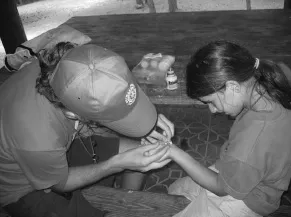
First aid and sympathy – a routine part of the leader’s job.
Adult practitioners of adventure sports can and should make their own decisions concerning the level of risk with which they are willing to engage and which they regard as tolerable for their own activities, but the margin of safety must be higher when, for instance, we are acting in loco parentis. This is discussed more fully in Chapter 14 but, for now, it will suffice to emphasise that risk management is our most effective lever of control over this margin and on the underlying balance between risk and security.
To win the trust of parents and their children, outdoor providers must demonstrate that they have expertise in the balancing act of risk and reward to such an extent that they can provide intense developmental experiences at a level of actual risk that is generally regarded as tolerable. This is why we need to be very good at managing risks – not only to reduce the risk of accidents but also to avoid killing the adventure. If providers are pushed into a corner where every sprained ankle results in an inquiry and a legal claim, it may become impossible to retain the illuminating spark of adventure.
It is now widely recognised that the provision of adventurous activities can be harnessed as a highly effective vehicle for learning about teamwork, about leadership, about personal interaction. It is also an unrivalled vehicle for learning the key life skill of balancing risk against opportunity.
By putting active risk management at the heart of adventure we can give young people a superb arena in which to develop their skills in managing the uncertainties of life, but only if we leave enough uncertainty of outcome in the process for their risk management to be real. We should a...