![]()
1 Designing and Managing Research Projects: An Overview
Topics covered in this chapter
- Origins of the book
- Who the book is aimed at
- Structure of the book
- Overview of chapters
- Source material and literature
For many people, setting out to do a research project for the first time can feel like a voyage into unknown seas. Exciting, perhaps, but also a little bit scary. What dangers might lie lurking just over the horizon? What fate could befall the unwary or ill-prepared? Often this sense of trepidation is compounded by a lack of clear navigational aids for the journey ahead. By this we mean basic, easy-to-follow advice indicating how to design and initiate a new research project, and how to manage the various phases of a research project once it gets going.
This book aims to provide a straight-forward, practical introduction to some of the more crucial knowledge and skills people are likely to need when setting out to do a research project in the social and health sciences. It covers issues such as how to choose a research design for a project, how to write a research proposal, how to apply for research funding and how to think about a project’s ethical dimensions. It also looks carefully at how to write up and disseminate research reports, paying particular attention to how to organise and present technical reports, student theses or dissertations, and manuscripts for journal articles. The book also offers a range of tips and suggestions on other important topics such as teamwork and supervision in research, the place of different types of computer software in research and the work options available for people interested in pursuing a career (or at least gainful employment) as a researcher.
A key goal of the book is to try to minimise the amount of trial and error that researchers have to use when learning how to design and do research projects. By considering the ideas and suggestions outlined here, researchers should be able to plan their projects more thoroughly and thoughtfully. This should help reduce the amount of precious time and energy expended on unnecessary tasks or solving unexpected problems, experiences that can be discouraging for the first-time researcher and often lead to projects being significantly disrupted or delayed, or even totally abandoned.
Origins of the book
The idea for this book was conceived over a decade ago when the first author, David Thomas, was operating a research methods advisory service and teaching graduate courses on social and health research at the University of Auckland. Through this work, David encountered many students and staff in the early stages of developing their research skills and pursuing careers as professional researchers. In talking with these people, it became clear that there were certain aspects of the process of designing, conducting and writing up research projects for which people tended to require the most advice or support – aspects that they were most likely to come unstuck on or find challenging. In response, David began developing a variety of course handouts and short webpage articles providing advice on these and other key aspects of the work associated with designing and doing research projects. These handouts and articles included practical tips and examples drawn from David’s own research experiences and reading. Later, the second author, Ian Hodges, also began contributing articles on selected topics based on his experiences of working as a researcher in government agencies and as a self-employed contractor.
After feedback from students and staff suggested the various handouts and articles had generally proved helpful, we decided there might be value in using the material as the starting point for developing a more comprehensive introductory workbook or guide for researchers. The structure and content of the current book has evolved out of this initial basic framework, with most of the original text now having been considerably expanded, updated and revised in the course of preparing the book for publication. This has included adding entirely new material on topics such as how to design a research project, getting ethics approval for research, working with colleagues and supervisors, and strategies for disseminating project findings.
Who is the book aimed at?
The book is aimed mainly at new and emerging researchers in the social and health sciences; these may be people who are just beginning their first significant research project, or making their first attempt to secure sizable funding for a research project, or are in the midst of writing up their first major project report. Many of these up-and-coming researchers will be based in universities or other higher learning institutions. Others will be employed in non-university research settings such as government departments or private sector businesses, or pursuing work as independent research contractors or consultants.
In our experience, most of these researchers are likely still to be coming to grips with many of the core tasks normally associated with designing and carrying out a fairly substantial research project. This includes tasks such as selecting appropriate research designs and research methodologies, preparing research proposals, submitting ethics applications, applying to external agencies for funding, managing project staff and resources, writing detailed research reports, and disseminating research findings to different audiences. This book is intended to help accelerate people’s understanding and awareness of these and other key areas of the research process. In particular, the book is intended to serve as an accompaniment to more experiential or ‘hands on’ ways of learning how to design and carry out a research project, such as by working directly alongside a team of more experienced researchers or in collaboration with an academic supervisor.
As readers will appreciate, the boundaries of social and health research are wide, covering such diverse disciplines as social anthropology, sociology, social geography, economics and community psychology, as well as the many health science disciplines such as medicine, nursing, physiotherapy, midwifery, epidemiology and public health. However, what generally unites all these different fields is a broad concern with better understanding the enormous array of conditions and factors influencing human behaviour, social interaction and well-being. Designing and undertaking research projects is central to this work, with the ultimate goal being to try to reveal new insights on these many different conditions and factors through the application of systematic, focused observation and inquiry.
Although new or emerging researchers in these various social and health research disciplines are often interested in very different research questions or problems, there are, in our experience, certain common principles related to designing and carrying out research projects that have general applicability across virtually all the disciplines. It is these common principles that we aim to focus on here, laying out some basic introductory guidelines and advice for up-and-coming researchers to think about and perhaps use as a foundation for their own work in the years ahead.
To make the book as accessible as possible, we have tried to write each chapter in fairly simple language, using only a minimum of jargon or specialist technical terms. In addition, for many of the core topics covered, such as designing a new research project, doing a literature review or organising and writing a research report, much of the information given is pitched at the level of the inexperienced beginner. Very little previous knowledge is assumed and quite a lot of text is devoted in places to spelling out basic principles and giving detailed examples of what we mean. We consider this approach to be appropriate in an introductory guidebook such as this, since in our experience new and emerging researchers are often looking for considerable detail and structure in the advice they get from others. In time they will almost certainly develop their own distinctive approaches for handling different research tasks, but in the beginning they tend to want very specific and unambiguous advice on how to do things.
Of course, we would like to think the book will have some value for more experienced researchers, too, especially researchers looking to refresh their knowledge or reflect on aspects of the research process in which they are particularly interested. Although much of the information presented in the book is quite pared down and simplified, and therefore may not always appeal to the more seasoned investigator, nonetheless many of the points we make could help some experienced researchers to see aspects of their current practice in a new light.
Structure of the book
Perceptive readers studying the contents list will have noticed that the chapters in the book are laid out in a sequence that roughly follows the steps involved in carrying out a research project. Planning and doing a research project often involves a fairly standard set of steps or stages (although not always). These include designing the project, preparing a research proposal, obtaining resources for carrying out the research, conducting and managing the project, writing a research report and communicating research findings.
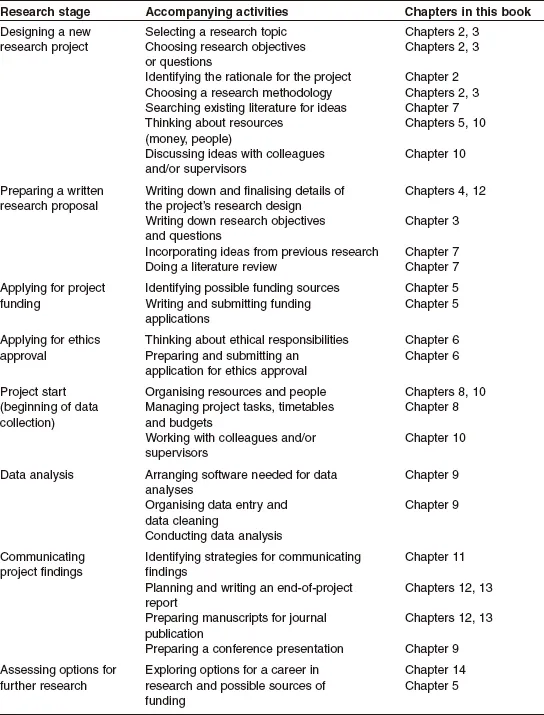
Table 1.1 outlines in more detail the steps or stages that we believe most experienced social and health researchers tend to follow when designing and running research projects. The table also lists the main activities usually done in each stage. The right-hand column of Table 1.1 indicates which chapters in the book cover skills and knowledge relevant to each research step or stage. For example, information on how to prepare and write a research proposal is in Chapter 4 and information on how to get funding for research projects is in Chapters 5 and 14.
TABLE 1.1 STAGES IN PLANNING AND CONDUCTING A RESEARCH PROJECT
If you are a largely a newcomer to research and have never designed or undertaken a research project before, it is probably wise to start the book at the beginning and work through each of the chapters systematically. This should provide a fairly good general introduction to the main aspects of doing a research project. However, each of the chapters in the book can also be read as separate, stand-alone pieces. This might be especially handy for people already in the midst of doing a research project who are looking for specific tips on how to do certain things, such as how to structure a research proposal or lay out a technical report.
Overview of chapters
This section provides more detail on the content of each the chapters in the book.
The next two chapters (Chapters 2 and 3) provide some guidance on how to identify and develop new ideas for research. Chapter 2 provides a framework for thinking about how to design a new research project, highlighting some of the key issues to consider. This includes looking at some of the different kinds of research questions, data collection procedures and data analysis techniques commonly used in social and health research. The chapter also introduces some basic research concepts and terms that will be used throughout the book.
Chapter 3 expands on some of the points touched on in Chapter 2, looking in particular at how to logically and succinctly define and write down a research project’s aims and objectives. In our experience, newcomers to research often do not pay sufficient attention to ensuring their research aims and objectives are well thought out and clearly expressed. This chapter offers suggestions on how to effectively conceptualise and frame statements describing a project’s research aims, objectives, questions and/or hypotheses.
The next four chapters, Chapters 4 to 7, focus on key tasks often vital to getting a new research project up and running. These include preparing a project proposal, submitting a funding application, preparing for an ethics review, and developing and writing a literature review.
A research proposal indicates the aims of a research project, why the project is important and how the project will be organised. Writing a research proposal is an opportunity for researchers to carefully plan a research project before it starts. Draft or completed research proposals can be given to other people for feedback or to raise interest in a project amongst colleagues, supervisors or potential project sponsors. Chapter 4 provides advice on how to organise and write a general research proposal. This type of general proposal could be written as part of planning for a PhD or Masters thesis, or for a similar research-based student project (including those submitted for ethical review). An example of a research proposal is shown in Appendix 1.
Some research projects will only be viable if adequate financial support is obtained from funding organisations. Chapter 5 provides advice on how to identify possible research project funding sources and strategies. It indicates the type of organisations that fund health and social research, how to select suitable funding sources and how to prepare and submit written applications for project funding. Strategies for getting funding for researcher-initiated projects are covered, as well as strategies for identifying and bidding for client-initiated or commercial research project contracts.
All research should be conducted ethically and with sensitivity to the needs of research participants. Chapter 6 sets out the key ethical principles and standards that health and social researchers should know about. It describes examples of the types of ethical requirements stipulated by organisations overseeing the conduct of research. The chapter also provides advice on how to prepare research proposals for scrutiny by ethics committees.
Preparing a literature review is often one of the first things a researcher will do in the early stages of a project. Literature reviews can be useful for detailing the findings of previous studies, identifying gaps in current knowledge and deciding which research methods are the best to use in new projects. Chapter 7 provides advice on how to research and write a literature review. It indicates how to find and critically assess relevant literature. It also outlines a model format for structuring the information presented in a literature review.
The next three chapters, Chapters 8, 9 and 10, are concerned with aspects of the day-today running of research projects. Chapter 8 outlines key skills and strategies for managing the ongoing work of a research project. This includes planning the timing and sequencing of tasks, monitoring the use of project resources, and managing the work of project team members. We highlight problems that can arise in these areas, as well...