A fascinating journey through the origins of American tourism
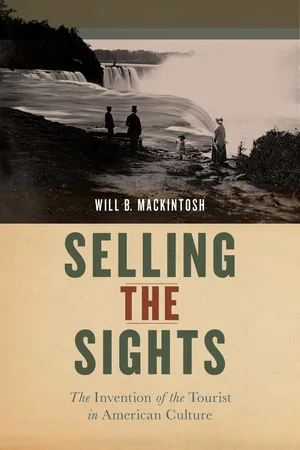
In the early nineteenth century, thanks to a booming transportation industry, Americans began to journey away from home simply for the sake of traveling, giving rise to a new cultural phenomenon —the tourist.
In Selling the Sights, Will B. Mackintosh describes the origins and cultural significance of this new type of traveler and the moment in time when the emerging American market economy began to reshape the availability of geographical knowledge, the material conditions of travel, and the variety of destinations that sought to profit from visitors with money to spend. Entrepreneurs began to transform the critical steps of travel—deciding where to go and how to get there—into commodities that could be produced in volume and sold to a marketplace of consumers. The identities of Americans prosperous enough to afford such commodities were fundamentally changed as they came to define themselves through the consumption of experiences.
Mackintosh ultimately demonstrates that the cultural values and market forces surrounding tourism in the early nineteenth century continue to shape our experience of travel to this day.
- 272 pages
- English
- ePUB (mobile friendly)
- Available on iOS & Android
eBook - ePub
About this book
Information
1 / Describing the Terraqueous Globe: Tourists and the Culture of Geographical Knowledge
In 1793, a Massachusetts minister named Jedidiah Morse published a “system of Geography” to which he gave the somewhat paradoxical title The American Universal Geography. Although the juxtaposition of words in his title seems jarring, it precisely captured Morse’s intellectual project and that of other geographers writing at the birth of the new nation. His book promised geographical information that was tailored to the needs of an independent United States, but more importantly, it sought to encompass the whole world between its covers. Writing in a moment that was shaped by the political and intellectual frameworks of the late Enlightenment, Morse presented himself as reluctant philosopher who sought to share his encyclopedic knowledge with a domestic audience. His geography took seriously the goal of being both American and universal at the same time.
Almost sixty years later, the largest American publishing firm, Harper and Brothers, issued a slim volume with the considerably more prosaic title Harper’s New York and Erie Rail-road Guide-book. Although it was Harper’s first foray into the burgeoning genre of guidebooks, it too was entirely typical of its moment. As its title suggested, it offered limited and focused geographical information designed for maximum utility for travelers along one particular rail line. It was produced on mechanized printing equipment by a large firm that made its publishing decisions according to its calculation of supply and demand in the market. It was written and illustrated to fill this demand by content producers who were already members of Harper and Brothers’ stable of authors and illustrators. In short, it was a standard product of the booming midcentury culture industry.
The wide gulf between Morse’s geography and Harper and Brothers’ guidebook was representative of the fundamental structural and intellectual changes that reshaped the distribution of geographical information over the first half of the nineteenth century. Early national Americans lived in what Matthew Edney has called “later Enlightenment elite cartographic culture.” In this culture, “production of knowledge depended not only on the measured survey and observation of the landscape but also on the reconstitution and interpretation of the resultant data to create a single corpus of geographic knowledge.” This data could be rationalized through the use of “reason,” which would “reconcile conflicting observations of points or view so that all phenomena could be systematically described within a single ‘archive.’”1 But by midcentury, the intellectual project of universal geography had retreated to the cheap textbooks and rote memorization exercises of common school classrooms, and to the professionalizing discipline of academic geography. Most geographical information available on booksellers’ shelves came instead from large commercial concerns that sought to publish only what their customers would buy, no more and no less. The new business techniques and national market orientation of these publishers drove significant innovation in the formats and genres through which this information was delivered, leading to a world of geographical publishing that was both more varied and more specialized than the heavy tomes of Jedidiah Morse.
The emerging dominance of culture industry practices led to an explosion in geographical publishing in the 1840s. Ever-larger quantities of geographical information were produced and distributed to an American audience with a seemingly limitless reading appetite, in both new and established genres. But this explosion in information availability was not evenly distributed across space. Some regions, routes, and resources were covered extensively by commercially produced texts, while other fell into or remained in obscurity. This unevenness was a direct result of the increasing market sophistication of the big New York and Philadelphia publishing houses; they sought to print only what they could produce cheaply and what would reliably sell to the largest possible audience. Although big midcentury commercial publishers like Harper and Brothers lacked modern market research techniques, they nevertheless understood their product well enough to focus on heavily traveled areas, like those along the route of the New York and Erie Railroad. The sheer quantity of geographical information available in the American marketplace of print grew enormously, but its scope also narrowed, especially compared to the goal of universality espoused by Morse’s generation.
In many ways, this deep structural change in the mechanisms of geographical knowledge production and distribution was not unique. The emergence of large, integrated commercial publishers that sought to dominate national book sales reshaped countless cultural and intellectual endeavors across the nineteenth century.2 Although it was reflective of broader trends, the commodification of geographical information has its own specific history that was shaped by the processes of gathering, producing, and sharing knowledge about space. The first authors and printers who moved away from Enlightenment universality were a generation of local businessmen and boosters who sought to deploy geographical information strategically in order to drive growth in their hometowns and home states beginning in the 1810s. Around the same time, a distinct group of entrepreneurs, printers, and engravers began to specialize in publishing geographical texts, first in Philadelphia and then in New York. This specialization allowed them to produce these expensive print objects more efficiently and distribute them more widely. However, that very innovation made the new genres pioneered by the local boosters and geographical specialists appealing to the large generalist industrial publishers that emerged in the 1840s and 1850s. By the eve of the Civil War, all of these groups produced geographical knowledge for sale to American readers who benefited from its unprecedented scale and variety of forms.
As with other culture industries, the tumbling rush of affordable entertainment existed alongside an imperative for standardization. But since much of this new geographical print was produced for use by travelers on the roads, rivers, and rails of the United States, this standardization shaped the real possibilities for travel on the ground. A variety of profit motives drove the creation of specialized guidebooks and gazetteers that enticed travelers onto the road with simple instructions and enticing descriptions of picturesque scenery and lively destinations. But these commercially produced texts enabled travel over a relatively limited set of routes, to a relatively limited set of destinations—both of which were selected by the logic of the market—which served to foreclose possibilities at the same time that new ones were produced. This new kind of travel, both enabled and limited by the commodification of geographical information, was undertaken by what contemporaries increasingly called “tourists.” The promoters, geographers, printers, and publishers who propelled this process of commodification did not invent tourism, but they did create the conceptual paradigms and material conditions of knowledge production that made it possible. The emergence of tourism and the growth of the print industries were inextricably linked in that tourists’ experiences were profoundly mediated by the changing conditions of print.
If the mid-nineteenth-century American geographical publishing industry was shaped by the innovative and disruptive forces of the culture industry, then its forebears at the turn of the nineteenth century were still deeply rooted in an earlier Enlightenment culture of geographical knowledge. The content of these early national geographies was shaped by the politics of the postrevolutionary moment, but the framework of the genre was still derived from imported prerevolutionary texts. The authors and printers who produced this boom shared with their Enlightenment forebears a number of fundamental assumptions about the purposes and processes of geographical knowledge production. They understood their work to be the product of individual publicly minded thinkers, who worked cooperatively but who nevertheless had distinct and identifiable intellectual voices. Their tone was collaborative because they understood themselves to be engaged in a collective project of knowledge production with universality as its goal, by which they meant both the acquisition of universal knowledge as well as its wide distribution toward the ends of universal geographical literacy. They imagined that this universal absorption of universal knowledge would happen in a sedentary context, in homes and classrooms, and that its production would also be largely, albeit not exclusively, a sedentary intellectual project. And even though their geographical ambitions were limitless, the means by which they produced their volumes were profoundly local, since early national printers mostly produced and distributed their wares on a limited scale. The content of these early geographies may have been “Americanized,” but the larger culture of geographical knowledge in which they wrote was deeply rooted in the vernacular transatlantic Enlightenment.3 Above all, they sought to build a nation of enlightened citizens, not mobile travelers.
Jedidiah Morse was the first and most prominent geographical author in the early republic, but he was far from the only one. Beginning in the late 1780s, American authors penned large numbers of new maps, schoolbooks, works of geography, and even geographically inspired novels designed to feed a voracious public appetite for geographical texts with an American accent.4 They created “Americanized” versions of old British geographies and generated new texts that were patterned on British examples.5 While teaching at a school for young women in New Haven in the 1780s, Morse felt the need for a concise, accurate, and affordable text “to facilitate the acquisition of geographical knowledge” of the new nation. He began to collect relevant information for a fresh American geography, from “a great variety of authors, miscellaneous papers, and verbal information,” intending at first to circulate it in manuscript form. However, upon “the advice of several worthy gentlemen,” Morse decided to publish his work in order to “exhibit it to public view.” In doing so, Morse hoped not only to supply the school market with “a concise, accurate and comprehensive description of the terraqueous globe” but also to supply individuals with a cheap volume for home use.6 The result of his labor was Geography Made Easy, a textbook printed in 1784, which launched his career publishing geographies in a variety of formats for both juvenile and adult audiences, and which inaugurated a lively trade in published geographical knowledge in the early republic. Early national Americans bought up geographical monographs, geographical grammars, gazetteers, and atlases in a range of formats, from slim primary textbooks to weighty library volumes.
This endeavor of producing universal geographical literacy attracted a diverse cohort of contributors. Morse’s geographical publications turned into a veritable franchise that outlived the man himself, who died in 1826. Geography Made Easy survived in print in various forms until the 1820s, with multiple editions issued almost annually along the east coast. The American Universal Geography, a more comprehensive two-volume text intended for the home audience, was first published in 1793 and remained in print until 1819, in both full-length and abridged editions. The American Gazetteer, a reference text Morse created by restructuring the content of his American Universal Geography into alphabetical order in 1797, was similarly widely distributed along the coast and in the interior, and remained in print until 1810. Morse also developed Geography Made Easy into a series of other volumes for classroom use, including Elements of Geography in the 1790s, and A New System of Geography, a schoolbook that combined a geographical grammar and an atlas, that he produced with his son in the 1820s.7
Morse’s prodigious output competed with texts from a wide range of other geographers. A Philadelphia author, engraver, and publisher named Joseph Scott loomed similarly large in the 1790s and 1800s, with a series of variously titled gazetteers, an atlas, and a textbook for classroom use. Like Morse, Scott embraced the rhetoric of universality, with titles like The New and Universal Gazetteer; Or, Modern Geographical Dictionary, published in 1799. Other writers participated in more limited ways. Benjamin Workman, a prodigious almanac author, published a textbook entitled Elements of Geography from the early 1790s to the 1810s. Caleb Bingham, a publisher and bookseller in Boston, offered A Short but Comprehensive System of the Geography of the World during the first decade of the nineteenth century. Nathaniel Dwight, a Connecticut doctor, minister, and textbook pioneer, contributed to Bingham’s text and published other school texts of his own. Even Susanna Rowson, better remembered as the author of early national bestseller Charlotte Temple, published “universal” geographies in 1804 and 1818. This list is hardly comprehensive, but it suggests how vibrant the print culture of universal geographical knowledge was in the first decades of the new nation.8
Despite their variety, these early producers and distributors of geographical knowledge all positioned themselves prominently in their own texts. Geographies from this period generally included extensive introductory material in which the author addressed the reader directly, explaining the scope of the work, its intended purpose, and the methods used to compile the information contained therein. As a result, these works had a personal air to them; they were products of individual, identifiable seekers of knowledge. As such, these texts looked backward to an eighteenth-century intellectual culture in which individual philosophers dedicated themselves to collecting, arranging, and distributing knowledge in order to contribute to the common good.
Early national geographical authors positioned their texts as precisely such contributions to the common good by characterizing their own decision to publish as reluctant. As we have seen, Morse claimed to have inaugurated the genre in 1784 only because “several worthy gentlemen” encouraged him to do so. Rowson struck a similar note in 1806. She had been encouraged to submit her manuscript entitled An Abridgement of Universal Geography to the press, but she “feared the implication of arrogance and presumption.” But like Morse, she allowed herself to be persuaded by “the flattering persuasions of several friends.”9 Morse even offered to give up his first gazetteer project in 1797. In his introduction to The American Gazetteer, he described a moment when he learned that “Capt. Thomas Hutchins, then Geographer General of the United States, contemplated a Work of the same kind.” Morse was concerned about competing with Hutchins, who, “being from the nature of his office, [was] far more competent to the task,” and so he “resigned his pretensions, and made him a tender of all the materials he had collected.” Hutchins, though, would have none of it, and “with a kindness and generosity which flowed naturally from his amiable and noble mind, Capt. Hutchins declined the offer, relinquished his design, and put into the hands of the Author all the collections he had made, together with his maps and explanatory pamphlets, which have contributed not a little to enrich this Work.”10 This performative disavowal of personal ambition was meant to suggest that these authors wrote only for the public benefit.

FIGURE 1.1. The title page of Susanna Rowson’s An Abridgment of Universal Geography (1806). Note the prominence of her name below the title. Courtesy of the William L. Clements Library, University of Michigan.
Nevertheless, autho...
Table of contents
- Cover
- Title Page
- Copyright Page
- Contents
- Introduction: A Physiology of Travelers
- 1. Describing the Terraqueous Globe: Tourists and the Culture of Geographical Knowledge
- 2. Yesterday the Springs, To-day the Falls: Tourism and the Commodification of Travel
- 3. I Find Myself a Pilgrim: Commodified Experience and the Invention of the Tourist
- 4. I’ll Picturesque It Everywhere: The Archetype of the Tourist in Satire
- 5. Traveling to Good Purpose: The Invention of the True Traveler
- Epilogue: Not for Tourists
- Acknowledgments
- Notes
- Index
- About the Author
Trusted by 375,005 students
Access to over 1.5 million titles for a fair monthly price.
Study more efficiently using our study tools.
Frequently asked questions
Yes, you can cancel anytime from the Subscription tab in your account settings on the Perlego website. Your subscription will stay active until the end of your current billing period. Learn how to cancel your subscription
No, books cannot be downloaded as external files, such as PDFs, for use outside of Perlego. However, you can download books within the Perlego app for offline reading on mobile or tablet. Learn how to download books offline
Perlego offers two plans: Essential and Complete
- Essential is ideal for learners and professionals who enjoy exploring a wide range of subjects. Access the Essential Library with 800,000+ trusted titles and best-sellers across business, personal growth, and the humanities. Includes unlimited reading time and Standard Read Aloud voice.
- Complete: Perfect for advanced learners and researchers needing full, unrestricted access. Unlock 1.5M+ books across hundreds of subjects, including academic and specialized titles. The Complete Plan also includes advanced features like Premium Read Aloud and Research Assistant.
We are an online textbook subscription service, where you can get access to an entire online library for less than the price of a single book per month. With over 1.5 million books across 990+ topics, we’ve got you covered! Learn about our mission
Look out for the read-aloud symbol on your next book to see if you can listen to it. The read-aloud tool reads text aloud for you, highlighting the text as it is being read. You can pause it, speed it up and slow it down. Learn more about Read Aloud
Yes! You can use the Perlego app on both iOS and Android devices to read anytime, anywhere — even offline. Perfect for commutes or when you’re on the go.
Please note we cannot support devices running on iOS 13 and Android 7 or earlier. Learn more about using the app
Please note we cannot support devices running on iOS 13 and Android 7 or earlier. Learn more about using the app
Yes, you can access Selling the Sights by Will B. Mackintosh in PDF and/or ePUB format, as well as other popular books in History & Hospitality, Travel & Tourism Industry. We have over 1.5 million books available in our catalogue for you to explore.