eBook - ePub
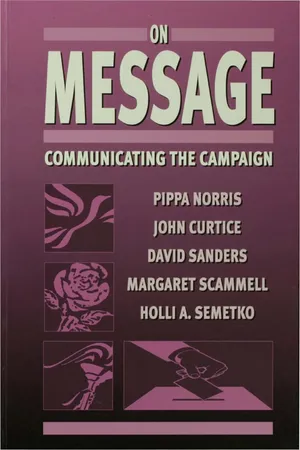
On Message
Communicating the Campaign
- 224 pages
- English
- ePUB (mobile friendly)
- Available on iOS & Android
eBook - ePub
On Message
Communicating the Campaign
About this book
To what extent are the techniques of campaigning and media management critical to the outcome of modern elections? This book brings together a group of leading scholars to provide a comprehensive analysis of the role and impact of political communications during election campaigns. They set the context of election campaigning in Britain, and the methodology used to undertand media effects, review party strategies and resulting media coverage, and draw together evidence of the impact of the 1997 British General Election campaign, analyzing how far television and the press media influenced the public?s civic engagement, agenda priorities, and party preferences.
Information
Publisher
SAGE Publications LtdYear
1999Print ISBN
9780761960744
9780761960737
Edition
1eBook ISBN
9781446233528
PART I
CONTEXT
1 Theories of Political Communications
On 1 May 1997 the sheer size of the Labour landslide victory surprised almost everyone, even Tony Blair. In the immediate aftermath, a common consensus quickly emerged to explain Labour’s historic success after eighteen years in the wilderness. The conventional account of the election stressed that Blair won as a result of a radical re-branding of the image of New Labour. Peter Mandelson, chief Labour strategist, was credited as the primary architect of victory. The creation of New Labour started in the mid-1980s and continued under the leadership of Neil Kinnock, John Smith and Tony Blair. The project involved three major components: the modernization of the party organization, by-passing activists so that internal power flowed upwards towards the central leadership and downwards towards ordinary party members; revision of traditional party policies with the abandonment of socialist nostrums and the adoption of a ‘third way’ straddling the middle ground of British politics; and last, but not least, the deployment of strategic communications to convey the image of New Labour.
The techniques of professional political communications were commonly regarded as so effective that Labour managed to stay ‘on message’ throughout the period of the ‘long’ campaign in the year before the election, and the six-week official campaign from mid-March to 1 May 1997. Moreover, in this view Labour’s assiduous wooing of the press paid off in reversing their historical disadvantage: during the 1997 election twice as many people were reading a newspaper which backed Labour than were reading one backing the Conservatives. The Sun’s defection into the Labour camp is often regarded as particularly important. In contrast, Conservative defeat has often been attributed to their failure to project a consistently positive image, with their election campaign derailed by leadership splits over Europe and dogged by news headlines dominated by sleaze. The lessons of strategic communications apparently embodied in Labour’s remarkable victory have been noted by many other parties, in the United States and Europe, not least by the Conservative Party in Britain.
But is the conventional view of the importance of strategic political communications correct? Often popular interpretations are based on post hoc explanations. The party which wins an election, especially with a landslide, is usually assumed to have run the most effective campaign. In this view the proof of a campaign is in the votes. Party consultants, strategists and journalists who frame our view of the outcome have a natural tendency and self-interest to believe that their role was important, indeed decisive. But if we look more closely and critically, is there systematic evidence to support this interpretation? The 1997 British general election campaign provides a case-study for testing two central claims: are strategic communications by parties important for electoral success? And do the news media have a powerful impact upon the electorate in election campaigns?
One of the most striking developments in recent years is the widespread adoption of the techniques of strategic communications by political parties. This process involves a coordinated plan which sets out party objectives, identifies target voters, establishes the battleground issues, orchestrates consistent key themes and images, prioritizes organizational and financial resources, and lays out the framework within which campaign communications operate. This development is part of the ‘professionalization’ or ‘modernization’ of campaigning, giving a greater role to technical experts in public relations, news management, advertising, speech-writing and market research. Many observers assume that the use of these techniques has become critical for the outcome of modern elections in many countries (Swanson and Mancini 1996).
New Labour’s victory in 1997 was widely regarded as a textbook triumph of packaging over politics, spin over substance, and image-building over ideology. This conventional explanation accords with an expanding literature which emphasizes the growing importance of political marketing, spin doctors and sound-bites, and the rise in the power of the news media as ‘king-makers’ in Britain (Franklin 1994; Kavanagh 1995; Scammell 1995; Jones 1995). The first concern of this book is therefore to establish how far strategic communications are important today for electoral success. In particular, did Labour’s communication strategy prove the most effective, as widely assumed, in the 1997 British general election? Were Labour most successful in influencing the news agenda? And as a result did they boost their party fortunes during the long and short campaign? Our answers, contrary to the conventional wisdom, are no, no and no. Insights into this issue help us to understand the process of strategic communications and its limitations in the modern campaign.
Equally important, many observers have emphasized the rise in the power of the mass media and their growing influence, for good or ill, in election campaigns. Some hope that television and the press can help to mobilize and energize voters, generate effective public deliberation which informs citizens, and produce ‘enlightened preferences’ (Gelman and King 1993; Lupia and McCubbins 1998). Others fear that predominant news values and journalistic practices lead to campaign coverage focusing on the strategic election game, tabloid scandal and down-market sensationalism rather than serious policy debate. Such practices are believed to encourage public cynicism, to alienate voters, and to lead to civic disengagement (Fallows 1996; Patterson 1993; Putnam 1995; Cappella and Jamieson 1997).
The second major concern of this book is to establish how far political coverage on television and in the national press has the capacity to influence the electorate, in particular their levels of civic engagement, issue priorities, and party preferences. We argue that the more exaggerated hopes and fears overestimate the power of newspapers and television to change the electorate within the limited period of an election campaign. Nevertheless we demonstrate that there is systematic and plausible evidence for consistent long-term learning, mobilization and persuasion effects associated with patterns of media use. Moreover, in contrast to previous British studies, we show that newspapers have only limited ability to change party support during the campaign but nevertheless positive television news has the capacity to boost a party’s fortunes significantly in the short term.
These issues are important in analyzing the specific reasons for the outcome of the 1997 British general election, but also more generally for understanding the impact of party communications and the news media in a modern democracy. While there are many other books about the 1997 election, including a companion study focusing on long-term social and ideological dealignment in the electorate (Evans and Norris 1999), there has been little examination of the systematic evidence about the effects of political communications in Britain. Since the structure of the information environment and the political system is important for electoral choice, we need to test whether we can generalize to the British context from the extensive literature on political communications in the United States and Europe. This book presents the first results of a research design combining three major elements: content analysis of party and news messages during April 1997; the 1997 British Election Study (BES) campaign panel survey; and an experimental study of the effects of television news (see Chapter 3 for details). To consider the central issues this introduction lays out alternative theories about the influence of political communications, describes the core conceptual framework, and outlines the plan of this book.
Theories of Mass Propaganda
We can identify three main schools of thought which have developed to account for the influence of political communications: pre-war theories of mass propaganda, post-war theories of partisan reinforcement, and recent theories of cognitive, agenda-setting and persuasion effects which form the framework for this book.
The earliest accounts of mass communications, popular in the 1920s and 1930s, were greatly impressed by the rapid growth and potential reach of mass communications, and stressed that the public could easily be swayed by propaganda on the radio and in newspapers. In Public Opinion, first published in 1922, Walter Lippmann emphasized that the ‘manufacture of consent’ and the ‘arts of persuasion’ were nothing new, since there had always been popular demagogues. Nevertheless he believed that the growth in circulation of the popular press, developments in advertising, and the new media of moving pictures and the wireless, had decisively changed the ability of leaders to manipulate public opinion:
Within the life of the generation now in control of affairs, persuasion has become a self-conscious art and a regular organ of government. None of us begins to understand the consequences, but it is no daring prophecy to say that the knowledge of how to create consent will alter every political calculation and modify every political premise. (Lippmann 1997)
Not only were the effects of mass communication pervasive, they were also seen as generally harmful for democracies. Lippmann’s premonitions seemed to be confirmed by the use of the media by authoritarian regimes in the inter-war years, and the development of more sophisticated and self-conscious psychological techniques of mass persuasion by the Allies in wartime. In the 1930s the Payne Fund Studies in the United States looked at the impact of movies on delinquency, aggression and prejudice, while early experimental studies by Hovland et al. (1949, 1953) examined the impact of the media for planned persuasion (McQuail 1992; Lowery and DeFleur 1995). Popular accounts in the inter-war years reinforced the notion that the mass media could have a direct and decisive impact upon shaping public opinion, and ultimately voting choices.
Theories of Partisan Reinforcement
Yet propaganda theories came under strong challenge from the first systematic research using the modern techniques of sample surveys to examine public opinion. Paul Lazarsfeld, Bernard Berelson and Hazel Gaudet at Columbia University used panel surveys in their classic study of Erie County during the 1940–44 American elections, in The People’s Choice (Lazarsfeld et al. 1944; Berelson et al. 1954). The Erie County study concluded that the main impact of the campaign was ‘reinforcement not change’, since partisans were strengthened in their voting choice. In this account elections went through four stages. First, as the campaign gathered momentum the rising volume of political news meant that people who had not been interested began to pay attention. As citizens woke up to the campaign, many increased their exposure to political information, thereby increasing their interest, in an interactive ‘virtuous circle’. To cope with the rising tide of political propaganda that became available, people brought selective attention into play. Partisans tuned into the information most congruent with their prior predispositions: in 1940 more Democrats listened to speeches by Roosevelt while more Republicans tuned into Wilkie. Political propaganda thereby served mainly to reinforce party support, reducing defections from the ranks. Once sufficient information had been acquired from the campaign, Lazarsfeld suggested, for many people uncertainty evaporated and the voting decision crystallized.
Nevertheless Lazarsfeld suggested that there were clear socioeconomic biases in ‘the attentive public’ so that the more educated became most informed as the campaign progressed. There was a small but politically important group of waverers who tended to be less attentive to the campaign, and (by implication) less informed than average (1944: 95–100). The conclusions undermined the assumptions of liberal democratic theory that elections should involve a process of rational deliberation about issues, candidates and parties by well-informed citizens. The overall message from the Lazarsfeld study was that theories of propaganda had largely exaggerated the effect of political communications on the mass public.
In summary, then, the people who did most of the reading and listening not only read and heard most of their own partisan propaganda but were also most resistant to conversion because of strong predispositions. And the people most open to conversion – the ones the campaign manager most wanted to reach – read and listened least. . . . The real doubters – the open-minded voters who make a sincere attempt to weigh the issues and the candidates dispassionately for the good of the country as a whole – exist mainly in deferential campaign propaganda, in textbooks on civics, in the movies, and in the minds of some political idealists. In real life, they are few indeed. (Lazarsfeld et al. 1944: 95–100)
Following in Lazarsfeld’s footsteps, the new orthodoxy in post-war American studies stressed theories of minimal consequences, which downplayed media influence (Klapper 1960). The earliest studies of the effects of television in Britain lent further weight to these conclusions. Many anticipated that television would become a powerful new weapon in the hands of political parties but the first systematic survey analysis in Britain emphasized that the overall impact of mediated communications was essentially one of reinforcement not change (Trenaman and McQuail 1961; Blumler and McQuail 1968). After the Erie County studies over twenty years elapsed before another study analysing individual-level change within the American campaign was produced (Mendelsohn and O’Keefe 1976; Patterson and McClure 1976).
Social and Party Alignments: It’s Class. Stupid
If campaign communication was largely unimportant for the outcome, what was decisive? Social psychological theories developed by Campbell et al. in The American Voter (1960) came to provide the conventional understanding of electoral behaviour. This framework became widely influential in Britain following publication of Political Change in Britain (1969, 2nd ed. 1974) by David Butler and Donald Stokes, which shared many of the same concepts and theoretical assumptions developed by the Michigan school.
Drawing on the British Election Study from 1963 to 1970, Butler and Stokes argued that politics remained peripheral to most people’s lives: the British electorate rarely participated politically and had minimal involvement in civic life. The typical British voter was seen as fairly uninformed about politics, falling far short of the expectations of citizenship in liberal theories of representative democracy. Butler and Stokes concluded that few people had consistent and stable opinion about well-known issues which divided the parties. Yet despite widespread ignorance about politics and minimal interest, nevertheless about three-quarters of the British electorate cast their vote. When faced with the choice of parties at the ballot box, Butler and Stokes concluded that British voters sought cognitive short-cuts, or ‘standing decisions’, to guide them through elections. As in the United States, during periods of stable partisan alignment, voters in Britain were seen as being rooted for many years, even for their lifetime, to one or other of the major parties.
Communications were critical, but largely operating at the interpersonal level, since political attitudes were believed to be reinforced through discussions with friends, colleagues and family who shared similar party attachments. Socialization theory explained how party loyalties developed when influenced by the family and social milieu of voters, including their neighbourhood, workplace and community. Partisan newspapers were also regarded as important reinforcing mechanisms, since people read the paper which most agreed with their own viewpoint. The role of the press was therefore primarily to mobilize, rather than to convert, partisan voters. For Butler and Stokes, modern party loyalties were founded on the rock of class identities although there was evidence for a weakening relationship as early as the 1960s, partly due to the influence of television (Butler and Stokes 1974: 419).
If voting behaviour is stable, there is little room for the influence of issues debated during the campaign, news coverage of leaders’ speeches, or indeed any short-term flux in party support. If voters are anchored for a lifetime, the campaign can be expected to reinforce partisans, to bring them ‘home’, and to mobilize them to turn out, but not to determine patterns of voting choice. Electoral studies therefore turned to understanding structural determinants on the vote (see, for example, Heath et at. 1985, 1991, 1994). Because of this dominant paradigm, beyond some occasional articles, it was not until two decades after Blumler and McQuail (1968) that a new study re-examined the effects of the...
Table of contents
- Cover Page
- Title
- Copyright
- Contents
- List of tables
- List of figures
- Preface
- Notes about the authors
- Part I: Context
- Part II: Process
- Part III: Impact
- Technical Appendix
- Bibliography
- Name Index
- Subject Index
Trusted by 375,005 students
Access to over 1.5 million titles for a fair monthly price.
Study more efficiently using our study tools.
Frequently asked questions
Yes, you can cancel anytime from the Subscription tab in your account settings on the Perlego website. Your subscription will stay active until the end of your current billing period. Learn how to cancel your subscription
No, books cannot be downloaded as external files, such as PDFs, for use outside of Perlego. However, you can download books within the Perlego app for offline reading on mobile or tablet. Learn how to download books offline
Perlego offers two plans: Essential and Complete
- Essential is ideal for learners and professionals who enjoy exploring a wide range of subjects. Access the Essential Library with 800,000+ trusted titles and best-sellers across business, personal growth, and the humanities. Includes unlimited reading time and Standard Read Aloud voice.
- Complete: Perfect for advanced learners and researchers needing full, unrestricted access. Unlock 1.5M+ books across hundreds of subjects, including academic and specialized titles. The Complete Plan also includes advanced features like Premium Read Aloud and Research Assistant.
We are an online textbook subscription service, where you can get access to an entire online library for less than the price of a single book per month. With over 1.5 million books across 990+ topics, we’ve got you covered! Learn about our mission
Look out for the read-aloud symbol on your next book to see if you can listen to it. The read-aloud tool reads text aloud for you, highlighting the text as it is being read. You can pause it, speed it up and slow it down. Learn more about Read Aloud
Yes! You can use the Perlego app on both iOS and Android devices to read anytime, anywhere — even offline. Perfect for commutes or when you’re on the go.
Please note we cannot support devices running on iOS 13 and Android 7 or earlier. Learn more about using the app
Please note we cannot support devices running on iOS 13 and Android 7 or earlier. Learn more about using the app
Yes, you can access On Message by Pippa Norris,John Curtice,David Sanders,Margaret Scammell,Holli A Semetko in PDF and/or ePUB format, as well as other popular books in Social Sciences & Sociology. We have over 1.5 million books available in our catalogue for you to explore.