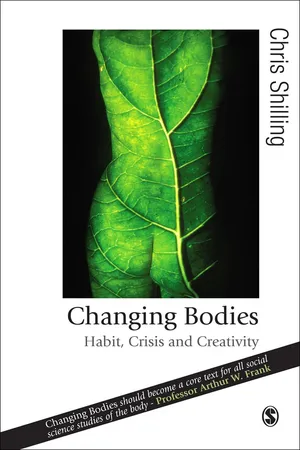
Where are we at with studies of Body & Society? What are the key accomplishments in the field? This book provides the clearest and most comprehensive account of work in this area to date.
Based on a novel theory of action it surveys the terrain by arguing that human identity, social relationships and moral figurations develop as a result of people living in and seeking to reach beyond the limits of their bodily being. From this starting point the author undertakes a series of studies on sport, transgenderism, migration, illness, survival and belief which illuminate the relationship between bodily change and action.
The book provides an unrivalled survey of theory and empirical research and explores the hitherto neglected tradition of American ?body studies?. Wide in scope, systematic and incisive the book represents a landmark addition to the field of studies in body and society.
- 216 pages
- English
- ePUB (mobile friendly)
- Available on iOS & Android
eBook - ePub
About this book
Information
Publisher
SAGE Publications LtdYear
2008Print ISBN
9781412908320
9781412908313
Edition
1eBook ISBN
9781473903784
1

Introduction
Body modification and transformation have exerted a growing fascination in contemporary consumer culture. This is partly because science and technology continue to weaken the boundaries separating flesh and machines and, in so doing, prompt us to revisit and revise our ideas about what it is to be a human being. It is also because the agents of bodily change – from cosmetic surgeons and tattooists, to personal trainers and style consultants – populate the high street and television schedules in ever greater numbers. People have long decorated and moulded their bodies in various ways, but the growth and variety of businesses designed to exploit the malleability of the flesh and its contents have turned bodywork into a hugely profitable industry.
The popularity of this cultural phenomenon raises a number of questions about the impact that bodily change has on people’s identities and capacities for action. It also raises wider issues concerning the morality of social orders in which so much money, time and energy are devoted to the aesthetics of embodiment. These are important matters, but it would, I think, be an error to restrict discussion of them to the most visible or novel ways in which bodily modification occurs. Our bodies change, develop and age from the womb through to our death and decomposition. The institutions that surround us, the relationships we enter into, and the habits we develop, all impact upon the appearances, capacities and meanings associated with our bodies. Bodily change sometimes occurs as a result of consciously formulated actions undertaken in situations of considerable autonomy, but it also happens frequently in circumstances over which individuals have little control. In these and in other situations, the ways in which bodily change occurs are related inextricably to people’s social actions as well as to the wider social structures in which they live.
It is this broad and general relationship between bodily change and social action that concerns this book. In what follows, I seek to develop an analytical framework, informed by pragmatism’s account of the external and internal environments of human action, that explores how people’s embodied appearances, identities and capacities are shaped by various combinations of habit, crisis and creativity. As a way of introducing this study, however, I want to start with a paradox. In coming to terms with the corporeal dimensions of social action, any adequate sociological approach to the subject has to go beyond bodily behaviour if it is to demonstrate the social consequentiality of our physical being. As Karen Fields (1995: lvi) implies, simply recognising bodily impulses and movements has the sociological significance of ‘so many potatoes in a sack’. This observation helps us understand why Weber (1968: 24–6, 65) defined meaningful social action as action oriented towards the behaviour of others, and distinguished action that was rational within a social context from mere affectual and habitual bodily reactions to events. It was the former rather than the latter that most identified us as humans, able to intervene creatively and intentionally in the flow of social life. Yet contemporary attempts to harness embodied action to society often travel so far from the biological organism – in their concern with such issues as discourse and image – that the materiality of their acting subjects disappears altogether (e.g. Butler, 1993). There is a balancing act to perform here. Sociology needs to account for the impact of society and culture on embodied actions, while also acknowledging that the embodied constitution of human action (an embodiment forged over the longue durée of human evolution that cannot simply be derived from current social orders) is itself consequential for these wider relationships, norms and values.
In seeking to meet this challenge, the rapidly growing and otherwise diverse collection of sociologically informed ‘body studies’ that emerged since the early 1980s has drawn in the main on two broad theoretical approaches. On the one hand, there are those who identify the governmental management of the body as setting key parameters to the overarching external environment in which social action occurs. Bryan Turner (1984), for example, draws on the distinctive concerns of Thomas Hobbes, Talcott Parsons and Michel Foucault with ‘the problem of order’ and ‘disciplinary regimes’ as a way of identifying the reproduction and regulation of populations through space and time, the restraint of desire, and the representation of bodies, as key action issues that face all societies. On the other hand, analysts have identified the body as central to the internal environment of social action. Arthur Frank (1991a: 43, 1991b), for example, views the opportunities and constraints of action as given by ‘the problems of bodies themselves’. Such action-oriented studies develop typically by being attentive to ‘the body’s own experience of its embodiment’ in various social contexts, and by drawing on interactionist, phenomenological and existentialist resources provided by such figures as Georg Simmel and Maurice Merleau-Ponty (Leder, 1990; Frank, 1991a: 48; Csordas, 1994).
Given the use of these traditional resources it should come as no surprise that while sociology’s focus on embodiment may be relatively new (at least in its present incarnation), contemporary approaches remain indisputably related to, and in certain respects recapitulate, those sociologies of order and of action that have long characterised the discipline (Dawe, 1970). Thus, the focus on bodies as providing the ‘core problems’ confronted by the external environment in which action occurs conceptualises human physicality as an object ordered by society. Bodies, irrespective of how they act, are essentially a structural problem. The interest in the body as central to the internal environment of social action, in contrast, highlights how human behaviour involves subjects who engage sensorially and emotionally (as well as cognitively) with their social world. The body is here viewed as integral to, and sometimes coterminous with, social action.
These approaches have done much to bring ‘body matters’ to the centre of academic debate about the nature and contexts of social action, but they face continuing challenges. Studies that begin their inquiries with the external environment confront the difficulty from this analytical ground of grasping embodied action as an active determinant of social systems, while those whose chosen starting point is the internal environment struggle to incorporate into their analyses a comprehensive sense of the wider social and cultural factors affecting embodied action and bodily changes. Theorists who have sought to draw a bridge between these approaches have fared little better. The writings of Pierre Bourdieu, for example, have proven highly influential, but his conception of habitus places the reproduction of the external environment at the very heart of his conception of action (Bourdieu, 1984). The problem with this is that embodied action appears predetermined – it both echoes and replicates existing structures – leaving those who operationalise Bourdieu’s work in their research employing strategies to modify its reproductive logic (see Shilling, 2005a).
Against this background, it is somewhat puzzling that the embodied focus on writers such as Hobbes, Parsons, Weber, Durkheim and a host of more recent theoretical figures including Foucault, Butler and Haraway, has not been accompanied by an equivalent interest in pragmatism. Pragmatism drew on various philosophical antecedents (Malachowski, 2004), but it was first formulated as an identifiable approach by Charles Sanders Peirce in the early 1870s, and named as a distinctive position by William James in an address to the Philosophical Union at the University of California, Berkeley, in 1898. It was developed further and deployed within substantive studies at the Chicago School of Sociology in the early decades of the twentieth century. John Dewey and George Herbert Mead were especially prominent in this respect. Only a few body theorists have taken this work seriously (e.g. Shusterman, 1992), however, despite more general theoretical studies highlighting the potential utility of pragmatism for analysing the social significance of corporeality (Joas, 1996). This is a serious oversight, I would suggest, as pragmatism’s recognition and explorations of the distinctive properties of, and the dynamic relationship that exists between, the external and internal environments of human action can help avoid the dangers of conflation. This tradition of inquiry can also usefully inform substantive studies of embodied subjects in their social and material contexts, as evident in the work of the Chicago School, thus helping to address what some critics have described as the relative lack of empirically informed work in the field of body studies.
In explicating how pragmatism explores the corporeal dimensions of social action, it is useful to first clarify how it differs from the dominant traditions in sociology. During the early years of the twentieth century, sociology was still coming to terms with how to translate the a priori assumptions central to its various philosophical foundations into methods and procedures that would facilitate empirical research. The French sociological tradition took as its starting point the primacy of the collectivity, for example, while the German tradition began with the self-directing individual (Levine, 1995). Yet both presented problems to sociologists interested in examining interactions between social actors and their environment without reducing one to the other. This was because the former tended to derive the capabilities of the subject from the properties of social structures, while the latter usually conceived the social environment in terms of the dispositions of (inter)acting individuals.
Pragmatism, in contrast, offered an alternative foundation for sociology. Instead of identifying either the collectivity or the individual as absolute starting points, it recognised that action was undertaken by individuals always already within a social and natural context, yet possessed of emergent capacities and needs that distinguished them from, and also enabled them to shape actively, their wider milieu. In this context, action, experience and identity arise from the ongoing interactions and transactions that occur between the internal environment of the embodied organism and its external social and physical environment.
It is this ability to maintain a view of the external and internal environments of action as distinctive, yet interacting, phenomena that is of particular utility for sociological studies of embodiment. Thus, pragmatism’s insistence on the human potential to ‘make a difference’ turns what sociologists have sometimes treated as exclusively socially determined organisms into phenomenologically aware, active body-subjects whose corporeal properties enable them to intervene creatively in the world. At the same time, pragmatism’s recognition that embodied actions are shaped in part by the distinctive properties of the social and natural world also avoids the dangers of viewing action as emanating from monadic subjects who are hermetically sealed from other people and from the material contexts in which they live (Burkitt, 1991). It is these characteristics that provide sociological studies into the corporeal dimensions of social action with a potential framework for investigation that differs in important respects from its classical antecedents.
I emphasise the word ‘potential’, because pragmatism provides us with no single theory ready to be applied in its totality to substantive studies of embodiment. Those most closely associated with pragmatism developed their work in distinctive directions, while the body-relevant studies conducted in the Chicago School were also characterised by much diversity. More radically, contemporary writers have harnessed the insights of pragmatism to theories which sometimes appear to have little in common with their antecedents (e.g. Rorty, 1982; Shusterman, 1992; see Halton, 1995). Rescher (1997) goes so far as to conclude that pragmatism has undergone a remarkable deformation from its original conception. Rather than condemning these developments, we might see them instead as tributes to the continuing creative potential of an approach possessed of greater flexibility than many other theories. In the spirit of this flexibility, my own concern is not to seek to identify or promote any single ‘authentic’ pragmatist theory, but to explore how some of the key insights developed by the likes of John Dewey, George Herbert Mead and William James can be drawn together within a broad and flexible framework that facilitates sociological investigations into the interactions that exist between the external and internal environments of embodied action. It is these investigations into the external social and physical milieu (that contextualise and shape action), on the one hand, and the internal needs and capacities (that inform action), on the other, that enable us to explicate and explore the relationship between social action and bodily change that lie at the heart of this book. My focus on action is intended to complement the current emphasis in body studies on utilising theory not as an end in itself, but as a means of expanding those empirically informed accounts that add to our knowledge of body-subjects in their social contexts.
Chapter 2, Embodying Social Action, begins this process in detail by focusing on how pragmatism can aid our understanding of the environments of social action, and of the common sociological concern with identity or character. Chapter 3, Embodying Social Research, explores how this paradigm of thought was developed and deployed in the empirically oriented writings of the Chicago School of Sociology. These chapters illustrate and explore the promise of pragmatism, but there is still much to be done if we are to maximise its capacity to assist sociological explorations into areas of human life in which embodiment is centrally visible. This issue is perhaps particularly pressing in cases where the external or internal environments seem to place overwhelming constraints on individual action and on people’s capacity for developing an integrated character or engaging in collective forms of moral action. It is also significant in relation to those cases in which the boundaries between these environments of action become particularly blurred or even, apparently, effaced.
This is the background against which Chapters 4–9 undertake a series of case studies which focus on embodied actions and bodily changes within radically different environments. The subjects covered in these substantive chapters provide illustrations of actions emanating from different contexts, and undertaken in situations characterised by wildly different constraints and opportunities. In terms of the contexts, three of them (Competing, Presenting and Moving) focus on actions associated with the contemporary, technological world. These deal respectively with the international significance of sport, transformations of the body involved in transgenderism, and the migrations undertaken by ‘dispossessed travellers’ in the global economy. The chapters on Ailing, Surviving and Believing, in contrast, analyse what might be described as more anthropological features of what it is to be an embodied human (albeit within specific milieu). These concentrate respectively on illness, the confrontation with death and belief. In terms of the constraints and opportunities dealt with by these chapters, Surviving, Ailing and Moving focus on situations in which people’s actions are heavily circumscribed, while Competing, Presenting and Believing switch attention to areas of life associated with the cultivation and expansion of at least a selection of human potentialities.
Chapter 4 focuses on a type of action which requires a surplus of energy over that required for mere survival, and is associated with the structured accumulation of skills in an area of life which receives considerable social recognition. Competing explores embodied action and change in sport. Sport has flourished in benign as well as in virulent social orders such as the Nazi state, tends to be associated in the public mind with health and fitness, and has been associated over the centuries with a broad range of social and political goals. In the contemporary era, sport also provides a particularly interesting example of how the competitive action that lies at its core mediates the relationship between individual character and national identity. Chapter 5, Presenting, explores the centrality of action to appearance by examining how transgendered individuals negotiate cultural norms surrounding the presentation of self. Sociologists have long suggested that presentational norms exert a major effect on a person’s identity, but the stories of those possessed of a profound sense that they are inhabiting the ‘wrong’ body shows how people can negotiate these norms in a manner which provides them with new opportunities for development. Chapter 6, Moving, focuses on those dispossessed travellers who constitute the underbelly of human migration. It explores how the actions and identities of refugees, asylum seekers, low-paid migrant workers and others excluded from global wealth, are forged through the travels in which they engage.
Chapter 7, Ailing, is concerned with illness and impairment in the context of an external environment that is shaped on the basis of the performative priorities embedded in a ‘health role’ (Frank, 1991a). Visions of healthy and aesthetically perfect bodies pervade consumer culture, but the ideal they project is a myth. Sooner or later virtually all of us get sick (defined biomedically as involving a diseased organism) and experience illness (defined sociologically as the subjective encounter with the symptoms and suffering associated with sickness). Entry into the ‘kingdom of sickness’, as Susan Sontag (1991) puts it, or into the world of physical or mental impairment, can have a devastating impact on our capacities for action and on our identities. Chapter 8, Surviving, explores social action oriented towards maintaining existence in the face of overwhelming odds. There can be fewer cases where social action is so constrained, or where life is so precarious, than in the ‘killing factories’ of the Nazi concentration camps or in the Soviet Gulag. Despite the vital differences between these systems – the Soviet camps were not established with the aim of facilitating genocide – millions died in them and the accounts of survivors provide us with a harrowing insight into embodied action at the extremes of life. Chapter 9, Believing, picks up on some of the religious undercurrents of Chapter 8 and addresses an important consequence of migration in the current era. Since the twentieth century, the West has been dominated by a technological culture predicated on the rational ‘enframing’ of society and nature (Heidegger, 1993 [1954]), yet this culture has confronted challenges to its hegemony. These have ranged in severity and scale from direct attacks on symbols of its authority (by terrorist groups who just...
Table of contents
- Cover Page
- Title Page
- Copyright Page
- Contents
- Acknowledgements
- 1 Introduction
- 2 Embodying Social Action
- 3 Embodying Social Research
- 4 Competing
- 5 Presenting
- 6 Moving
- 7 Ailing
- 8 Surviving
- 9 Believing
- 10 Conclusion
- Bibliography
- Name Index
- Subject Index
Trusted by 375,005 students
Access to over 1.5 million titles for a fair monthly price.
Study more efficiently using our study tools.
Frequently asked questions
Yes, you can cancel anytime from the Subscription tab in your account settings on the Perlego website. Your subscription will stay active until the end of your current billing period. Learn how to cancel your subscription
No, books cannot be downloaded as external files, such as PDFs, for use outside of Perlego. However, you can download books within the Perlego app for offline reading on mobile or tablet. Learn how to download books offline
Perlego offers two plans: Essential and Complete
- Essential is ideal for learners and professionals who enjoy exploring a wide range of subjects. Access the Essential Library with 800,000+ trusted titles and best-sellers across business, personal growth, and the humanities. Includes unlimited reading time and Standard Read Aloud voice.
- Complete: Perfect for advanced learners and researchers needing full, unrestricted access. Unlock 1.5M+ books across hundreds of subjects, including academic and specialized titles. The Complete Plan also includes advanced features like Premium Read Aloud and Research Assistant.
We are an online textbook subscription service, where you can get access to an entire online library for less than the price of a single book per month. With over 1.5 million books across 990+ topics, we’ve got you covered! Learn about our mission
Look out for the read-aloud symbol on your next book to see if you can listen to it. The read-aloud tool reads text aloud for you, highlighting the text as it is being read. You can pause it, speed it up and slow it down. Learn more about Read Aloud
Yes! You can use the Perlego app on both iOS and Android devices to read anytime, anywhere — even offline. Perfect for commutes or when you’re on the go.
Please note we cannot support devices running on iOS 13 and Android 7 or earlier. Learn more about using the app
Please note we cannot support devices running on iOS 13 and Android 7 or earlier. Learn more about using the app
Yes, you can access Changing Bodies by Chris Shilling,Author in PDF and/or ePUB format, as well as other popular books in Social Sciences & Sociology. We have over 1.5 million books available in our catalogue for you to explore.