This book ensures that students will feel confident to manage purpose, projects and people to deliver good- quality educational and developmental youth work with and for young people. It also caters for those with youth work management experience by providing an opportunity to review and further develop management skills and understanding in the context of a volatile policy environment.
- 160 pages
- English
- ePUB (mobile friendly)
- Available on iOS & Android
eBook - ePub
Managing Modern Youth Work
About this book
When people set out to qualify in youth work they do not anticipate that it?s about managing themselves; aims, intentions and outcomes; programmes and projects; case work; educational experiences and environments; budgets; volunteers and staff; and young people?s development.
Information
Chapter 1
Introduction
Mary Tyler
Rationale for the book
When people set out to qualify in youth work, they are keen to develop their understanding of young people and their skills to work with them. They do not generally anticipate that they will also need to learn about managing – managing themselves; aims, intentions and outcomes; activities and projects; learning experiences and environments; budgets; volunteers and staff. Perhaps most important of these responsibilities is managing themselves – if youth workers cannot do this, then young people will lose out. They also have to manage the educational opportunities and processes they create otherwise young people’s learning and enjoyment will be limited by this. They must manage the other people whose role is to contribute to these processes or else projects will flounder. This book takes a positive approach encouraging workers to feel and to be able to be in charge, rather than feel like victims at the mercy of the world. What can be more rewarding than knowing you are responsible for successful responsive youth work which is making a positive difference to young people’s lives?
Whilst developing skills as effective informal educators, the youth worker in training and the recently qualified professional are also building the necessary management skills and this book is designed to play a part in that. These skills are initially focused on the worker but steadily they become integrated into the wider range of responsibilities that the emerging professional undertakes. Those experienced workers who move into roles with more management responsibility can use this book to review these skills and add to them using the practical information, advice and discussion offered.
The book starts from the youth worker at the hub and their relationship with their immediate environment and what they can control and influence. Then, chapter by chapter, it progresses outward from the hub towards the edges of the circle in the direction of government policy and its implications. At each step outwards the worker is enabled to develop an understanding of this widening world; their position and power; who judges the work they are responsible for; what is involved in managing others to do that work; how they can extend their influence; and what they can achieve. Workers will also increasingly recognise their managerial position: facing towards youth work funding and the policies driving it while simultaneously facing in the other direction towards young people and others in the communities with whom they work.
This book aims to achieve this developmental journey by providing plenty of practical advice and illustration of the operational (day to day) and strategic (longer term) work managers of youth work have to be able to handle competently. It uses a number of questions and activities to help the reader’s reflection and learning process. Earlier chapters are directed more at those new to thinking about and taking management responsibility. The later chapters are designed more for experienced workers and managers. The earlier chapters include more theory than later chapters as they have a scene-setting role but this is not a textbook about management theory. It is a book about how to do it. There are suggestions for further reading at the end of each chapter. An outline of each chapter is provided at the end of this introduction.
This first chapter is designed to set the scene by considering the extent to which professional youth work involves management work. It identifies what management work comprises, looking at the range of responsibilities and tasks and their balance depending on the grade and level at which you are employed and in what kind of work context. It also provides an introduction to some management theory by looking at a model of management roles and a broad definition of management. Ideas about management that are taken for granted are challenged by contrasting briefly the positivist and interpretivist perspectives in order to engage you as a critically reflective practitioner and thinker about management. It briefly sets out the current context of youth work in England and argues that it is even more essential than before that youth work is well managed.
National Occupational Standards
At the beginning of each chapter in this book the relevant occupational standards for youth work will be identified to help you clarify potential learning outcomes. These were published early in 2008 and represent the latest agreed ‘range of functions undertaken across youth work, across the public and voluntary sectors’ (LLUK, 2008, Appendix 2). The main functions and principal areas of activity are listed in Figure 1.1 (see p3). The full set of standards is available from the Lifelong Learning website (www.lluk.org.uk). There is no assumption that any one youth worker will be doing all this. This book is clearly concerned mainly with the management activities (significantly functions 4 and 5), more of which will obviously be undertaken by those with specific management responsibilities although many of the activities are seen to be interrelated.
Management as a reality of modern youth work
Students’ knowledge and understanding of youth work as they enter professional training is often based almost entirely on face-to-face work. However, the reality is that the full-time professional worker may well spend no more than 50 per cent of their time face to face with young people depending on the nature of their role.
The key purpose of youth work is to……
‘Enable young people to develop holistically, working with them to facilitate their personal, social and educational development, to enable them to develop their voice, influence and place in society and to reach their full potential’
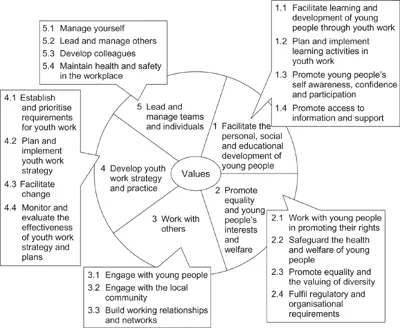
With the values at the centre, this diagram identifies five first-level functions (as set out within the main circle) undertaken in achieving the key purpose. The numerical order is for convenience only, and does not imply a particular hierarchy. The second-level functions indicated in the surrounding boxes are those undertaken in achieving the relevant first-level function.
Figure 1.1 National Occupational Standards for Youth Work
Source: LLUK, 2008
Youth workers have to gather data about and get to know the neighbourhoods they work in and the groups of young people who are their key focus. They may also need to research need; plan both alone and with colleagues; prepare funding bids; book minibuses and order stationery; attend meetings in and beyond their organisations; recruit, manage and supervise staff and volunteers; collate and input monitoring data; and write reports. This activity is not face-to-face youth work. Some of this is administration but most of it is management work. We will look at definitions of management later in this chapter under the section ‘The meaning of management’.
ACTIVITY 1.1
- What do youth workers do in their capacity as managers of youth work? Depending on your level of experience and responsibility, list the activities you do, or observe others do, which could be described as management.
- How do you feel about the nature of this work and taking responsibility for it?
The amount of management work youth workers undertake and its range depends on the grade at which they are employed. The national JNC employer–staff agreement used by a wide range of youth work employers states that an experienced ‘youth and community support worker’ in England and Wales will ‘deliver operational youth and community support work in local and area projects’ (JNC, 2007, Appendix 2). Anyone employed at the ‘professional range’ (qualified at higher education level or the equivalent) will ‘carry strategic and operational responsibility for service delivery, design and development’ (JNC, 2007, Appendix 2). The competence needed ‘involves the application of knowledge and skills in a broad range of complex, technical or professional work activities performed in a wide variety of contexts, with a substantial degree of personal responsibility and autonomy’ (JNC, 2007, Appendix 2).
ACTIVITY 1.2
Read this list taken from the Joint Negotiating Committee for Youth and Community Workers guidance on allocation to ranges (JNC, 2007, Appendix 1: 1–2). Which of these duties do you identify as management tasks?
Example of key duties for the youth and community support worker.
- Working directly with young people to develop their social education by providing programmes of activities, services and facilities.
- Establishing contact with and guiding young people as part of local programmes.
- Providing advice and support to local community groups and agencies.
- Assisting in the motivation, retention, developing and support of staff and volunteers.
- Contributing to service development by planning, delivering and monitoring of local provisions.
- Implementing equal opportunities policies.
- Establishing and maintaining relationships with young people and community groups.
- Maintaining quality of service provision including giving directions to other workers.
- First line management responsibility for workers and volunteers, including recruiting, developing and initial disciplining of staff.
- Initiating and monitoring developments of services, particularly with other agencies.
- Performing and ensuring the discharge of administrative duties (including budget control, records keeping and health and safety).
Example of key duties for professional range.
- Performing all the duties for youth and community support workers.
- Managing and developing a range of services.
- Managing and developing staff and facilities.
- Working with other agencies to develop services across the community.
- Design, lead and implement a youth work curriculum.
- Leading project development and implementation.
Management responsibilities and roles
Your management responsibilities will vary according to not only your grade but also the context. All youth workers are responsible for the quality of their own work and are accountable formally to their employing organisation and their manager and informally to young people. Many are responsible for one or more projects too so they have to manage, for instance, budgets, equipment, buildings and other staff and volunteers. This contrasts with the circumstances of some other professionals who work with young people who are clearly responsible just for managing their own workload.
The type of management responsibility you carry is also dependent on the level where you are sited in the organisation hierarchy. The higher up the organisation, the more strategic responsibility you have and the more time you spend in decision making but the more you are dependent on those you manage for information to understand what is happening at service delivery level. If you work in a local community delivering youth work for the local authority or a voluntary organisation, then local adults, young people and part-time staff and volunteers will tend to see you as the leader as well as the manager and may expect you to be able to make decisions that you do not have the authority to make. Although some of these stakeholders will understand that you are an employee of a larger organisation, others will need to learn this from you.
Typically as a youth work professional you have to provide leadership as well as ensure things are ticking over. A simple and commonly used distinction between leadership and management is that the first is about providing strategic direction, what the organisation is for, and the second is about coordination of a set of activities, what it does, to achieve that direction.
There are many ways of understanding the range of roles and tasks of the manager. Sandy Adirondack looks at managers in the voluntary sector. Her diagram of ‘What managers do’ (2006, p3) places the core work of the organisation, in this case youth work, at the hub of a wheel of management categories since managers in small agencies and...
Table of contents
- Cover
- Title
- Copyright
- Dedication
- Contents
- Foreword from the Series Editors
- 1 Introduction
- 2 Managing yourself and your work
- 3 Managing in organisations
- 4 Managing people
- 5 Managing resources
- 6 Managing projects and programmes
- 7 Managing a public service in a business culture
- 8 Managing in a complex and fast-changing policy environment
- 9 Conclusion
- Index
Trusted by 375,005 students
Access to over 1.5 million titles for a fair monthly price.
Study more efficiently using our study tools.
Frequently asked questions
Yes, you can cancel anytime from the Subscription tab in your account settings on the Perlego website. Your subscription will stay active until the end of your current billing period. Learn how to cancel your subscription
No, books cannot be downloaded as external files, such as PDFs, for use outside of Perlego. However, you can download books within the Perlego app for offline reading on mobile or tablet. Learn how to download books offline
Perlego offers two plans: Essential and Complete
- Essential is ideal for learners and professionals who enjoy exploring a wide range of subjects. Access the Essential Library with 800,000+ trusted titles and best-sellers across business, personal growth, and the humanities. Includes unlimited reading time and Standard Read Aloud voice.
- Complete: Perfect for advanced learners and researchers needing full, unrestricted access. Unlock 1.5M+ books across hundreds of subjects, including academic and specialized titles. The Complete Plan also includes advanced features like Premium Read Aloud and Research Assistant.
We are an online textbook subscription service, where you can get access to an entire online library for less than the price of a single book per month. With over 1.5 million books across 990+ topics, we’ve got you covered! Learn about our mission
Look out for the read-aloud symbol on your next book to see if you can listen to it. The read-aloud tool reads text aloud for you, highlighting the text as it is being read. You can pause it, speed it up and slow it down. Learn more about Read Aloud
Yes! You can use the Perlego app on both iOS and Android devices to read anytime, anywhere — even offline. Perfect for commutes or when you’re on the go.
Please note we cannot support devices running on iOS 13 and Android 7 or earlier. Learn more about using the app
Please note we cannot support devices running on iOS 13 and Android 7 or earlier. Learn more about using the app
Yes, you can access Managing Modern Youth Work by Liz Hoggarth,Bryan Merton,Mary Tyler in PDF and/or ePUB format, as well as other popular books in Social Sciences & Social Work. We have over 1.5 million books available in our catalogue for you to explore.