eBook - ePub
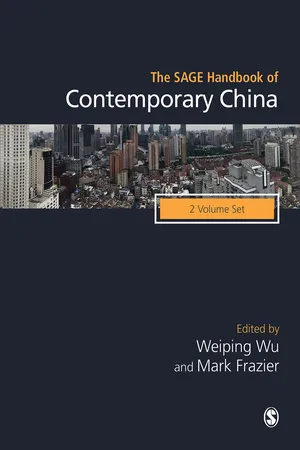
The SAGE Handbook of Contemporary China
- 1,356 pages
- English
- ePUB (mobile friendly)
- Available on iOS & Android
eBook - ePub
The SAGE Handbook of Contemporary China
About this book
The study of contemporary China constitutes a fascinating yet challenging area of scholarly inquiry. Recent decades have brought dramatic changes to China?s economy, society and governance. Analyzing such changes in the context of multiple disciplinary perspectives offers opportunites as well as challenges for scholars in the field known as contemporary China Studies. The SAGE Handbook of Contemporary China is a two-volume exploration of the transformations of contemporary China, firmly grounded in the both disciplinary and China-specific contexts. Drawing on a range of scholarly approaches found in the social sciences and history, an international team of contributors engage with the question of what a rapidly changing China means for the broader field of contemporary China studies, and identify areas of promising future research. Part 1: Context: History, Economy, and the Environment Part 2: Economic Transformations Part 3: Politics and Government Part 4: China on the Global Stage Part 5: China?s Foreign Policy Part 6: National and Nested Identities Part 7: Urbanization and Spatial Development Part 8: Poverty and Inequality Part 9: Social Change Part 10: Future Directions for Contemporary China Studies
Information
Table of contents
- Cover
- Half Title
- Associate Editors
- Title Page
- Copyright Page
- Contents
- List of Figures
- List of Tables
- Notes on the Editor and Contributors
- Introduction
- Part I Context: History, Economy and the Environment
- 1 The Making of the Modern State and Quest for Modernity
- 2 Nationalism and the Nation-state
- 3 Continuity and Change: The Economy in the Twentieth Century
- 4 Geographic and Environmental Setting
- Part II Economic Transformations: Introduction
- 5 Evolution of Market Reforms
- 6 State-Owned Enterprise: Reform, Performance and Prospects
- 7 The Rural Economy
- 8 Economic Growth and Labor Security
- 9 Inbound Foreign Direct Investment
- 10 Financial System
- 11 Technology, Innovation and Knowledge-Based Economy
- 12 Sustaining Growth: Energy and Natural Resources
- Part III Politics and Government: Introduction
- 13 The Communist Party and Ideology
- 14 Corruption in Reform Era: A Multidisciplinary Review
- 15 Campaigns in Politics: From Revolution to Problem Solving
- 16 Popular Protest
- 17 Bureaucracy and Policy Making
- 18 Local and Grassroots Governance
- 19 Labor Politics
- 20 Legal and Judicial System
- Part IV China on the Global Stage: Introduction
- 21 China as a Global Financial Power
- 22 China and Global Energy Governance
- 23 China and Global Regimes1
- 24 Engagement in Global Health Governance Regimes
- Part V China's Foreign Policy: Introduction
- 25 China–US Relations in a Changing Global Order
- 26 China–Japan Relations
- 27 Chinese–Russian Relations1
- 28 China's Relations with the Korean Peninsula
- 29 Chinese Foreign Policy: Southeast Asia
- Part VI National and Nested Identities: Introduction
- 30 Popular Nationalism
- 31 Taiwanese Identity
- 32 Hong Kong Identity
- 33 Chinese Outside China
- 34 Studying Tibetan Identity
- 35 Uyghur Identities
- 36 Ethnic Studies Beyond Tibet and Xinjiang
- 37 Religion
- 38 Sexual Minorities
- Part VII Urbanization and Spatial Development: Introduction
- 39 Urbanization and Urban System
- 40 Population Mobility and Migration
- 41 Financing Urbanization and Infrastructure
- 42 Land and Housing Markets
- 43 Socio-Spatial Transformation of Cities
- Part VIII Poverty and Inequality: Introduction
- 44 Poverty and Its Alleviation
- 45 Regional Inequality: Scales, Mechanisms and Beyond
- 46 The Making of the ‘Migrant Class'
- 47 Gender, Migration and HIV/STI Risks and Risk Behaviors
- 48 Income Inequality and Class Stratification
- Part IX Social Change: Introduction
- 49 Demographics and Aging
- 50 Social Welfare
- 51 China's Education System: Loved and Hated
- 52 Nightlife and Night-Time Economy in Urban China
- 53 Family Life
- 54 Health, Disease and Medical Care1
- 55 Media Since 1949: Changes and Continuities
- Part X Future Directions for Contemporary China Studies
- 56 The Future(s) of China Studies1
- 57 The Future of China's Past
- 58 China and the Challenges of Comparison
- Index
Trusted by 375,005 students
Access to over 1.5 million titles for a fair monthly price.
Study more efficiently using our study tools.
Frequently asked questions
Yes, you can cancel anytime from the Subscription tab in your account settings on the Perlego website. Your subscription will stay active until the end of your current billing period. Learn how to cancel your subscription
No, books cannot be downloaded as external files, such as PDFs, for use outside of Perlego. However, you can download books within the Perlego app for offline reading on mobile or tablet. Learn how to download books offline
We are an online textbook subscription service, where you can get access to an entire online library for less than the price of a single book per month. With over 1.5 million books across 990+ topics, we’ve got you covered! Learn about our mission
Look out for the read-aloud symbol on your next book to see if you can listen to it. The read-aloud tool reads text aloud for you, highlighting the text as it is being read. You can pause it, speed it up and slow it down. Learn more about Read Aloud
Yes! You can use the Perlego app on both iOS and Android devices to read anytime, anywhere — even offline. Perfect for commutes or when you’re on the go.
Please note we cannot support devices running on iOS 13 and Android 7 or earlier. Learn more about using the app
Please note we cannot support devices running on iOS 13 and Android 7 or earlier. Learn more about using the app
Yes, you can access The SAGE Handbook of Contemporary China by Weiping Wu, Mark Frazier, Weiping Wu,Mark Frazier,Author in PDF and/or ePUB format, as well as other popular books in Politics & International Relations & Politics. We have over 1.5 million books available in our catalogue for you to explore.