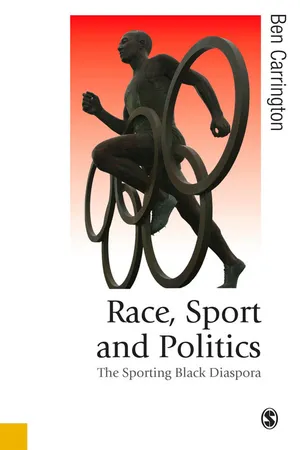
Written by one of the leading international authorities on the sociology of race and sport, this is the first book to address sport?s role in ?the making of race?, the place of sport within black diasporic struggles for freedom and equality, and the contested location of sport in relation to the politics of recognition within contemporary multicultural societies.
Race, Sport and Politics shows how, during the first decades of the twentieth century, the idea of ?the natural black athlete? was invented in order to make sense of and curtail the political impact and cultural achievements of black sportswomen and men. More recently, ?the black athlete? as sign has become a highly commodified object within contemporary hyper-commercialized sports-media culture thus limiting the transformative potential of critically conscious black athleticism to re-imagine what it means to be both black and human in the twenty-first century.
Race, Sport and Politics will be of interest to students and scholars in sociology of culture and sport, the sociology of race and diaspora studies, postcolonial theory, cultural theory and cultural studies.
- 216 pages
- English
- ePUB (mobile friendly)
- Available on iOS & Android
eBook - ePub
About this book
Information
Publisher
SAGE Publications LtdYear
2010Print ISBN
9781412901031
9781412901024
Edition
1eBook ISBN
9781446244623
1

Sporting Resistance: Thinking Race and Sport Diasporically
The idea of diaspora offers a ready alternative to the stern discipline of primordial kinship and rooted belonging. It rejects the popular image of natural nations spontaneously endowed with self-consciousness, tidily composed of uniform families: those interchangeable collections of ordered bodies that express and reproduce absolutely distinctive cultures as well as perfectly formed heterosexual pairings … It disrupts the fundamental power of territory to determine identity by breaking the simple sequence of explanatory links between place, location, and consciousness. It destroys the naïve invocation of common memory as the basis of particularity in a similar fashion by drawing attention to the contingent political dynamics of commemoration. (Paul Gilroy)
Sport is a key site of pleasure and domination, via a complex dialectic that does not always produce a clear synthesis from the clash of opposing camps. It involves both the imposition of authority from above, and the joy of autonomy from below. It exemplifies the exploitation of the labor process, even as it delivers autotelic pleasures. (Toby Miller)
I believe and hope to prove that cricket and football were the greatest cultural influences in nineteenth-century Britain, leaving far behind Tennyson’s poems, Beardsley’s drawings and concerts of the Philharmonic Society. These filled space in print but not in minds. (C.L.R. James)
Sporting Resistance: Gramsci and Sport
In order to produce a cultural theory of race and sport it is first necessary to map the theoretical terrain in order to judge what of the existing frameworks can usefully be retained, what needs to be revised and what should be jettisoned. Therefore this chapter delineates the core conceptual problems of this study and provides a general theoretical framework that seeks to show how the key concepts introduced in the previous chapter and developed throughout the book, namely the ‘white colonial frame’, ‘sporting racial projects’, ‘the sporting black Atlantic’ and ‘the black athlete’, are interrelated and help us towards a more complex way of thinking about race and sport both across time and space.
The chapter proceeds by assessing the ideas of key sport sociologists and historians, in particular the work of hegemony theorists of sport and the definitional framing of sport and modernity provided by the historian Allen Guttmann. Despite the importance and widespread influence of these ways of viewing sport, it is suggested that a fundamental rethinking is required in order to take into account the significance of race in relation to both theories of social development within the west and the emergence of modern sport. It is argued that a profoundly Eurocentric model of sport’s global ‘diffusion’ continues to haunt mainstream accounts of modern sport’s development, producing what I term the Myth of Modern Sport. Seeking to develop an alternative post/colonial theory of sport, the chapter concludes by arguing for a diasporic reading of race and sport that might help to make better sense of the symbolic significance, social impact and political importance of sporting black Atlantic stars and their potential roles as agents of resistance to the logic and practices of white supremacy.
Within the sociology of sport it has now become something of a canonical orthodoxy to date the development of the critical, broadly Gramscian, moment in sports studies to the early to mid-1980s (Carrington and McDonald 2009). In particular, John Hargreaves’s (1986) Sport, Power and Culture, a socio-historical account of sport, class formation and politics in Britain, and Richard Gruneau’s (1983/1999) Class, Sports and Social Development, a similar analysis of the social transformations affecting Canadian sport, are often cited as two of the most important monographs produced during this period.1 This ‘turn to hegemony theory’ enabled critical scholars to avoid both the latent conservatism of earlier accounts of sport that posited the inherently integrative functionality of sports and the economic determinism of Marxist approaches that tended to read sport solely through the prism of athletic bodily alienation, false class consciousness on the part of working-class fans, and sport’s general capitulation to the ideologies of capital. Chas Critcher (1986: 335) noted at the time that for such theorists, ‘the way out of the dichotomy between liberal idealism and vulgar Marxism lies in a model of sport as a relatively autonomous cultural practice within more general hegemonic class relations’.2 Sport, in short, was viewed within such accounts as a contested site wherein the play of power could be found, a cultural site of class domination ‘from above’ as well as the location for forms of symbolic and material resistance ‘from below’.
John Hargreaves (1986: 6–7) clarifies this central analytical point by arguing that ‘sport was significantly implicated in the process whereby the growing economic and political power of the bourgeoisie in nineteenth-century Britain was eventually transformed into that class’s hegemony in the later part of the century’. In other words, as Hargreaves’s book title plainly states, sport has to be located as a central, contested facet of culture, that is itself immersed within the broader circuits of (predominantly although not exclusively) classed power relations. For Hargreaves, in what has now become a somewhat classic formulation of hegemony theory:
Power resides more in the ability of the hegemonic group to win consent to, and support for, its leadership, and on its ability to pre-empt and disorganize opposition, so that the major forces in society are unified behind the hegemonic group and forceful, coercive measures against opposition to the pattern of hegemony acquire legitimacy as well. Hegemony is achieved through a continuous process of work: potential resistance is anticipated, organized opposition is overcome and disarmed by broadening and deepening the base of support. Thus alliances with subaltern and subordinate groups are brought off, concessions to and compromises with potential as well as actual opponents are made. (1986: 7)
If the analytical concerns for Hargreaves center around class, sport and British industrialism, then for Gruneau, working through a remarkably similar set of issues from the location of Canada, the interrelationship of sport and class needs to be situated in the context of the study of social development itself. ‘Put most simply,’ Gruneau (1983/1999: xxix) states, ‘I argue that any examination of the changing nature of human possibilities in social development must be drawn ineluctably to a very old sociological problem: the problem of class inequality and domination. It was this problem that defined many of the personal troubles and public issues of citizens in the earliest stages of liberal democracy’. Gruneau (p. 1) centers his study in the context of what he terms the two core problems of sociological theory, namely the problem of human agency and the problem of class inequality and structural change.
Tracing the dialectical relationship between freedom and autonomous play on the one hand and domination and cultural constraint on the other, Gruneau theorizes sport itself as a potentially liberatory space for self-actualization. Gruneau (p. 3) brings to the fore the ‘fundamental paradox’ of play, namely that it appears as both an independent and spontaneous as well as a dependent and regulated aspect of human agency. By extension, sport is viewed as a relatively autonomous institutionalized form that embodies play’s central paradox: it is a space of freedom, creativity and human expression that can only come into being in the context of formalized rules that govern and delimit its boundaries, ethically, spatially and temporally.
In trying to avoid an overly voluntarist and metaphysical notion of play, as found within the writings of John Huizinga, Gruneau posits a more materialist account of sport, understood as a collective social experience that is actively made and remade by the participants themselves. An account of sport, in other words, that is ‘sensitive to the dialectical relationships between socially structured possibilities and human agency’ (p. 27). This requires an understanding and analysis of the historical conditions within which these dialectical relationships have taken place in order to map, in precise detail, the nature and consequences of these moments of freedom and limitation. Thus, as with Hargreaves, Gruneau utilizes hegemony as a way to think through the play of power within sport: ‘the concept of hegemony allows for the idea of reflexive human agency in a manner not shared by functionalist models of inculcation or socialization’ (p. 60).
‘Additional Considerations’: The Limits to Orthodox Hegemony Theory
In these insightful propositions we see both the promise of and limits to what a critical sociology of sport might offer for a cultural theory of race and sport. Hargreaves, Gruneau and other orthodox hegemony theorists, open up a space to think through sports as a modality for freedom and human actualization. Sport is read as a contested terrain wherein competing ideologies of domination and resistance can be traced. Nothing is guaranteed in terms of political outcomes. Sport is neither understood as a freely chosen leisure pursuit somehow divorced from the material conditions of its existence nor is it reducible to those very same economic determinants that would otherwise, and in the last instance, collapse all forms of culture making back into the logic of capital accumulation. Coercion as well as consent is ever present and sports and their participants are viewed as agents in the production of the very social relations from which they derive. Following this line of argument, Gruneau suggests that sports are ‘active constitutive features of human experience’ (p. 17) that should be analyzed in the context of the struggles over the limits and possibilities of the rules and resources through which they are themselves defined. Thus, depending ‘on their association with divergent material interests, the meanings of sports, like all cultural creations, have the capacity to be either reproductive or oppositional, repressive or liberating’ (p. 17).
But there are problems with how even these erudite theorists define the nature of political struggle and which forms of human experience are seen as central and which, by default, get cast as marginal. At first glance, these approaches appear to open up the possibility to think through racial formation (as well as questions of gender and sexuality) in the context of broader cultural battles over access to and ownership of sports, the meanings produced therein, and the effects of these contestations on social development more generally. However, such accounts’ explanatory powers are rendered partial by their failure to engage in any substantive way with questions of race as well as their limited analysis of the structuring effects of European colonialism on class formation and on ‘the west’ itself.
Class, Sports and Social Development, for example, addresses the development of sport in the age of colonialism yet the theory of colonialism presented is significantly underdeveloped and there is a near total absence of any discussion of racism itself.3 Thus, invoking C. Wright Mills, Gruneau’s earlier remark concerning the ‘personal troubles and public issues of citizens in the earliest stages of liberal democracy’ (p. xxix) fails to acknowledge that for many blacks in North America and elsewhere the ‘early stages of liberal democracy’ were predicated upon their informal and formal exclusion from the very category of ‘the citizen’ and thus their reduced capacity to access and formally shape the public sphere. This begs the question, exactly which ‘citizens’ are being imagined here?
The 1857 Dred Scott v. John F.A. Sandford US Supreme Court decision vividly demonstrated that for black people the supposedly inalienable rights that derived from citizenship within liberal democratic societies were always conditional. Liberal concepts of citizenship were, from their very inception, explicitly racialized. In the American context, for example, Melissa Nobles (2000) has shown how the supposedly universal ideals of the Enlightenment and the claims of egalitarianism and liberty that were produced by the American Revolution were born in contradiction with the actual practices of a profoundly racialized American civic society. Nobles observes that racial identity mattered precisely because citizenship and access to the polity were dependent upon it:
To be free and white and to be free and black were distinct political experiences. Free whites were presumptively citizens. In the early years of the republic, in the absence of federal statutory definition, they became citizens by choosing to support the republican cause and, by the early nineteenth century, by birthright. As citizens, they enjoyed the full benefits of political membership (including the franchise). The citizenship status of free blacks remained unclear throughout the antebellum period. (2000: 28)4
These significant elisions flow from how Gruneau (narrowly) defines the founding concerns of sociological analysis. It is not so much that Gruneau fails to ‘add’ race to his analysis but more fundamentally that his theoretical framework is itself structured in such a way as to preclude any serious consideration of the multiplicity of ideological determinations and inequalities that constitute the social field in the first place. Put simply, Gruneau’s class-centric framing of the epistemic foundations of modern liberal democracies derives from his reliance on the ‘classic sociological tradition’ meaning there is little analytical room for theorizing domination, freedom and play (and hence sport) through anything other than a reified class lens. The weaknesses (as well as strengths) of the classical sociological tradition are then reproduced in toto by Gruneau himself.
The ‘foundational’ problems that Gruneau identifies concern human agency and the problem of class inequality and structural change. But the concept of ‘the human’ is left unproblematized. The opportunity to think through the (prior) category of the human, that is who was included and who excluded from this putatively universal nomenclature, is missed. Similarly it is not social inequality and the problem of structural change and social development that underpins the analysis but simply class inequality that is asserted to be the defining social division. Thus the analysis of the patterns of ‘inequality, domination, and subordination in capitalist societies’ (1983/1999: 48) starts and ends with social class ‘and the particular organization of rules and resources that define class systems’ (p. 48). From this premise Gruneau seeks to develop a general theory of industrial society and sport (p. 48) but, again, this ‘industrial society’ is one that is dislocated from the context of the colonial forms of exploitation and slave economics that made western industrialization possible in the first place (Blaut 1993; Williams 1944/1994).
There is, of course, much debate among economic historians and others as to the precise role of colonialism, the slave trade and the exploitation of slave labor itself in providing the economic stimulus and wealth necessary for the early formation of European and particularly British capitalism, and the extent to which capitalism then relied upon and thus sustained ‘New World’ slavery. While the dry calculation as to the actual level of profit extracted from the ‘costs of investment’ remain open to debate, it is undoubtedly the case, as Robin Blackburn (1997) has shown, that the super-exploitation of slaves enabled the development of capitalist industrialization to proceed on a level and scale that would not otherwise have been possible. This is not to argue that trans-Atlantic slavery necessarily ‘produced’ capitalism, in any simple economic or even political sense, but rather:
that exchanges with the slave plantations helped British capitalism to make a breakthrough to industrialism and global hegemony ahead of its rivals. It also shows that industrial capitalism boosted slavery. The advances of capitalism and industrialism nourished, in fateful combination, the demand for exotic produce and the capacity to meet this large-scale demand through the deployment of slave labor. The slave systems of the late-eighteenth- and early nineteenth-century New World had far outstripped those of the earlier mercantilist epoch. (Blackburn 1997: 572)5
Thus having disavowed race and gender as constitutive of inequality in the west, Gruneau’s analysis proceeds with such issues safely relegated to epiphenomenal features, allowing the inter-play between capital, slavery and colonialism to disappear as core conceptual problematics.6 That is not to say that questions of race and gender are completely disregarded. Gruneau is too sophisticated a thinker to simply ignore them and he is clearly aware of the analytical problems that race and gender present for his class-centric framework. But these concerns end up shunted to the conceptual sidelines via the obligatory, unsatisfactory, use of the apologetic endnote. At the start of his second chapter, which is titled ‘Problems of Class Inequality and Structural Change in Play, Games, and Sports’, Gruneau adds the following endnote:
I recognize, of course, that there are a great range of social relations beyond class relations which might influence people’s collective powers to ‘structure’ play, games and sports and ‘finish off’ the range of meanings commonly associated with them. Gender, ethnicity, and religion, for example, all might be identified as influencing resources that can be brought to bear on the structuring of sport … Yet, I think it important that this issue be understood in the context of the ensemble of social relations that define different ways of living in modern societies. In this study I have emphasized the role of class as a central consideration in understanding this totality. It is clear, however, that far more needs to be taken into account and I hope to do this in future work on the intersections of class and patriarchy. (1983/1999: 137, emphasis in original)
Non-class subjectivities are duly acknowledged as important and as ‘influencing resources’ on sport though it is unclear whether these social relations play an a priori constitutive role in the making of sport itself. Gender (although not race, which is presumably what the inclusion of ‘ethnicity’ above refers to) is deemed to be of some importance, but is left out of the current analysis to be included at some later stage. Chas Critcher (1986) argues that such omissions bring into question the degree to which the interventions of Hargreaves and Gruneau in pa...
Table of contents
- Cover Page
- Title Page
- Copyright Page
- Contents
- Acknowledgments
- List of Figures
- Introduction: Sport, the Black Athlete and the Remaking of Race
- 1 Sporting Resistance: Thinking Race and Sport Diasporically
- 2 Sporting Redemption: Violence, Desire and the Politics of Freedom
- 3 Sporting Negritude: Commodity Blackness and the Liberation of Failure
- 4 Sporting Multiculturalism: Nationalism, Belonging and Identity
- Conclusion: Race, Sport and the Post/colonial
- References
- Index
Trusted by 375,005 students
Access to over 1.5 million titles for a fair monthly price.
Study more efficiently using our study tools.
Frequently asked questions
Yes, you can cancel anytime from the Subscription tab in your account settings on the Perlego website. Your subscription will stay active until the end of your current billing period. Learn how to cancel your subscription
No, books cannot be downloaded as external files, such as PDFs, for use outside of Perlego. However, you can download books within the Perlego app for offline reading on mobile or tablet. Learn how to download books offline
Perlego offers two plans: Essential and Complete
- Essential is ideal for learners and professionals who enjoy exploring a wide range of subjects. Access the Essential Library with 800,000+ trusted titles and best-sellers across business, personal growth, and the humanities. Includes unlimited reading time and Standard Read Aloud voice.
- Complete: Perfect for advanced learners and researchers needing full, unrestricted access. Unlock 1.5M+ books across hundreds of subjects, including academic and specialized titles. The Complete Plan also includes advanced features like Premium Read Aloud and Research Assistant.
We are an online textbook subscription service, where you can get access to an entire online library for less than the price of a single book per month. With over 1.5 million books across 990+ topics, we’ve got you covered! Learn about our mission
Look out for the read-aloud symbol on your next book to see if you can listen to it. The read-aloud tool reads text aloud for you, highlighting the text as it is being read. You can pause it, speed it up and slow it down. Learn more about Read Aloud
Yes! You can use the Perlego app on both iOS and Android devices to read anytime, anywhere — even offline. Perfect for commutes or when you’re on the go.
Please note we cannot support devices running on iOS 13 and Android 7 or earlier. Learn more about using the app
Please note we cannot support devices running on iOS 13 and Android 7 or earlier. Learn more about using the app
Yes, you can access Race, Sport and Politics by Ben Carrington in PDF and/or ePUB format, as well as other popular books in Social Sciences & Sociology. We have over 1.5 million books available in our catalogue for you to explore.