- 208 pages
- English
- ePUB (mobile friendly)
- Available on iOS & Android
eBook - ePub
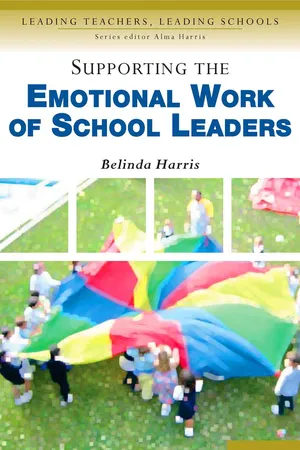
Supporting the Emotional Work of School Leaders
About this book
This practical book deals with the emotional and moral dimensions of school leadership. The author sets out the intra-personal and interpersonal attributes, attitudes and behaviours necessary to develop emotional and moral leadership within the school community. The book provides a range of person-centred strategies for building communities of professionally committed, relationally competent, collaborative individuals.
Trusted by 375,005 students
Access to over 1.5 million titles for a fair monthly price.
Study more efficiently using our study tools.
Information
1 Introduction
In recent decades the experience of students, teachers and leaders in schools has been directly affected by a range of external factors, which have fundamentally changed the character and nature of schooling. This book is premised on the understanding that whilst politicians claim success for education reforms by quoting improvements in numeracy and literacy targets they refuse to acknowledge or engage with the deeper-seated negative effects of relentless change on the psychological health of schools and communities. Neither do they confront the relationship between many of their educational policies and the crisis in confidence felt by leaders, teachers and pupils in many schools.
Many ‘failing’ schools for example, are trapped in a performance cul-de-sac with few means at their disposal for turning themselves around within the required one year period to prevent school closure (Harris et al., 2006). There has been relatively little consideration or systematic investigation into the emotional distress of pupils, parents and communities as a result of school failure and school closure,1 but it is reasonable to speculate that in many communities this has contributed to a collective sense of hopelessness with associated feelings of being ‘missed’, let down and marginalised. It is my contention that the instrumental and accountability driven approach to system-wide reform has created more disturbing and challenging problems for society and schools to grapple with. This is a position finding widespread support in other countries (Elmore, 2003; Williams, 2001).
There is a real crisis in education best exemplified perhaps by the prevalence and seriousness of violence against teachers (NAS/UWT, 2004), by the numbers of teachers that have retired early with stress-related ill-health and the large number of newly qualified teachers that fail to take up appointments in schools or leave the profession within five years of completing their training (Carlyle and Woods, 2002). It is acknowledged that global capitalism, the rise of the technological society, the pace of change, the demise of traditional community support systems and the widening gulf between rich and poor have contributed to high levels of psychological damage in society. It is sad and possibly inevitable that the social and emotional effects of these changes are reflected back to us through the attitudes and behaviours of children and young people in our schools.
So, what does this book have to offer teachers and leaders committed to enhancing the educational experience of all members of their school community? In this book I draw on extensive personal and professional experience of working in schools, on empirical evidence and on the literature on teacher effectiveness, human relations, counselling, school improvement and educational leadership to propose a more dynamic, inclusive and relational stance towards school change. Unlike the task and performance models of school improvement that have dominated the educational landscape, the approach presented in this book places people, relationships and learning back in the driving seat of change.
Given this premise, there is no intention or pretence to offer a ‘quick fix’ to the current set of circumstances or to provide a set of techniques aimed at short term solutions. Instead, I am concerned to engage readers with the deeper personal, social and emotional challenges of change leadership, to highlight the intra-personal, interpersonal and inter-group dynamics that underpin and permeate school life. These dynamics may reflect healing, energising forces for good or the contaminating, emotionally draining forces of criticism, negativity and apathy. These aspects of organisational life are often noticed and felt at an intuitive level. They are less often acknowledged, understood and engaged with in ways that accept and affirm the underlying distress in schools and see it as symptomatic of something bigger which needs respectful, caring and firm attention.
It is my belief that despite working harder and longer hours to support children and to implement change, many teachers are pedalling against a policy current that appears so strong that teaching has become literally heartbreaking and soul destroying work. The research and experience underpinning this book have led me to the view that schools have all the ingredients to create enriching, loving communities of practice yet vital nutrients are not being harnessed to revitalise, enthuse and energise jaded professionals. The unique perspectives, passions and intelligences of young people, parents, teachers and support staff have leadership capabilities which, if honoured, embraced and nurtured, can lead to active engagement and participation in leadership practices and foster deep, sustainable, relation-rich learning and personal growth.
As a gestalt psychotherapist I bring a certain theoretical lens and set of values to the analysis of data. Three of these are worthy of mention at this point in my deliberations. I aim to provide the reader with some insights into the differently textured threads that are woven into the fabric of this work. Firstly, Kurt Lewin’s (1951) ‘field theory’ is a point of view that I find useful as a way of perceiving events holistically. It is one map of the territory of human experience in relationship, wherever (for example, classrooms, playground, staffroom) and however (for example, pairs, groups, departments) those relationships are constituted. A field theory map of human experience extends the concept of holism, that is, viewing the person as a ‘whole’ intellectual, emotional, physical and spiritual being, to include the person in their environment, culture and community. This ‘whole’ way of seeing and thinking acknowledges and embraces the intimate inter-connectedness between the individual, the events that shape their lives and the settings in which these events take place.
In field theory the act of knowing is also a relationship between the perceiver and perceived as events are always perceived in relationship. Each individual is therefore an agent in the field as well as a recipient of others’ engagements in the field and will construct their version of events in ways that suit how they position themselves and are also positioned within the field. There is, for example, an interactive field between myself the author and you the reader right now. As I sit here I wonder what energies, ideas and feelings you are bringing to my work as you read.
Secondly, this book is underpinned by a belief in the equivalence and equi-potentiality of reason and emotion in helping people to make sense of their lives and of their personal, social and professional identities (Parks, 2000). Schools are powerhouses of emotion as individuals engage with each other, with learning, with their values, and with the everyday pleasures, excitements and joy that occur when relationships and learning combine in creative exploration and discovery. They are also minefields of disappointment, envy, ‘fear, anguish, depression, humiliation, grief and guilt’, and not just for the teachers involved. In Jeffrey and Woods’ (1996) study of teacher stress it is clear that children and young people also bear the brunt of teachers’ negative emotions in the ‘field’ that is the classroom.
Most recently, worrying trends of violence have taken root in some schools as young people reflect back and act out the depersonalisation and rage they experience in their daily lives. Instrumental educational change has created a culture of mistrust, hostility and conflict (Halton, 1995) which studies of teacher emotions have largely avoided exploring in any detail.
Exercise
Which of the aforementioned emotional constructs most closely resemble your own experience of school and are there any that you particularly notice by virtue of their absence?
Finally, this work is premised on a humanistic view of human nature (Goldstein, 1939; Allport, 1955; Maslow, 1970, 1971), namely that the majority of people have an innate natural tendency to engage with their environment in personally and socially constructive ways. In other words, everyone has agency and therefore the potential for different levels and forms of leadership, whether in relation to learning, administration, individual and collective well being or community relations. However, in the course of human development through childhood and into adulthood everyone experiences challenges to their core sense of self, self worth and self efficacy. Indeed it is the formative process of working through such experiences that supports maturation and enhances the capacity for effective relating with others, particularly those in authority. Unfortunately, many young people experience such intense and sustained challenges to and violations of their core sense of self that they are unable to engage with the process of maturation. Their interactions with significant others, usually people in authority, have involved the intentional or unintentional misuse or abuse of personal power.
In this way the political, economic and social conditions in wider society are heartlessly and aggressively acted out in both private and public spaces. Persistent experiences of being undermined, dismissed, shamed or traumatised by rage, for example, have a deleterious effect on the individual’s view of themselves and act as inhibitors of personal growth, learning and agency. Furthermore, the earlier such abuse is experienced the sooner a habit of violence and aggression is internalised that is highly resistant to change (Rutter et al., 1998). In other words, being treated as an object, an ‘It’ rather than as a person, rubs off, especially when the social, political and cultural field reinforces this view of certain people as objects and when the majority view of ‘normality’ and ‘acceptability’ is used to oppress or disenfranchise certain minority groups.
A huge market in self help books perpetuates the myth that socially inflicted psychological wounds can be cured by individual’s cognitive understanding and introspection. Deep, sustained healing, however, needs at least one sensitive, responsive and reparative relationship, which is experienced in a safe, consistent and emotionally containing environment. In such conditions the individual’s pain and distress is heard, accepted and actively ‘met’ or responded to by gently challenging the internalised feelings of negative worth and value. Such relationships can be nurtured in school settings to support individuals and groups (Pattison and Harris, 2006; Harris, Vincent et al., 2006; Hudson, 2006). However, the relational stance that is promoted here transcends that of the traditional counsellor, pastoral teacher or leader. Whilst self awareness is accepted as the sine qua non of good citizenship and leadership, awareness and emotional competences are not considered to be sufficient. In fact, the competency model of emotional intelligence advocated by Goleman (1995) and others, may unwittingly collude with and reinforce an ‘I–It’ approach to relationships, whereby the right skill or phrase can be prized from the emotional toolkit to ensure that individuals collaborate in the implementation of personal rather than social agendas.
More creative relationships are needed, founded on deep inner awareness, knowledge and understanding of self in all constructive and destructive configurations. In this way, the self that engages with pupils, colleagues, parents, governors and the wider educational community is fully present (emotionally, intellectually, spiritually and morally), fully inclusive (in touch with the needs, wishes and preferences of self and simultaneously able to reach out and ‘touch’ the needs, wishes and preferences of the other) and willing to make a commitment to the co-creation of the field (to the spontaneity and creativity of the moment and the endless possibilities of what unfolds in the contact between both parties). Such relationships acknowledge our vulnerabilities and cultivate and refine our strengths together with the leadership capacity that lies untapped or is expressed through less socially constructive patterns of behaviour. Such relationships treat the other as a cherished ‘Thou’ rather than an ‘It’.
To summarise, I argue that the current social, political and economic climate has depersonalised communities and cut people off from internal and external sources of care and support, making them an ‘It’. It is the inability of governments to engage teachers’ hearts and minds and to involve them as partners in policy making that is one of the key failures of school reforms and one which has had serious consequences for the power dynamics of relationships experienced in classrooms, staffrooms and playgrounds. The current preoccupation with and pressure to achieve targets leads to relationships characterised more by the exercise of power and control than by the co-creation of engaging learning opportunities and environments. The emotional work of leadership therefore involves facilitating and supporting each person’s active engagement in meaningful dialogue, deep learning and collaborative agency. The unfolding ‘co-created field’ of the classroom, school, educational community or wider social environment is more likely to be experienced as a vibrant, life-enhancing space in which people may thrive and develop their own capacity for leadership. To be effective in this work the leader has a duty of care to attend to their emotional needs and recognise how these might otherwise undermine their most concerted efforts to support, care for and mobilise others. Once more I am wondering how you, the reader, are responding to this assertion on my part and how this interacts with your values and experience.
The empirical base
This work has been informed by my participation in a number of research and development projects. The data from these projects informs large sections of this book. My experience as a secondary teacher, curriculum and pastoral leader, community liaison teacher and school counsellor in deprived, yet vibrant inner city communities, has also contributed to my understanding of the emotional work of leadership and has informed my choice of postgraduate studies in human relations, counselling and psychotherapy.
In recent years hundreds of teachers on experiential taught masters programmes in Human Relations, Counselling, Special Needs and Educational Leadership have developed my understanding and afforded me opportunities to visit schools and work with groups of teachers on specific projects. There is a significant body of research evidence for the effectiveness of experiential learning in human relations for teachers’ personal and professional lives (for example, Hall et al., 1988; Hall et al., 1996) and also of the transferability of this learning to school life in England and beyond (for example, Harris and Biddulph, 2000; Harris, 2001). This personal and professional knowledge has informed a series of vignettes which frame specific chapters. The characters and schools represented therein reflect composite depictions of real people, places and events and highlight key issues or them...
Table of contents
- Cover Page
- Title Page
- Copyright Page
- Contents
- Acknowledgements
- Foreword
- 1 Introduction
- 2 Leading in an emotionally challenging context
- 3 The emotional work of school leadership
- 4 Developing emotional awareness
- 5 Understanding personal process
- 6 Wounding self and others
- 7 Values: a process approach
- 8 Caring for self and others
- 9 In trauma and in health
- Postscript
- References
- Index
Frequently asked questions
Yes, you can cancel anytime from the Subscription tab in your account settings on the Perlego website. Your subscription will stay active until the end of your current billing period. Learn how to cancel your subscription
No, books cannot be downloaded as external files, such as PDFs, for use outside of Perlego. However, you can download books within the Perlego app for offline reading on mobile or tablet. Learn how to download books offline
Perlego offers two plans: Essential and Complete
- Essential is ideal for learners and professionals who enjoy exploring a wide range of subjects. Access the Essential Library with 800,000+ trusted titles and best-sellers across business, personal growth, and the humanities. Includes unlimited reading time and Standard Read Aloud voice.
- Complete: Perfect for advanced learners and researchers needing full, unrestricted access. Unlock 1.5M+ books across hundreds of subjects, including academic and specialized titles. The Complete Plan also includes advanced features like Premium Read Aloud and Research Assistant.
We are an online textbook subscription service, where you can get access to an entire online library for less than the price of a single book per month. With over 1.5 million books across 990+ topics, we’ve got you covered! Learn about our mission
Look out for the read-aloud symbol on your next book to see if you can listen to it. The read-aloud tool reads text aloud for you, highlighting the text as it is being read. You can pause it, speed it up and slow it down. Learn more about Read Aloud
Yes! You can use the Perlego app on both iOS and Android devices to read anytime, anywhere — even offline. Perfect for commutes or when you’re on the go.
Please note we cannot support devices running on iOS 13 and Android 7 or earlier. Learn more about using the app
Please note we cannot support devices running on iOS 13 and Android 7 or earlier. Learn more about using the app
Yes, you can access Supporting the Emotional Work of School Leaders by Belinda M Harris in PDF and/or ePUB format, as well as other popular books in Education & Education General. We have over 1.5 million books available in our catalogue for you to explore.