![]()
———— Part One ————
Context and Themes
![]()
———— 1 ————
Law, Social Work and Children
- Introduction: legal values and social work values in child care practice
Common values of law and social work Values for child care social work practice
Where the tensions arise: interpretation of values and principles, and functional differences
- The functions of law and the functions of social work
A definition of social work
A definition of law?
Duty and discretion: the role of the law and the role of the child and family social worker
Exercise of discretion: legal principles and requirements
The welfare principle
Standard-setting
Human rights
Law’s functions and social work’s values
- Law and the principles of human rights
Where does human rights law come from?
The ECHR
The UNCRC
Impact on social work
- Law and the principles of social justice
What is social justice?
Social justice and human rights
Using human rights law to promote social justice
- Law, professional integrity and accountability
How does law support these values?
The rule of law
The meaning of ‘accountability’
Openness and impartiality
- Lawyers and social workers
Inter-disciplinary working: from good practice to good law?
Child and family social workers: law enforcers or human rights campaigners?
- Law, social work and the child
Theorising children and childhood
The child and family social worker’s dilemma
- Conclusion
Introduction: legal values and social work values in child care practice
The purposes of this chapter are to describe the respective functions of law and social work with children, to identify common values underlying the two disciplines and to introduce some concepts and themes that run throughout the book. Some of these concepts and themes are illustrated by examples drawn from case-law and legislation that will be explained in more detail in later chapters.
Law both enables and constrains the practice of social work with children and families. Law provides:
- authority: law confers on social workers authority to take action which would otherwise, in many situations, constitute an unlawful interference in private and family life; and
- principles: law imports principles, rooted in legal values, which are applied in interpreting rules and in assessing the legality of social work decisions.
Common values of law and social work
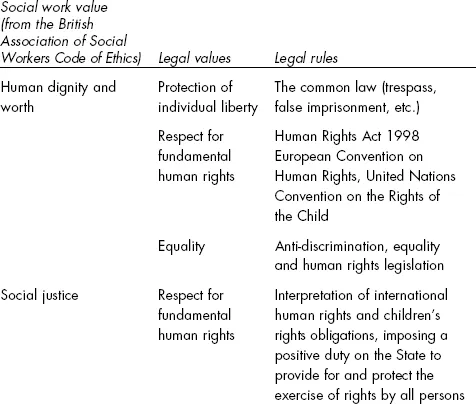
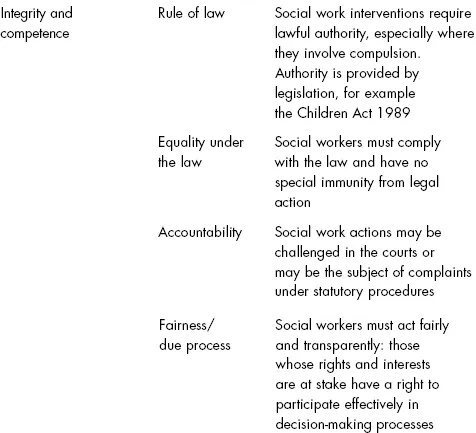
There is substantial commonality between the underlying values of the disciplines of law and social work. In particular, law provides a set of rules of obvious relevance to the social work value of human dignity and worth, by providing a code of internationally recognised human rights. Less obviously, the same set of rules may help promote the rather more uncertain value of social justice. Legal values such as the rule of law, equality under the law, accountability and fairness/due process can also be seen as supportive of the social work values of integrity and competence. Box 1.1 illustrates this.
Values for child care social work practice
The National Occupational Standards for Child Care at Post Qualifying Level (NOSCCPQ) contain a statement of ‘child care values for social work practice’ which makes explicit links with some of the legal values and legal rules shown in Box 1.1. The child care values are stated to be ‘drawn from the UN Convention on the Rights of the Child and human rights legislation’ (Sector Skills Council, 2005: 8). Box 1.2 notes the relevant UNCRC articles in relation to the list of values in the NOSCCPQ.
As the NOSCCPQ state, ‘values are integral to rather than separate from good practice’ (Sector Skills Council, 2005: 8). This link between social work standards and legal values and rules makes effective and proactive promotion of the rights of children and families, understood in terms of the UNCRC and ECHR, a measure of professional competence as well as a legal obligation. At the level of values and principles, this suggests a close affinity between the two disciplines.
Box 1.2 VALUES FOR CHILD CARE SOCIAL WORK PRACTICE: NATIONAL OCCUPATIONAL STANDARDS FOR CHILD CARE AT POST QUALIFYING LEVEL
- children’s and young people’s best interests shall be of primary consideration in all actions affecting them (Article 3 UNCRC);
- children and young people are enabled to develop and achieve their full potential (Articles 6, 24–29 UNCRC);
- children and young people have the right to express their views and have them taken into account in all matters affecting them (Article 12 UNCRC);
- children and young people should remain, wherever possible, within their family and community networks (Articles 9, 18 UNCRC);
- children and young people are to be protected from and empowered to address all forms of discrimination (Article 2 UNCRC);
- children and young people are to be protected from and empowered to address all forms of abuse (Article 19 UNCRC);
- children and young people have the right to be given proper care by those looking after them (Articles 18, 20 UNCRC);
- children and young people with disabilities must be helped to be as independent as possible and to be able to play a full and active part in everyday life (Article 23 UNCRC);
- children and young people should have their identity affirmed through the promotion of their religious, cultural, racial and linguistic background (Articles 8, 20, 30 UNCRC);
- children and young people in Wales have the right to receive services in the Welsh language (Article 30 UNCRC);
- children and young people have the right to services which are free from prejudice (Article 2 UNCRC).
Where the tensions arise: interpretation of values and principles, and functional differences
In practice, despite this commonality of underlying values, there can be tension between lawyers and social workers. This flows in part from functional, structural and organisational differences. It also flows from traditional and counter-traditional views of children and childhood, which play differently into different areas of law and practice: for example, when dealing with child protection or youth justice. Lawyers and social workers alike are influenced by their own personal experiences and perspectives as well as the professional culture in which they work. Mutual, enhanced understanding of the roles, functions, views and traditions of practitioners in the different disciplines is important if inter-disciplinary working, which is a statutory requirement under the Children Act 1989 and Children Act 2004 as well as a professional objective, is to deliver the hoped-for benefits.
The functions of law and the functions of social work
A definition of social work
Despite the common ground between social work values and legal values, the two disciplines clearly have different functions and the focus of professional practice in each is, necessarily, different. The definition of social work agreed by the International Federation of Social Workers and adopted by the British Association of Social Workers (BASW) says that it is:
a profession which promotes social change, problem solving in human relationships and the empowerment and liberation of people to enhance well-being. Utilising theories of human behaviour and social systems, social work intervenes at the points where people interact with their environments. Principles of human rights and social justice are fundamental to social work. (BASW, 2003)
It is clear from this that social work is concerned with outcomes: with effecting change in people’s lives, improving their well-being, enabling them to ‘interact with their environments’ more successfully. This may mean being able to improve their family relationships, the material condition of their lives, their physical and emotional health and so on.
A definition of law?
There is no generally accepted definition of ‘law’. The question ‘What is law?’ has been addressed by many legal philosophers, sometimes by avoiding the question or transforming it into a description of legal rules and activities that can be contrasted with other forms of obligations and activities. However, law is often seen as being concerned pre-eminently with authority and process rather than outcomes. In the field of public law, where the interaction between law and social work with children and families is for the most part situated, law confers authority for social work action (by means of statutory powers and duties) and provides supervision over the process of its exercise (by means of mechanisms such as statutory complaints procedures, statutory appeals or judicial review). The law is generally constructed and applied in a way which confers discretion on those empowered to act (social workers or, formally, local authorities carrying out social services functions), reserving to the legal system the role of ensuring, in the event of challenge, that this discretion is properly interpreted and applied.
Duty and discretion: the role of the law and the role of the child and family social worker
The general principle is that the courts should not trespass into the area of discretion which Parliament has conferred on local authority social work teams. This is in part because of the constitutional concept of the separation of powers which holds that the legislative, executive and judicial functions of the State must each be confined to their proper role. Thus, once Parliament (the ‘legislative’ function) has created a system whereby discretion is conferred on local authorities (the ‘executive’ function), the courts (the ‘judicial’ function) should not interfere in a way that undermines the legislative intention or substitutes the court’s own judgment for that of the local authority. The quotation from Lord Nicholls in Re S, Re W [2002] in Box 1.3 neatly demonstrates this principle. The case concerned the court’s role in keeping under review the implementation of care plans. The judgment contributed to legislative changes, dealt with in Chapter 8. Here, the case is used simply to demonstrate the careful demarcation of functions between the courts and local authorities, in this case under the Children Act 1989.
Exercise of discretion: legal principles and requirements
This neat division between authority, process and outcomes is, however, over-simplistic as a description of the way in which law impacts on social work. In the same speech in Re S, Re W, Lord Nicholls went on to point out that the Children Act 1989 confers certain key outcome-oriented decisions on the court rather than on the local authority, notably the decision whether a care order should be made. Furthermore, law enshrines principles and sets standards which must be adhered to in the course of social work interventions in the lives of children and their families. Such principles and standards help to resolve the tensions inherent in social work practice with children, in the sense that the application of the relevant principle or adherence to the relevant standard will provide direction and enable a decision to be made.
Box 1.3 RE S, RE W [2002], EXTRACT FROM THE JUDGMENT OF LORD NICHOLLS
... the 1989 Act gave effect to a policy decision on the appropriate division of responsibilities between the courts and local authorities ... The particular strength of the court lies in the resolution of disputes: its ability to hear all sides of a case, to decide issues of fact and law, and to make a firm decision on a par...