- 152 pages
- English
- ePUB (mobile friendly)
- Available on iOS & Android
eBook - ePub
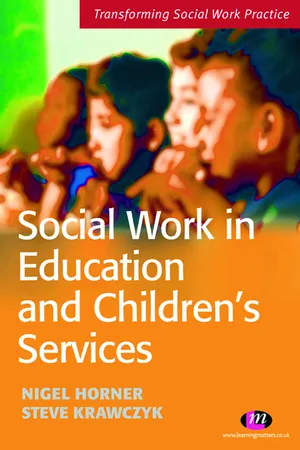
Social Work in Education and Children′s Services
About this book
In light of the profound changes confronting the Child Welfare landscape, social work practitioners are expected to understand both the current and anticipated inter-relationships between social work and education. A clear introduction to social work in an educational setting, this book supports students on the social work degree course and builds on the success of the Transforming Social Work Practice series, which is based on common learning principles.
Trusted by 375,005 students
Access to over 1.5 million titles for a fair monthly price.
Study more efficiently using our study tools.
Information
Chapter 1
Schools, social work and education welfare: Historical perspectives
Ignorance is like a delicate exotic fruit, touch it and the bloom is gone. The whole theory of modern education is radically unsound. Fortunately, in England, at any rate, education produces no effect whatsoever.
(Oscar Wilde, The Importance of Being Earnest, 1895, Act 1)
… what we must look for here is, first, religious and moral principle; secondly, gentlemanly conduct; third, intellectual ability.
(Dr Thomas Arnold, Headmaster of Rugby School (cited in Strachey, 1986, p167))
We’ve got compulsory education, which is a responsibility of hideous importance; and we tyrannise children to do that which they don’t want, and we don’t produce results.
(Sir Keith Joseph (quoted in Chitty 1997, p80))
ACHIEVING A SOCIAL WORK DEGREE
This chapter will help you to meet the following National Occupational Standards:
Key Role 1: Prepare for and work with individuals, families, carers, groups and communities to assess their needs and circumstances:
- Prepare for social work contact and involvement.
It will also introduce you to the following academic standards as set out in the social work subject benchmark statement (Quality Assurance Agency for Higher Education (QAA), 2000):
2.2.1 Defining principles
Social work is located within different social welfare contexts. Within the UK there are different traditions of social welfare (influenced by legislation, historical development and social attitudes) and these have shaped both social work education and practice in community-based settings including group care.
3.1.2 The service delivery context
- The location of contemporary social work within both historical and comparative perspectives.
- The complex relationships between public, social and political philosophies, policies and priorities and the organisation and practice of social work, including the contested nature of these.
3.1.3 Values and ethics
- The nature, historical evolution and application of social work values.
- Rights, responses, freedom, authority and power in the practice of social workers as moral and statutory agents.
3.1.5 The nature of social work practice
- The factors and processes that facilitate effective inter-disciplinary, inter-professional and inter-agency collaboration and partnership.
A very brief history of education
The dramatist Oscar Wilde held a particular view of education – as something necessarily damaging and brutal in its destruction of presumed innocence/ignorance – which is at once amusing and yet striking by virtue of being so out of step with the views and beliefs of the times in which it was said (and indeed with today’s received ideas). We have learned to take it for granted that education is a good thing, and that therefore all that matters is making good education available for all. But like any aspect of childhood, modern ideas about education are socially and historically constructed, and are therefore contested and complex. Whilst the State invests significant resources into trying to ensure and enforce school attendance for all children and young people between the ages of 5 and 16, such efforts are driven, in historical terms, by relatively recent ideas about the desirability of universal mass education. After all, the upper classes in sixteenth- and seventeenth-century England were in fear of the consequences of having a readily available printed and translated Bible and a literate working class, both of which, they believed, would lead to a breakdown in law and the social order. They were therefore set against the idea of extending education to the populace as a whole, and thought of it as essentially a preserve of a privileged elite. Bernard Mandeville, in his 1742 work The fable of the bees, represents beautifully the persistence of these views:
The Welfare and Felicity … of every State and Kingdom require that the Knowledge of the Working Poor should be confined within the Verge of their Occupations, and never extended (as to things visible) beyond what relates to their Calling. (Mandeville, 1970, pp294–95)
Yet a proportion of parents of all classes sought an education for their children, in the face of apparent resistance from children themselves. Nearly 300 years before the advent of compulsory elementary education in Britain, Shakespeare is alluding to a universal and timeless truth, that of parents making children go to school against their wishes:
And then the whining school-boy, with his satchel
And shining morning face, creeping like a snail
Unwillingly to school
(William Shakespeare, As you like it, II.vii.139)
So, it is abundantly clear that for centuries, parents, carers and families chose to educate their children – either at home or in formal institutions, sometimes known as schools, academies or seminaries – long before the State began to introduce the idea of compulsion. What was their motivation?
ACTIVITY 1.1
How do we make sense of this desire for education, for schooling, and why did post-Renaissance Europe slowly but gradually move towards universal elementary education for children? On the basis of what you have read so far, and by reflecting upon your own assumptions about education, note down three key reasons for this development.
(1)
(2)
(3)
Comment
Your thoughts might have covered a number of possible motivations, which can be clustered around some general ideas:
- you might have felt that parents wanted their children to be educated in order for them to be disciplined and controlled;
- in a connected vein, you might have focused on the moral instruction of children in terms of religious understanding and adherence;
- or you might have emphasised the presumed social and economic advantage that stems from education, associated with the acquisition of manners and an understanding of arts, music and culture;
- or lastly, education might be seen as being about snobbery value, about competitive edge, about status and social advantage.
In his historical study of childhood, Cunningham (1995, pp101–102) suggests that parents had three primary motivations for sending their children to some kind of schooling:
(1) religious instruction;
(2) for the social advancement that flowed from literacy; and
(3) as a convenient childcare service.
For the majority of the population, school fees were an impediment to consistent and long-term attendance, and school numbers were clearly affected by seasonal activity (such as harvesting), temporary hardship or economic slumps. Nevertheless, as Cunningham further notes (1995, p105), numerous studies revealed the extent to which schooling originated from parental (if not child) demand, in spite of these apparent difficulties. To fully understand the emergence of mass (if not compulsory) education, we need to reflect upon the set of ideas that flowed from the Reformation, and thence from the Enlightenment in Europe.
To the Protestant leader, Martin Luther (1530), education was so important that failures in parental duty in this matter merited the intervention of others to secure the welfare of the child. He suggested that if parents did not attend to education, the children cease to belong to their parents and fall to the care of God and community. Such a remark presages much later beliefs by the likes of Dr Barnardo that children should be properly rescued from parents who failed to nurture, protect and educate their offspring, and which coalesced into a coherent child welfare perspective defined by Fox Harding (1997) as Child Rescue and State Paternalism.
Cunningham’s study (1998) shows that compulsory education occurred in much of Europe for decades, and in some cases centuries, earlier than in England and Wales – in the seventeenth century in Scotland (in 1616, an Act of the Scottish Parliament stated that every parish should have a school and a teacher), in the eighteenth century in Saxony (1769), in Austria (1774), followed by Poland, Prussia, Hungary, France, and in the first decades of the nineteenth century in Denmark and the Netherlands.
Following on from Luther, the conviction as to the importance of education was central to the leaders of the French Revolution, with Danton stating that children belong to society before they belong to their family and Robespierre asserting that the country has the right to raise its children; it should not entrust this to the pride of families or to the prejudices of particular individuals – both quotations affirming education as the vehicle by which the State assumed the right to nurture, develop, discipline, shape, mould and indeed create its own future citizens.
In spite of the collapse of revolutionary republican ideas in France and the return of monarchy, Cunningham (1995, p156) suggests that in that country the vast majority of children did attend a school before the 1880s … because their parents and communities wanted and expected them to, rather than because central government tried to enforce attendance.
The very fact that education seemed more advanced in many of those European countries embroiled in the year of revolutions (1848) fed precisely into a cautious English consciousness highly resistant to State interference, and one that believed that literacy would lead to dissatisfaction, unrest and social disintegration.
Nevertheless, the demand for a literate workforce flowed from advanced industrialised capitalism, and what became established as compulsory elementary schooling was not a direct descendant of Renaissance educational philosophy, but predicated on a form of training, that was concerned with discipline, obedience, conformity, respect, punctuality and preparation for work. As the British sociologist Herbert Spencer suggested: Education has for its object the formation of character (Social Statistics I, Ch, 2.4), and the character to be formed was one rooted in the prevailing social order of industry and empire. As Parton (2006, p13) observes, the emergence of the sciences of man (as distinct from the sciences of material things) resulted in the school, the hospital and the prison being established as sites for both individualising and totalising forms of knowledge, and for developing judgments about what is normal. One such notion of normalcy has become the idea that all children over a particular age (usually five) should be formally educated, usually at school, under a scheme increasingly referred to as National Education.
In the introduction to this book, we explored the broad and optimistic vision of the New Labour project as to the benefits that are seen to inexorably accrue from raising school standards and achievement levels. Whilst the language may be different, the sentiments are direct descendants of those at the beginning of the nineteenth century:
National education is the first thing necessary. Lay but this foundation and the superstructure of prosperity and happiness, which may be erected, will rest upon a rock; lay but this foundation, poverty will be diminished and want will disappear in proportion as the lower classes are instructed in their duties for then only will they understand their true interests.
(The Quarterly Review VIII, 1812, cited in Petrie, 2003, p67)
Such a statement merits analysis, in that ...
Table of contents
- Cover
- Title
- Copyright
- Contents
- Dedication
- Introduction
- 1 Schools, social work and education welfare: Historical perspectives
- 2 The Children Act 2004: Requirements and the key principles
- 3 The broader legal context of contemporary practice
- 4 School’s out: Making sense of disaffection, absenteeism and exclusion
- 5 School’s in: Addressing particular issues
- 6 Related issues and practice challenges
- 7 Educational outcomes and children looked after
- 8 What are we going to do about it? Assessment and intervention
- 9 What works? The evidence base for effective inclusive education strategies
- 10 Pointers to the future?
- Appendix 1 Timeline of education and social work developments
- Appendix 2 Identifying barriers to access: A checklist
- Appendix 3 Resources and information
- References
- Index
Frequently asked questions
Yes, you can cancel anytime from the Subscription tab in your account settings on the Perlego website. Your subscription will stay active until the end of your current billing period. Learn how to cancel your subscription
No, books cannot be downloaded as external files, such as PDFs, for use outside of Perlego. However, you can download books within the Perlego app for offline reading on mobile or tablet. Learn how to download books offline
Perlego offers two plans: Essential and Complete
- Essential is ideal for learners and professionals who enjoy exploring a wide range of subjects. Access the Essential Library with 800,000+ trusted titles and best-sellers across business, personal growth, and the humanities. Includes unlimited reading time and Standard Read Aloud voice.
- Complete: Perfect for advanced learners and researchers needing full, unrestricted access. Unlock 1.5M+ books across hundreds of subjects, including academic and specialized titles. The Complete Plan also includes advanced features like Premium Read Aloud and Research Assistant.
We are an online textbook subscription service, where you can get access to an entire online library for less than the price of a single book per month. With over 1.5 million books across 990+ topics, we’ve got you covered! Learn about our mission
Look out for the read-aloud symbol on your next book to see if you can listen to it. The read-aloud tool reads text aloud for you, highlighting the text as it is being read. You can pause it, speed it up and slow it down. Learn more about Read Aloud
Yes! You can use the Perlego app on both iOS and Android devices to read anytime, anywhere — even offline. Perfect for commutes or when you’re on the go.
Please note we cannot support devices running on iOS 13 and Android 7 or earlier. Learn more about using the app
Please note we cannot support devices running on iOS 13 and Android 7 or earlier. Learn more about using the app
Yes, you can access Social Work in Education and Children′s Services by Steve Krawczyk,Nigel Horner in PDF and/or ePUB format, as well as other popular books in Social Sciences & Social Work. We have over 1.5 million books available in our catalogue for you to explore.