![]()
1
WHAT ARE TRANSFERABLE SKILLS AND WHY THEY ARE NEEDED?
This chapter reviews the:
• Skills that people bring to doctoral study
• Further skill requirements with a working definition of transferable skills
• Context: the history of change in doctoral education
• Particular developments in relation to training during and beyond the doctorate
• Consequences for careers beyond the doctorate
• Impact on the people involved: researchers, supervisors, trainers and other support staff
Skills at the commencement of the doctorate
Since the doctorate is the pinnacle of award-bearing courses in Higher Education, all those starting a doctorate will already have many relevant skills to bring to bear on the task – indeed, they will have been selected by the university because they have demonstrated some of those skills and have shown potential for developing others. Some will be very confident that they already have most of the required skills, while others may face with trepidation the requirement to conduct research that will ‘make an original contribution to knowledge’. This demonstrates the wide variation in those who embark on doctoral studies, which is reflected also in the range and diversity of skills that each individual brings to the task, although it is not always the most confident who are the most skilled.
Over the last two decades the variety in student background has increased, as has the range of doctoral degrees to which they can address themselves. Not only is the gender ratio more balanced (although there continues to be some disciplinary differences), but those seeking qualification through Professional Doctorates have added to the number of more mature, and hence more experienced, doctoral researchers, studying full- or part-time. They often bring more employment-related skills to the task but do not always recognise their value, whereas those with more recent experience in Higher Education tend to have what we might call ‘knowledge of the system’ and more practised academic skills.
You, the reader, may be just embarking on a doctorate, or on your way to completing it and wondering about your career beyond the conferment of your degree, or be involved with postdoctoral research and looking to move on with your career. At this point you might like to begin to consider the skills you already have that you think you might need for the next stage or those that will enhance your career prospects overall. As you work your way through this book, you will find we suggest that you engage in some activities that will help you to clarify just what skills you do have and how you might strengthen, expand and harness them in pursuing your career. We suspect that you will have more appropriate and useful attitudes, abilities and aptitudes than you may think at this moment, but it might give you confidence to begin to identify some of your potential right away by trying Activity 1.1 ,which explores your skills beyond those learned in school and academia.
ACTIVITY 1.1 A FIRST LIST OF POTENTIALLY TRANSFERABLE SKILLS Think back over any full- or part-time jobs that you have had, including vacation jobs or those to earn pocket money while you were still at school. List the skills that you brought to bear in them.
Then think of the hobbies you have or have had. Did they develop any skills that you could add to your list?
When we discussed our own experiences related to this, we recognised the cultivation of general attributes, such as time keeping and being organised, and some specific skills, for instance, that vacation jobs like waiting tables or bartending developed our skills of handling difficult people and multi-tasking, while hobbies such as gardening developed project planning, experimentation and many others that may not have seemed obvious at the time. Thus we feel sure that everyone reading this already has many skills, some in embryonic form and others that need re-orientating to fit different circumstances, but a range of useful skills nevertheless.
A first look at skills required during the doctorate
You may be wondering why we did not start by emphasising obvious academic skills since these will clearly be key ones for doctoral study, or perhaps you suspect that academic and ‘generic/transferable skills’ are beasts of different kinds. Let us allay that suspicion and agree that academic skills are part of the transferable skills family, as you will see in much more detail in Chapter 4, but we would like to emphasise that they are only part of that family (see Chapters 5, 6 and 7). Further, we want to highlight that those academic skills that served well at first degree level, and even at master’s level, require considerable development to enable candidates to complete a doctoral study. Let us illustrate our point with a metaphor.
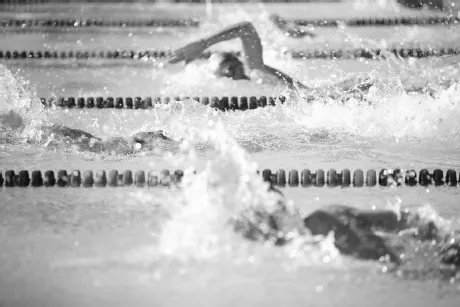
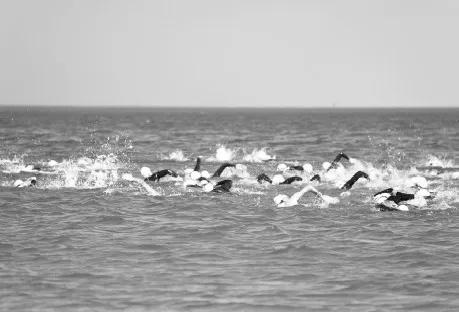
In the case of swimming, our early experiences and efforts in swimming baths may well have made us strong competitors in local and even national races and, indeed, we may have won so many that we had been chosen to represent our country’s team at the Olympics. We would then have had to adapt our skills to a much bigger pool and develop our techniques, strength and stamina further to cope with the much stronger competition, albeit with a coach at the ready with instructions and a warm towel while our friends and supporters cheered us on. This is the equivalent of developing our academic prowess through school, first degree and then perhaps a master’s degree. If we begin our doctoral studies expecting that the task will involve an even bigger pool with increasingly stronger competition, then we will be surprised by the complete change in environment and skills requirements that it presents. In terms of difficulties and challenges, it is more equivalent to attempting to swim the English Channel while the sense of accomplishment at the end is more about pride in your own development than in beating off competitors.
The lanes have disappeared, only the general direction of travel is indicated; the end point is well out of sight; there are unpredictable waves and currents; the deeper water contains many terrors both below the surface with the elements. S/he will help by alerting you to possible dangers and may guide you through the shipping lanes. Your friends and supporters wave you off from the shore and a few might make the journey to the other side to congratulate you when you reach the other shore. Otherwise you will be alone, ploughing on regardless of being weary and cold, as you learn to tolerate the mental uncertainty … and the jellyfish and other unexpected floating and swimming objects. However, there will be patches of calm water in which to recoup some energy and reflect on how far you have come; you will feel a rush of serotonin-powered elation when you realise that a sleepless night has resulted in a major move forward; your strokes will be more powerful as you progress and you will experience joy when you reach what previously appeared to be an unobtainable goal.
This is a different task with new rules, not all of which will have been clear when you volunteered for it. Although your swimming skills, competitive spirit, strong body and so on, which have served you well so far, will stand you in good stead during the rest of the journey, there will be other skills to be learnt and practised along the way. Further, not every gold medal winner from the swimming pool will excel at this new task, while some who did not make the national team will bring other skills to bear which will see them safely to the opposite shore.
We guess that you will see how this analogy applies to the process of doctoral study, with other comparisons emerging with greater experience of it. For instance, the ability to learn new things is of course important in both the swimming baths and sea, at undergraduate and postgraduate level, but the skills of discriminating, evaluating and challenging received wisdom become predominant at the doctoral level and not everyone has practised this before. What is more, those skills, while important in the academic context, may need some adaptation when encountering other work environments, as you will see in Chapters 8 and 9. Further, if the 2012 London Para-Olympics taught us nothing else, it did demonstrate that having a perfect body is not essential for swimming excellence, which resonates with our own experience that a traditional background of school and university success is not an essential precursor for the development of a good researcher. Those with a more varied background have often developed other pertinent skills along the way.
Beyond the doctorate – why learning generic, transferable skills is important
To prolong the metaphor a bit longer: armed with the experience of the English Channel, you will be better prepared to swim in other seas, some of which, some of the time, will be less demanding or will require only minor adaptations to your skill inventory. Then you will become adept at spotting the need for a new skill and acquiring it in time for ocean crossings.
In the Prologue we referred to the notion that the development of skills has always been a facet of doctoral education, but only an implicit part in the past when the prime objective was to reach the goal of producing a thesis that demonstrated the work towards, and the achievement of, an original contribution to knowledge. Of course skills were learnt in the process but, first, they tended to be mainly those developed in relation to a specific research project and, secondly, there was little encouragement to articulate them explicitly. In the past, when few people attained a doctorate and the likely career pursued thereafter was one in Higher Education, academic employers understood the requirements and outcomes of academic study and took for granted that they had been achieved by people with a doctorate seeking a research-related role in the academy. (Of course then, and occasionally now, people undertook doctoral study not for any future employment but simply as an intellectual challenge. If you are such a person, we suspect that you will find it satisfying to monitor what other skills are acquired along the way to the academic achievement, especially as many of these will be survival skills in the general game of life!)
In terms of pursuing a career beyond the doctorate, times have changed. In the next section we will review how things changed, and why, but now a larger number of people with high academic qualifications are seeking employment in a very wide range of work situations, while employers require clear articulation of how the attributes acquired during doctoral study and research work meet their needs. They prefer these attributes to be readily transferable from the doctorate/research to the work situation, whatever it is. This has led to the use of specific terms for such attributes: generic and transferable skills. They are defined as generic in that they are not restricted to a particular task or work environment and transferable in that, having been learnt/practised in one situation, they are flexible and can be applied to another task in another situation, albeit with some modification.
Using our example in Activity 1.1 , the skill of handling difficult people, learned through vacation work or other jobs, can be transferred during doctoral study to managing supervisors or research participants and then transferred again to dealing with seniors and clients as a professional beyond the doctorate. Before we discuss the process of development of the ‘skills agenda’ in doctoral education, Activity 1.2 will provide you with a c...